Maja Popovska

House rehab checklist
What a house rehab checklist covers and who completes it A house rehab checklist...

6
Last Updated: Oct 27, 2026
Free PDF 1 page, print-ready Clinician-reviewed
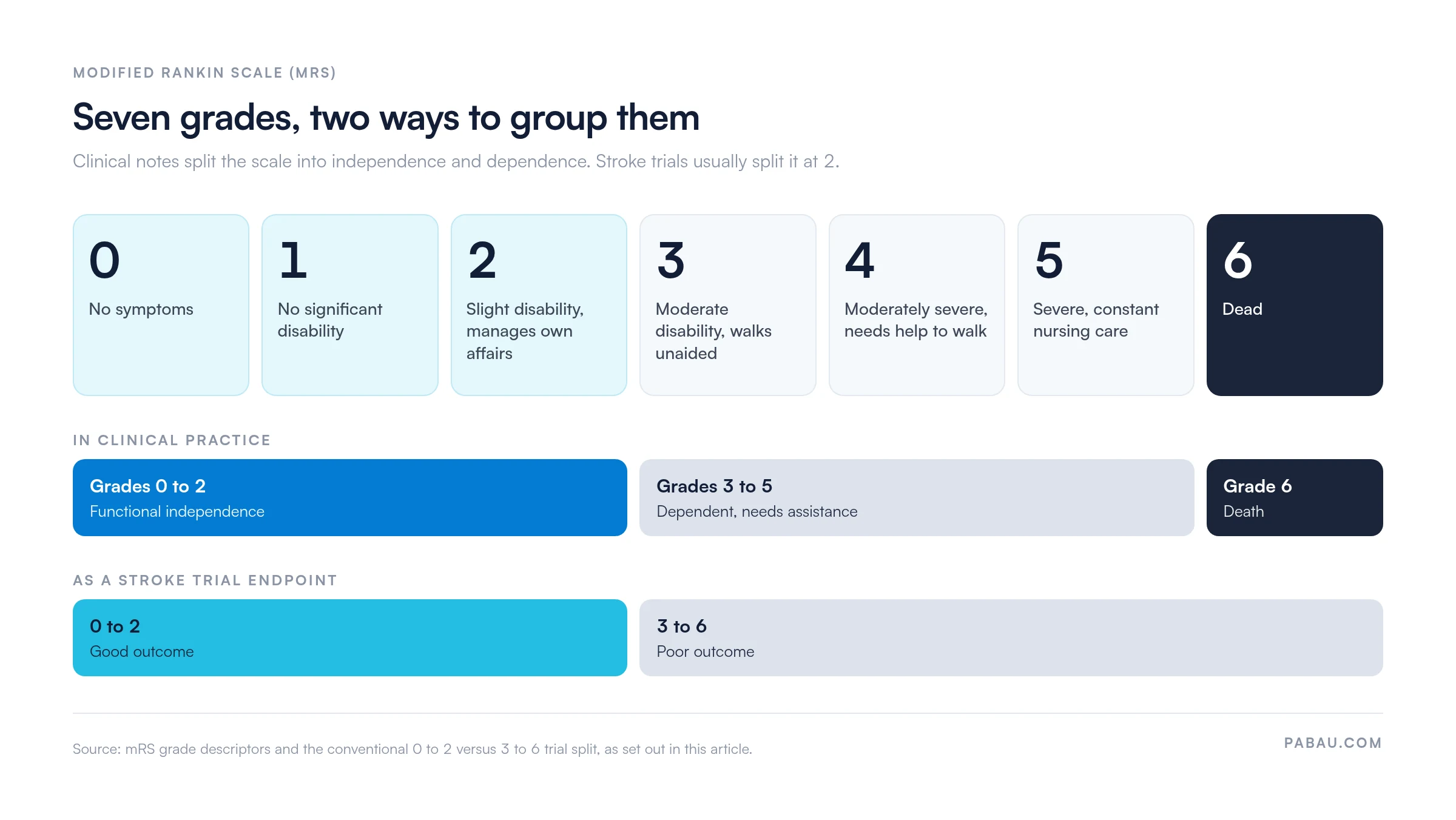
The modified Rankin Scale (mRS) grades disability after a stroke or other neurological event on a 7-point scale, from 0 (no symptoms) to 6 (death). It shows how dependent a patient is in daily life, and it is the most widely used functional outcome measure in stroke research and care. Scores of 0 to 2 mean the patient looks after their own affairs without help, while 3 to 5 mean they need assistance. This guide covers each grade, the structured interview, the pre-stroke baseline and the score's use as a trial endpoint.
A one-page rating sheet with the seven grade descriptors, from 0 (no symptoms) to 6 (death). It adds interview and observation instructions, plus fields for the patient, rater, date and comments.
Start from scratch, or upload this PDF or any form you already use, and Pabau's AI Form rebuilds it with tick boxes, text fields and a signature. Attach it to the treatment once, and every patient gets it on time.
AI Form rebuilds the consent, history and aftercare forms you already use. You review each one, then publish.
Patients complete forms on their phone before they arrive, so the front desk stops retyping paper.
Every signed form is versioned and attached to the treatment record, ready when you need it.
Set how long a consent stays valid. Returning patients skip forms they have already signed.
Supports HIPAA and GDPR compliance AES-256 encryption 4.8 on G2 4.7 on Capterra Trusted by 4,000+ practices worldwide

The modified Rankin Scale grades disability from 0 (no symptoms) to 6 (death).
Scores 0 to 2 are the usual dichotomized good-outcome threshold in stroke trials.
Structured interviews improve inter-rater reliability compared with unstructured assessment.
Record the premorbid score separately so change over time is clear in your Pabau Client record.
Clinicians use the modified Rankin Scale to grade global disability and functional outcome after stroke and other neurological disorders. It adapts the original Rankin scale published in 1957, with the wording refined by van Swieten in 1988.
The scale is built around independence in daily life rather than specific impairments. It captures whether a patient can manage their own care, work and social life, which is why it sits alongside clinical measures in stroke pathways.
Each grade describes a level of dependence, and the patient gets the grade that best fits their current function. The grades are ordinal, so a 4 means more dependence than a 3. The steps between neighboring grades are not equal in size, though.
Grades 0 to 2 are generally treated as functional independence, and 3 to 5 indicate degrees of dependency that need assistance. Stroke trials draw the line in the same place, treating 0 to 2 as the conventional dichotomized threshold for a good outcome. The chart below lays both groupings over the seven grades.
Administration is most reliable when the clinician works through a structured interview rather than forming a global impression. The interview asks the patient, or an informed proxy such as a caregiver, about walking, self-care and daily tasks. The clinician then matches the answers to the closest grade.
Structured interviews improve inter-rater reliability compared with unstructured assessment, as shown by Wilson et al. (2005) and Banks and Marotta (2007), both published in Stroke. Standardizing the questions is the simplest way to make scores comparable across clinicians.
The premorbid mRS records the patient’s function before the stroke, which gives a baseline for judging recovery. Without it, a score of 3 after an event is hard to read. The patient may have scored 3 before the stroke too, or 0.
Premorbid scores are usually collected from a family member or caregiver. Because proxy informants can overestimate or underestimate function, record who gave the answer and note any uncertainty alongside the score.
In acute stroke trials, the mRS is used as a primary or secondary endpoint because it reflects overall disability rather than a single deficit. Analysis is often dichotomized at 0 to 2 versus 3 to 6, though full ordinal analysis is also common.
The scale is not universally accepted as the right endpoint. Critics note that it can be insensitive to upper limb function and aphasia recovery. Trials sometimes pair it with other measures, such as the Stroke Impact Scale.
The modified Rankin Scale and the Barthel Index both measure disability, but they answer different questions. The mRS grades overall independence, while the Barthel Index scores specific activities of daily living.
Clinicians who want formal training can look to university stroke programs. The National Institute of Neurological Disorders and Stroke (NINDS) also publishes rater training resources. Programs change, so check the current availability and URL of any free course before relying on it.
Certification gives you a training record and doesn’t change your scope of practice. Check what it covers against your practice’s own documentation standards.
The PDF is a one-page rating sheet for recording a single mRS assessment. It gives your team the same layout every time, with these parts:
The sheet has no separate premorbid field. Complete a second copy for the pre-stroke baseline and mark it as premorbid in the comments.
Record the score with its date, time point and informant, so the next clinician can see what changed. Many stroke services track the mRS next to other outcome measures, so keep them on the same review dates.
Store the premorbid score as its own entry rather than in free-text notes. A separate field makes the baseline easy to find when you review recovery months later.
Many practices still score the mRS on paper, then type a number into free-text notes. The premorbid score, the informant and the reasoning rarely make it across, so the trend is hard to read at the next review.
Rehab teams using Pabau’s physical therapy EMR can send the scale as a digital form and save each completed rating to the patient’s file. Pabau’s medical records management keeps baseline and follow-up scores in one Client record, next to treatment notes.
At each follow-up, the clinician opens one file and sees the baseline, every rating and the reasoning behind borderline grades. Change since the stroke takes seconds to read, with no search through old notes.

Pabau’s Client records let your team log premorbid and follow-up scores against each patient, so the trend is clear at every review.

The mRS is only as useful as the consistency behind it. Score it with a structured interview, record the premorbid baseline as its own entry, and note your reasoning whenever a patient sits between two grades.
Do that, and a follow-up score shows whether the patient has recovered, held steady or lost ground since the stroke. The cost is a few extra minutes per assessment, and it buys scores another clinician can trust.
Book a demo to see how Pabau keeps every mRS rating, baseline and note together in the patient’s Client record.

Scoring self-care item by item? Modified Barthel Index breaks daily living into individual activities, scored from 0 to 100.
Need the patient’s view of stroke recovery? Stroke impact scale covers strength, communication, memory and participation in one questionnaire.
Assessing arm and hand recovery? Upper limb functional assessment adds the upper limb detail the mRS can miss.
Checking independence in basic self-care? Katz Index of Independence in ADLs rates six basic activities as independent or dependent.
Tracking several scales over time? Outcome measures template helps you choose, score and track measures at each review.
The modified Rankin Scale is a 7-point ordinal scale that grades global disability after neurological events, most often stroke. It runs from 0 (no symptoms) to 6 (death).
Scores of 0 to 2 are generally treated as functional independence. Scores of 3 to 5 indicate dependency that needs some or constant assistance.
Yes, free training resources exist, including NINDS materials, but availability changes. Confirm the current course and URL before relying on it.
A structured interview with a patient or informed proxy usually takes a few minutes. Borderline cases take longer because probe questions are needed.