CPT code 21011: Excision of soft tissue tumor of the face
CPT code 21011: Official descriptor and procedure overview CPT code 21011, as pu...

Last Updated: Oct 8, 2026
Billable Code Specific Code
S49.022A is the billable ICD-10-CM code for salter-Harris Type II physeal fracture of upper end of humerus, left arm, initial encounter for closed fracture.
To that end, this reference walks through the 7th character options, the code hierarchy, the related codes, and the documentation each element needs.
Let Pabau's smart automation suggest the right codes, reduce claim denials, and keep your practice compliant—effortlessly.
Automate repetitive tasks and focus on what matters most—your patients.
Reduce coding errors and ensure compliance with the latest regulations.
Clean claims, fewer denials, and faster reimbursements.
Powerful insights and reporting to help your practice thrive.
HIPAA compliant SOC 2 certified GDPR-compliant Trusted by 4,000+ clinics worldwide

S49.022A is a billable ICD-10-CM code for Salter-Harris Type II physeal fracture of the upper end of humerus, left arm, initial encounter for closed fracture.
Six 7th characters apply to S49.022: A, D, G, K, P and S. They separate the initial encounter, four healing outcomes and a sequela.
Documentation must specify fracture type, laterality, anatomical site and encounter type before a coder can assign S49.022A.
Practice management software like Pabau submits and tracks ICD-10-CM claims through its Claim.MD clearinghouse integration.
The FY2026 ICD-10-CM code set is maintained jointly by the Centers for Medicare and Medicaid Services and the National Center for Health Statistics. Within that set, S49.022A is a billable, specific code, valid for claim submission.
A physeal fracture happens at the cartilaginous growth plate, which separates the epiphysis from the metaphysis in developing bone. In other words, it is also called a growth plate fracture or an epiphyseal fracture.
The Salter-Harris classification grades these injuries from Type I through Type V. Specifically, Drs. Robert Salter and W. Robert Harris built the system around each fracture pattern’s relationship to the growth plate.
A Salter-Harris Type II fracture is the most common physeal fracture type. Specifically, the fracture line runs through the physis and exits through the metaphysis. As a result, that leaves a triangular metaphyseal fragment known as the Thurston Holland fragment, and the epiphysis stays intact.
At the upper end of the humerus, this pattern usually follows a fall on an outstretched arm. Similarly, direct trauma to the shoulder in a skeletally immature patient produces it too. Growth plates close in adolescence, so the injury is seen mainly in children and teenagers.
The Salter-Harris classification drives both the treatment approach and the prognosis. For example, Type II fractures at the upper end of the humerus generally carry a favorable prognosis. This is because the fracture does not cross into the epiphysis, which lowers the risk of growth arrest.
Accurate classification in the clinical record is what makes the ICD-10-CM code selection possible. Without it, a coder working from a generic “humerus fracture” note, with no Salter-Harris type, cannot assign S49.022A.
Under ICD-10-CM fracture coding guidelines, every fracture code needs a 7th character naming the type of encounter. Specifically, the CDC/NCHS ICD-10-CM coding tool carries the Official Guidelines that define each encounter type. In total, six 7th characters apply to S49.022. Of these, one covers the initial encounter, four cover subsequent encounters at different stages of healing, and one covers a sequela.
“Initial encounter” does not mean the first time a patient sees any provider. Instead, it means the patient is receiving active treatment. For example, a child sent to a specialist for surgical planning two weeks after the injury is still in the initial encounter.
Use S49.022A until care shifts to routine healing management. In fact, the A-to-D decision is one of the most consequential 7th character calls in orthopedic coding. Furthermore, the same distinction shapes how encounter types affect medical billing workflows beyond fracture coding.
Each character in S49.022A narrows the diagnosis one step further. For instance, reading the code from left to right shows which detail the documentation has to supply. It also shows where a less specific code takes over, when laterality or fracture type is missing.
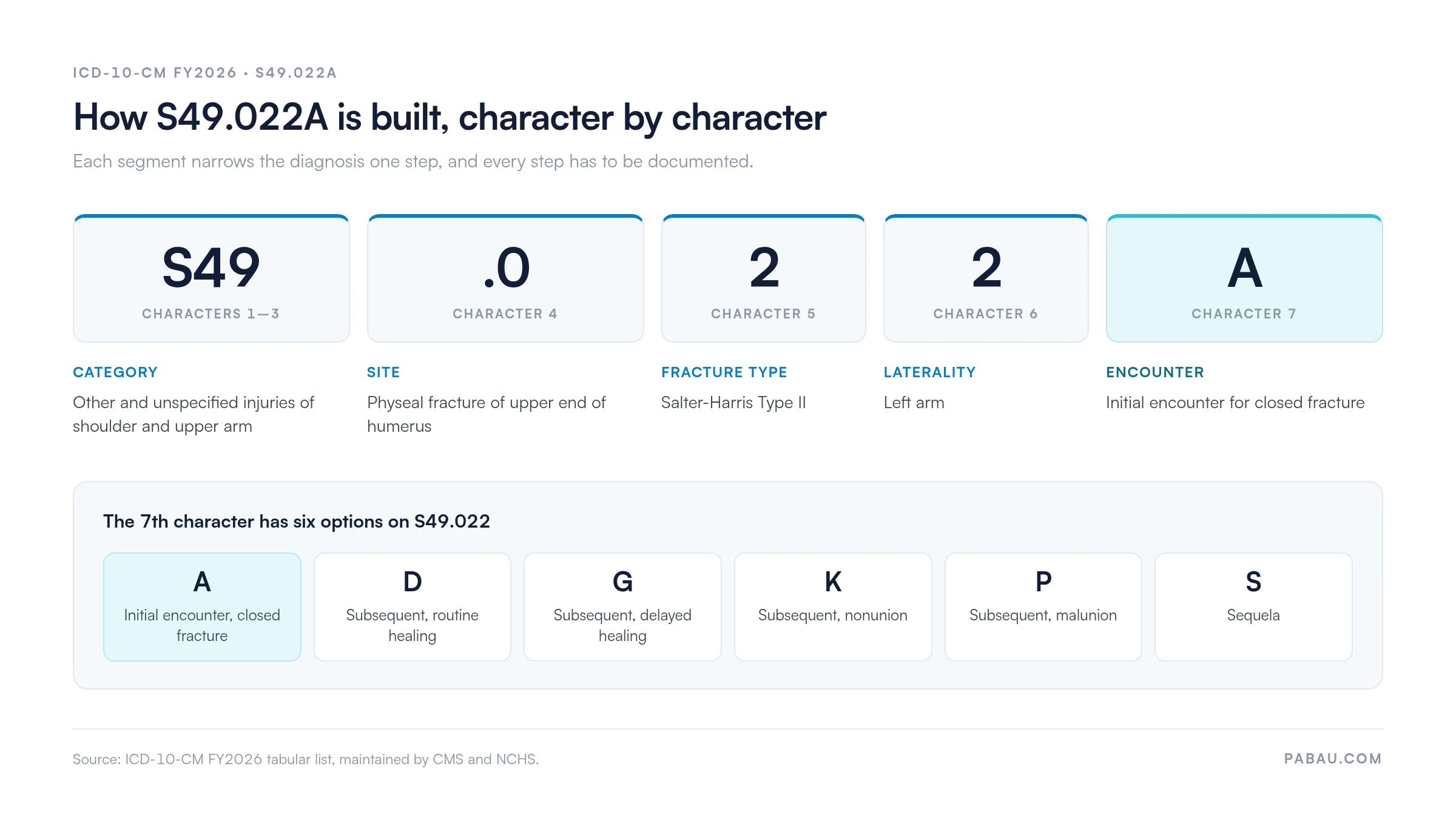
S49.022 is not a billable code on its own, because the 7th character is required. As a result, claims that arrive truncated, with no A, D, G, K, P or S, are usually rejected at the clearinghouse before they reach the payer. To prevent this, Pabau’s Claim.MD clearinghouse integration can flag an incomplete code before the claim goes out.
Several closely related codes cover the same fracture type at different lateralities, encounter stages, or Salter-Harris classifications. Consequently, choosing the wrong code from this family is a frequent source of audit findings, particularly when laterality documentation is incomplete.
When the Salter-Harris type is not documented, coders should query the treating clinician before assigning a code. Otherwise, assigning Type II without radiologic confirmation of the Thurston Holland fragment exposes the practice to upcoding risk. Additionally, you can search related codes and their coding guidance through the AAPC Codify ICD-10-CM lookup.
Physeal fractures are overwhelmingly pediatric injuries. This is because the growth plate is cartilaginous and mechanically weaker than the bone around it. Consequently, that makes it the path of least resistance during an injury. Once the physis closes at skeletal maturity, these fracture patterns stop occurring, which is why the code set treats them as a distinct family.
Orthopedic practices and pediatric emergency departments need documentation protocols written for children, the same discipline that ICD-10-CM diagnostic coding for trauma presentations asks for. For example, when a child presents with proximal humerus pain after a fall, the note must name the Salter-Harris type. Otherwise, a note reading only “proximal humerus fracture” routes the coder to a different code family.
Incomplete documentation is a common source of coding errors for Salter-Harris fractures. After all, a coder cannot make a clinical determination on their own. Therefore, if the record does not state each required element, the claim cannot be supported with S49.022A.
The ICD-10-CM Official Coding Guidelines are mandated under HIPAA for covered entities, and they require documentation to match the specificity of the code assigned. Specifically, four elements must be present in the clinical record to code S49.022A:
Standardized intake and clinical note templates help practices that struggle with incomplete fracture documentation. For example, Pabau’s digital forms and clinical documentation tools capture structured data at the point of care. As a result, laterality, fracture classification and encounter type get recorded in named fields rather than left to free-text recall.
Consistent standards are also the foundation of medical billing compliance across orthopedic and pediatric workflows.
Review your EHR note templates for Salter-Harris fractures. Specifically, each template should prompt clinicians to record the classification, the laterality, the anatomical location and the encounter purpose. As a result, structured fields catch the most common S49 coding errors before a coder touches the claim.
CPT procedure codes pair with S49.022A based on the services rendered at the initial encounter. For instance, closed reduction, open reduction, imaging and casting each carry their own code. The pairings below reflect common clinical practice. However, coverage and authorization policies vary by payer, so verify each pairing against CMS guidance and payer LCD policies before submission.
The ICD-10-CM guidelines govern the diagnosis assignment. In contrast, CPT selection needs a separate review of the procedural documentation. Therefore, practices billing for sports medicine and orthopedic services should confirm current payer policies for proximal humerus procedures before submitting.
Once the code is assigned and the CPT procedures are selected, the claim has to pass clearinghouse validation before it reaches the payer. For example, a truncated code, a mismatched laterality or the wrong encounter character all get caught there. In contrast, practices working from spreadsheets and PDF batches often learn about the rejection days later.
Pabau connects to Claim.MD, our US clearinghouse partner, which reaches thousands of US payers. For a practice coding S49.022A, the claim is submitted from the record that already holds the encounter. As a result, the diagnosis and the procedure codes travel together, and the clearinghouse response comes back into the same place.
Claim.MD also returns real-time eligibility responses for over 400 payers, so a billing team can confirm coverage before the encounter closes. In addition, understanding what makes a clean claim is a practical starting point for reducing rejections on physeal fracture submissions.
For practices that receive denials on S49 codes, structured denial management workflows help track root causes and prevent repeat errors. Similarly, practices new to clearinghouse integration can review how the Claim.MD clearinghouse works alongside Pabau’s billing tools.

Pabau integrates with Claim.MD to validate ICD-10-CM codes before submission, catch incomplete 7th characters, and streamline orthopedic billing workflows. See how it works for your practice.

S49.022A is only as defensible as the note behind it. Specifically, the Salter-Harris type, the anatomical site, the laterality and the encounter character each have to appear in the record. Otherwise, no coder can supply them afterward. In fact, the template the clinician types into does more for accuracy than the claim scrubber at the end.
Fix the note template first, then the submission path. A practice that captures the four elements at the point of care will code S49.022A correctly on the first pass. The six 7th characters then stop being a guessing game at follow-up.
Pabau’s claims management software and Claim.MD integration carry that record through to the payer. To see this in practice, book a demo to see how fracture documentation and claim submission sit in one record.

Need to understand how ICD-10-CM codes affect reimbursement workflows? Electronic remittance advice explained covers how ERA files tie diagnosis codes back to payment decisions.
Coding another ICD-10-CM trauma or diagnostic code? ICD-10 code for situational anxiety shows how the same 7th character and encounter-type rules apply across different code families.
Managing billing across multiple injury types? ICD-10 code for autistic disorder demonstrates the documentation specificity required for other ICD-10-CM diagnostic code articles.
S49.022A is a billable ICD-10-CM diagnosis code for a Salter-Harris Type II physeal fracture of the humerus. Specifically, it covers the upper end of the bone, the left arm, and the initial encounter for a closed fracture. In addition, the code is valid for FY2026, effective October 1, 2025.
A Salter-Harris Type II fracture is a growth plate injury. Specifically, the fracture line passes through the physis and exits through the metaphysis. As a result, that leaves a triangular metaphyseal fragment called the Thurston Holland fragment. Overall, it is the most common Salter-Harris fracture type and generally carries a favorable prognosis because it does not involve the epiphysis directly.
Use S49.022A when the patient is receiving active treatment for the fracture (initial encounter). In contrast, use S49.022D when the fracture is healing and the visit involves routine follow-up care such as cast checks or repeat imaging during recovery. In other words, the distinction is based on the nature of care provided, not the date of the visit relative to injury.
Yes. S49.022A is valid for FY2026, having become effective on October 1, 2025 as part of the annual ICD-10-CM update. Furthermore, the code has not been revised or retired in the current edition and remains valid for reimbursement purposes.