HCPCS Code L1904: Ankle orthosis billing and coverage guide
HCPCS Code L1904: Code descriptor and device specifications HCPCS Code L1904 des...

Last Updated: Oct 23, 2026
V2784 is the HCPCS Level II code for a lens, polycarbonate or equal, any index, per lens. It is an add-on code, billed with the base lens code (V2100-V2499) for each lens made of polycarbonate or an equivalent impact-resistant material.
Medicare covers lenses only for pseudophakia or aphakia, and V2784 also needs a documented medical need such as monocular vision. Those claims carry the KX modifier plus RT or LT. High-index plastic lenses go to V2782 or V2783 instead, because both exclude polycarbonate.
Let Pabau's smart automation suggest the right codes, reduce claim denials, and keep your practice compliant—effortlessly.
Automate repetitive tasks and focus on what matters most—your patients.
Reduce coding errors and ensure compliance with the latest regulations.
Clean claims, fewer denials, and faster reimbursements.
Powerful insights and reporting to help your practice thrive.
HIPAA compliant SOC 2 certified GDPR-compliant Trusted by 4,000+ clinics worldwide

HCPCS code V2784 is an add-on for a polycarbonate or equal lens at any index, billed per lens with the base lens code.
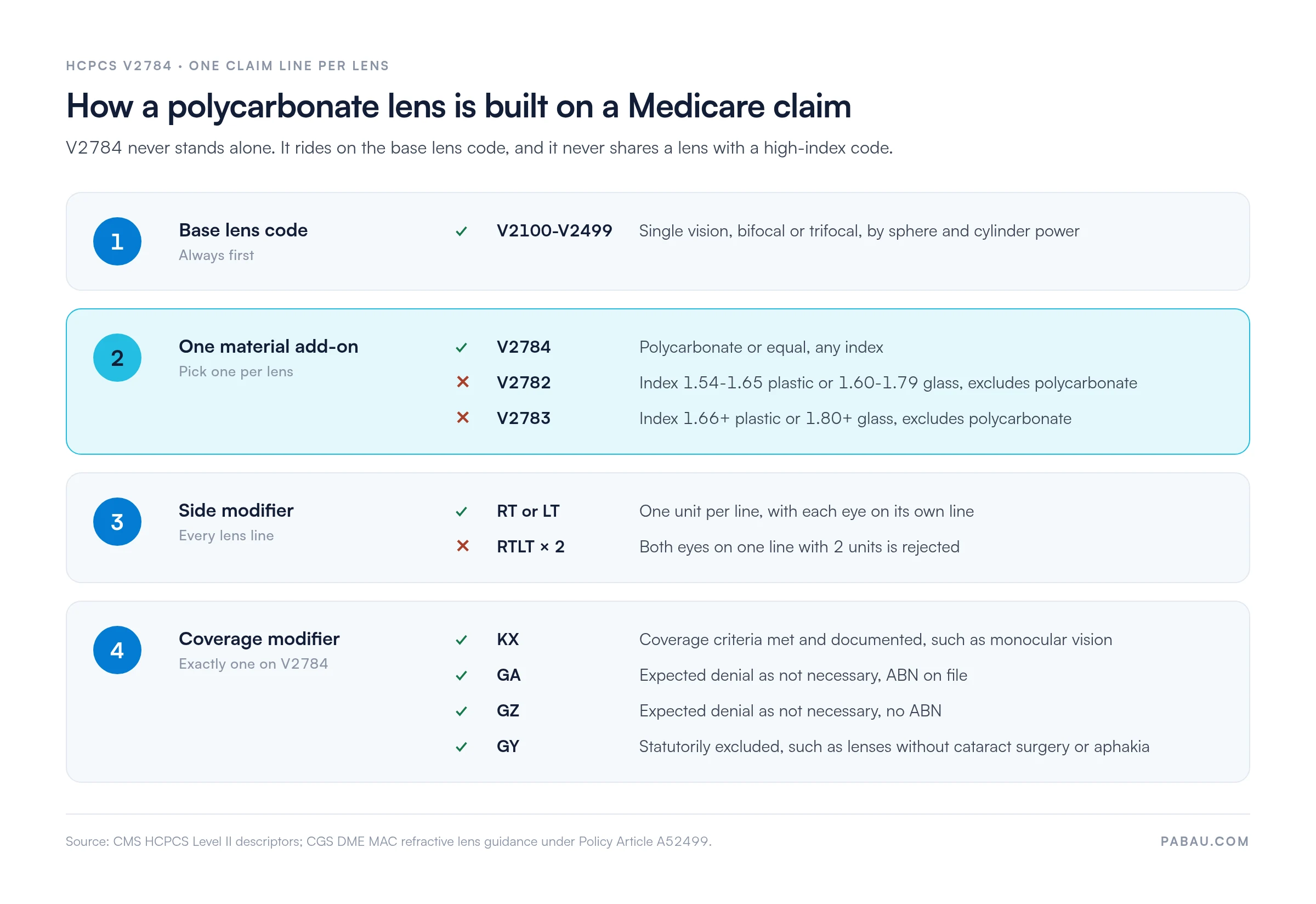
Medicare wants each lens on its own claim line with RT or LT and one unit, never both eyes on one line.
Medicare covers lenses only for pseudophakia or aphakia, and V2784 also needs a documented medical need and the KX modifier.
Never bill V2782 or V2783 on the same lens as V2784, because both high-index codes exclude polycarbonate.
Coatings and tints such as V2744 and V2750 go on their own lines, each with the coverage modifier the policy requires.
HCPCS code V2784 is defined by the Centers for Medicare & Medicaid Services (CMS) as “Lens, polycarbonate or equal, any index, per lens.” It sits in the V2000-V2999 range of HCPCS Level II vision codes, which covers spectacle lenses, frames, contact lenses and low-vision aids.
V2784 describes the lens material, not the whole lens. You report the base lens code first, from V2100-V2499, and then add V2784 for the same lens. The neighboring lens, frame and coating codes are all listed in our HCPCS code library.
Three parts of the descriptor carry most of the billing weight:
Because V2784 is a vision supply code, Medicare pays it under the DMEPOS fee schedule, not the Physician Fee Schedule. Claims go to the DME MAC for the patient’s region, and the allowed amount varies by state.
V2784 covers any spectacle lens made of polycarbonate or a clinically equivalent high-impact material, at any prescription power. “Or equal” is CMS shorthand for materials that match polycarbonate’s impact resistance.
Materials typically included:
Materials and items excluded from V2784:
Billing V2784 alongside the base lens code is correct coding, not unbundling. For a single vision lens, that means V2100 or the neighboring code for the power, plus V2784 for the material. The stacking error is a second material code on the same lens, such as V2784 with V2782 or V2783.
Most V2784 denials start on the claim line itself. Work through these steps for every lens you dispense:
The CGS refractive lens fact sheet names V2784 among the five lens codes that need one of those modifiers. The diagram below shows how the four pieces fit together for one lens.
Link each line to the diagnosis that supports it. Place of service is typically 11 (Office) for practices that dispense in-house, but confirm it against the payer’s manual.
Commercial plans and Medicaid managed care set their own unit and modifier formats. Some accept two units on one line, so check the plan’s billing manual before the first claim.
Before billing V2784 at volume with a new payer, send one claim and see how it handles your units and modifiers. Keep a note of the response, because payers sometimes update HCPCS policies mid-year without announcement.
Every V2784 claim needs an ICD-10-CM diagnosis that supports the lens. For Medicare, refractive lenses are covered only for pseudophakia, aphakia and congenital aphakia, so routine refractive error alone does not qualify.
The table groups the codes most often paired with V2784. CMS Policy Article A52499 is the authoritative source for Medicare, so verify unusual indications against it.
Medicare: Part B covers one pair of eyeglasses or contact lenses after each cataract surgery with IOL insertion, as a prosthetic device. Patients with aphakia are covered too. Outside those diagnoses, refractive lenses are statutorily excluded and take the GY modifier.
Polycarbonate adds a second test inside that benefit. Medicare generally treats V2784 as not reasonable and necessary unless a medical need is documented, such as monocular vision. With that need on file, bill V2784 with KX. Without it, use GA if the patient signed an ABN, or GZ if not.
Medicare DMEPOS fee schedule: V2784 is paid under the DMEPOS fee schedule, which sets allowed amounts by state. CMS updates the file at least annually, with quarterly revisions in between. Check the current rate on the CMS DMEPOS fee schedule page rather than relying on last year’s figure.
Medicaid: Coverage is state-administered and varies widely. Some states cover polycarbonate lenses for all ages, while others limit coverage to children or require a documented clinical reason. Check the state Medicaid provider manual for V2784 rules before assuming coverage.
Commercial and managed care payers: Coverage ranges from broad, with polycarbonate standard for all ages, to restrictive, with prior authorization for polycarbonate as an upgrade. Payers such as Centene publish vision clinical policies that set when V2784 qualifies without authorization. Requirements change by plan year, so confirm them annually.
Build a payer grid for the top five plans on your panel. List each plan’s V2784 prior-auth triggers, modifier requirements and covered diagnosis codes. Review it each January, when fee schedules and clinical policies reset.
The V278x series is where coders most often misbill, because the codes describe very different things. V2781 is a lens design, while V2782 and V2783 are index-based material codes. V2785, V2787 and V2788 are not spectacle lens features at all.
Practical rule: ask what each code describes. A polycarbonate progressive lens can carry V2781 for the progressive design and V2784 for the material, on top of its base lens code. A high-index plastic lens takes V2782 or V2783 instead of V2784, never both.
Check the AAPC HCPCS code reference if a descriptor creates doubt.
A dispensed polycarbonate lens often carries a coating or tint as well. Each one has its own HCPCS add-on code on a separate claim line, because V2784 covers the material only.
Bill each add-on per lens, on its own line, with the same RT or LT modifier and linked diagnosis. Photochromic lenses take V2744, while solid and gradient tints take V2745.
On Medicare claims, the modifier depends on why an add-on will not be paid.
Use GY for an item that is statutorily excluded, such as a coating on lenses for routine refractive error, and skip the ABN. Use GA when Medicare would deny the item as not reasonable and necessary and the patient signed an ABN. Use GZ when no ABN was signed.
Verify each add-on code with the HCPCS Level II lookup tools after the annual update, since CMS can revise, replace or retire supply codes.
Solid documentation protects against audits and supports appeals when claims are denied. For HCPCS code V2784, the record set typically includes these items:
Practices that align their billing compliance workflows with each payer’s rules catch a missing record before the claim goes out. Finding it on a remittance costs far more time.
V2784 denials cluster around a predictable set of errors. Most of them can be avoided when the claim is built, which beats fixing them on appeal.
Practices with repeat denials benefit from a structured denial management process that tracks reason codes and spots systemic errors. Knowing what a clean claim looks like for each payer removes most of these triggers at the source.
Run this quick check on every V2784 claim before it leaves the practice:
Many optical billing teams send lens claims and then check payer portals by hand to see what happened. A denied V2784 line can sit unnoticed for weeks that way, long after the glasses have gone home.
Pabau, the practice management platform we build, submits claims electronically and tracks each one’s status next to the patient record. Its simpler claims management shows which lens claims are pending, paid or denied. Your team can then correct a rejected line and resubmit it quickly.

Pabau submits your optical claims and tracks their status next to the patient record, so denied V2784 lines get fixed and resent faster. See how it fits your practice.

V2784 rewards practices that treat it as an add-on. Build every polycarbonate lens on its base code and give each eye its own line. Then match the coverage modifier to the record before the lens is dispensed.
The trade-off sits with Medicare. Most polycarbonate lenses will not be paid there. An honest GY, GA or GZ claim protects you better than a KX the chart cannot support. Confirm commercial and Medicaid rules each January, when their policies reset.
Book a demo to see how Pabau tracks your lens claims from submission to payment.

Need to understand how claim errors get tracked and resolved? Denial management in healthcare explains the full cycle from root-cause analysis to appeal submission.
Want a cleaner billing workflow before claims go out? What is a clean claim? covers the structural requirements every V-code claim needs to pass first-pass review.
Looking for guidance on superbill setup for optical dispensing? Superbill documentation outlines what fields matter for HCPCS supply codes and how to structure the record.
Billing a progressive design on the same lens? HCPCS code V2781 covers the progressive lens add-on and how to bill it.
Dispensing a high-index plastic lens instead? HCPCS code V2783 explains the high-index threshold for plastic and glass lenses.
No. V2784 describes a spectacle lens material. Contact lenses use codes in the V2500-V2599 range, such as V2500 for a spherical PMMA contact lens, billed per lens.
The DME MAC for the patient’s region processes them, not the Part B MAC. The practice must be enrolled as a DMEPOS supplier to bill eyeglass lenses to Medicare.
No. KX means a medical need is documented in the record, such as monocular vision. A patient who simply wants lighter or thinner lenses does not meet it, so bill with GA or GZ instead.
Many do, because impact resistance protects children’s eyes. Some states cover polycarbonate for all ages, while others limit it to children or require a documented clinical reason. Check the state vision provider manual first.
No. V2783 describes a high-index plastic or glass lens and excludes polycarbonate. A lens takes one material code, so pick the one that matches the lens you dispensed.