CCSD code F0420: Lip reconstruction using a skin flap
CCSD code F0420: definition, descriptor and procedure scope CCSD code F0420 is d...

Last Updated: Oct 16, 2026
V2511 is the HCPCS Level II code for contact lens, gas permeable, toric, prism ballast, per lens.
It covers one rigid gas permeable lens with a toric, prism-ballast design, billed per lens with an RT or LT modifier. A soft toric lens is V2521, and a spherical GP lens is V2510. Medicare covers it for aphakia and once after each cataract surgery with an intraocular lens. The fitting is billed separately under a CPT code.
Let Pabau's smart automation suggest the right codes, reduce claim denials, and keep your practice compliant—effortlessly.
Automate repetitive tasks and focus on what matters most—your patients.
Reduce coding errors and ensure compliance with the latest regulations.
Clean claims, fewer denials, and faster reimbursements.
Powerful insights and reporting to help your practice thrive.
HIPAA compliant SOC 2 certified GDPR-compliant Trusted by 4,000+ clinics worldwide

V2511 bills one gas permeable (rigid) contact lens with a toric, prism-ballast design, so each eye goes on its own claim line.
Lens material and design pick the code: a spherical GP lens is V2510, a GP bifocal is V2512, and a soft toric lens is V2521.
No contact lens descriptor mentions aphakia, so the diagnosis never decides between V2511 and its neighboring codes.
Medicare covers V2511 for aphakia, and once after each cataract surgery with an IOL, not for routine astigmatism correction.
Append RT or LT to every V2511 line, and bill the fitting separately under its CPT fitting code.
HCPCS Code V2511 sits in the V2500-V2599 contact lens series of the HCPCS Level II code set maintained by CMS. The official descriptor reads: Contact lens, gas permeable, toric, prism ballast, per lens.
Two parts of that descriptor decide the code. “Gas permeable” means a rigid lens material. “Toric, prism ballast” means a lens shaped to correct astigmatism and weighted so it holds its orientation on the eye.
The descriptor does not mention aphakia or any other diagnosis. Aphakia matters for Medicare coverage of every contact lens code, but it plays no part in choosing V2511 over its neighbors.
Medicare treats contact lenses after cataract surgery as prosthetic devices, so they bill through the DMEPOS system. A practice that dispenses V2511 to Medicare patients needs a valid DMEPOS supplier enrollment.
V2511 covers the lens itself when two conditions hold. The lens is made of a rigid gas permeable (GP or RGP) material, and its design is toric with prism ballast. A toric lens carries different powers along two meridians, and the prism ballast keeps those meridians in place as the patient blinks.
Included under V2511:
Not covered by V2511:
The prescription drives the choice. A cylinder power and axis on a GP prescription point to V2511, while a GP prescription with no cylinder supports V2510. Check the material as well, because a soft lens written with the same cylinder is V2521.
V2511 is medically necessary when the patient’s condition calls for a rigid toric lens and the payer covers that condition. For Medicare, the condition is narrow: the patient lacks the natural lens of the eye. Commercial and Medicaid plans may accept a wider list.
The chart should state why the patient needs a rigid toric lens rather than spectacles or a soft lens. A reviewer reads that note to decide whether V2511 is covered or an elective upgrade.
The V2510-V2513 group covers gas permeable lenses, and V2520-V2523 covers hydrophilic (soft) lenses. Each group splits by design in the same order: spherical, toric, bifocal, then extended wear. V2511 and V2521 are the two toric codes, separated only by material. The grid below shows how those two questions land on a single code.
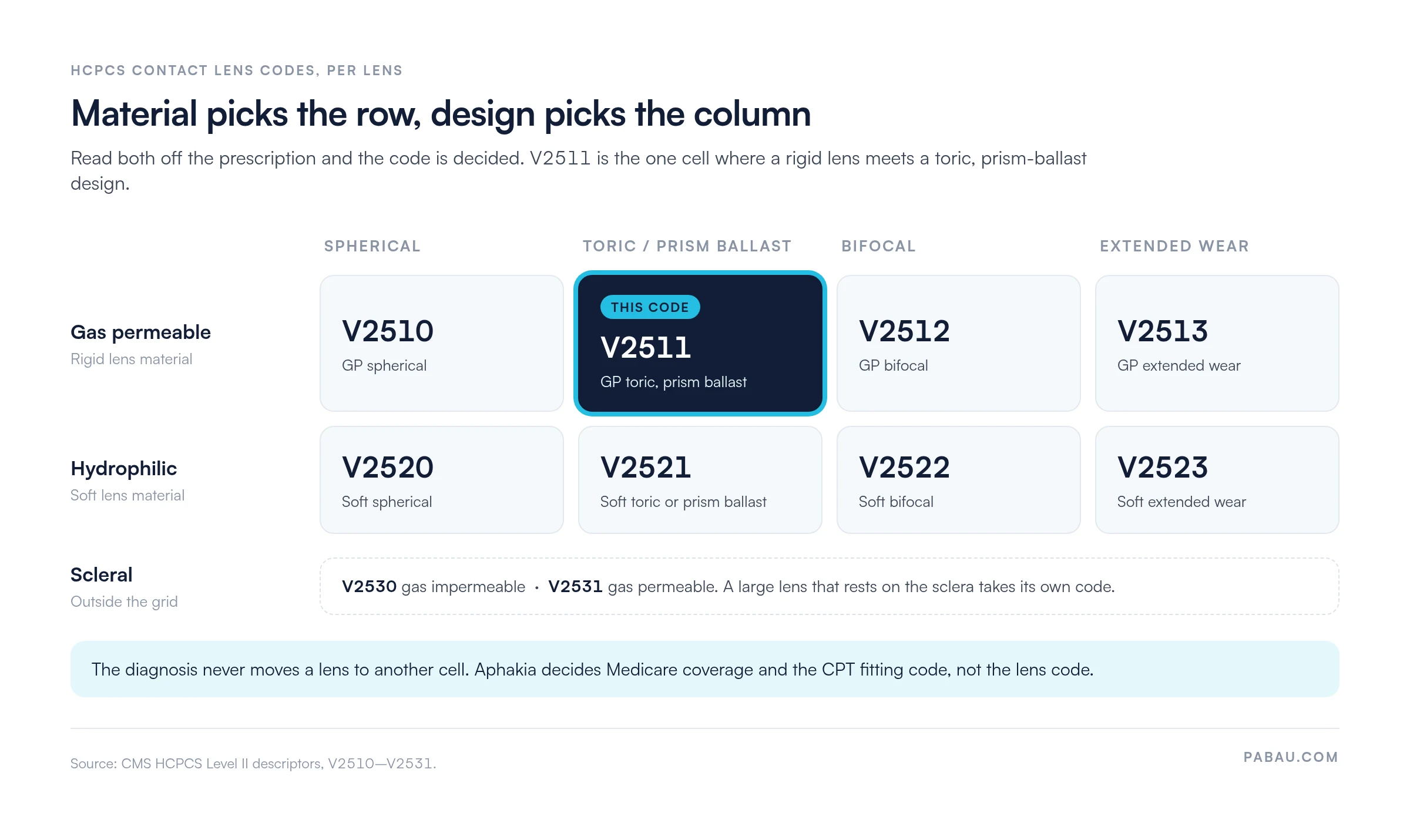
The patient’s diagnosis plays no part in this choice. An aphakic patient wearing a GP toric lens is billed V2511, and so is a non-aphakic patient wearing the same lens.
Two slips cause most wrong-code denials here. A soft toric lens billed as V2511 fails the material test. A GP bifocal billed as V2511 fails the design test, even when prism ballast holds it in position.
Every V2511 line needs a linked ICD-10-CM diagnosis code that supports medical necessity. For Medicare, the Refractive Lenses policy article (A52499) lists the covered diagnoses. The H27.0x aphakia series is the primary code family.
Laterality has to line up across the diagnosis code, the V2511 line item and the modifier. A right-eye lens needs H27.01, the RT modifier and a single unit of V2511 on that line. A mismatch on any of the three usually ends in a medical necessity denial or a coding edit.
Some payers also want the surgical history on the claim as a secondary diagnosis. Check each payer’s coverage policy to see whether the operative history in the chart is enough.
Before submitting, cross-reference the diagnosis code laterality (H27.01 vs. H27.02), the modifier (RT vs. LT), and the prescribing provider’s contact lens fitting notes. All three must agree on which eye is being treated. A mismatch on any one element is enough for an automatic edit at adjudication.
Medicare Part B does not cover contact lenses for routine vision correction. It covers them as prosthetic devices that restore the focusing power of the natural lens. That makes aphakia a coverage condition for the whole V2500-V2599 family, not a way to pick one code over another.
Medicare Advantage plans set their own cost-sharing, and many add a routine vision benefit that Original Medicare lacks. Medigap has no vision benefit. It only supplements cost-sharing on Medicare-covered prosthetic lenses. Check which benefit the claim falls under as part of your billing compliance requirements.
Traditional Medicare does not generally require prior authorization for contact lens supplies. Medicare Advantage plans set their own rules, and many require it for DMEPOS items. Commercial and Medicaid plans vary, so check each plan before the lens is ordered.
When a plan requires prior authorization (PA), it usually asks for the diagnosis and the GP toric prescription with its cylinder power. Some plans also want the operative report. Submitting the claim before the PA is on file is one of the most avoidable denials for this code.
The Medicare Refractive Lenses policy requires the RT or LT modifier on every lens code, and most other payers follow the same rule. A missing laterality modifier is one of the most frequent reasons a V2511 line comes back unpaid.
For a pair, bill two lines: V2511-RT with 1 unit, then V2511-LT with 1 unit. Billing both eyes on one line with a quantity of 2 is a formatting error that triggers edits at the DME MAC. For a clean claim submission, check both lines before the claim leaves the practice.
Complete records support medical necessity and hold up in a post-payment audit. The chart should contain the following before the claim is submitted, in line with medical billing fundamentals.
Pabau, the practice management platform we build, keeps the prescription, surgical history and delivery receipt in one patient record. Staff stop hunting for documents before each V2511 claim, and the file is ready when an auditor asks for it.
V2511 billing comes down to clean line items on the CMS-1500 or 837P. Follow these steps for each dispensing encounter.
Aphakia does shape the fitting code, even though it never shapes the lens code. A non-aphakic patient fitted with V2511 lenses takes 92310 or 92314. An aphakic patient takes 92311 or 92312, or 92315 or 92316 when a technician directs the fitting.
Most V2511 denials can be prevented. The table maps frequent denial scenarios to a typical claim adjustment reason code (CARC) and the fix for each. Effective denial management in healthcare starts with spotting these before the claim leaves the practice.
When a denial posts on the electronic remittance advice, match the code to the table before you correct the claim. Tracking denials by reason code also shows which V2511 errors keep coming back.
Medicare sets allowed amounts for V2511 through the DMEPOS fee schedule. The schedule is state-specific and updated every year, so the rate depends on where the patient lives.
Practices that reconcile V2511 payments against each contracted rate catch underpayments before they build up. Use the AAPC HCPCS code lookup to cross-check the descriptor before you update a fee.
Run a monthly audit of V2511 claims against your active payer contracts. Filter for denials tied to missing information, diagnosis mismatch or frequency limits. Three or more denials from one payer on the same reason code usually trace back to one step in your billing process.
Most V2511 errors start before the claim is built. The cylinder power sits in the prescription, the diagnosis sits in the exam note, and the delivery receipt sits in a paper file. Billing staff then rebuild the claim by hand and miss a modifier or pick the wrong lens code.
Pabau’s claims management software flags a missing diagnosis code before the claim is filed. It alerts billing staff when the RT or LT modifier does not match the diagnosis laterality. It also tracks prior authorization against the dispensing date.

For practices that bill several payers, each plan’s rules sit inside the billing workflow. A Medicare Advantage plan that needs PA gets flagged when the lens is dispensed, not when the claim comes back. The result is fewer returned lines and faster payment on lens claims.

Pabau flags missing diagnosis codes, mismatched modifiers and prior authorization issues when the lens is dispensed, so V2511 claims go out clean.

Two facts on the prescription decide V2511: a gas permeable material and a toric, prism-ballast design. Read both before the claim is built, and the choice between V2511, V2510, V2512 and V2521 is already made. The diagnosis then decides whether the payer covers the lens, not which code it gets.
For Medicare patients, confirm aphakia or a recent cataract surgery with an IOL first, because routine astigmatism correction is never covered. Book a demo to see how Pabau keeps the prescription, modifiers and fitting line in one record, so each V2511 line matches the chart.

Billing a soft lens instead? HCPCS Code V2520 covers the spherical hydrophilic lens that sits one row below V2511 in the contact lens series.
New to Medicare claims for vision supplies? Medicare billing walks through enrollment, claim forms and the coverage rules that decide whether a lens is paid.
HCPCS code V2511 covers one gas permeable (rigid) contact lens with a toric, prism-ballast design. It is the code for a GP lens that corrects astigmatism. Each unit is one lens, so each eye goes on its own claim line with an RT or LT modifier.
Yes, but only for aphakia or after cataract surgery. Aphakic patients (H27.0-, Q12.3) are covered, including medically necessary replacements. Pseudophakic patients (Z96.1) get one pair of eyeglasses or contact lenses after each cataract surgery with an IOL. Routine astigmatism correction is not covered.
Both are gas permeable lenses, and the design is the difference. V2511 is a toric, prism-ballast lens that corrects astigmatism. V2512 is a bifocal lens with near and distance zones. The patient’s diagnosis plays no part in choosing between them.
Both codes describe toric or prism-ballast contact lenses, and the material is the only difference. V2511 is a gas permeable (rigid) lens, and V2521 is a hydrophilic (soft) lens.
For Medicare, the primary ICD-10-CM codes are H27.01 (aphakia, right eye), H27.02 (aphakia, left eye) and H27.03 (bilateral aphakia). Q12.3 covers congenital aphakia, and Z96.1 covers pseudophakia. The diagnosis laterality must match the RT or LT modifier on each V2511 line. Use H27.00 (unspecified) only when laterality is genuinely unknown.
The most common reasons are a missing RT or LT modifier and a routine refractive diagnosis sent to Medicare. Others include the wrong code for the lens material or design, a missing prior authorization, and a fitting fee on the lens line. Each one can be caught with a check before submission.
Traditional Medicare does not generally require prior authorization for V2511. Medicare Advantage plans and many commercial payers do. Check the plan’s rules before the lens is ordered, and enter the PA reference number on the claim to avoid an automatic denial.