CPT Code 26410: Hand extensor tendon repair billing guide
CPT code 26410: Official descriptor and procedure overview CPT code 26410 report...

Last Updated: Nov 24, 2026
T4533 is the HCPCS Level II code for youth sized disposable incontinence product, brief/diaper, each. One unit is one tab-closure brief or diaper.
T-codes are for state Medicaid use, and the CMS file marks T4533 as not covered by Medicare. The youth pull-on bills as T4534, while pediatric briefs bill as T4529 or T4530.
Let Pabau's smart automation suggest the right codes, reduce claim denials, and keep your practice compliant—effortlessly.
Automate repetitive tasks and focus on what matters most—your patients.
Reduce coding errors and ensure compliance with the latest regulations.
Clean claims, fewer denials, and faster reimbursements.
Powerful insights and reporting to help your practice thrive.
HIPAA compliant SOC 2 certified GDPR-compliant Trusted by 4,000+ clinics worldwide

HCPCS Code T4533 covers one youth sized disposable incontinence brief/diaper (tab-closure style), billed each under state Medicaid programs. Medicare does not cover it.
The youth pull-on (protective underwear) is a different code, T4534. Pediatric sized briefs bill as T4529 or T4530, and adult briefs as T4521 to T4524 or T4543.
Each state Medicaid fee schedule sets the rate for T4533, because CMS publishes no federal payment amount for T codes.
Pabau’s claims management software submits claims, checks eligibility, and posts remittances against the patient record, so code and quantity errors surface early.
The official descriptor for HCPCS Code T4533 is “Youth sized disposable incontinence product, brief/diaper, each.” That wording comes from the CMS HCPCS quarterly update, and the January 2027 file, posted on November 13, 2026, carries it unchanged. The code took effect on January 1, 2005.
A brief/diaper is the open style that fastens at the sides with tabs. It is fitted while the wearer lies down or sits, which suits children with limited mobility or a caregiver changing them.
T4533 sits in the disposable incontinence product range, T4521 to T4545, which splits products by wearer size and by style. Pages for the neighboring codes sit in our HCPCS code library.
CMS created the T codes for state Medicaid agencies, and they are not valid for Medicare claims. The CMS file gives T4533 coverage code M, “non-covered by Medicare.” Each state then sets its own rate, quantity limits, prior authorization rules, and documentation requirements, so those details can differ widely between programs.
The official descriptor sets three conditions: the product is disposable, it is a brief/diaper, and it is youth sized. Confirm the product meets all three before a T4533 claim goes out.
Youth is the one wearer size that gets a single code per style. Pediatric briefs split into small/medium (T4529) and large (T4530), and adult briefs run from small to extra large (T4521 to T4524).
CMS sets no waist or weight range for “youth,” so state programs and product catalogs draw that line. Confirm the state’s size criteria before billing.
The disposable incontinence codes turn on two questions: how big is the wearer, and is the product a brief or a pull-on? Medicaid systems check the billed code against the beneficiary’s age and the product on file. A neighboring code is therefore one of the most frequent causes of T-series denials.
Set out as a grid, those two questions leave one code for each combination of wearer size and product style.
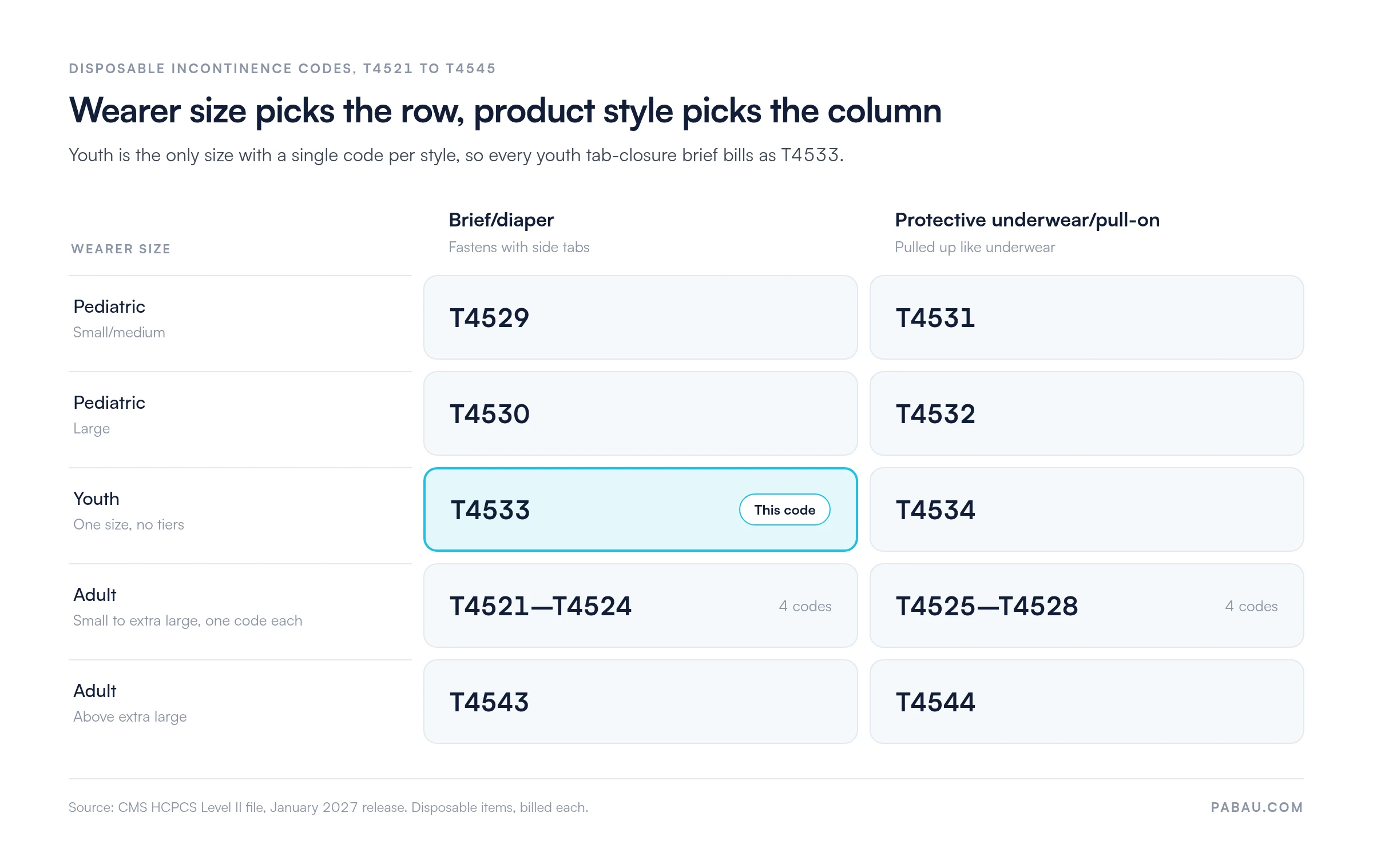
Critical selection rule: T4533 applies only when the product is (1) disposable, (2) a brief/diaper with tab closures, and (3) youth sized.
A youth pull-on is T4534. A pediatric sized brief is T4529 or T4530, and an adult brief falls in T4521 to T4524 or T4543. Check your state’s current HCPCS file and provider manual too, since some programs add local size definitions or modifiers.
Run a quarterly reconciliation of your T-series code selections against the product catalog your DME supplier provides. Invoices often use brand names, not HCPCS descriptors. Map each SKU to the right T code by style and size, so a youth brief never ships under T4534.
Coverage for T4533 varies by state Medicaid program. Each state’s Medicaid agency and its contracted managed care organizations (MCOs) set coverage, quantity limits, and prior authorization thresholds independently.
General eligibility criteria shared across most state programs that cover T4533 include:
EPSDT matters most for youth claims. Under federal EPSDT rules, states must cover medically necessary services for Medicaid enrollees under 21. That holds even where the state plan excludes the service for adults. T4533 can therefore be payable in a state that excludes adult incontinence supplies, provided the record shows medical necessity for this child.
Prior authorization is required in many states but not all. Many programs also cap the monthly quantity, and the cap differs by state and by the beneficiary’s assessed need. Billing above that cap without prior authorization is a frequent denial trigger.
CMS publishes no federal payment amount for T4533. T codes are priced by each state Medicaid fee schedule, not the Medicare DMEPOS fee schedule. Rates also shift with MCO contract terms and each state’s update cycle. The Maryland Department of Health, for example, publishes its T code rates in its DME fee schedule.
Rates change with each fee schedule update and differ between fee-for-service Medicaid and MCO contracts. Billing at a stale rate is a common source of revenue leakage for DME suppliers. Query the state’s provider portal, or ask the MCO’s provider relations team, before submitting high-volume T4533 claims.
T4533 billing follows the standard DME supply claim workflow, but a few T-series steps are easy to miss. The process below reflects common requirements across state Medicaid FFS programs. Cross-check it against your state’s provider manual, because requirements differ.
Documentation for youth incontinence brief claims under T4533 typically includes the following elements, though state requirements vary:
A handful of systematic errors account for most T4533 denials. Knowing them in advance reduces rework and protects revenue. Billing software with claim validation can flag many of them before submission.
Structured denial management strategies help here. Track denial codes, group them by root cause, and fix the source rather than each claim. Over time, that cuts the administrative load considerably.
T4533 claims must carry an ICD-10-CM diagnosis code that documents a qualifying incontinence condition. The code must match the patient’s documented condition, and no single diagnosis guarantees payment. These codes commonly appear on youth incontinence supply claims:
Always check the state Medicaid program’s accepted diagnosis list for incontinence supplies. Some programs publish an approved ICD-10 list in the DME provider manual, and claims outside it are denied automatically. Every claim should tie the diagnosis to the supply through a documented clinical rationale.
DME suppliers billing T4533 must hold active Medicaid enrollment in every state where they deliver. For fee-for-service Medicaid, that means credentialing through the state agency’s provider enrollment process. For MCO contracts, suppliers enroll separately with each MCO serving their patients.
Key compliance obligations for T4533 billing include:
Maintaining DME billing compliance across several states takes a systematic approach to credentialing calendars, documentation checklists, and claim validation.
Most T4533 denials trace back to a detail that never reached the claim: the product style, the unit count, or an expired order. When the order sits in one system and the claim in another, billers re-key those details by hand, and that is where errors creep in.
Pabau, a practice management platform with built-in claims software for billers, keeps the patient record and the claim in one place. Claim submission, eligibility checks, claim status, and remittance posting all run against that same record. A rejected youth brief claim surfaces the day it happens, so the biller can fix it well before month-end reconciliation.
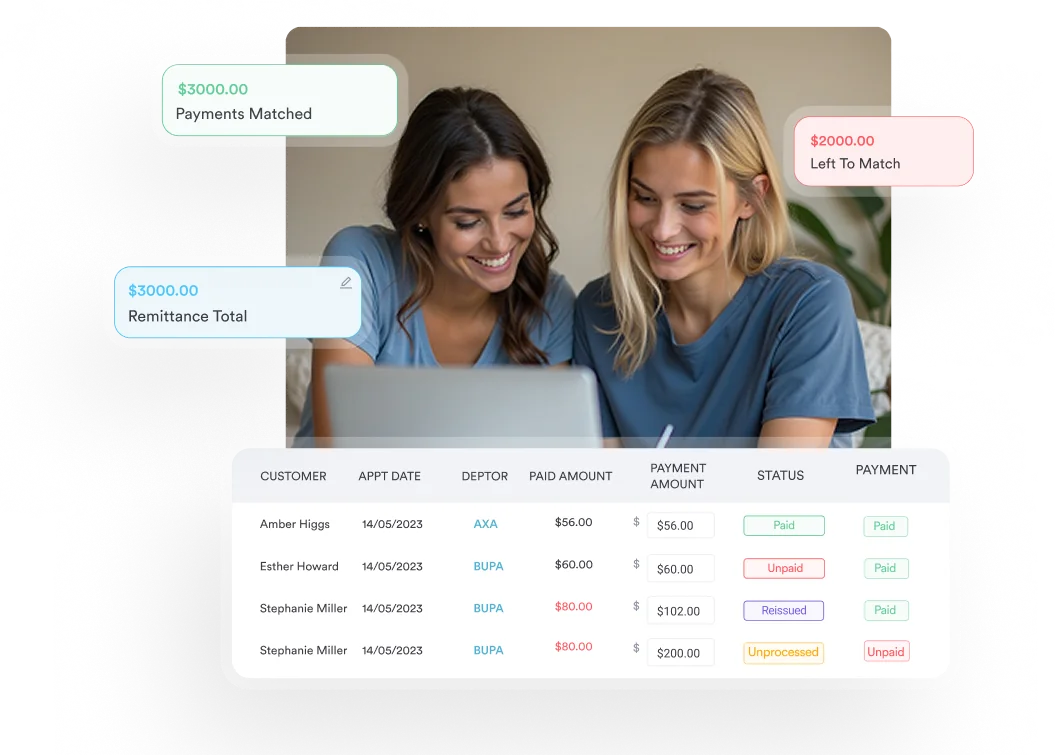

Pabau’s claims management software submits claims, checks patient eligibility, tracks claim status, and posts remittances against the patient record. See how practices and DME teams use Pabau to cut billing errors on Medicaid supply codes.

Brand and absorbency play no part in choosing T4533. Construction and size decide it. A youth sized brief with tab closures bills as T4533, and the same child’s pull-ons bill as T4534. Get the style and size right on the order and the delivery record, and the code follows.
The rest of the claim depends on your state: its rate, its quantity cap, its PA rules, and its diagnosis list. Check them before the first shipment, not after the first denial. Book a demo to see how Pabau keeps orders, claims, and remittances in one workflow.

Need a broader overview of Medicaid billing rules? What is medical billing explains the end-to-end claims process for Medicaid and commercial payers.
Looking for revenue cycle best practices for DME teams? What is revenue cycle management provides a full framework for reducing leakage across the billing cycle.
HCPCS Code T4533 covers one youth sized disposable incontinence brief/diaper, billed each under state Medicaid programs. It applies to the tab-closure brief style, not to pull-ons. Medicare does not cover it.
T4533 is a brief/diaper, the style that fastens with side tabs. The youth pull-on, or protective underwear, is a separate code, T4534. Bill the code that matches the product on the delivery record.
No. The CMS HCPCS file gives T4533 coverage code M, non-covered by Medicare. T codes exist for state Medicaid agencies, so claims go to the state Medicaid program or its managed care organization.
T4533 is a youth sized disposable brief/diaper. T4532 is a pediatric sized disposable protective underwear/pull-on in large size. They differ in both wearer size and product style, so neither can stand in for the other.
Coverage varies by state and is not uniform nationally. Many states cover T4533 for beneficiaries under 21 through EPSDT. Confirm rates and coverage on each state’s Medicaid provider portal or fee schedule.
Expect to need a signed prescriber order naming the product and quantity, plus a CMN or equivalent clinical note. Add a supporting ICD-10 diagnosis, delivery confirmation, and proof of active Medicaid supplier enrollment. Exact requirements vary by state.
Log into your state Medicaid provider portal, open the DME or incontinence supply fee schedule, and search for T4533. For MCO patients, ask the MCO’s provider relations team, since contract rates can differ. Re-check whenever a new fee schedule is published.