HCPCS code T2036: Overnight therapeutic camp billing guide
HCPCS code T2036: Definition and code details HCPCS code T2036 is the Level II c...

Last Updated: Oct 7, 2026
HCPCS code T2043 is the state Medicaid code for hospice continuous home care, billed per hour. It pays for crisis-level care that keeps a terminally ill patient at home instead of in an inpatient bed. The hospice must deliver at least 8 hours of care between one midnight and the next. Nurses must provide more than half of those hours.
Miss either test and the day pays at the routine home care rate. Medicare does not accept T-codes, so getting the units right on the Medicaid claim decides what the hospice is paid. The sections below follow a crisis day from the first nursing visit to the finished claim.
Let Pabau's smart automation suggest the right codes, reduce claim denials, and keep your practice compliant—effortlessly.
Automate repetitive tasks and focus on what matters most—your patients.
Reduce coding errors and ensure compliance with the latest regulations.
Clean claims, fewer denials, and faster reimbursements.
Powerful insights and reporting to help your practice thrive.
HIPAA compliant SOC 2 certified GDPR-compliant Trusted by 4,000+ clinics worldwide

HCPCS code T2043 bills hospice continuous home care per hour on state Medicaid claims, and Medicare does not pay T-codes.
A continuous home care day needs at least 8 hours of direct care between one midnight and the next.
More than half of those hours must come from licensed nurses, or the day pays at the routine rate.
Medicaid hospice rates follow Medicare’s, and the FY 2027 national base is $71.95 an hour before wage adjustment.
Check your state’s unit rule, because Ohio bills one T2043 unit per hour while Medicare’s revenue code 0652 counts 15-minute units.
HCPCS code T2043 is the Level II code for hospice continuous home care, billed per hour. It took effect on October 1, 2003. It also sits in the T-code range reserved for state Medicaid agencies, so Medicare doesn’t pay it.
Continuous home care is the most intensive hospice care a patient can receive without moving to a facility. A nurse stays with the patient through a medical crisis, often with an aide or homemaker alongside. The aim is to control symptoms at home, so the patient avoids a transfer to an inpatient bed.
Medicaid pays hospices at four levels of care. T2043 is the only one billed by the hour, while the other three pay a flat daily rate. That hourly unit is what makes this code easy to get wrong.
Every T2043 hour has to trace back to a crisis. Under 42 CFR 418.204, nursing care can be covered continuously, for up to 24 hours a day, during a period of crisis. A crisis is a period when the patient needs continuous care to manage acute medical symptoms.
The CMS Medicare Benefit Policy Manual, chapter 9 sets the detailed rules, and state Medicaid programs build on them. It names a practical trigger, too. When a caregiver who has been giving skilled care can no longer do it, a nurse may be needed to fill that role.
Situations in the CMS examples that can support a crisis day include:
Location matters as well. Continuous home care can happen in the patient’s own home, including a long-term care facility where they live. It cannot be billed during a stay in a hospital, a skilled nursing facility, or a hospice inpatient unit.
Exhaustion alone isn’t a crisis. In one CMS example, an 80-year-old caregiver needs help with bathing, meals and walking. That patient fits inpatient respite care, not continuous home care.
Once a crisis is documented, two tests decide whether the day pays at the continuous rate. The hospice must provide at least 8 hours of direct care in a 24-hour day that begins and ends at midnight. The hours don’t need to be back to back, so 4 in the morning and 4 at night count.
Next, the care must be predominantly nursing. More than half of the hours must come from a registered nurse (RN), licensed practical nurse (LPN) or licensed vocational nurse (LVN). Aides and homemakers can add hours, but they can’t make up the majority.
Several kinds of time never count toward the total:
Fall below 8 hours and the day pays as routine home care. The same happens when aide hours outnumber nursing hours. Hospices also cannot drop aide hours from the count to reach a nursing majority.
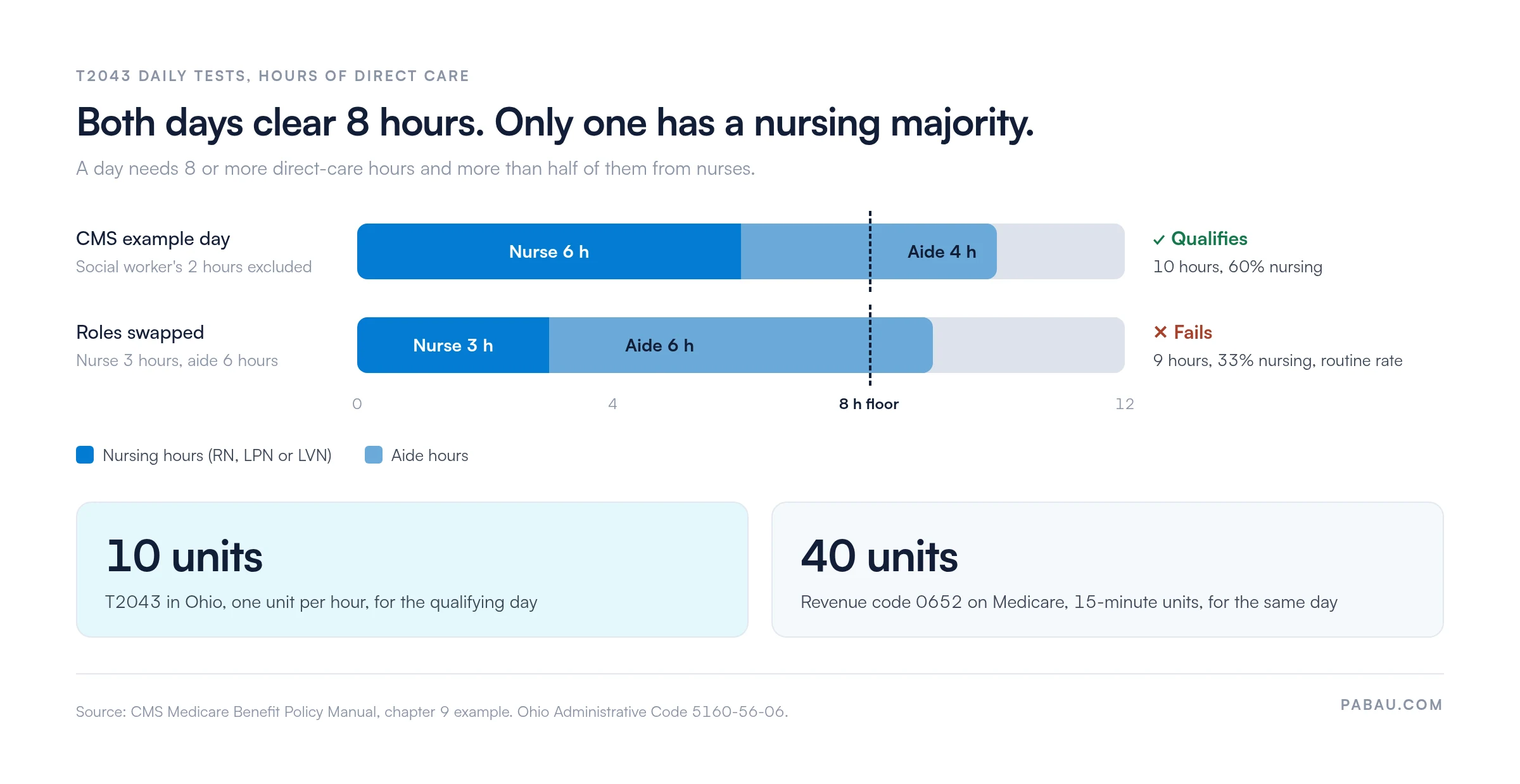
Here is how one day from the CMS guidance adds up. A patient near death has worsening pain, vomiting and air hunger.
Nursing made up 6 of the 10 hours, so the day qualifies. Swap the roles, with 3 nursing hours and 6 aide hours, and it wouldn’t. The chart below puts both days side by side, with the units each one bills.
With the daily rules clear, it helps to see where T2043 sits. Medicaid programs that bill with HCPCS Level II codes use five hospice T-codes. Four of them match a Medicare revenue code. Chapter 11 of the Medicare Claims Processing Manual lists those revenue codes.
Each day carries one level of care. On a crisis day you bill T2043, not T2042 as well. Room and board under HCPCS code T2046 is the exception, because it is an add-on for nursing facility residents. Federal law sets that payment at no less than 95% of the facility’s Medicaid daily rate.
Watch out for T2041, too. It sits next door numerically, but it describes self-directed supports brokerage under a waiver, billed per 15 minutes. It isn’t a hospice code at all.
Medicaid hospice rates are built on the Medicare rates, which CMS updates every October. The FY 2027 Medicaid hospice rate letter sets the floor states must pay from October 1, 2026.
These are national base rates, not what lands in your account. States adjust the wage portion by the hospice wage index, and for continuous home care that follows where the patient lives. States may also pay above the minimum, so your state fee schedule is the final word.
Patients covered by both programs follow a different path. Medicare pays the hospice benefit first, and Medicaid then pays nursing facility room and board. In that case the crisis day goes on the Medicare claim as revenue code 0652, not T2043.
This is where clean crisis care turns into a rejected claim. Medicare reports continuous home care in 15-minute increments, while T2043’s descriptor says per hour. A quick Q&A shows how the two fit.
How does Ohio count it? Ohio Administrative Code 5160-56-06 bills T2043 at one unit per hour. It also requires a minimum of eight hours a day.
How does Medicare count it? The same 8-hour floor is 32 units on revenue code 0652. Units round to the nearest 15-minute increment, not up to the next hour.
Do any states add modifiers? Yes. MassHealth’s hospice manual pairs T2043 with modifier TN for care outside the county where the hospice is located.
So what goes on the claim? For the 10-hour day above, that means 10 units of T2043 in Ohio, or 40 units of 0652 on Medicare. Read your state’s hospice billing instructions before converting units.
With the unit settled, the claim itself follows a predictable path. Each step depends on the one before it.
Continuous home care draws close review. CMS lists continuous home care medical necessity as an approved Recovery Audit topic. A chart that shows hours but no crisis is the weakest file a reviewer can open.
A record that holds up usually contains:
Shift schedules don’t count as documentation. CMS states that continuous home care billing should reflect direct patient care, not staff working hours.
Most T2043 problems come from the same handful of habits. Each one below either cuts the payment to the routine rate or sends the claim back.
When the same mistake keeps coming back, treat it as a process problem, not a one-off. Our guide to denial management in healthcare shows how to trace each denial to its cause.
Run through these points on every crisis day, so the claim leaves your desk as a clean claim.
During a crisis, time records often live in three places. Nurses chart in one system, aides fill in paper logs, and billing rebuilds the day from both. When those records disagree, the claim is hard to defend.
Pabau, the clinical records and practice management platform we build, keeps visits, timed notes and signed forms on the patient’s record. Billing staff can then check the hours against the chart before coding. Our claims management tools also confirm that required claim fields are complete before submission.


Pabau keeps visits, timed clinical notes and signed forms on one patient record. Your billing team can match T2043 hours to the chart before the claim goes out.

T2043 rewards hospices that can prove three facts for each day: a crisis, at least 8 hours, and a nursing majority. Miss one, and the day pays at the routine rate no matter how hard the team worked.
Your state manual decides the unit, so read it before the first crisis, not after the first rejection. Then make timed, discipline-by-discipline notes the standard for every continuous home care shift. Book a demo to see how Pabau keeps visit notes, signed forms and billing on one patient record.

Want claims that pay on the first pass? What is a clean claim in medical billing? explains what a payer checks before it accepts a claim.
Preparing for a billing audit? Medical billing compliance explains the documentation and coding standards auditors check first.
Want steadier cash flow from Medicaid claims? What is revenue cycle management walks through each stage from eligibility to payment posting.
New to HCPCS and claim forms? What is medical billing covers how codes, claims and payers fit together.
No. The add-on pays only on routine home care days in the patient’s last seven days of life. It covers RN and social worker visits, which Ohio bills with G0299 and G0155. A day billed under T2043 already pays at the hourly continuous rate.
Federal rules set no fixed number of days. They do limit continuous home care to brief periods of crisis. Each day needs notes showing the crisis is still active, and the patient returns to routine home care once symptoms are controlled.
Sometimes. CMS counts nurse practitioner services as nursing hours when an RN, LPN or LVN would otherwise perform them. Time spent acting as the patient’s attending physician does not count.
Only if your state adopts it. For Medicaid, the cap is optional and must be written into the state plan. The Medicare cap for the year ending September 30, 2027, is $36,174.75 per patient.