HCPCS code T2043: Hospice continuous home care billing guide
HCPCS code T2043 pays for hospice crisis care by the hour HCPCS code T2043 is th...

Last Updated: Oct 7, 2026
HCPCS code T2036 is the Level II code for therapeutic camping, overnight, waiver; each session. State Medicaid programs use it to pay for an overnight camp stay delivered under a home and community-based services waiver. One unit equals one session, and Medicare does not pay for the code.
Day camps without an overnight stay use T2037 instead. Each state decides which waivers cover T2036 and what a session pays. So before you bill, check that the camp, its dates and the code appear in the participant's approved service plan.
Let Pabau's smart automation suggest the right codes, reduce claim denials, and keep your practice compliant—effortlessly.
Automate repetitive tasks and focus on what matters most—your patients.
Reduce coding errors and ensure compliance with the latest regulations.
Clean claims, fewer denials, and faster reimbursements.
Powerful insights and reporting to help your practice thrive.
HIPAA compliant SOC 2 certified GDPR-compliant Trusted by 4,000+ clinics worldwide

HCPCS code T2036 bills one overnight therapeutic camp session delivered under a Medicaid home and community-based services waiver.
One unit equals one session, and your state waiver manual or payer procedure sets what a session includes.
Medicare does not pay for T2036, so the claim goes to the state Medicaid program or its managed care plan.
Day camps without an overnight stay use T2037, and states can limit either code to specific waivers.
Most denials trace back to a camp missing from the service plan, an expired authorization, or the wrong waiver.
HCPCS code T2036 is the Level II code for therapeutic camping, overnight, waiver; each session. It belongs to the T-codes, a series created for state Medicaid agencies. Within that series, T2036 sits in the waiver services range, T2012 to T2041.
Put simply, the code pays for an overnight camp stay with a therapeutic purpose. The participant must be enrolled in a waiver that lists the service. Before you bill, confirm the descriptor against the AAPC entry for T2036 or the CMS quarterly HCPCS file.
T2036 covers a camp stay that runs overnight. The waiver pays for it because the participant’s service plan names camp as a support. In practice, the plan ties the stay to a goal, such as a break for an unpaid family caregiver.
Michigan offers a documented example. Macomb County Community Mental Health (MCCMH) treats camp as a respite care service. Case managers help families choose an appropriately licensed camp during person-centered planning. The camp must also hold a signed contract with MCCMH before the stay.
That pattern is common to waiver services generally. The payer funds the session, while the camp delivers it. Your billing team sits between the two and has to prove both sides line up.
T2036 is narrow by design. It does not cover day camps, home respite or clinical day programs. Each of those has its own code, and mixing them up causes avoidable denials.
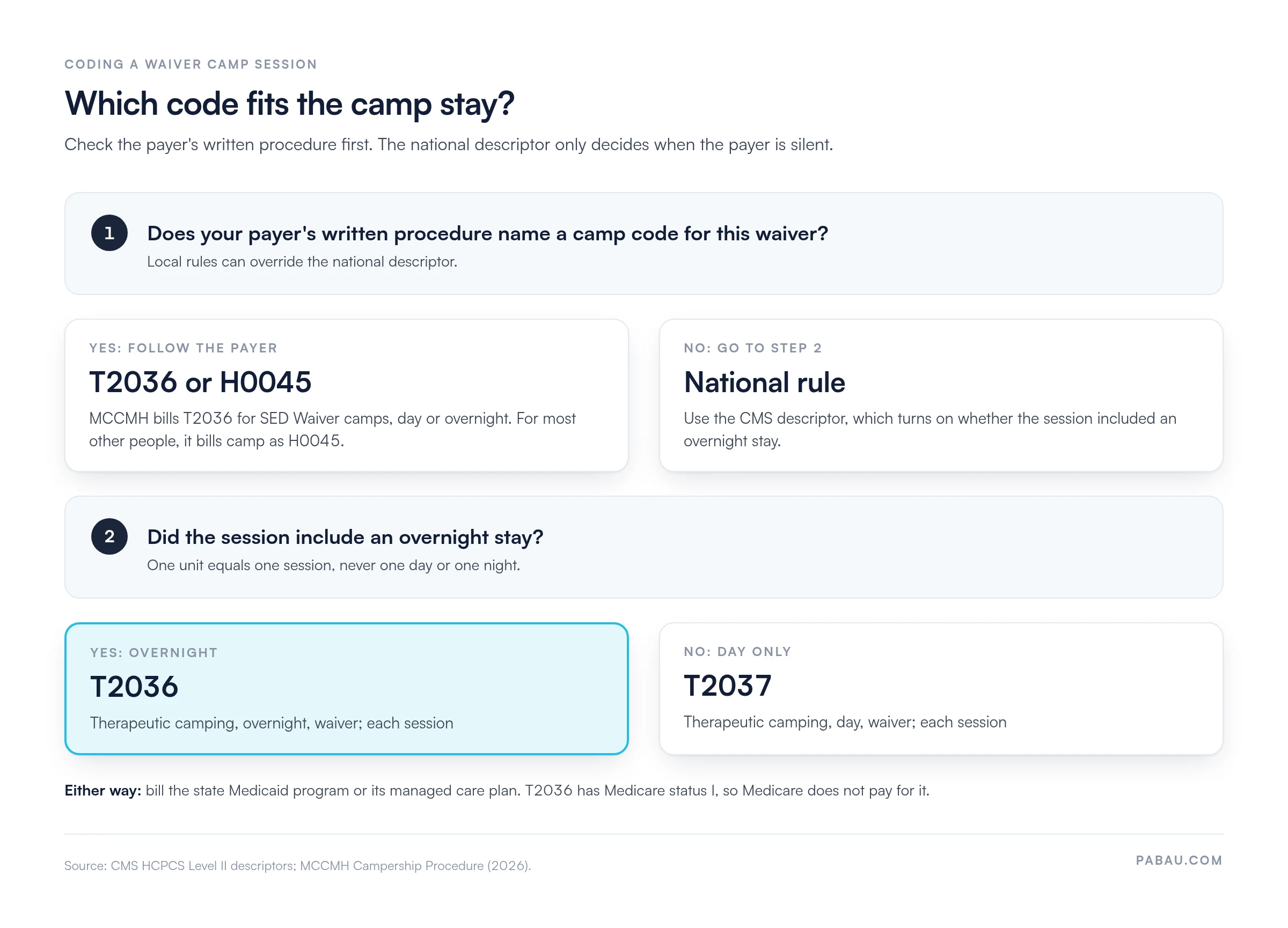
Next, check your payer before you assume T2036 is open to every waiver. MCCMH reserves T2036 for people on the SED Waiver. For most other people, it bills camp as H0045.
MCCMH also uses T2036 for both day and overnight camps on that waiver. So local rules can override the national descriptor. When they conflict, follow the payer’s written procedure and keep a copy on file. The decision below puts both checks in the right order.
Only providers enrolled with the state Medicaid program, or contracted with its managed care plan, can bill T2036. The participant must also be enrolled in a waiver that covers therapeutic camping.
Coverage follows the waiver, not a single diagnosis. Each waiver serves a defined target group. Michigan’s SED Waiver, for instance, serves children with serious emotional disturbance.
Local rules can narrow eligibility further. MCCMH offers camp only to people who live with an unpaid primary caregiver. People in licensed group homes or supported living arrangements do not qualify.
Get authorization before the session starts. Federal waiver rules tie every service to the person-centered service plan, so the camp has to appear there first.
MCCMH’s procedure shows what a plan entry needs. The plan must list:
The case holder then submits a prospective authorization request. MCCMH has seven calendar days to decide on medical necessity. A denial triggers a Notice of Adverse Benefit Determination to the person or their guardian.
After the stay, keep proof that the session happened. The camp’s attendance record, the authorization and the invoice should all match the billed dates. That trail is the backbone of sound billing compliance.
No national list pairs T2036 with specific ICD-10-CM codes. Medicare does not pay for the code, so CMS publishes no coverage policy for it. Eligibility comes from the waiver instead.
Report the primary diagnosis documented in the participant’s assessment and service plan. If your state manual or managed care plan lists accepted diagnoses, follow that list. Never borrow a diagnosis table from another code or another state.
Each state sets its own T2036 rate. No national rate exists. Some payers cap spending per session rather than paying a fixed fee.
MCCMH shows how this works. It allows up to $750 per session, with one session per fiscal year. SED Waiver participants can receive up to $1,400 per session, for up to three sessions a year.
Pull your state’s current schedule at the start of each fiscal year. Then check each managed care contract, because a plan can set its own terms.
Run through these checks for every claim. Each one maps to a denial you can prevent.
On the CMS-1500, the prior authorization number goes in box 23. Electronic 837P claims carry it in the prior authorization reference field.
T2036 denials are predictable. Most come from treating the code like a day program or a generic respite code.
Track denials by reason, not claim by claim. A repeat reason points to an intake or planning step that needs fixing. A simple denial management routine catches those patterns early.
Camp claims usually fail on paperwork that lives in different places. The service plan sits in one system, the authorization letter in an inbox, and the claim in a clearinghouse portal.
Pabau, the practice management platform we build, keeps those pieces on one patient record. Its claims tools for billing teams pre-fill the claim from that record. It also checks required fields, such as authorization numbers, before the claim is sent.
In the US, claims go out through Claim.MD, with eligibility checks, remittance posting and status tracking included. Pabau does not choose codes for you, so your team still confirms T2036 against the payer’s rules. What changes is that a claim can’t go out with a required field missing.

Pabau pre-fills claims from the patient record and checks required fields before they go out. US practices submit through Claim.MD and track every claim to payment.

T2036 rewards precision. It pays for one overnight camp session, for a defined waiver group, at a rate your state sets.
So start with the payer’s written procedure, not the national descriptor. Local rules decide which waiver can use the code and what a session may cost. Once the plan entry and authorization are right, the claim tends to follow.
Book a demo to see how Pabau keeps the record, the authorization and the claim aligned for every waiver service you bill.

Billing a waiver day program instead? HCPCS code T2020 explains how per diem day habilitation is billed.
Need the code for clinical day treatment? HCPCS code H2012 covers hourly behavioral health day treatment.
Seeing the same denials every month? Denial management in healthcare shows how to build a tracking and appeal routine.
Checking coverage before a camp session? Insurance eligibility verification walks through the checks to run first.
Does your payer route camp through respite? HCPCS code H0045 explains how out-of-home respite is billed per diem.
No. T2036 carries Medicare status I, meaning Medicare does not pay for it. Bill the state Medicaid program or its managed care plan.
T2036 took effect on October 1, 2003. It sits in the HCPCS T-code series created for state Medicaid agencies.
It can, if your payer defines a session that way. The national descriptor says each session but sets no length. Check the waiver manual or the payer’s camp procedure.
Some payers treat it that way. Macomb County Community Mental Health in Michigan lists camp in the plan as a respite care service. Other states may classify it differently.
The CMS short descriptor is Camp overnite waiver/session. Fee schedules and claim software often show this abbreviated form.