

CCSD code G5100: Bypass of duodenum billing guide
CCSD code G5100 bills a bypass that leaves the duodenum in place CCSD code G5100...

Last Updated: Oct 16, 2026
T2029 is the HCPCS Level II code for specialized medical equipment, not otherwise specified, waiver. State Medicaid agencies use it for equipment a home and community-based waiver authorizes when no more specific code describes the item.
Medicare does not pay for T2029. Each state sets the billing unit, the price, the modifiers, and the prior authorization rules. Most states also expect an item description and an invoice to support the claim.
Let Pabau's smart automation suggest the right codes, reduce claim denials, and keep your practice compliant—effortlessly.
Automate repetitive tasks and focus on what matters most—your patients.
Reduce coding errors and ensure compliance with the latest regulations.
Clean claims, fewer denials, and faster reimbursements.
Powerful insights and reporting to help your practice thrive.
HIPAA compliant SOC 2 certified GDPR-compliant Trusted by 4,000+ clinics worldwide

HCPCS code T2029 reports specialized medical equipment, not otherwise specified, under a Medicaid home and community-based waiver.
It is an equipment code, so there is no national billing unit, and each state defines the unit and the price.
Medicare does not pay for T2029, and most states price it manually from an invoice or quote.
Use T2028 for waiver supplies and T2029 for waiver equipment, since mixing the two is a common coding error.
Pabau, the practice management platform we build, submits US claims through Claim.MD and tracks their status, while your team still selects the code and modifiers.
HCPCS code T2029 is a Level II HCPCS code that state Medicaid agencies use to report specialized medical equipment under a waiver program. The official descriptor reads: T2029 – Specialized medical equipment, not otherwise specified, waiver. It has been in effect since October 1, 2003, and it sits in the T-code range CMS maintains for state Medicaid agencies.
CMS updates the code set through its HCPCS Level II maintenance process. For the Level II codes around T2029, our HCPCS guides for billers give each code the same breakdown as this page.
Two words in the descriptor do most of the work. “Equipment” separates T2029 from its supply counterpart, T2028. “Not otherwise specified” means the code names a category of items, not a single product. The descriptor carries no time unit, so the state decides how a T2029 line is counted and priced.
T2029 covers equipment that a participant’s approved waiver service plan authorizes and that no more specific code describes. States write their own definitions of specialized medical equipment. These usually include devices and adaptive aids that help a participant live, move, or communicate at home and in the community.
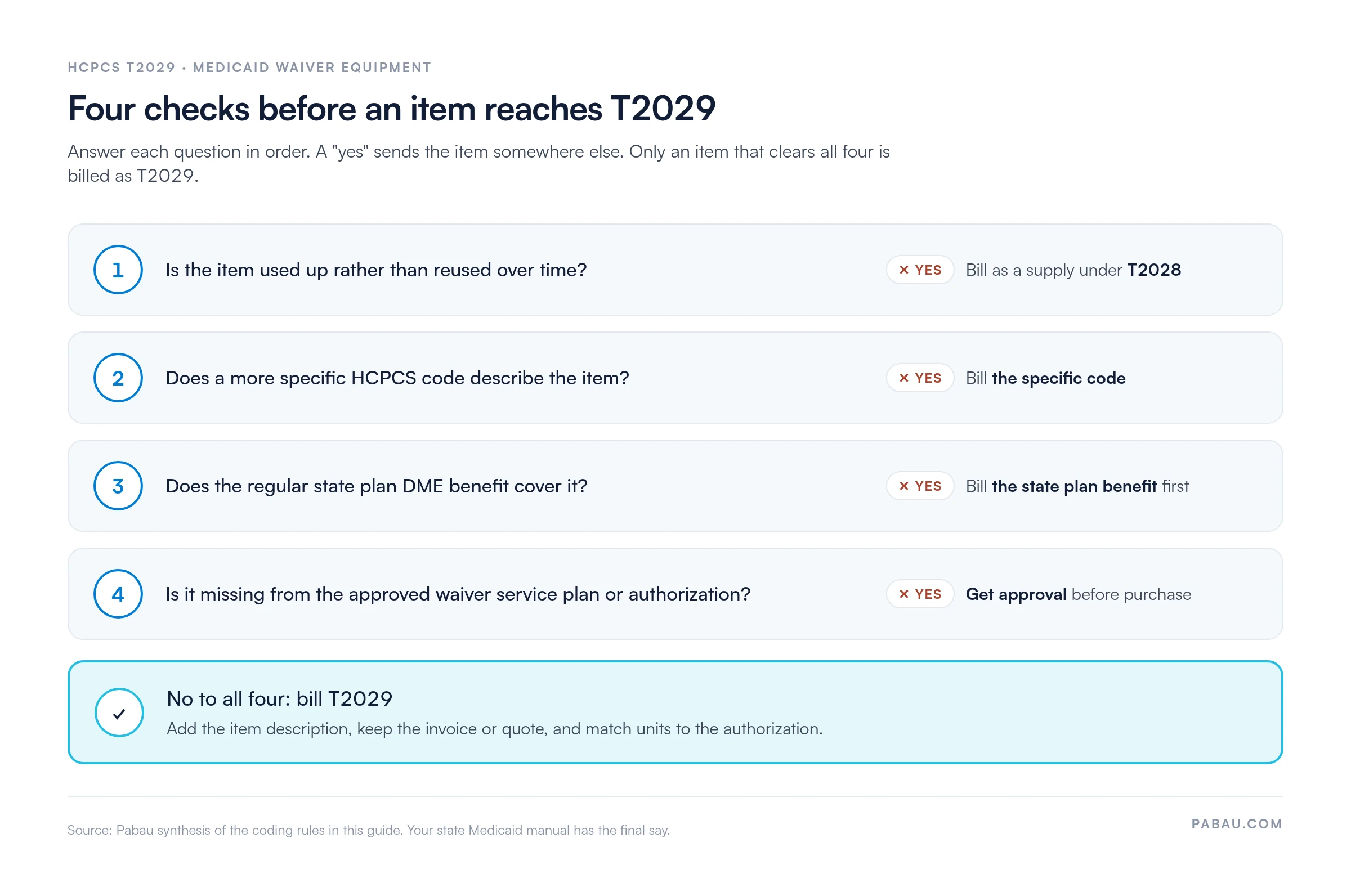
The code does not cover disposable supplies, which belong under T2028. It also does not replace a specific HCPCS code. Many waivers fund equipment only after the regular state plan durable medical equipment (DME) benefit has declined it or does not cover it. Check your state manual for that rule before you code.
Run those exclusions as an ordered check. Each “yes” sends the item to a different code or benefit, and only what remains is billed as T2029.
T2029 is accepted by state Medicaid programs and the managed care organizations (MCOs) that run their home and community-based services (HCBS) waivers. Medicare does not pay for it. A claim sent to a Medicare Administrative Contractor (MAC) with T2029 will not be paid.
Each state Medicaid agency decides how the code works in its programs. The billing unit, the pricing method, the modifiers, prior authorization, and documentation can all differ between states. A billing team working across several states needs each state’s provider manual, plus any MCO manual that applies.
Because T2029 is a not-otherwise-specified code, the claim has to tell the payer what the item is. Most states ask for a description of the equipment on the claim line or in the claim note. Many also want the invoice or a quote on file, and some want it attached.
The unit is whatever the state defines, and for equipment that is most often one item. Bill the quantity that matches the authorization. Some states also set a dollar cap for specialized medical equipment per item or per plan year. Keep the page of the state manual you relied on with the billing record.
T2029 has no national modifier set. Any modifier on the claim comes from your state Medicaid manual or your MCO contract. Some states use state-defined U modifiers to identify the waiver program. Other states expect no modifier at all on T2029.
Never append a modifier your state has not listed for T2029. An unlisted modifier can stop the claim at the payer’s front-end edits and delay payment.
Every T2029 claim needs a record that shows the equipment was authorized, bought or delivered, and received by the participant. Thin documentation is both a denial trigger and an audit risk. Good medical billing compliance practice means keeping the following in the record before the claim goes out.
A superbill documentation workflow that carries the authorization number and item description onto the claim cuts transcription errors. Clean claim submission depends on that data being complete before the claim leaves the practice.
Most state waiver programs require the equipment to be approved before it is bought. The approval usually comes through the participant’s service plan or a separate request to the state or MCO. Without an approval that covers the item and the date of service, the claim is likely to deny.
Some states ask for more than one supplier quote above a set dollar amount, or a clinician’s recommendation for the item. Equipment bought before approval may not be paid, and retroactive approval is not guaranteed. Insurance eligibility verification should also confirm the participant’s waiver enrollment is active.
Send the item description, the quote, and the plan reference together with the authorization request. When the approved item matches the invoice word for word, the claim and the authorization reconcile without a manual review.
The codes around T2029 cover different waiver services, so a wrong pick usually means a denial. T2028 is the code most often confused with T2029. T2028 covers specialized supplies, while T2029 covers specialized equipment. The other neighbors are childcare and assisted living codes with their own time units.
The T2028 and T2029 choice turns on the item itself. Equipment is reused over time, while supplies are used up. Where your state publishes its own list of what counts as equipment or supply, follow that list.
T2029 denials mostly trace back to the state rules that sit around a not-otherwise-specified code. These are the most frequent causes and the fix for each. Structured denial management workflows help you spot the pattern before it repeats.
T2029 has no national rate, because Medicare does not price it. Each state Medicaid agency decides what it pays. As a not-otherwise-specified code, T2029 is often priced item by item from the supplier invoice or quote. Some states also set a cap per item or per plan year for specialized medical equipment.
To find your state’s method, check the state Medicaid agency’s fee schedule and the provider manual for its waiver programs. The fee schedule may list T2029 as manually priced rather than give a dollar figure. For the current descriptor, the AAPC HCPCS code lookup draws on the CMS release.
Save the state fee schedule and provider manual pages you used, with the effective date in the file name. When an audit questions a manually priced T2029 line, you can show the pricing rule in force on the date of service.
Waiver equipment claims fail when the item, the authorization, and the invoice do not line up. Pabau keeps those records on the patient file next to the claim. Your billing team still chooses the code, the units, and any state modifier.
Pabau’s claims software for US practices submits claims electronically through its Claim.MD clearinghouse integration. It then tracks each claim’s status, so a rejected or denied T2029 line shows up quickly. Your team can correct the description or attach the invoice and resubmit.
A manually priced claim already waits for a reviewer, so each resubmission pushes payment back again. That is why revenue cycle management treats coding accuracy as a cash flow issue for waiver providers.

Pabau keeps the service plan, invoice, and patient record next to each claim. It submits US claims through Claim.MD and tracks their status, so denied T2029 lines are easy to find and fix.

T2029 pays when the claim proves three things: the equipment was approved, the item is described, and the price is supported. Read your state manual before your first claim, because it decides the unit, the modifiers, and how the item is priced.
The cost of skipping that step is a manual review on every line. Get the authorization, the description, and the invoice to match once, and later claims for the same participant move faster. Book a demo to see how Pabau submits and tracks Medicaid waiver claims for your practice.

Need to understand how clearinghouse edits catch claim errors before payers do? Clean claim submission covers the pre-submission validation steps that prevent avoidable denials.
Working through a backlog of denied waiver claims? Denial management in healthcare outlines the systematic approach to categorizing, appealing, and preventing recurring denials.
Want to understand how the revenue cycle connects coding to cash flow? Revenue cycle management explains the end-to-end billing process from eligibility check to payment posting.
HCPCS code T2029 covers specialized medical equipment, not otherwise specified, under a state Medicaid home and community-based waiver. It applies to equipment the participant’s approved service plan authorizes when no more specific code describes the item. Each state defines which equipment qualifies.
T2028 reports specialized supplies, not otherwise specified, under a waiver, while T2029 reports specialized medical equipment. Supplies are used up, and equipment is reused over time. Where your state publishes its own list of equipment and supplies, follow that list.
Most state waiver programs require approval before the equipment is bought, usually through the service plan or a separate request. Some states also want supplier quotes or a clinician’s recommendation. A claim without an approval covering the item and date of service is likely to deny.
The usual causes are a missing authorization, no item description on the claim, and no invoice to price it. Coding a supply as T2029 or using an unlisted modifier also causes denials. So does billing an item that the regular state plan DME benefit covers.
T2029 has no national rate, and Medicare does not pay for it. Each state Medicaid agency sets its own method, and many price the code manually from the supplier invoice or quote. Some states also cap spending per item or per plan year.
T2029 has no national modifier set. Some states assign U modifiers to identify the waiver program, and some MCOs add their own rules. Others bill the code with no modifier. Use only the modifiers your state or MCO manual lists for T2029.



