HCPCS Code E0272: Foam rubber mattress billing guide
HCPCS Code E0272: official descriptor and code overview HCPCS Code E0272 is the ...

Last Updated: Nov 6, 2026
T1024 is the HCPCS Level II code for evaluation and treatment by an integrated, specialty team. The team gives coordinated care to children with multiple or severe disabilities, billed per encounter.
T1024 is a T-code for state Medicaid agencies, and CMS lists it as not payable by Medicare. Each state sets its own unit rules, modifiers and rates. For example, Florida uses it for early intervention team evaluations, but that is a local choice rather than the national meaning.
Let Pabau's smart automation suggest the right codes, reduce claim denials, and keep your practice compliant—effortlessly.
Automate repetitive tasks and focus on what matters most—your patients.
Reduce coding errors and ensure compliance with the latest regulations.
Clean claims, fewer denials, and faster reimbursements.
Powerful insights and reporting to help your practice thrive.
HIPAA compliant SOC 2 certified GDPR-compliant Trusted by 4,000+ clinics worldwide

HCPCS code T1024 bills evaluation and treatment by an integrated specialty team for children with multiple or severe disabilities.
The national billing unit is one encounter, not one day and not 15 minutes.
CMS lists T1024 as not payable by Medicare, so the claim goes to the state Medicaid program or its managed care plan.
T1024 is not a national early intervention code, although some states, such as Florida, use it for early intervention team evaluations.
A team roster, notes from each discipline and a shared plan of care are what keep a T1024 claim payable.
HCPCS code T1024 bills evaluation and treatment by an integrated, specialty team contracted to provide coordinated care to children with multiple or severe disabilities. One unit equals one encounter with that team. The official descriptor still uses the older wording “multiple or severely handicapped children.”
T1024 sits in the HCPCS Level II T-code range, T1000-T5999, which CMS reserves for state Medicaid agencies. The CMS HCPCS quarterly file lists it as not payable by Medicare. It was added on January 1, 2003, and is still active.
T1024 is not a per diem code. Nationally, it is also not tied to early intervention under Part C of the Individuals with Disabilities Education Act (IDEA). A state can still adopt it for early intervention team visits, so the state billing manual decides how you use it.
T1024 pays for one encounter in which a contracted team of specialists evaluates or treats a child together. The key word is integrated. The disciplines work from one coordinated plan, rather than as separate referrals billed one by one.
Depending on the state program, a T1024 encounter can include:
Florida is one example of local use. Its 2026 Early Intervention Services fee schedule bills initial and follow-up psychosocial and developmental evaluations under T1024.
Physical, speech and occupational therapists can render them. So can licensed early intervention professionals and Infant Toddler Developmental Specialists (ITDS).
The national descriptor says nothing about early intervention, so Florida’s rules bind only Florida claims. Another state may use T1024 for a different team service, or not pay it at all.
Because T1024 pays for a coordinated team encounter, several services sit outside it.
Whether a state pays T1024 and a single-discipline code for the same child on the same date is a state rule. Check the billing manual before you bill both.
The codes from T1023 to T1027 sit next to each other but bill different services. The billing unit is the quickest way to tell them apart, and the population is the second.
T1024 and T1026 both serve children with complex needs, so they are the pair most often mixed up. T1024 covers a team encounter, while T1025 and T1026 cover ongoing time in a clinic program. The guide below turns those unit and population rules into six questions.
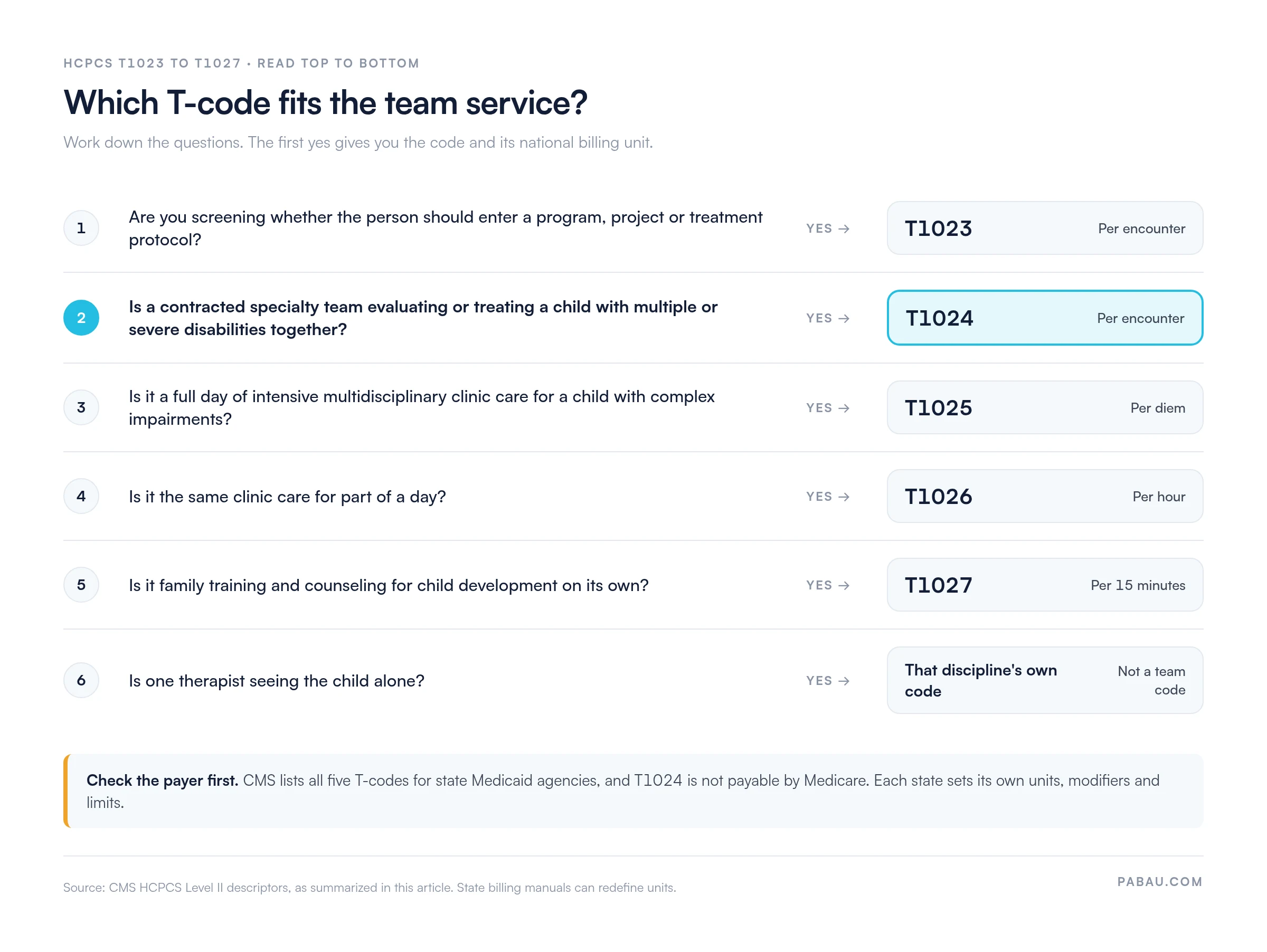
The national descriptor sets one unit per encounter. However, a state can define its own unit for the code, so the fee schedule decides what goes in the units field.
Florida also caps multidisciplinary evaluations at two hours per team member, per event. As a result, a three-person evaluation can carry up to four units for each team member’s provider type.
Claims follow the standard CMS-1500 or 837P format, with the unit count in Box 24G. Pabau, the practice management platform we build, supports both formats in its claims management workflow. That cuts manual entry on T-code claim lines.
Store the unit rule for T1024 against each payer, not against the code. A per-encounter claim showing four units can read as four encounters to a payer that expects one.
CMS sets no modifier requirement for T1024, so modifier rules come from each state fee schedule and plan contract. Florida’s 2026 early intervention schedule is a published example:
Another state may use different modifiers for T1024, or none. Therefore, check the current fee schedule for the state and plan you bill before you append one.
There is no national prior authorization rule for T1024. Each state Medicaid program and managed care plan sets its own.
Where approval applies, record the authorization number, its dates and the approved encounters on the child’s record. An encounter outside those dates is denied just like one with no authorization.
The records behind T1024 need to show two facts: a team saw the child together, and the encounter followed a coordinated plan.
The integrated findings are what separate a T1024 encounter from several visits on one day. In Pabau, a team can build one digital form template that captures every member’s input at the point of care.
There is no federal fee for T1024, because Medicare does not pay it. Each state Medicaid program sets its own rate, and managed care plans set theirs in the provider contract.
These figures come from Florida’s 2026 Early Intervention Services fee schedule, and the maximums are the rate multiplied by four units. Other states publish their rates in their own Medicaid fee schedules, so check the current file before you quote one.
Most T1024 problems trace back to the payer, the unit count or the team record. In addition, a clear denial management workflow helps your team work each remittance quickly.
Payer and unit errors can usually be corrected and resubmitted. By contrast, authorization denials tend to need an appeal. Knowing the common claim denial codes shortens both routes.
A T1024 claim depends on records from several people: each team member’s notes, the shared findings and the authorization. When they sit in separate files, the claim goes out without proof that the team worked together.
Pabau keeps those records on one patient file. Digital forms capture each discipline’s input, and the calendar books the whole team into one appointment.
When the claim is ready, Pabau sends it through its Claim.MD clearinghouse integration. That route adds real-time eligibility checks and electronic remittance advice (ERA) retrieval. However, Pabau does not choose codes or units for you, so your team still applies the state rules above.

Pabau keeps every team member’s notes, the shared plan and the appointment on one patient record. Claims then go out through Claim.MD from that data.

T1024 is a team code billed per encounter, and most errors start when it is treated as a day rate or an early intervention catch-all. Before the first claim, write down how your state defines the unit, which modifiers it wants and how many evaluations it allows.
Then bill each encounter from the team’s shared record, not from separate visit notes. Book a demo to see how Pabau keeps team notes, plans of care and claims on one record.

Want to understand how clearinghouse integration reduces claim errors? Claim.MD clearinghouse overview explains how electronic claim routing, real-time eligibility and ERA retrieval work in practice.
Looking for compliance standards for Medicaid billing? Medical billing compliance covers documentation retention, audit readiness and HIPAA transaction requirements for Medicaid billers.
Sending T-code claims electronically? The 837 file explained walks through the electronic claim format that carries your T1024 lines to the payer.
Need approval before the team encounter? The prior authorization process covers how to request, track and renew approvals with Medicaid plans.
HCPCS code T1024 covers evaluation and treatment by an integrated, specialty team for children with multiple or severe disabilities. It is billed per encounter to state Medicaid programs.
Not at the national level, because the descriptor describes a specialty team encounter for children with multiple or severe disabilities. However, some states use it locally, and Florida bills early intervention evaluations under T1024.
No, the national billing unit is one encounter. T1025 is the per diem code in this range, and it covers a full day of intensive multidisciplinary clinic care.
No, because CMS lists T1024 as not payable by Medicare. Instead, bill it to the state Medicaid program or its managed care plan.
T1024 bills one encounter with an integrated specialty team. By contrast, T1026 bills intensive multidisciplinary clinic care for children with complex impairments by the hour.
CMS sets none, so the state decides. Florida, for example, uses GP, GN and GO for the therapy discipline. It adds UK or TS for initial or follow-up evaluations, and TL or HN for other provider types.
Common reasons are a claim sent to Medicare, the wrong unit count, a solo visit billed as a team encounter or a missing state modifier. An evaluation over the state limit or a missing authorization also leads to denial.