

CCSD code G5100: Bypass of duodenum billing guide
CCSD code G5100 bills a bypass that leaves the duodenum in place CCSD code G5100...

Last Updated: Oct 16, 2026
T1026 is the HCPCS Level II code for intensive, extended multidisciplinary clinic services for children with complex impairments, billed per hour. The official descriptor names children with complex medical, physical, mental and psychosocial impairments.
State Medicaid programs use it for partial-day care at Prescribed Pediatric Extended Care (PPEC) centers. These centers give medically fragile children nursing and therapy during the day. Medicare does not pay T1026, and each state sets its own hourly rate, daily cap and prior authorization rules.
Let Pabau's smart automation suggest the right codes, reduce claim denials, and keep your practice compliant—effortlessly.
Automate repetitive tasks and focus on what matters most—your patients.
Reduce coding errors and ensure compliance with the latest regulations.
Clean claims, fewer denials, and faster reimbursements.
Powerful insights and reporting to help your practice thrive.
HIPAA compliant SOC 2 certified GDPR-compliant Trusted by 4,000+ clinics worldwide

HCPCS Code T1026 bills intensive, multidisciplinary clinic services for children with complex medical needs, with one unit per hour.
State Medicaid programs use it for partial-day care at Prescribed Pediatric Extended Care (PPEC) centers, while T1025 bills a full day.
CMS lists T1026 as not payable by Medicare, so the claim goes to the state Medicaid program or its managed care plan.
The partial-day ceiling depends on the state: four hours in Florida and Texas STAR Kids, and six hours in Mississippi.
Prior authorization, a current plan of care and a parent-signed daily attendance log are what keep a T1026 claim payable.
HCPCS code T1026 bills intensive, extended multidisciplinary care delivered in a clinic setting, counted by the hour. Specifically, the patients are children with complex medical, physical, mental and psychosocial impairments. State Medicaid programs use it for partial-day care at Prescribed Pediatric Extended Care (PPEC) centers. For example, Florida, Mississippi and Texas all list it this way in their PPEC policies.
Moreover, T1026 sits in the HCPCS Level II T-code section, which CMS reserves for state Medicaid agencies. Consequently, the CMS HCPCS quarterly file gives it Medicare coverage code I, which means not payable by Medicare. In addition, it was added on January 1, 2003, and has no termination date in the October 2026 file.
T1026 is not a personal care code. Instead, paraprofessional personal care is billed with T1019 (per 15 minutes) or T1020 (per diem), and a home health aide visit is T1021.
T1026 pays for the hours a medically fragile child spends in a licensed PPEC center under nursing supervision. For instance, the Florida PPEC coverage policy describes the service as skilled nursing supervision and therapeutic interventions in a non-residential setting. In particular, it lists the services a PPEC day must include at a minimum:
First, Florida covers children under 21 who need continuous therapeutic interventions or skilled nursing supervision. A physician must also judge the child medically stable and not a threat to self or others. Similarly, Mississippi’s fee schedule covers ages 0 to 20 and requires prior authorization for every PPEC code.
The PPEC day starts when the child arrives at the center, or is picked up for escorted transportation. It ends when the child leaves the center or is returned home. However, a full day of the same service is billed as T1025 instead.
The hourly rate pays for the center’s own package of care, so several services sit outside it.
Likewise, transport time stays out of the hour count. For example, the Texas CSHCN Services Program manual (August 2021) says transit time does not count toward its 400-hour annual limit.
Because T1026 and T1025 share the same descriptor, they differ only in the billing unit. Thus, T1026 counts the hours of a partial day, and T1025 pays one flat rate for a full day. Therefore, choose the code from the hours the child attended that day.
First, one unit of T1026 equals one hour of PPEC care. However, the partial-day ceiling, the rounding rule and any annual cap all come from the state, not from CMS.
In fact, the rounding rules change what the same visit is worth. For example, a child who attends for 3 hours and 20 minutes bills three units in Mississippi, which pays completed hours only. By contrast, under the Florida and Texas CSHCN 15-minute rule, the same visit bills four units.
Bill T1026 from the signed daily log, not from the planned schedule. If a child goes home early, the departure time on the log sets the unit count.
CMS sets no modifier requirement for T1026, so modifier rules come from each state fee schedule and plan contract. These are the ones the published PPEC schedules show:
U modifiers are defined by each state, so U6 can mean something different in another Medicaid program. Consequently, check the modifier against the current fee schedule for the state and plan you bill.
In fact, every state program reviewed for this guide requires prior authorization before T1026 hours begin.
Texas requires the authorization before the start of care, so hours delivered earlier fall outside it. Therefore, track the start date, end date and approved hours for each child, and renew before the period runs out.
The records behind T1026 need to show two facts: the child needed PPEC care, and attended for the hours billed.
Finally, the hour count on the claim should match the arrival and departure times in the signed log. Besides, sound medical billing compliance habits keep those records ready for a Medicaid review.
First, there is no federal fee for T1026, and each state Medicaid program sets its own hourly rate. The figures below come from published state and plan schedules, so check the current file before you rely on them.
Specifically, Mississippi updated its PPEC rate calculation to the 2023 average small nursing facility rate, effective May 1, 2025. In addition, the July 2026 schedule carries the current rates. The Texas STAR Kids figures are the HHSC rates from June 2023, so check the current HHSC PPECC rate before you bill. Meanwhile, Florida publishes its PPEC rates in a separate fee schedule on the AHCA website.
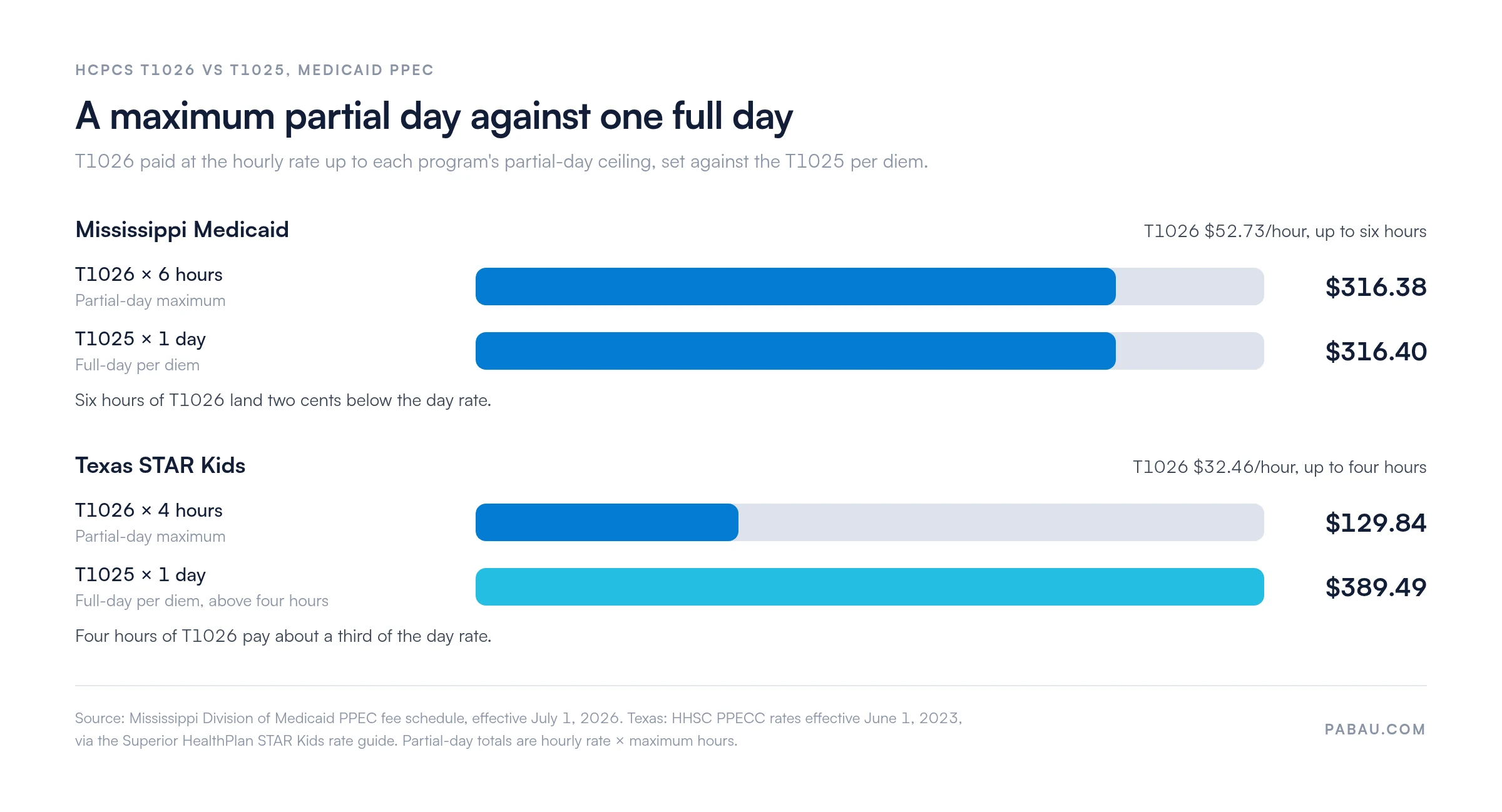
Therefore, the partial-day ceiling decides how far apart the two codes sit. For example, six Mississippi hours of T1026 pay $316.38, two cents under the T1025 day rate. By contrast, four Texas STAR Kids hours pay $129.84, about a third of the $389.49 full-day rate.
Most T1026 problems trace back to the payer, the authorization or the hour count. In addition, knowing the common claim denial codes helps your team read each remittance quickly.
First, payer and code errors can usually be corrected and resubmitted. In contrast, authorization denials tend to need the plan reconsideration or appeal route, with the signed plan of care attached. As a result, a clear denial management workflow keeps those two tracks apart.
Overall, a T1026 claim depends on three records: the plan of care, the authorization and the signed daily log. When they live in separate binders and spreadsheets, hours get billed that the log cannot support.
Instead, Pabau, the practice management platform we build, keeps those records on one patient file. For instance, digital forms capture the parent’s signature and the day’s arrival and departure times. Furthermore, the calendar shows each child’s scheduled days, so staff can compare attendance with the authorized hours.
When a claim is ready, Pabau’s cleaner claim submission sends it through Claim.MD using data already on the record. It then tracks the claim status for you. However, it does not choose codes, add modifiers or audit documentation, so your team still applies the state rules above.

Pabau keeps signed daily logs, plans of care and appointments on one patient record. Claims go out through Claim.MD from that data, and you track their status in one place.

T1026 is simple to describe and easy to bill wrongly, because the rules that matter sit in each state’s PPEC policy. Before the first claim, write down your state’s partial-day ceiling, rounding rule, caps and modifiers. Finally, bill each day from the signed log, not from the planned schedule.
As a result, that habit keeps corrected claims and appeals rare, and it holds up when Medicaid reviews the file. Book a demo to see how Pabau keeps PPEC logs, plans of care and claims on one record.

Billing a full PPEC day? HCPCS code T1025 covers the per diem version of the same service.
New to the revenue cycle? What is medical billing explains the end-to-end process and where Medicaid T-codes fit within it.
Want a systematic approach to reducing Medicaid rejections? Denial management in healthcare covers the workflows and appeal strategies that recover revenue faster.
Looking for compliance standards for Medicaid billing? Medical billing compliance outlines the documentation and audit-readiness practices that protect centers billing Medicaid codes.
HCPCS code T1026 covers hourly, multidisciplinary clinic care for children with complex medical, physical, mental and psychosocial impairments. State Medicaid programs use it for partial-day care at Prescribed Pediatric Extended Care (PPEC) centers.
T1025 pays a full PPEC day at a flat per diem rate, while T1026 pays a partial day by the hour. Florida and Texas STAR Kids cap T1026 at four hours a day, while Mississippi caps it at six.
No, because the CMS HCPCS file lists T1026 with coverage code I, meaning not payable by Medicare. Instead, bill it to the state Medicaid program or its managed care plan.
Yes, in every state program reviewed for this guide. For example, Florida authorizes PPEC services every 180 days, and Texas requires approval before the start of care. Mississippi’s fee schedule also flags T1026 for prior authorization.
It depends on the state. For instance, Mississippi pays completed hours only. However, Florida and the Texas CSHCN Services Program round up to a full hour when at least 15 minutes is delivered after the first hour.
No, because personal care services are billed with T1019 per 15 minutes or T1020 per diem. Instead, T1026 covers multidisciplinary clinic care for children with complex needs, usually in a PPEC center.
First, keep a current plan of care, the prior authorization and a daily attendance log signed by the parent or guardian. In addition, Florida requires the plan of care to be updated every 180 days and signed by the PPEC registered nurse and physician.



