

CCSD code G5100: Bypass of duodenum billing guide
CCSD code G5100 bills a bypass that leaves the duodenum in place CCSD code G5100...

Last Updated: Oct 16, 2026
76514 is the CPT code for ophthalmic ultrasound, diagnostic; corneal pachymetry, unilateral or bilateral (determination of corneal thickness).
The descriptor is ultrasound-based, so 76514 reports contact pachymetry only. Optical and OCT-based corneal thickness measurement is reported with unlisted code 92499 instead. Beyond technique, most denials trace back to the inherently bilateral structure and the Medicare once-per-lifetime limit, which applies per patient rather than per eye. Get all three right and most CPT code 76514 claims clear on first submission.
Let Pabau's smart automation suggest the right codes, reduce claim denials, and keep your practice compliant—effortlessly.
Automate repetitive tasks and focus on what matters most—your patients.
Reduce coding errors and ensure compliance with the latest regulations.
Clean claims, fewer denials, and faster reimbursements.
Powerful insights and reporting to help your practice thrive.
HIPAA compliant SOC 2 certified GDPR-compliant Trusted by 4,000+ clinics worldwide

CPT code 76514 covers ultrasound (contact) corneal pachymetry, unilateral or bilateral. Optical and OCT-based pachymetry is billed separately under unlisted code 92499.
The code is inherently bilateral, so one unit covers both eyes. Append modifier -52 when only one eye is measured, not modifier -50.
Medicare covers CPT code 76514 once per lifetime per patient for glaucoma suspects, under CMS LCD A56548. A signed ABN is required before any repeat session is billed.
Pabau’s claims management tools help ophthalmology practices flag lifetime-limit alerts and auto-populate ICD-10 pairs before submission.
CPT code 76514 describes ophthalmic ultrasound, diagnostic; corneal pachymetry, unilateral or bilateral (determination of corneal thickness).
The procedure measures corneal thickness with a contact ultrasound probe placed on the anesthetized cornea. The descriptor has always been ultrasound-based, and no AMA revision has extended it to optical techniques.
Non-contact optical coherence tomography (OCT) pachymetry is reported with the unlisted code 92499, which CMS LCD article A56548 names for optical pachymetry. Payers commonly value 92499 at about the same level as 76514, but it remains a distinct code.
Unlisted codes carry no published fee, so payers set payment from the report submitted with the claim. The same mechanics apply to CPT code 76499, whose guide covers the procedure report and comparable-code explanation payers expect.
Corneal thickness measurement matters in two settings. The first is glaucoma evaluation. Thinner corneas produce artificially low intraocular pressure readings on applanation tonometry, which can hide glaucomatous pressure elevation. Pachymetry corrects for that.
The second is pre-surgical corneal assessment. Before LASIK and other refractive procedures, pachymetry confirms that enough stromal thickness remains after the planned tissue removal.
Medicare covers CPT code 76514 when it is medically necessary for a covered indication, as detailed in CMS LCD A56548. Settling which diagnoses qualify is the first step in building a clean claim.
Covered indications fall into three broad categories:
Medicare covers CPT code 76514 once in a lifetime per beneficiary who is a glaucoma suspect or has ocular hypertension, per CMS LCD A56548. The limit belongs to the patient, not to each eye. One unit of 76514 already reports the bilateral service, so no separate allowance is tracked for a second eye.
Before billing a repeat pachymetry session for a Medicare patient, an Advance Beneficiary Notice of Noncoverage (ABN) must be on file. Billing without one once the lifetime limit is exhausted leaves the practice carrying the charge.
Modifier -GA reports that an ABN was issued, which shifts liability for the charge to the patient. Modifier -GZ reports an expected denial with no ABN on file, and the practice writes the charge off. Modifier -GY is a different signal again, reserved for a service Medicare excludes by statute.
Commercial payers vary. Many impose no lifetime limit at all, so review each payer’s clinical policy bulletin before assuming one applies.
Check your practice management system before every Medicare pachymetry encounter. A flag showing the date of any prior 76514 claim takes seconds to set up. That one alert is what stops a repeat claim going out without an ABN behind it.
Every CPT code 76514 claim requires a linked ICD-10-CM diagnosis code that establishes medical necessity. The table below lists the codes recognized under CMS LCD A56548. Sending the claim with an unsupported diagnosis is the fastest route to a medical necessity denial.
Laterality matters here. Submitting H40.00 without its laterality character will trigger an edit in many payer systems. Use the most specific available code, and check it against the covered list in the applicable LCD before you submit. The ICD-10-CM code library carries the descriptor and coding notes for each diagnosis above.
Because CPT code 76514 is inherently bilateral, modifier selection is the most common source of billing confusion. One billed unit of 76514 already represents the bilateral procedure.
Appending modifier -50 to an inherently bilateral code typically results in incorrect double-payment or a payer rejection, unless that payer’s policy explicitly requires it.
The practical rule is short. Bilateral pachymetry on the same date bills as one unit of CPT code 76514, with no modifier. Unilateral pachymetry bills as one unit with modifier -52 appended. Check the payer’s own policy before adding -50 to any 76514 claim.
Medicare reimbursement for CPT code 76514 is set by the CMS Medicare Physician Fee Schedule (MPFS). The 2026 national unadjusted rate is about $11.69 for a bilateral session. That figure comes from 0.35 total RVUs multiplied by the 2026 conversion factor of $33.4009. Facility and non-facility payment is identical for this code.
Geographic Practice Cost Index (GPCI) adjustment moves the payment up or down by locality. Use the CMS MPFS lookup tool with your locality code for an accurate figure.
Commercial payer rates vary substantially. Some payers reimburse at a percentage of the Medicare fee schedule, while others work from separately negotiated contract rates.
Reading the remittance advice after each 76514 payment shows which payers sit below the expected rate, which is what a contract renegotiation needs. Catching an underpayment early also keeps it inside the appeal window.
Corneal pachymetry rarely stands alone in a glaucoma workup. Knowing which codes are commonly co-billed, and whether NCCI bundling edits apply, prevents unnecessary claim holds. Verify NCCI edits through the AAPC CPT code lookup or the CMS NCCI Policy Manual before routinely pairing codes.
Thorough documentation is what turns a medically appropriate service into a payable claim. CMS LCD A56548 and most commercial payer policies name specific elements the medical record has to carry for CPT code 76514. Capturing each of them at the time of service is what keeps the claim out of a retrospective audit.
First-pass acceptance rates move further at the documentation stage than at the submission stage. A complete record before submission is always faster than an appeal after a denial.
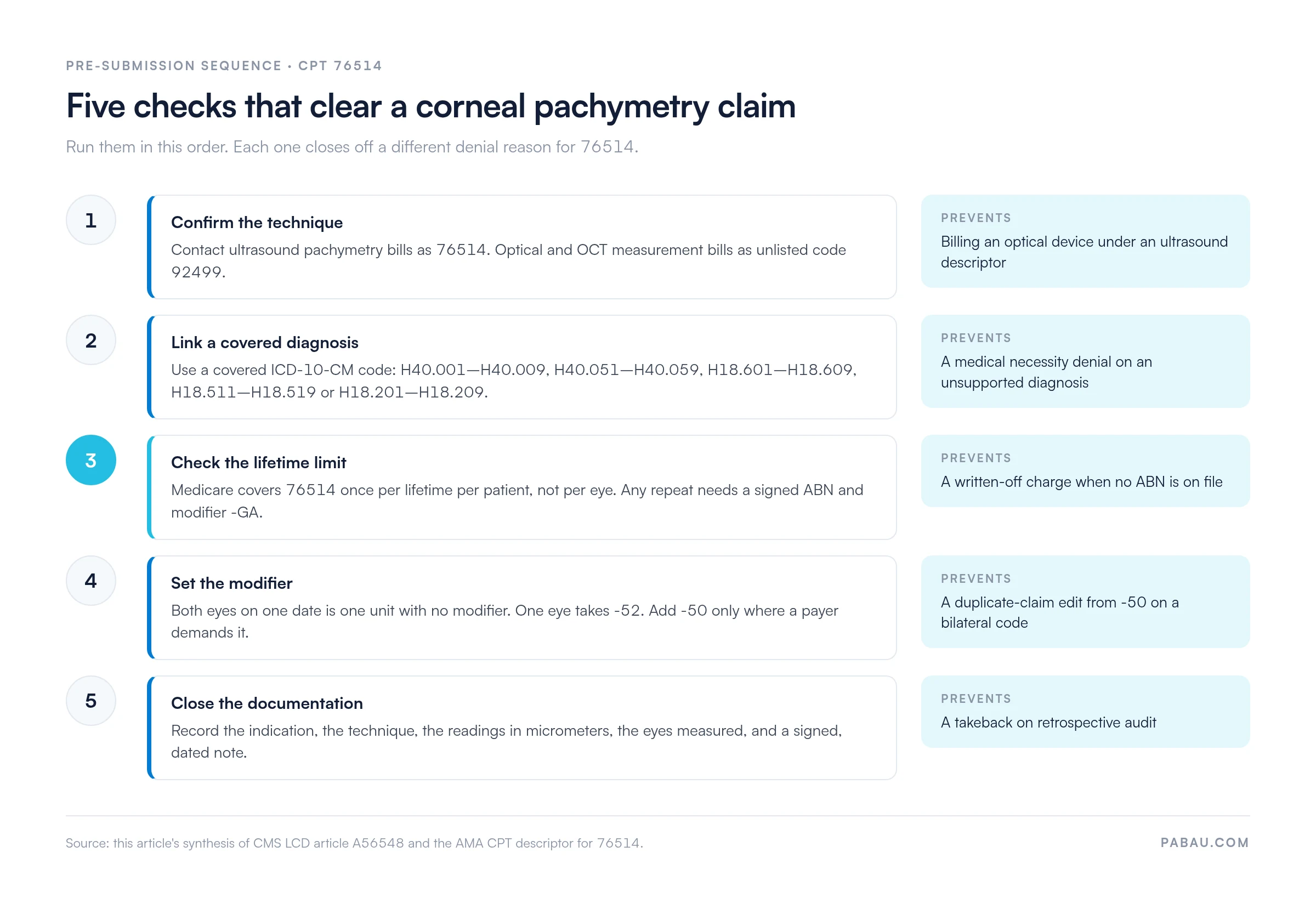
Every 76514 denial below is catchable at the desk, before the claim goes out. Working these checks into a pre-submission routine is what separates a clean claim from a month-long appeal.
The same rules read more usefully as a sequence to run before the claim leaves the practice.
The errors above share one cause. Manual checks are being applied to a code with layered rules. Practice management software like Pabau holds those rules at the point of care instead. Built-in CPT and ICD-10 catalogues put the right code pairs in front of the clinician while the encounter is charted.
Practices carrying Medicare patients with several ophthalmic diagnoses get the most out of cleaner claims management. The workflow flags a prior 76514 claim before the next encounter is booked, so the ABN conversation happens in advance rather than after a denial.
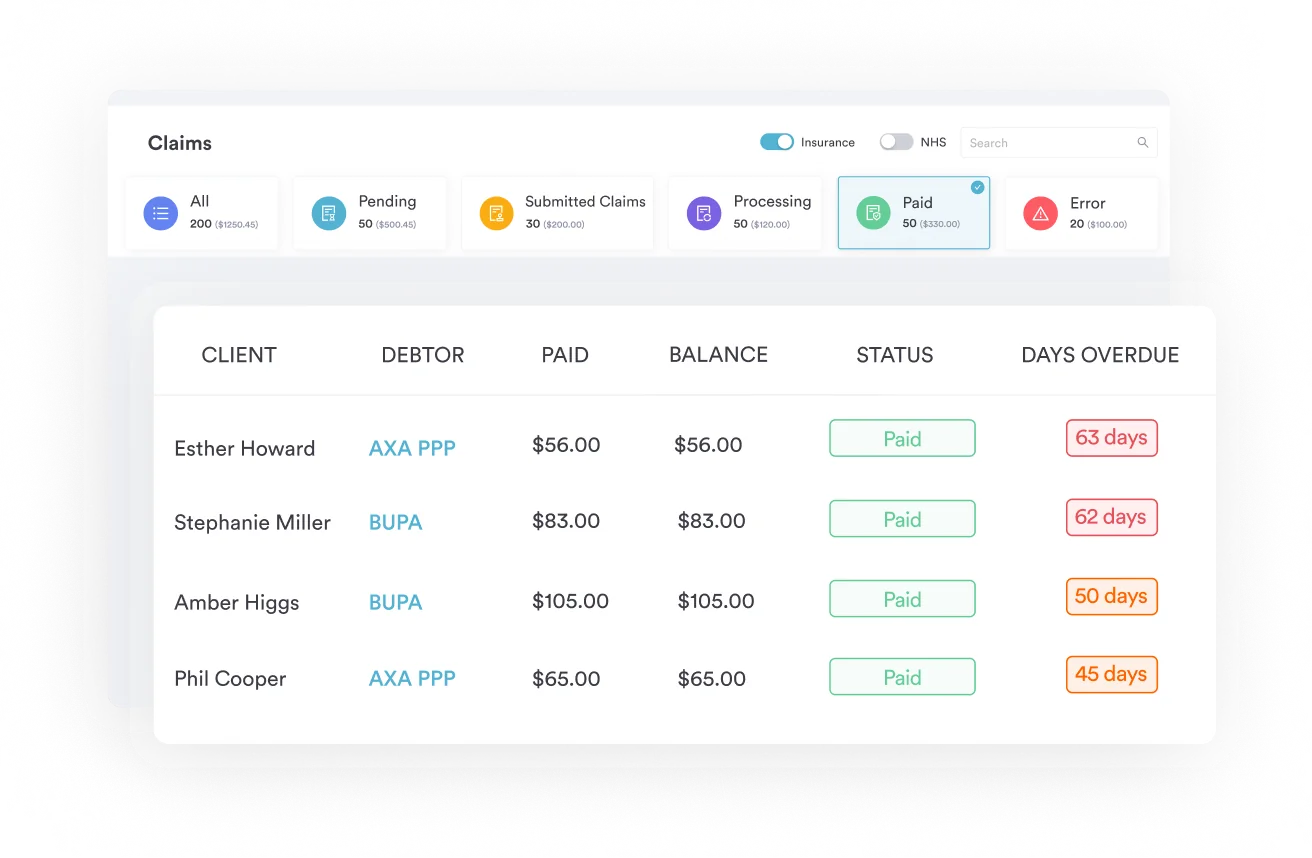
Claims then submit electronically to US payers through our Claim.MD clearinghouse integration. Modifier rules and ICD-10 linkage are reviewed before the CMS-1500 leaves the practice. Remittance advice reconciles automatically, so an underpayment surfaces within days instead of at the end of a quarter.
Run a quarterly audit of your 76514 claims against the lifetime-limit data in your billing system. Check whether any of them posted without a prior-claim check, and whether an ABN was on file where one was needed. It is a short review that keeps a year of small write-offs from piling up.

Pabau’s integrated claims tools help ophthalmology practices auto-populate ICD-10 pairs, flag Medicare lifetime limits, and submit cleaner 76514 claims through our Claim.MD clearinghouse integration.

Three rules govern most of the billing complexity around CPT code 76514. It is inherently bilateral, Medicare covers it once per lifetime per patient, and the descriptor is ultrasound-only.
Optical and OCT pachymetry stays on unlisted code 92499. Practices that build those rules into a pre-encounter checklist spend far less time on appeals.
Almost all of the work on a 76514 claim pays off before the encounter, not after the denial. Built-in modifier rules and a clearinghouse connection take the manual checking out of submission. Book a demo to see how Pabau handles ophthalmology claims from charge entry through remittance.

Need to understand claim denials at a deeper level? Denial management in healthcare covers root causes, appeal workflows, and prevention strategies for ophthalmology and other specialties.
Want to see how clearinghouse submission works in practice? The 837 electronic claim file guide explains how CPT and ICD-10 data flows from your EHR to payers through a clearinghouse.
Looking for billing compliance guidance? Superbill documentation best practices shows how to structure encounter records that survive audit scrutiny.
CPT code 76514 is the billing code for ophthalmic ultrasound, diagnostic; corneal pachymetry, unilateral or bilateral (determination of corneal thickness). It reports corneal thickness measured with a contact ultrasound probe. Optical and OCT-based pachymetry is not included, and CMS directs that service to the unlisted code 92499.
No. The 76514 descriptor covers ophthalmic ultrasound, so it reports contact pachymetry only. CMS LCD article A56548 directs optical and OCT-based pachymetry to the unlisted code 92499. Payers often value 92499 near the 76514 rate, but the two are separate codes.
Yes. CPT code 76514 is inherently bilateral, meaning one billed unit covers pachymetry on both eyes when performed bilaterally. Modifier -50 should not be appended for routine bilateral billing. Append modifier -52 when pachymetry is performed on one eye only to indicate reduced services.
Use modifier -52 (reduced services) when corneal pachymetry is performed on only one eye. Most payers reimburse at approximately 50% of the bilateral rate. Modifier -RT or -LT may be added for laterality when the payer’s system requires it. On an inherently bilateral code, -52 remains the primary modifier for a unilateral service.
No. Under CMS LCD A56548, Medicare covers CPT code 76514 once per lifetime per patient, not once per eye. Because the code is inherently bilateral, one unit reports both eyes and no separate allowance is tracked for a second eye. Any repeat session needs a signed ABN before the service is rendered, and billing one without an ABN leaves the practice carrying the charge.
Covered diagnosis codes include glaucoma suspect codes H40.001-H40.009, ocular hypertension H40.051-H40.059, keratoconus H18.601-H18.609, Fuchs endothelial dystrophy H18.511-H18.519, and corneal edema H18.201-H18.209. Always use the most specific code with the correct laterality character. Verify it against the applicable LCD before submitting.
Yes, in most cases, but only when a separately documented evaluation and management service was performed and is distinct from the pachymetry encounter. The E&M documentation must stand independently and not be supported solely by the pachymetry result. Verify per payer, as some commercial payers apply additional same-day bundling edits.



