

CCSD code G5100: Bypass of duodenum billing guide
CCSD code G5100 bills a bypass that leaves the duodenum in place CCSD code G5100...

Last Updated: Oct 16, 2026
S0800 is the HCPCS Level II code for laser in situ keratomileusis (LASIK), billed one unit per eye.
Medicare excludes elective refractive surgery under Chapter 16 of its Benefit Policy Manual, so S0800 only ever goes to a commercial or vision plan. Most denials trace back to the bilateral mechanics. Practices submit one unit for a two-eye procedure instead of two units carrying RT and LT modifiers.
Let Pabau's smart automation suggest the right codes, reduce claim denials, and keep your practice compliant—effortlessly.
Automate repetitive tasks and focus on what matters most—your patients.
Reduce coding errors and ensure compliance with the latest regulations.
Clean claims, fewer denials, and faster reimbursements.
Powerful insights and reporting to help your practice thrive.
HIPAA compliant SOC 2 certified GDPR-compliant Trusted by 4,000+ clinics worldwide

HCPCS Code S0800 describes laser in situ keratomileusis (LASIK), billed per eye to non-Medicare commercial payers only.
Bilateral LASIK is billed as two units with RT and LT modifiers, unless a payer’s own policy calls for modifier 50.
Medicare excludes S0800 outright, most state Medicaid programs exclude it too, and commercial prior authorization rules change every plan year.
S0800 never applies to PRK, which is reported with S0810 because no dedicated CPT code exists for the procedure.
Pabau’s claims tracking software submits each S0800 claim electronically and tracks it, so denials surface in the billing queue.
HCPCS Code S0800 is the Level II code for laser in situ keratomileusis, better known as LASIK. It covers correction of refractive error in one eye. Non-CMS coding entities created the S-series for billing outside the Medicare program, and commercial insurers set their own fee schedules for it.
According to the CMS HCPCS overview, S-codes exist where a payer category accepts no CPT equivalent. That makes S0800 the standard billing vehicle for LASIK across most commercial and vision plans.
The table below captures the core reference facts every biller needs before submitting an S0800 claim.
CPT codes are maintained by the American Medical Association and recognized universally, including by Medicare. HCPCS Level II S-codes are maintained by non-governmental entities for commercial payer use.
The practical difference shows up at submission. When a payer’s policy manual names S0800, do not substitute a CPT code without written instruction, and do not make the swap in reverse either. Using CPT where a commercial plan expects S0800 is a common cause of avoidable denials.
S0800 covers the complete primary LASIK procedure for one eye: flap creation, excimer laser ablation, and flap repositioning. It bundles no service that is billed separately on the same or a later date.
A common over-coding error is using S0800 for PRK. PRK removes corneal tissue directly without creating a flap, and S0800’s descriptor specifies laser in situ keratomileusis, so the flap technique is definitional.
PRK has no dedicated CPT code of its own. Where a payer insists on a CPT code rather than S0810, the service goes out as unlisted CPT 66999. Submitting S0800 for PRK is a coding error with compliance implications, not a stylistic preference.
When the excimer laser removes diseased corneal tissue rather than correcting refraction, the service goes out as HCPCS code S0812 for phototherapeutic keratectomy.
S0800 is billed per eye, not per procedure session. Bilateral LASIK performed at the same visit requires two units, not one, and each eye must be identified with the appropriate laterality modifier.
Most commercial and vision plans treat S0800 as a per-eye code, with RT and LT as the default way to bill both eyes. Modifier 50 applies only where an individual payer’s policy tells coders to use it instead of two line items. Verify this every year, because payer policies on bilateral coding change without notice.
Because S0800 is a non-Medicare HCPCS code, payer acceptance varies widely. Checking which programs cover LASIK under S0800 before submission prevents straightforward eligibility denials. Practice management software like Pabau submits S0800 claims electronically and tracks each one. Its claims tracking software reports the payer’s response back into the billing queue, so a rejection surfaces early.
Confirm LASIK benefits with the plan before scheduling, not on the day of the procedure. When a plan offers LASIK as a discount program rather than a covered benefit, S0800 is not billable to insurance. The patient pays out of pocket at the program’s negotiated rate.
Prior authorization failure is the most common denial driver after Medicare submission errors. When a commercial plan covers LASIK, it usually requires pre-authorization documenting refractive stability and candidacy. Submit at minimum:
Authorization reference numbers must appear on the claim. Requirements change each plan year, so never assume last year’s policy still applies.
CPT code 66821 describes YAG posterior capsulotomy for a secondary membranous cataract, not LASIK. Confusing the two produces both underpayment and compliance risk. CPT 66821 is a Medicare-covered code for a different procedure on a different ocular structure. S0800 is the correct code when a non-Medicare payer covers primary refractive LASIK.
When a commercial payer tells the practice to use a CPT code instead of S0800, get that instruction in writing and keep it. Submit as directed, but flag the claim in your billing records.
A payer’s instruction does not override your compliance obligations. Using a code that does not describe the service performed is still a coding error, even at the payer’s request. Confirm with your compliance officer before you switch.
HCPCS Code S0800 must be paired with an ICD-10-CM diagnosis code that documents the refractive error being corrected. Payers use the diagnosis to confirm medical necessity for the benefit category. The most common refractive error codes for LASIK are:
Myopia by laterality is the most frequent pairing, and H52.11 carries the coding detail behind the right-eye entry above. Do not report Z96.1 with S0800. That code describes intraocular lens status after cataract surgery, not a refractive error. The preoperative manifest refraction in the chart must match the laterality and condition in the ICD-10-CM code.
Most S0800 denials are preventable at the pre-submission stage. Stopping one costs the practice far less than the best appeal letter written after the claim has aged.
The CARC and RARC codes returned on an ERA transaction identify the reason behind each rejection. Our reference on denial codes explains what each one is telling the biller.
HCPCS Code S0800 has no CMS national fee schedule, because Medicare does not cover the service. The CMS Physician Fee Schedule lookup returns no RVU assignment for it. Each commercial payer’s contract with the practice sets the reimbursement, and published benchmarks are scarce because those rates are proprietary.
What coders and billers can still determine through payer portals:
Tracking payer-specific S0800 rates is part of broader revenue cycle work for ophthalmology and refractive surgery practices. Renegotiate contracts where your specialty association’s benchmark data puts your contracted rates below the regional median.
Use your practice management system’s HCPCS code search to confirm each payer’s contracted S0800 rate before scheduling a patient. Payers sometimes change their LASIK benefit structure mid-year. Confirming at scheduling stops a non-covered benefit turning up on the day of surgery.
Code-lookup sites list the descriptor and the modifier rules. Few of them hand the coder something the clinical team can work from. Every item below must be in the chart before the claim goes out, because missing documentation drives both initial denials and audit exposure.
The timeline below shows when each document has to exist, from the first refraction through to the submitted claim.
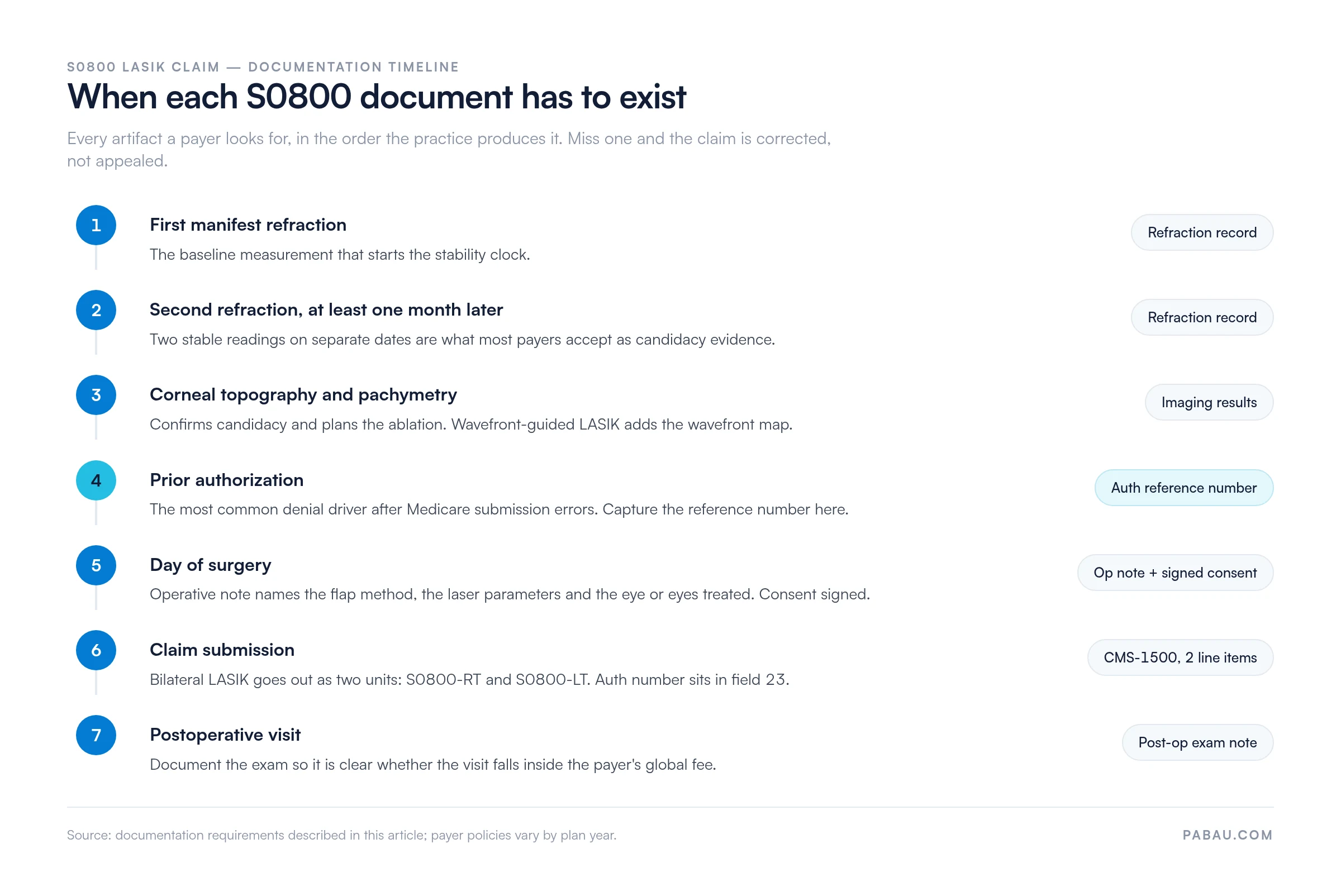
A superbill structured for ophthalmology should carry all six data points as a pre-submission checklist. The biller can then confirm completeness before the claim is generated.
S0800 can be billed alongside a same-day evaluation and management (E/M) or refraction service. That is valid where the E/M is separately identifiable and carries its own medical necessity. Without the right modifier, the claim triggers a bundling edit that denies the E/M rather than the S0800.
The AAPC HCPCS code reference is where coders can confirm S0800’s status and its related codes at the start of each year.
Build a payer-specific S0800 policy matrix in your practice management system. For each commercial and vision plan you bill, record the accepted bilateral approach and the prior auth requirements. Add the global period length and the E/M bundling rules. Review it at the start of each plan year. This single document prevents most recurring S0800 denials.
Most refractive practices build the S0800 claim in one system and submit it in another. A coder keys the two line items into a clearinghouse portal, then waits for an ERA to say what happened. The rejection arrives detached from the chart that produced it.
Pabau keeps the whole sequence on one patient record. The operative note, the signed consent, the authorization number and the claim sit together. Claims go out electronically, and each one carries its status back into the billing queue.
The practice can see which S0800 claims are still open, which came back, and what the payer said about each. Correcting a unit count then means opening the chart, rather than reconciling three systems.

Pabau submits S0800 claims electronically and tracks each one against the patient’s chart. A rejected bilateral claim is then corrected from the same record that produced it.

HCPCS Code S0800 is straightforward in concept but demanding in execution. The code itself is simple. The complexity sits in the bilateral mechanics, the payer-by-payer coverage rules, and the documentation standards that decide whether a claim gets paid.
Get the two line items and the authorization number right at submission, and most of the denial list above never reaches your aging report. Book a demo to see how Pabau handles an S0800 claim from the operative note through to the payer’s response.

Need to understand how clearinghouse edits catch HCPCS errors? What is a medical claims clearinghouse explains how electronic claim routing works before a claim reaches a payer’s adjudication system.
Want to reduce billing errors across all payer types? Revenue cycle management explained covers the full workflow from eligibility check through payment posting for outpatient surgical practices.
Want fewer corrected claims on bilateral procedures? What is a clean claim sets out the fields a payer checks first, which is where unit counts and modifiers get caught.
Building a pre-submission checklist for the clinical team? What is a superbill shows how to structure one so every code and diagnosis reaches the biller intact.
Checking LASIK benefits before you schedule? Insurance eligibility verification walks through the checks that catch a non-covered elective benefit early.
HCPCS Code S0800 covers laser in situ keratomileusis (LASIK) for correction of refractive error in one eye, billed per eye to non-Medicare commercial payers. It includes the complete primary LASIK procedure, including flap creation, laser ablation, and flap repositioning. LASIK enhancements, PRK, and any lens procedures are not covered under this code.
S0800 is billed per eye. Bilateral LASIK performed at the same session requires two units with RT (right eye) and LT (left eye) modifiers on separate line items. Submitting one unit for bilateral LASIK is the single most common S0800 billing error.
No. Medicare excludes elective refractive surgery under Chapter 16 of the CMS Medicare Benefit Policy Manual. S0800 claims submitted to Medicare will be denied. The code is designed exclusively for use with commercial payers, vision benefit plans, and certain federal programs.
Modifier RT (right eye) and LT (left eye) are the standard modifiers for S0800. One is required whenever a single eye is treated, and both appear on a bilateral claim. Modifier 50 (bilateral) is used only when a specific payer’s policy explicitly requires it instead of RT/LT line items. Eyelid modifiers E1-E4 do not apply to S0800.
No. PRK (photorefractive keratectomy) is reported with S0810, not S0800. S0800’s descriptor specifies laser in situ keratomileusis, so the flap technique is definitional. PRK has no dedicated CPT code, so where a payer demands CPT rather than S0810, the service goes out as unlisted CPT 66999.



