HCPCS Code V5095: Semi-implantable middle ear hearing prosthesis
HCPCS Code V5095: Definition and clinical descriptor HCPCS Code V5095 is the Lev...

Last Updated: Nov 25, 2026
S0341 is the HCPCS Level II code for the second or third stage of a lifestyle modification program for management of coronary artery disease. Each stage includes all supportive services.
S0341 reports the middle of a structured program that helps patients with coronary artery disease change how they eat, exercise and manage stress. One stage rate covers the supportive services in that quarter, such as supervised exercise, nutrition counseling and group support. The code sits between S0340 for the first stage and S0342 for the fourth. Medicare does not pay S0341, so practices bill it only to payers or programs whose contract recognizes the series, and many commercial payers do not. Medicare covers approved programs, such as Ornish and Pritikin, as intensive cardiac rehabilitation instead.
Let Pabau's smart automation suggest the right codes, reduce claim denials, and keep your practice compliant—effortlessly.
Automate repetitive tasks and focus on what matters most—your patients.
Reduce coding errors and ensure compliance with the latest regulations.
Clean claims, fewer denials, and faster reimbursements.
Powerful insights and reporting to help your practice thrive.
HIPAA compliant SOC 2 certified GDPR-compliant Trusted by 4,000+ clinics worldwide

HCPCS code S0341 reports the second or third quarter (stage) of a lifestyle modification program for coronary artery disease, including all supportive services.
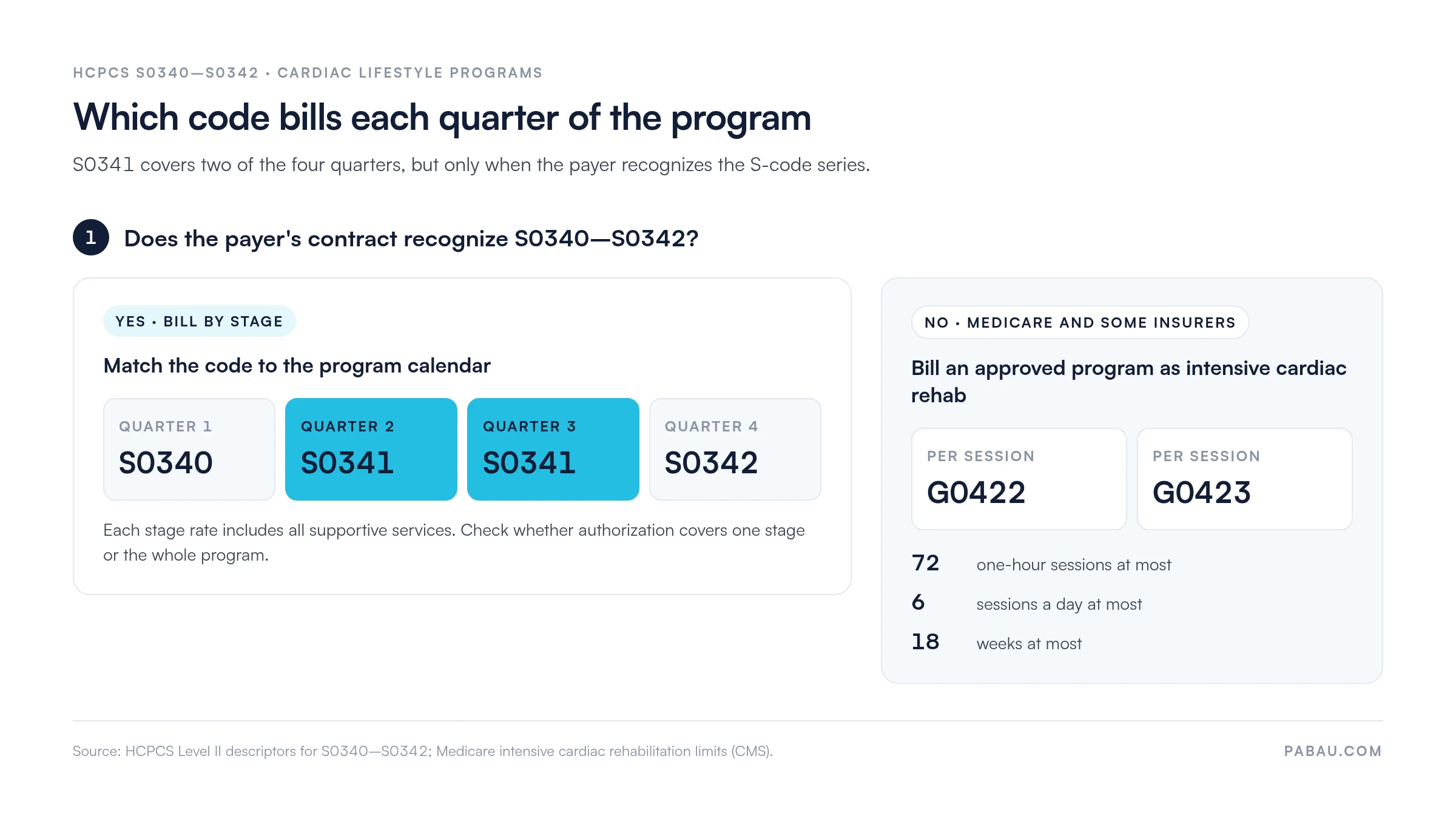
S0341 sits between S0340 for the first stage and S0342 for the fourth. The code you bill must match the patient’s place in the program calendar.
Medicare does not pay S0341 and instead covers approved programs, such as Ornish and Pritikin, as intensive cardiac rehabilitation under G0422 and G0423.
Commercial coverage varies, and some payers list S0340-S0342 as not covered, so verify benefits and authorization before each stage starts.
Documentation must show the qualifying coronary diagnosis, the stage dates, session attendance and dated progress against the treatment plan.
HCPCS code S0341 is the Level II code for the second or third quarter, or stage, of a lifestyle modification program for coronary artery disease.
The code series runs by stage, and Aetna’s intensive cardiac rehabilitation policy lists S0341 with its official descriptor alongside S0340 and S0342.
Official descriptor for S0341: “Lifestyle modification program for management of coronary artery disease, including all supportive services; second or third quarter / stage.” The code belongs to the S-code range, which the Centers for Medicare and Medicaid Services describes as temporary national codes. Private payers use S-codes to report services that have no other national code. S-codes do not always stay in use, and CMS deleted famotidine code S0028 on March 31, 2025.
Because one descriptor covers two stages, S0341 reports both the second and the third quarter. If a contract defines a unit as one stage, a full program reports S0341 once for each of those two stages. Confirm the unit definition in the contract before the first claim goes out.
The three codes share one descriptor and differ only by stage. That makes the wrong stage a frequent and avoidable coding error. The stage follows the program calendar, not the date of any single visit.
Bill S0340 for the opening stage and S0342 only once the patient reaches the fourth. When a payer does not recognize the series, the program follows a different route, shown in the diagram below.
The descriptor says “including all supportive services,” so each stage is a bundled service. Lifestyle programs for coronary artery disease, such as the Ornish and Pritikin models, combine several components every week.
Payers that accept S0341 pay one rate for the stage and expect these components inside it. Billing them again as separate line items invites a duplicate-service denial.
Several services sit close to a lifestyle program but fall outside S0341. Others overlap with it so closely that a payer will refuse to pay both.
Medicare does not pay S0341, so Medicare NCCI edits do not apply to Medicare claims. Commercial payers write their own bundling edits, so read each payer’s policy.
Medicare does not pay S0341, and its HCPCS coverage indicator is I, not payable by Medicare. Medicare pays for approved lifestyle programs through intensive cardiac rehabilitation instead. The Ornish, Pritikin and Benson-Henry programs are on the approved list. Those sessions are limited to 72 one-hour sessions, up to six a day, over as long as 18 weeks.
Before the first stage starts, ask the payer three questions. Does it recognize S0340-S0342? Does it pay approved programs as intensive cardiac rehabilitation instead? Does each stage need its own authorization? The answers set the coding path for the whole program.
Prior authorization rules for S0341 vary by payer. A lifestyle program runs for months, so payers that cover one often want approval before the program starts. Expect the request to ask for these items.
Approval for the first stage does not always carry into the second. Check whether the payer issues one authorization for the program or one per stage, and track each expiry date.
Auditors reviewing a lifestyle program claim look for proof of three facts. The patient qualified, attended the sessions and progressed through the billed stage. A documented lipid disorder can sit on the claim as a secondary diagnosis, such as E78.00 for pure hypercholesterolemia.
A record that shows attendance alone does not support a stage rate. Good billing compliance practice ties each stage claim to dated progress measures and a reviewed plan.
S0341 denials cluster around a few root causes. The table maps each one to its usual claim adjustment reason code (CARC) and the fix.
Systematic denial management for staged programs means tracking denials by payer and by stage. A pattern often shows up only at the second stage, when an authorization granted for the first one lapses.
Getting S0341 paid on the first submission takes the same five checks for every stage.
Keep a stage tracker for each enrolled patient with four columns: stage, dates, authorization and claim status. A blank column spotted before the stage ends can still be filled before the claim goes out.
Staged programs are hard to bill from a spreadsheet. The billing team has to know each patient’s current quarter, whether the authorization still covers it and what the payer paid for the last stage.
Pabau, a practice management platform, keeps the stage, the authorization and the claim on one patient record. For US practices, its cleaner claims management sends CMS-1500/837P claims through Claim.MD. It also runs eligibility checks, imports ERA remittances and handles secondary claims.
The practice records each prior authorization’s code, dates and sessions on the patient’s case, and Pabau warns when one is missing. The team then learns that an approval has lapsed before the next stage starts, not after the denial arrives.

Pabau sends US claims through Claim.MD and tracks each prior authorization’s dates and sessions on the patient’s case. Your team spots a lapsed approval before the next stage is billed.

S0341 is a middle-stage code for a program most payers handle differently. Settle the coding path with each payer before enrollment. That one answer decides whether the program bills as S-code stages or as intensive cardiac rehabilitation.
Once that path is set, the work is calendar discipline. Track the stage, keep the authorization current and record progress at each checkpoint, and the second and third stages pay as cleanly as the first. Book a demo to see how Pabau helps your team track authorizations and claims for staged cardiac programs.

Need a broader view of medical billing workflows? What is medical billing explains the full revenue cycle from encounter to payment, including where S-codes fit in the payer landscape.
Seeing recurring denials across program stages? Denial management in healthcare covers root-cause analysis and appeal workflows for reducing denial rates.
Want to strengthen your compliance documentation practices? Billing compliance requirements outlines the documentation standards auditors use when reviewing claims.
HCPCS code S0341 covers the second or third quarter, or stage, of a lifestyle modification program for coronary artery disease. The stage rate includes all supportive services, such as supervised exercise, nutrition counseling, stress management and group support. S0340 covers the first stage and S0342 the fourth.
No. S0341 carries HCPCS coverage indicator I, which means Medicare does not pay it. Medicare covers approved lifestyle programs, such as Ornish, Pritikin and Benson-Henry, as intensive cardiac rehabilitation billed with G0422 or G0423.
The three codes share one descriptor and differ only by stage. S0340 reports the first quarter, S0341 the second or third, and S0342 the fourth. Bill the code that matches the patient’s place in the program calendar.
The record needs the qualifying coronary diagnosis, a signed physician order and an individualized treatment plan. It also needs the stage dates, a session attendance log and dated progress measures. A record that shows attendance alone does not support the stage rate.
It depends on the payer. Payers that cover lifestyle programs often require approval before the program starts. Some approve the whole program while others approve one stage at a time, so check expiry dates before each stage.
Not for the same sessions. Each session belongs on one coding path: S0341, outpatient cardiac rehabilitation (93797, 93798) or intensive cardiac rehabilitation (G0422, G0423). Billing the same sessions under two paths triggers an overlap denial.
Common causes are a payer that does not recognize the S-code series, missing authorization and the wrong stage code. Overlap with cardiac rehabilitation sessions and thin documentation also cause denials. The CARC code on the remittance advice shows which one applies.