CCSD code A2720: Proximal gastric vagotomy billing guide
What is CCSD code A2720? CCSD code A2720 is the procedure billing code assigned ...

Last Updated: Oct 8, 2026
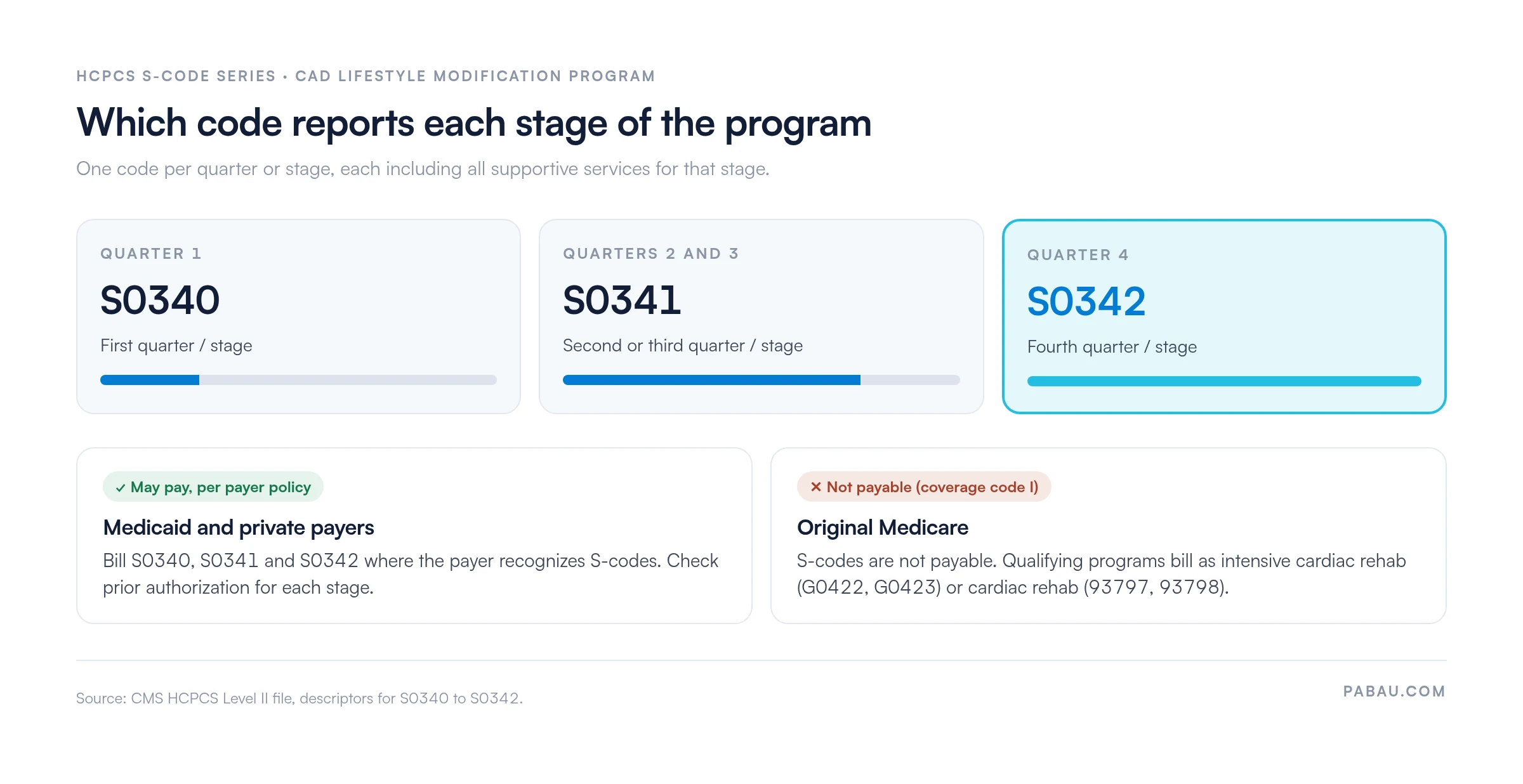
S0342 is the HCPCS Level II code for the fourth quarter or stage of a coronary artery disease lifestyle modification program. The code covers all supportive services in that stage. It closes a series that starts with S0340 for the first quarter and S0341 for the second or third.
S0342 is a temporary S-code for Medicaid programs and private payers, and Original Medicare does not pay it. Confirm the payer recognizes the code before you bill, because skipping that check is a common cause of denial.
Let Pabau's smart automation suggest the right codes, reduce claim denials, and keep your practice compliant—effortlessly.
Automate repetitive tasks and focus on what matters most—your patients.
Reduce coding errors and ensure compliance with the latest regulations.
Clean claims, fewer denials, and faster reimbursements.
Powerful insights and reporting to help your practice thrive.
HIPAA compliant SOC 2 certified GDPR-compliant Trusted by 4,000+ clinics worldwide

HCPCS Code S0342 reports the fourth quarter or stage of a coronary artery disease lifestyle modification program, including all supportive services.
S0340 covers the first quarter or stage and S0341 the second or third, so the code on the claim must match the patient’s stage.
Original Medicare does not pay S0342, but qualifying programs can bill intensive cardiac rehab (G0422, G0423) or cardiac rehab (93797, 93798).
No national rate exists for S0342, and Medicaid programs and private payers each set their own allowable and prior authorization rules.
Pabau’s claims management software lets your team enter S0342 on the claim, submit it electronically, and track its status in one place.
HCPCS Code S0342 reports the fourth quarter or stage of a structured lifestyle modification program for managing coronary artery disease. Its official descriptor reads “Lifestyle modification program for management of coronary artery disease, including all supportive services; fourth quarter / stage.” Medicaid programs and private payers may pay it, but Original Medicare does not.
S0342 is the last code in a three-code series. S0340 reports the first quarter or stage, and S0341 reports the second or third. S0342 closes the program once the patient reaches its final stage.
The diagram below shows which code covers each stage, and where Original Medicare patients go instead.
S-codes are temporary national Level II codes. They exist for private payers and Medicaid programs that need to report services without a matching CPT code. The codes appear in the CMS HCPCS file, which updates quarterly, so confirm the descriptor in the current release before you bill.
The table below captures the key classification facts for S0342.
S-series codes are not owned by the AMA and carry no CPT copyright. Anyone can download them from the HCPCS release files on CMS.gov.
S0342 covers the fourth quarter or stage of a coronary artery disease lifestyle modification program. The descriptor includes all supportive services for that stage. Payers expect one S0342 claim to represent the whole stage, rather than each session within it.
Knowing what S0342 does not cover matters just as much.
When in doubt, query the payer portal or call provider relations before the stage starts.
Medicaid programs and many commercial insurers may recognize S0342, while Original Medicare does not. Medicaid acceptance is not uniform, though. Each state Medicaid program sets its own fee schedule and code coverage, so coverage in one state says little about the next.
Run insurance eligibility verification through your practice management system or payer portal before the stage begins. For S0342, confirm two things separately. The code must be on the payer’s fee schedule, and the patient’s plan must cover the program.
Original Medicare does not pay S-series HCPCS codes, and S0342 carries coverage code I in the HCPCS file. No amount of documentation changes that. For a Medicare patient, the next step depends on whether the program qualifies as covered cardiac rehabilitation.
Before billing S0342 for a patient with a Medicare card, check whether they are enrolled in Original Medicare or a Medicare Advantage plan. Medicare Advantage plans set their own benefits, and some cover S-codes that Original Medicare does not. One call to the plan’s provider line confirms coverage before the stage starts.
No single national reimbursement rate exists for HCPCS Code S0342. CMS publishes no national fee schedule for S-series codes. Each Medicaid program and private payer sets its own allowable amount through its fee schedule or plan contract.
Reimbursement for S0342 works across three layers.
If a payer’s fee schedule is not public, the remittance advice from a paid claim is often the most reliable reference for the allowable amount. AAPC Codify and PGM Billing’s HCPCS lookup provide reference data. Neither publishes payer-specific contracted rates, so confirm those with each payer.
Prior authorization requirements for HCPCS Code S0342 vary by payer and by plan. No rule applies across every Medicaid program or commercial insurer. Check the billing compliance requirements for each payer before the fourth stage begins.
When a payer does require prior authorization (PA) for S0342, the process usually follows these steps.
Each S0342 claim needs complete supporting documentation, and missing elements are a reliable denial trigger. Building a clean claim for S0342 means assembling these elements before submission.
Because S0342 manages coronary artery disease, the diagnosis on the claim should document that condition. Codes from the I25 category for chronic ischemic heart disease, such as I25.10, are the usual fit. The diagnosis must match the medical record, and payer edits flag claims where it doesn’t match the program.
Select the most specific ICD-10-CM code available. An unspecified code may pass initial edits but can trigger a medical necessity review if the record supports a more specific one. Document the condition fully in the clinical note before you assign the code.
S0342 rarely needs a modifier. It reports a whole program stage, so laterality modifiers such as LT and RT do not apply. Modifier 59 has no code-specific role here either.
Modifier 25 marks a significant, separately identifiable evaluation and management (E/M) service on the same day. Payers rarely need it with S0342. Append it only if the payer accepts it with S-codes and a separate E/M visit is documented. A single note that blends both services won’t support it on audit.
The codes most often confused with S0342 are its own siblings in the series. A stage billed under the wrong code can pay at first and only surface in a post-payment audit. The table compares S0342 with those codes and with the Medicare alternatives.
The crosswalk between S-codes and CPT codes depends on the payer. One payer may cover the program under S0342, another under a CPT code, and a third under neither. Check each payer’s own code mapping to confirm the right code.
Most S0342 denials fall into a handful of root causes. The claim adjustment reason code (CARC) or remark code (RARC) on the remittance advice points to the corrective action. The denial codes in medical billing reference provides the full CARC and RARC mapping.
Resubmitting every denial without a correction wastes the appeal window. Structured denial management workflows match each denial to its fix before anything goes back to the payer.
Appeals for S0342 denials follow a structured process. Each payer sets its own appeal deadline, so check the window on the remittance advice and act quickly.
A year-long program means a separate claim for each stage, each with its own payer checks. Many practices track those claims in spreadsheets and payer portals, which makes a missed stage or a stalled claim easy to overlook.
Pabau, the practice management platform we build, includes claims management software that keeps that work in one place. Your team enters S0342 with the diagnosis and modifiers on the claim, submits it electronically, and follows its status from the same system.
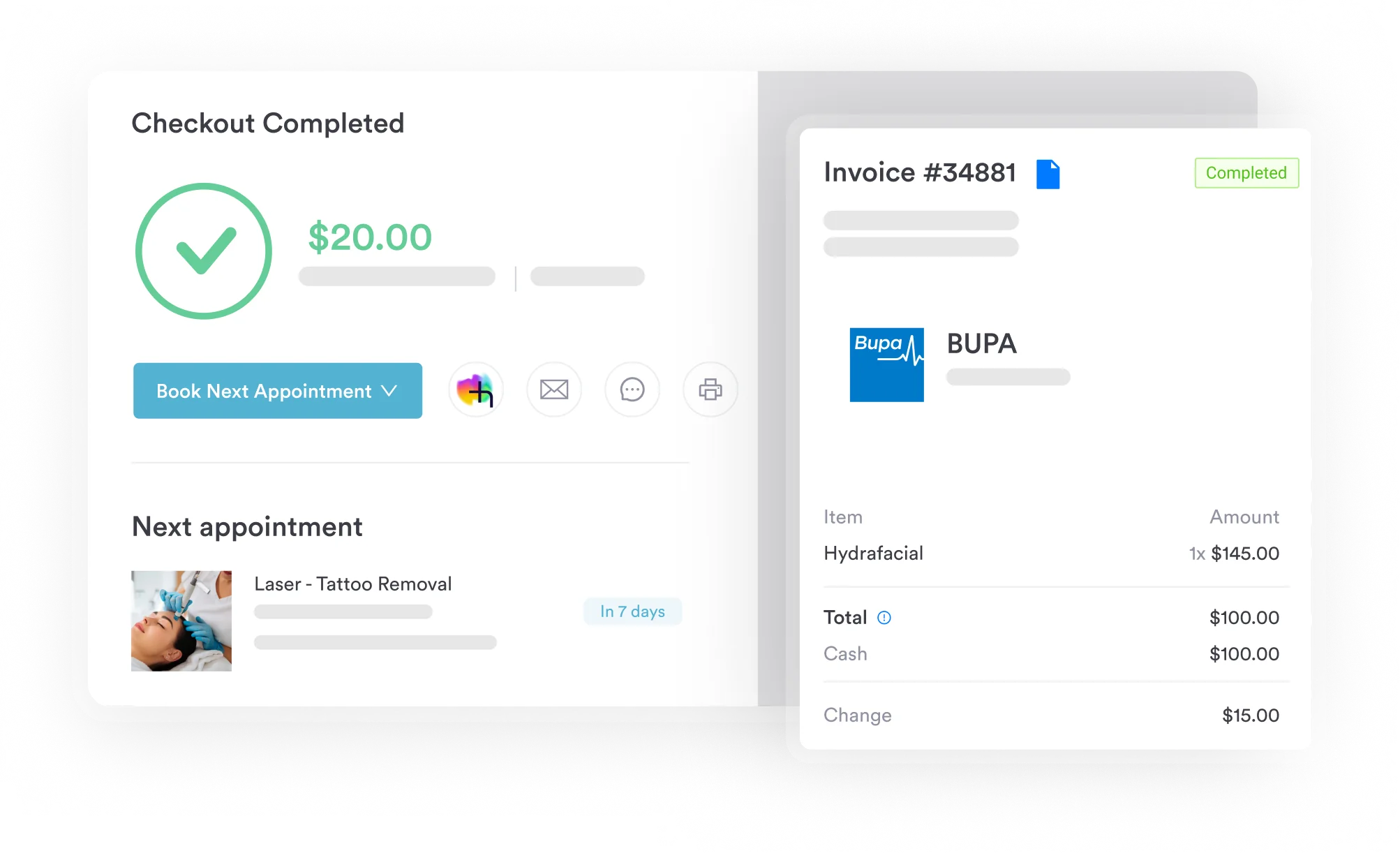
With submission and status tracking in one system, the billing team can see where each stage claim stands without chasing it payer by payer. That leaves more time for the eligibility and authorization checks each stage needs.

Pabau lets your team enter HCPCS codes, submit claims electronically, and follow each claim’s status. Stalled stage claims surface before the appeal window closes.

S0342 only pays when three conditions line up. The payer recognizes S-codes, the patient has reached the fourth stage, and the claim bills the stage rather than its sessions. Check all three before the stage begins, not after a denial arrives.
For Original Medicare patients, stop looking for a way to make S0342 pay. Decide early whether the program qualifies as cardiac rehabilitation, and bill those codes or give a voluntary notice instead. Book a demo to see how Pabau helps your team submit and track each S0342 stage claim.

Billing the first stage of the program? HCPCS Code S0340 covers the first quarter or stage of the same coronary artery disease lifestyle program.
Need a structured approach to claim denials? Denial management in healthcare covers the end-to-end process for identifying, appealing, and preventing billing denials.
Want to understand how electronic remittances work? Electronic remittance advice explains how to read ERA transactions and map CARC and RARC codes to corrective actions.
Looking to tighten your overall billing compliance? Billing compliance requirements outlines the regulatory framework practices follow when submitting HCPCS and CPT claims.
Want fewer claims bounced back on the first pass? What makes a clean claim lists the elements payers check before they accept a claim for processing.
HCPCS Code S0342 is a temporary Level II code for the fourth quarter or stage of a coronary artery disease lifestyle modification program. It includes all supportive services. It follows S0340 for the first stage and S0341 for the second or third. The code appears in the CMS HCPCS file, but Original Medicare does not pay it.
No. Original Medicare does not pay S-series HCPCS codes, and S0342 carries coverage code I in the HCPCS file. Qualifying programs can bill intensive cardiac rehabilitation under G0422 or G0423, or cardiac rehabilitation under 93797 or 93798. Medicare Advantage plans set their own benefits, so verify with the specific plan.
No single national rate exists for S0342. Each state Medicaid program and each private payer sets its own allowable amount. Check the state Medicaid fee schedule, your MCO contract, or your commercial payer contract. Remittance advice from paid claims is often the most practical reference.
Only if the payer accepts modifier 25 with S-codes and a separate evaluation and management service is documented on the same day. Payers rarely need it with S0342. A single note that blends both services will not withstand payer review.