CCSD Code C7920: Pars plana vitrectomy with tamponade, buckling and retinopexy
CCSD Code C7920: Definition and official descriptor CCSD Code C7920 is the CCSD ...

Last Updated: Nov 11, 2026
S0320 is the HCPCS Level II code for telephone calls by a registered nurse to a disease management program member for monitoring purposes, per month. One unit covers one month of monitoring calls.
CMS lists S0320 as not payable by Medicare. Commercial insurers and some Medicaid plans that contract for disease management set their own coverage, rate and documentation rules.
Let Pabau's smart automation suggest the right codes, reduce claim denials, and keep your practice compliant—effortlessly.
Automate repetitive tasks and focus on what matters most—your patients.
Reduce coding errors and ensure compliance with the latest regulations.
Clean claims, fewer denials, and faster reimbursements.
Powerful insights and reporting to help your practice thrive.
HIPAA compliant SOC 2 certified GDPR-compliant Trusted by 4,000+ clinics worldwide

HCPCS Code S0320 reports telephone calls by a registered nurse to a disease management program member for monitoring, billed as one unit per month.
S0320 is a temporary national S-code, added to the HCPCS file on October 1, 2002, and CMS lists it as not payable by Medicare.
Commercial insurers and some Medicaid plans that contract for disease management decide whether S0320 pays, at what rate, and with what proof.
A clean S0320 claim rests on proof of program enrollment, an RN call log for the month, and a diagnosis for the condition being managed.
S0320 is not a drug code, since oral tamoxifen 10 mg is S0187 and no code S0321 exists in the HCPCS file.
HCPCS Code S0320 is the Level II code for telephone calls by a registered nurse to a disease management program member for monitoring. Its unit is one month. It belongs to the S-series, the temporary national codes that private insurers and Medicaid agencies use where no permanent code fits.
S0320 describes a nursing service. A registered nurse calls an enrolled program member to check on a chronic condition, and the practice reports one unit for that month of calls.
S0320 is sometimes confused with the drug S-codes around it. Oral tamoxifen citrate, 10 mg, is S0187, and there is no code S0321. The next code after S0320 in the HCPCS file is S0340.
The table below is read from the CMS alpha-numeric HCPCS file, October 2026 release. Check the current HCPCS quarterly update before you rely on any field, because CMS can revise S-codes each quarter.
S0320 captures nurse-led telephone monitoring inside a structured disease management program. Four parts of the descriptor decide whether a month of calls fits.
Other program services have codes of their own. The initial program assessment is S0315, a reassessment is S0316, and a per diem program charge is S0317. Physician telephone and care management services are reported with CPT codes, not S0320.
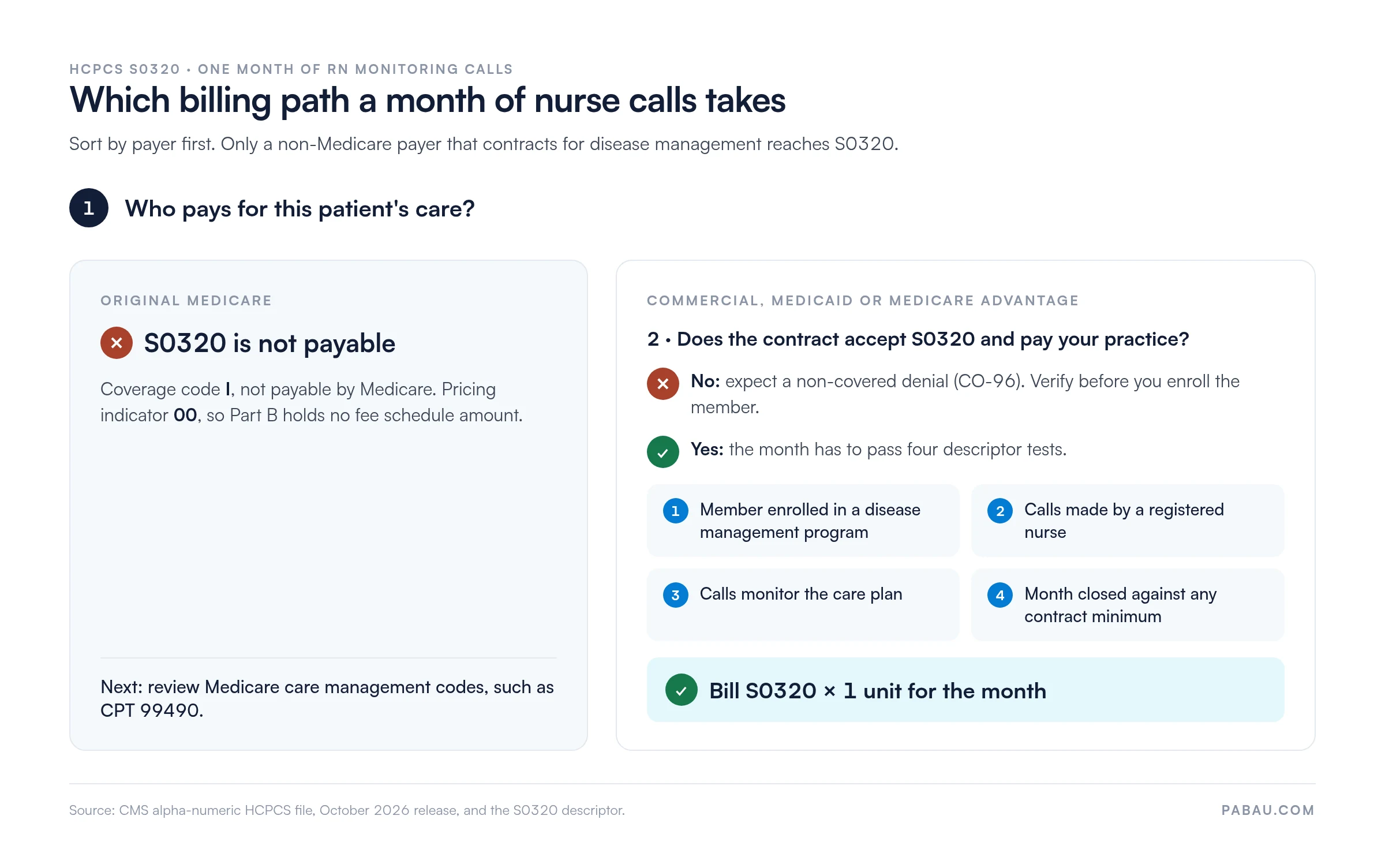
CMS assigns S0320 coverage code I, which the HCPCS record layout defines as not payable by Medicare. S-codes exist for private payers and Medicaid agencies, and Medicare contractors do not price them.
The pricing indicator 00 says the same thing from the payment side. Part B holds no fee schedule amount for S0320, so there is no Medicare allowed amount and no 80/20 split.
For an Original Medicare patient, comparable work is reported through Medicare care management codes. Chronic care management code 99490, for example, covers clinical staff time for a patient with two or more chronic conditions in a calendar month. It has its own consent, care plan and time rules, so read them before you switch codes.
Payers that accept S0320 write their own policy. Coverage, rate and documentation rules come from the contract, not from a national fee schedule.
Ask four questions at verification. Does the plan accept S0320, which providers does it pay, what is the monthly rate, and does prior authorization apply? Record the answers and the call reference number on the patient account.
Payers that pay S0320 usually audit two facts. The member was enrolled in the program, and a registered nurse made monitoring calls that month. Keep proof of both in the record.
An attempted call that never reaches the member is not monitoring. Log it anyway, but check the contract before you count it toward the month.
The diagnosis on an S0320 claim is the chronic condition the program manages. Code it to the highest specificity the record supports. The unspecified codes below illustrate common programs and are not a payer coverage list.
Confirm current code status in the CDC/NCHS ICD-10-CM browser tool. Replace an unspecified code whenever the record names the type.
Sort each month by payer before anyone builds a claim. The diagram shows where Original Medicare drops out and which four tests the remaining payers check.
S0320 sits among the S-codes for disease management and care coordination. Each code below is active in the October 2026 HCPCS file. For codes outside this range, search the HCPCS code library.
Most S0320 denials trace back to the payer, the contract or the unit count. The table maps each signal to its cause and fix.
Set S0320 up as a month-end charge, not a per-call charge. Close each member’s month, count the completed RN calls, and bill one unit. A charge line per call is the fastest route to a units or duplicate denial.
Disease management billing breaks down when the call log, the enrollment record and the claim live in different places. A nurse logs calls in a spreadsheet, and the biller rebuilds the month from memory.
Pabau, the practice management platform we build, keeps all three on one patient record. Enrollment forms and the care plan sit in Pabau’s digital forms on the patient record. The nurse logs each call as a treatment note on the same record. Vitals and weight trends sit there too, so the nurse sees the last reading before the next call.
For US practices, Pabau’s claims management software submits CMS-1500 claims through Claim.MD and posts ERA remittances. Prior authorization codes, dates and sessions are tracked on the case, with a warning when one is missing.

Pabau holds the enrollment forms, care plan and call notes on one patient record. Your team can track prior authorizations and submit the monthly claim from the same system.

S0320 pays only where a contract says it does. The descriptor is narrow, covering an enrolled member, a registered nurse, monitoring calls and one unit a month. The payer decides the rest.
So the work comes before the first call. Confirm the plan accepts S0320 and pays your practice, then build the call log the payer will audit. Keep Original Medicare patients on Medicare care management codes instead.
Book a demo to see how Pabau keeps disease management call notes and monthly claims on one patient record.

Billing the daily program rate instead? HCPCS Code S0317 covers the disease management per diem and how it pairs with S0315 and S0316.
Reassessing a member mid-program? HCPCS Code S0316 covers the disease management follow-up and reassessment.
Need a framework for reducing claim rejections across your practice? Denial management in healthcare covers the workflow from root-cause analysis to appeal timelines.
Looking for documentation controls your team can follow consistently? Medical billing compliance outlines the controls that keep S-code and CPT claims clean across payer types.
HCPCS Code S0320 is a Level II S-code for telephone calls by a registered nurse to a disease management program member for monitoring. It is billed per month, and one unit covers one month of calls. CMS added the code to the HCPCS file on October 1, 2002.
No. CMS assigns S0320 coverage code I, not payable by Medicare, and pricing indicator 00. Original Medicare does not pay S-codes. Medicare care management services use CPT codes such as 99490 instead.
One. The descriptor is per month, so one unit covers the month however many monitoring calls the nurse made. Check the payer contract for any minimum number of calls.
No. S0320 is a nurse telephone monitoring service. Oral tamoxifen citrate 10 mg is S0187, and there is no code S0321 in the HCPCS file.
Keep proof of program enrollment and the care plan. Log each RN call with the date, duration, the nurse’s credential and what was discussed. Payers also look for a monthly summary of completed calls.
Some commercial insurers, Medicaid programs and Medicare Advantage plans accept S0320 under disease management contracts. Each sets its own rate and rules, so verify the plan before the first billed month.