CPT code 63081: Vertebral corpectomy, cervical spine
CPT code 63081: official descriptor and procedure overview CPT code 63081 descri...

Last Updated: Oct 6, 2026
S0317 is the HCPCS Level II code for disease management program; per diem. It bills each day a patient actively takes part in a disease management program.
Medicare does not reimburse S-codes, so S0317 is billed to commercial payers and Medicaid managed care plans instead. It sits beside S0315, the initial assessment code, and S0316, the follow-up reassessment code. Common billing errors on S0317 are the wrong payer, missing enrollment proof, or a whole billing period sent as one unit.
Let Pabau's smart automation suggest the right codes, reduce claim denials, and keep your practice compliant—effortlessly.
Automate repetitive tasks and focus on what matters most—your patients.
Reduce coding errors and ensure compliance with the latest regulations.
Clean claims, fewer denials, and faster reimbursements.
Powerful insights and reporting to help your practice thrive.
HIPAA compliant SOC 2 certified GDPR-compliant Trusted by 4,000+ clinics worldwide

S0317 belongs to the HCPCS Level II S-code series, which commercial payers and Medicaid programs use instead of Medicare.
Medicare does not reimburse HCPCS S-codes, including S0317, so a claim sent to Medicare fee-for-service is denied.
Each billable unit equals one calendar day of disease management program participation, not a per-episode or per-visit unit.
S0317 sits in a three-code series: S0315 covers the initial assessment, S0316 the follow-up reassessment, and S0317 each program day.
Pabau’s claims management software tracks the status of every S0317 claim from submission to payment.
HCPCS Code S0317 carries the official descriptor “Disease management program; per diem” as maintained in the CMS HCPCS Level II code set. The S-prefix marks it as one of the S-codes. S-codes are temporary national codes maintained by the HCPCS National Panel, used by commercial payers and Medicaid programs rather than Medicare. That is why S0317 has no Medicare fee schedule entry.
The quick-reference table below captures the core billing attributes coders need before submitting a claim.
A disease management program billable under S0317 is a structured, coordinated care model that helps patients with chronic conditions manage their illness between provider visits. The patient stays enrolled for an ongoing period, and the payer funds the daily monitoring, education, and coordination the program delivers between visits.
Services typically bundled into an S0317 program include the following.
Qualifying chronic conditions vary by payer contract. They commonly include type 2 diabetes, chronic obstructive pulmonary disease (COPD), congestive heart failure, hypertension, asthma, coronary artery disease, and chronic kidney disease. Payers generally require a confirmed diagnosis of a qualifying condition before enrollment. That confirmation must appear in the supporting documentation at the time of claim submission.
S0317 does not cover acute care episodes or wellness coaching for patients without a documented chronic condition. Nor does it cover individual clinical visits, which are billed separately under CPT codes. Bundling an acute-care visit into an S0317 per diem claim is a frequent cause of audit findings.
S0315, S0316, and S0317 describe different stages of one disease management program, so one enrolled patient can generate claims under all three. S0315 covers the initial assessment that starts the program. S0316 covers follow-up or reassessment, and S0317 covers each day of active participation.
The practical rule: match each service to the stage its descriptor names, then check which of the three codes the payer contract reimburses. A contract may pay for one, two, or all three. Billing daily participation under S0315 or S0316, or an assessment under S0317, earns a denial even when the program and its documentation are sound.
Medicare does not cover HCPCS Code S0317 or any other S-code. The exclusion applies to the whole S-code series, whatever the clinical service. Because S-codes are temporary codes for non-Medicare payers, no Medicare Administrative Contractor (MAC) will process an S-code claim. Submitting S0317 to Medicare fee-for-service wastes a claim cycle and delays the correct payer submission.
The following payer types typically accept S0317, though coverage terms vary by plan and state.
Prior authorization is required by many payers for S0317. The authorization request typically asks for the patient’s confirmed chronic condition diagnosis and a description of the program. It also asks for the expected program duration and the credentials of the clinical staff delivering it. Submitting a claim without required prior authorization is a leading cause of S0317 denials on commercial plans. Check payer-specific requirements before the patient’s first program day, not after the billing period closes.
Verify S0317 coverage before enrolling each patient. Call the payer’s provider line and confirm which S0315-S0317 codes the contract reimburses. Ask specifically about prior authorization requirements, and document the call with a reference number. A five-minute call at enrollment prevents a denial that takes weeks to appeal.
Disease management programs generate more documentation than a standard clinical visit. Per diem billing requires evidence that the patient took part in the program on each billed day. Because every billed day is its own unit, a payer can ask for proof of activity on any one of them.
Strong medical billing compliance for S0317 requires the following records to be in place before claim submission.
There is no CMS national fee schedule for HCPCS Code S0317. Because Medicare excludes S-codes entirely, CMS does not publish a Medicare payment rate for S0317 in its Physician Fee Schedule lookup tool. Reimbursement is set entirely by individual payer contracts and, for Medicaid, by each state’s Medicaid fee schedule publication.
To find the reimbursement rate that applies to your claims, use the following approach.
Never quote a specific dollar figure to a patient or a payer based on a third-party rate estimate without confirming the contracted rate directly. Set billed charges at reasonable market rates. On codes with no published fee schedule, inflated charges are a common source of balance billing disputes.
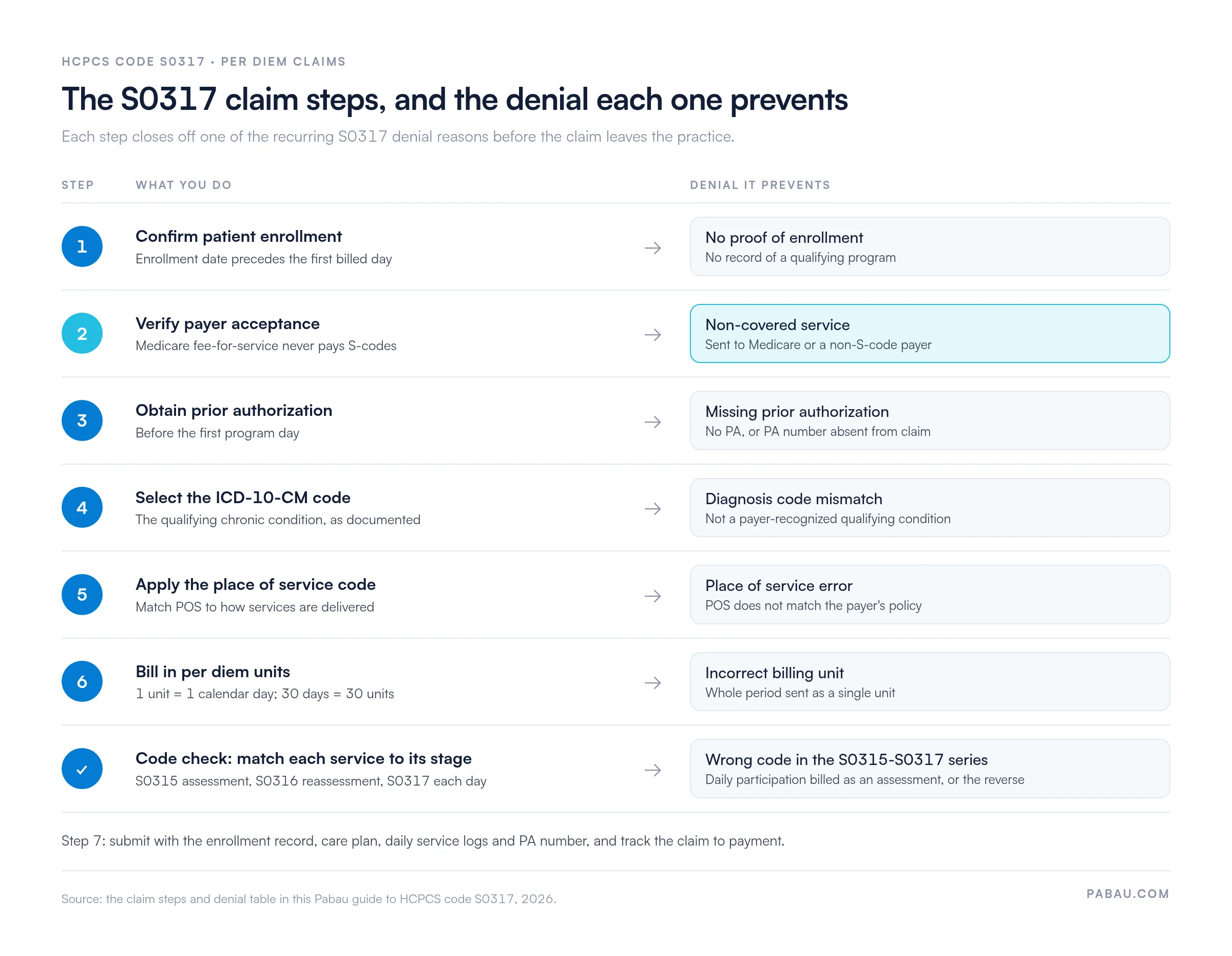
A clean S0317 claim follows a specific preparation sequence. Skipping any step is where denials enter the cycle, and the chart below pairs each step with the denial it prevents.
The ICD-10-CM diagnosis code paired with S0317 must reflect the qualifying chronic condition that triggered program enrollment. The table below covers the conditions most frequently managed under disease management programs and their corresponding ICD-10 codes.
Select the most specific ICD-10 code available based on the treating provider’s documentation. Unspecified codes (such as E11.9 or I50.9) are acceptable only when specificity is not documented. Payers may still request more documentation before paying disease management claims that carry them.
S0317 denials cluster around a small set of recurring errors. Understanding which denial codes correspond to which root cause makes appeals faster and prevents the same error on future claims.
Good denial management on S0317 means tracking which reason codes appear most often. Trace each one back to the workflow step where the error enters the claim. A pattern of “missing PA” denials points to an enrollment intake gap. A pattern of “non-covered service” points to a payer verification gap at the point of enrollment.
For a full reference on the claim adjustment reason codes behind S0317 denials, see the guide to medical billing denial codes. It covers CARC codes and how to read remittance advice for each denial type.
Run a monthly S0317 denial audit: pull all denied claims for the code, group by CARC/RARC code, and identify the top two denial reasons. Address the root cause in your intake workflow rather than managing each appeal individually. Fixing the intake step stops the same denial from recurring on next month’s claims.
A disease management program produces a long run of claims for each enrolled patient. Many practices track them in a spreadsheet beside the practice system, noting the payer, the billing period, and the days billed. That list drifts once a claim is resubmitted or a second biller works the queue.
Pabau’s claims management software puts every claim on one dashboard, with a live status of pending, submitted, processing, paid, or error. Insurer and policy details sit on the patient record, so each invoice routes to the correct payer. Filtering by insurer, date, or invoice ID finds an earlier S0315 or S0317 submission in seconds.
Before a claim goes out, Pabau runs validation checks in the background, and the Send button stays disabled until the details insurers require are present. In the US, claims go electronically to payers through Pabau’s Claim.MD connection, alongside eligibility checks and remittance posting. Your billers see at a glance which program days are paid and which need follow-up.

Pabau’s claims management software shows the live status of every S0317 claim on one dashboard. It routes each invoice to the correct insurer and holds submission until the required details are present.

HCPCS Code S0317 is a reimbursable code for disease management programs under commercial and Medicaid managed care payers. It demands more upfront workflow than a standard procedure code. Per diem billing, the Medicare exclusion, and prior authorization on most commercial plans all create points where a claim can fail before submission.
Getting S0317 right starts at enrollment. Verify the payer, confirm which S0315-S0317 codes the contract reimburses, obtain prior authorization, and lock in the diagnosis code the documentation supports. From there, the daily service log and care plan documentation carry the claim. Pabau’s claims management software tracks every claim’s status from submission to payment, so long program enrollments need less manual follow-up. Book a demo to see every S0317 claim on one dashboard, from first program day to payment.

Need a reference for reading remittance advice on denied S0317 claims? Electronic remittance advice explained covers how to interpret ERA files and match denial codes to their root causes.
Want to understand how disease management billing fits into the broader revenue cycle? Revenue cycle management explained walks through how each billing step connects from patient intake to payment posting.
Preparing for a payer audit on your disease management program claims? Medical billing compliance guidance covers documentation standards and audit-readiness for HCPCS claims.
HCPCS Code S0317 is a Level II alphanumeric code for a disease management program billed on a per diem basis. Each unit represents one calendar day of a patient’s active participation in a structured chronic-condition management program. It belongs to the HCPCS S-code series used by commercial payers and Medicaid managed care organizations, not Medicare.
No. Medicare does not reimburse HCPCS S-codes, including S0317. The S-code series was created specifically for non-Medicare payers, so submitting S0317 to Medicare fee-for-service results in an automatic denial. Patients with Medicare Advantage (Part C) may have coverage depending on their specific plan, which should be verified directly with the plan before billing.
The three codes describe different stages of one disease management program. S0315 covers the initial assessment and initiation of the program. S0316 covers follow-up or reassessment, and S0317 covers each calendar day of active participation. A payer contract may reimburse any or all of them, so confirm which codes it lists before billing.
Potentially, but payers vary on this. Some commercial plans allow S0317 alongside chronic care management CPT codes (such as 99490) if the services are distinct and not duplicative. Others consider them mutually exclusive. Review the payer’s medical policy before billing both codes in the same period. Document clearly that each service is separate and clinically justified.