HCPCS code T2043: Hospice continuous home care billing guide
HCPCS code T2043 pays for hospice crisis care by the hour HCPCS code T2043 is th...

Last Updated: Oct 7, 2026
S0315 is the HCPCS Level II code for disease management program; initial assessment and initiation of the program.
Medicare does not pay it. S-codes sit outside the CMS Medicare fee schedule, so submitting S0315 to Medicare produces an automatic denial. Reimbursement comes from state Medicaid programs and commercial payers instead. The code covers the initiation phase only, and most payers require it on file before any follow-on program service. S0316 and S0317 both sit behind it in that sequence.
Let Pabau's smart automation suggest the right codes, reduce claim denials, and keep your practice compliant—effortlessly.
Automate repetitive tasks and focus on what matters most—your patients.
Reduce coding errors and ensure compliance with the latest regulations.
Clean claims, fewer denials, and faster reimbursements.
Powerful insights and reporting to help your practice thrive.
HIPAA compliant SOC 2 certified GDPR-compliant Trusted by 4,000+ clinics worldwide

HCPCS Code S0315 covers the initial assessment that starts a disease management program.
Medicaid and commercial payers reimburse S0315, while Medicare excludes it with no appeal pathway.
Bill S0315 once per program episode, and always before S0316 or S0317 reach a claim.
Rates vary by payer and by state Medicaid program, so verify the current rate with each payer.
Pabau’s claims management software shows every claim’s live status and holds submission until required details are present.
HCPCS Code S0315 is a temporary S-code maintained by the Centers for Medicare and Medicaid Services (CMS). It describes the initial assessment and program initiation phase of a disease management program.
S-codes belong to HCPCS Level II, a code set that runs parallel to CPT. It covers services, supplies, and programs the CPT catalog does not capture. Medicare does not recognize S-codes, so the payer on the claim decides whether S0315 can be submitted at all.
The official CMS descriptor for S0315 is: Disease management program; initial assessment and initiation of the program.
CMS designates S-codes as temporary codes assigned outside the AMA’s CPT process. They give Medicaid and private payers a way to reimburse services that CPT does not yet classify.
S0315 captures the initiation phase only. That is the first comprehensive encounter, where a patient is assessed and formally enrolled in a disease management program.
No single national fee schedule governs S0315 reimbursement. CMS publishes no Medicare Physician Fee Schedule rate for the code, because Medicare excludes every S-code. Individual payer contracts set the rate, and for Medicaid each state runs its own rate-setting process.
You can use the CMS Physician Fee Schedule lookup tool to check how a payer aligns with Medicare rates on other services. Do not expect an S0315 entry there.
For commercial contracts, the rate is negotiated as part of the overall provider agreement. Medicaid rates follow state-specific schedules that are updated annually and vary widely between states.
Always verify current rates directly with each payer. Publishing a single dollar figure for S0315 would mislead, given how far rates move between programs and states.
Medicare does not cover S0315. CMS policy excludes every HCPCS S-code from Medicare payment, and neither documentation nor an appeal will change that.
A claim submitted to Medicare comes back denied as CARC 96, non-covered charges, or CARC 204. CARC 204 reports a service that is not covered under the patient’s plan. The five payer types below each send an S0315 claim somewhere different. Confirm coverage before the claim is built.
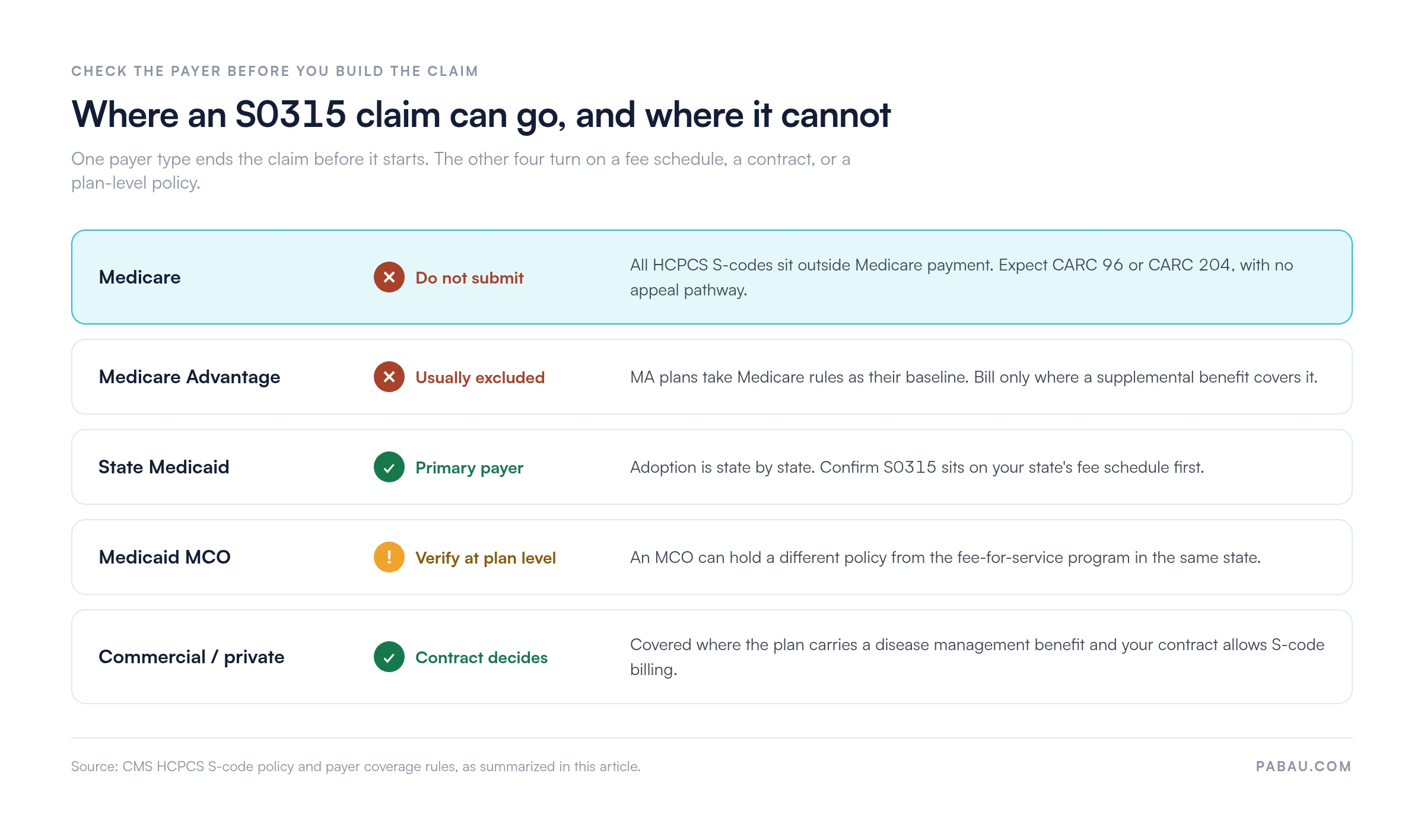
The most common S0315 denial starts with a Medicare patient enrolled in a disease management program. The claim goes out before anyone checks the payer type. Flagging payer type at intake stops it.
S0315 is billed once per disease management program episode. It represents the initial assessment and program initiation, so it is not an ongoing per-encounter service. Billing it more than once per episode is a common audit trigger.
S0316 and S0317 handle subsequent encounters. Using S0315 for a follow-up visit produces a denial, or an overpayment demand on audit. Practice management software like Pabau keeps that history visible.
Pabau’s medical claims management software shows the live status of every submitted claim, so a biller can confirm the initiation claim was accepted.
Modifier applicability for HCPCS S-codes is payer-specific, so verify it against each payer’s current billing guidelines. The table below covers the modifiers most often referenced alongside S0315 by Medicaid and commercial payer policies.
Strong documentation is the main defense against post-payment audits on S0315 claims. Payers treat disease management as a higher-scrutiny benefit, so they often request records. They want proof that the initial assessment was substantive. The record must also show the patient joined a structured program, rather than receiving counseling at a routine visit.
Keeping this documentation in a structured format, separate from general visit notes, makes a payer record request far quicker to answer. Nobody has to assemble the response from several systems.
S0315 is the first code in the S031x disease management family. Each code covers a distinct phase of program delivery, and they are not interchangeable.
Submitting S0316 before S0315 has been billed creates a sequencing error, and so does using S0315 for a follow-up encounter. Either one triggers a denial or overpayment recovery.
S0316 and S0317 both require S0315 to have been billed first, for the same patient and program episode. Some payers enforce this as an automated edit.
A claim for S0316 with no prior S0315 on file returns a denial. Correcting it means submitting the initiation claim first. Confirm with each payer whether they enforce sequencing at the claim level, or retrospectively on audit.
Before billing S0316 or S0317 for a patient, run a claim history check to confirm S0315 was accepted for the same program episode. Payers that enforce sequencing edits deny S0316 when S0315 was never received. Correcting it means resubmitting S0315 first, which adds weeks to your payment timeline.
Every S0315 claim needs at least one ICD-10-CM diagnosis code to establish medical necessity. Disease management programs are authorized for patients with chronic, high-cost conditions that need structured ongoing management. The diagnosis on the claim should name the condition the patient is enrolling to manage.
A separate acute problem from the same visit does not support the claim. Pairing S0315 with an incidental diagnosis is a common audit finding that draws repayment demands.
The codes below are among those most often paired with disease management program claims. Each reflects a chronic condition that typically qualifies a patient for a program.
The AAPC HCPCS code lookup carries pairing guidance for your payer’s disease management benefit. The ICD-10-CM code set explains how these diagnosis codes are organized and updated.
Code specificity matters. Where a more specific ICD-10 code exists, payers increasingly expect it to support medical necessity. E11.65, type 2 diabetes with hyperglycemia, carries more weight than E11.9. Submitting an unspecified code when the record supports a specific one is what auditors flag first.
Most practices track S-code claims in a spreadsheet beside the practice system. Someone notes which patient was enrolled, which payer was billed, and when the initiation claim went out. The list drifts as soon as a claim is resubmitted, or a second biller works the queue.
Pabau’s claims management software puts every claim on one dashboard, with a live status of pending, submitted, processing, paid, or error. Insurer and policy details sit on the patient record, so each invoice routes to the correct payer. Filtering by insurer, date, or invoice ID finds an earlier S0315 submission in seconds.
Before a claim goes out, Pabau runs validation checks in the background. The Send button stays disabled until the details insurers require are present. In the US, claims go electronically to thousands of payers through Pabau’s Claim.MD connection, alongside eligibility checks and remittance posting.
That gives a biller one place to answer the question S0316 and S0317 depend on. Was the initiation claim accepted, and when?

Pabau’s claims management software shows the live status of every claim on one dashboard. It routes each invoice to the correct insurer and holds submission until the required details are present.

The most expensive S0315 mistake happens before a word of documentation is written. Submitting to Medicare wastes the claim, and confirming payer type at the eligibility check prevents it.
After that, the billing logic is steady. Bill S0315 once per program episode. Document the initial assessment in enough detail to survive a payer audit. Sequence S0316 and S0317 behind it, and check each payer’s coverage and modifier rules before the claim is built.
Keeping that history in one place is what stops the second claim going out before the first one clears. Book a demo to see how Pabau tracks S0315 and the rest of the S031x family through to payment.

Need to understand how claims reach payers? Medical claims clearinghouse guide explains how electronic claims are routed, validated, and paid across payer networks.
Dealing with HCPCS code denials? Denial codes in medical billing covers the most common denial reason codes and how to resolve each one before refiling.
Checking coverage before the visit? Insurance eligibility verification sets out how to confirm a patient’s payer and plan before the claim is built.
Building the claim from the visit record? Superbill explains what belongs on one and how it feeds a clean claim.
HCPCS Code S0315 bills the initial assessment and formal enrollment of a patient into a disease management program. It covers the first structured encounter, where the patient’s condition is evaluated and the program begins. Bill it once per program episode. Medicaid and commercial payers accept it, and Medicare does not.
No. Medicare does not cover HCPCS Code S0315, or any other S-code. CMS policy excludes every HCPCS S-code from Medicare payment. A claim sent to Medicare returns denied as CARC 96 or CARC 204, with no appeal pathway.
S0315 covers the initial assessment and program initiation. It is billed once, when a patient first enrolls in a disease management program. S0316 covers the follow-up and reassessment encounters that come after. S0315 must appear on the patient’s billing history before S0316 can be submitted for the same episode.
GT or 95 apply when the initial assessment is conducted by telehealth. Modifier 59 applies when the service shares a date with another procedure and bundling edits kick in. State Medicaid-assigned modifiers (U1-U9, UA-UD) apply where a state program requires a program-type identifier. Verify modifier requirements with the payer before appending any of them.
You need the qualifying diagnosis with an active ICD-10-CM code, and a structured initial assessment note written for disease management enrollment. You also need signed patient consent or a program agreement, plus the prior authorization number where one applies. The rendering provider must be credentialed with the payer for disease management services. A generic visit note does not satisfy payer documentation standards.
Medicaid coverage for S0315 is state-specific. Most states running structured disease management programs have adopted S0315 into their fee schedules, but not all of them have. Managed Medicaid plans (MCOs) may also hold coverage policies separate from fee-for-service Medicaid in the same state. Verify coverage with your state Medicaid program or MCO before billing.