

CCSD code G5100: Bypass of duodenum billing guide
CCSD code G5100 bills a bypass that leaves the duodenum in place CCSD code G5100...

Last Updated: Oct 16, 2026
S0221 is the HCPCS Level II code for medical conference by a physician with interdisciplinary team of health professionals or representatives of community agencies to coordinate activities of patient care (patient is present); approximately 60 minutes.
S-codes were created to allow Medicaid programs and commercial payers to report services not captured in the main HCPCS Level I (CPT) system.
Three elements must all be true before you can report S0221:
Fall short on any one of the three and S0221 is the wrong code for the encounter.
Let Pabau's smart automation suggest the right codes, reduce claim denials, and keep your practice compliant—effortlessly.
Automate repetitive tasks and focus on what matters most—your patients.
Reduce coding errors and ensure compliance with the latest regulations.
Clean claims, fewer denials, and faster reimbursements.
Powerful insights and reporting to help your practice thrive.
HIPAA compliant SOC 2 certified GDPR-compliant Trusted by 4,000+ clinics worldwide

HCPCS code S0221 covers a physician-led medical conference with interdisciplinary team members, patient present, lasting 60 minutes.
Medicare reimburses no HCPCS S-code, including S0221. Medicaid and commercial payers may cover it, at rates that vary by state and plan.
S0221 differs from S0220 only in duration. Confirm the conference ran the full 60 minutes before you bill S0221.
Practice management software like Pabau flags non-covered payers and structures conference documentation for clean claim submission.
The table below summarizes the key technical attributes of HCPCS code S0221 as published by CMS.
Medicare does not reimburse HCPCS code S0221 or any other S-code. The exclusion holds in every locality and every clinical context, because CMS keeps the whole S-code series out of Medicare payment by design. Submitting S0221 to a Medicare contractor will result in an automatic denial.
Always verify the payer type before submitting this code, and build that check into your billing workflow. Confirming coverage at the point of scheduling prevents these denials entirely.
Medicaid programs and commercial insurers are the intended payers for this code. Coverage is not universal among them either. State Medicaid programs each set their own policies, and commercial plan coverage depends on the individual plan’s benefit design. The table below outlines the general payer landscape.
Practices with a mixed payer population should flag S0221 encounters at scheduling, not at claim submission. A payer-eligibility checkpoint inside the care coordination workflow catches the Medicare cases before a claim leaves the building. That same checkpoint applies to HCPCS code S0281, the S-code for maintaining a medical home care plan.
There is no single national rate for S0221. Because Medicare excludes S-codes, CMS does not publish a Physician Fee Schedule rate for this code. Reimbursement depends entirely on the payer and, for Medicaid, on the state. Commercial rates usually track the plan’s own valuation of a 60-minute physician-led care conference, in line with comparable time-based E/M or care management services.
For state Medicaid programs that cover S0221, rates are published in each state’s fee schedule lookup resources. Rates vary significantly. States with strong care coordination benefits tend to assign higher rates, while others limit coverage to specific populations such as complex chronic care patients. Pull the current year’s state fee schedule from your Medicaid agency portal before you quote expected reimbursement internally.
Before you schedule a 60-minute interdisciplinary conference for a Medicaid patient, check the current benefit year. Confirm that your state Medicaid program still lists S0221 as a covered service. Coverage can change with state budget cycles, and a retroactive denial on a 60-minute conference is costly to appeal.
Modifiers signal additional information about how a service was delivered. For HCPCS code S0221, modifier use follows the rules of the billing payer. Not all commercial plans or Medicaid programs require modifiers on S-codes, but several are commonly appended when the clinical circumstances call for it.
Always review the payer’s own HCPCS modifier policy before appending any modifier. An incorrect modifier can trigger a denial as easily as a missing one. The NLM HCPCS Level II API gives you programmatic access to current code and modifier data. That can support automated modifier logic in your billing workflow.
The only meaningful difference between S0220 and S0221 is time. S0220 covers a medical conference by a physician with interdisciplinary team members, patient present, at 30 minutes. S0221 covers the identical service at 60 minutes. Billing the wrong code because the conference ran shorter than expected is one of the most frequent errors on these claims.
If a conference runs 45 minutes, bill S0220, not S0221. Upcoding to the 60-minute code when the conference did not reach that threshold creates audit exposure, and a payer audit can then trigger recoupment. Document the start and end time of every conference in the clinical record to support whichever code is billed.
Time is the last check, though, rather than the first. The four checks below run in order, and the first three decide whether any conference code applies at all.
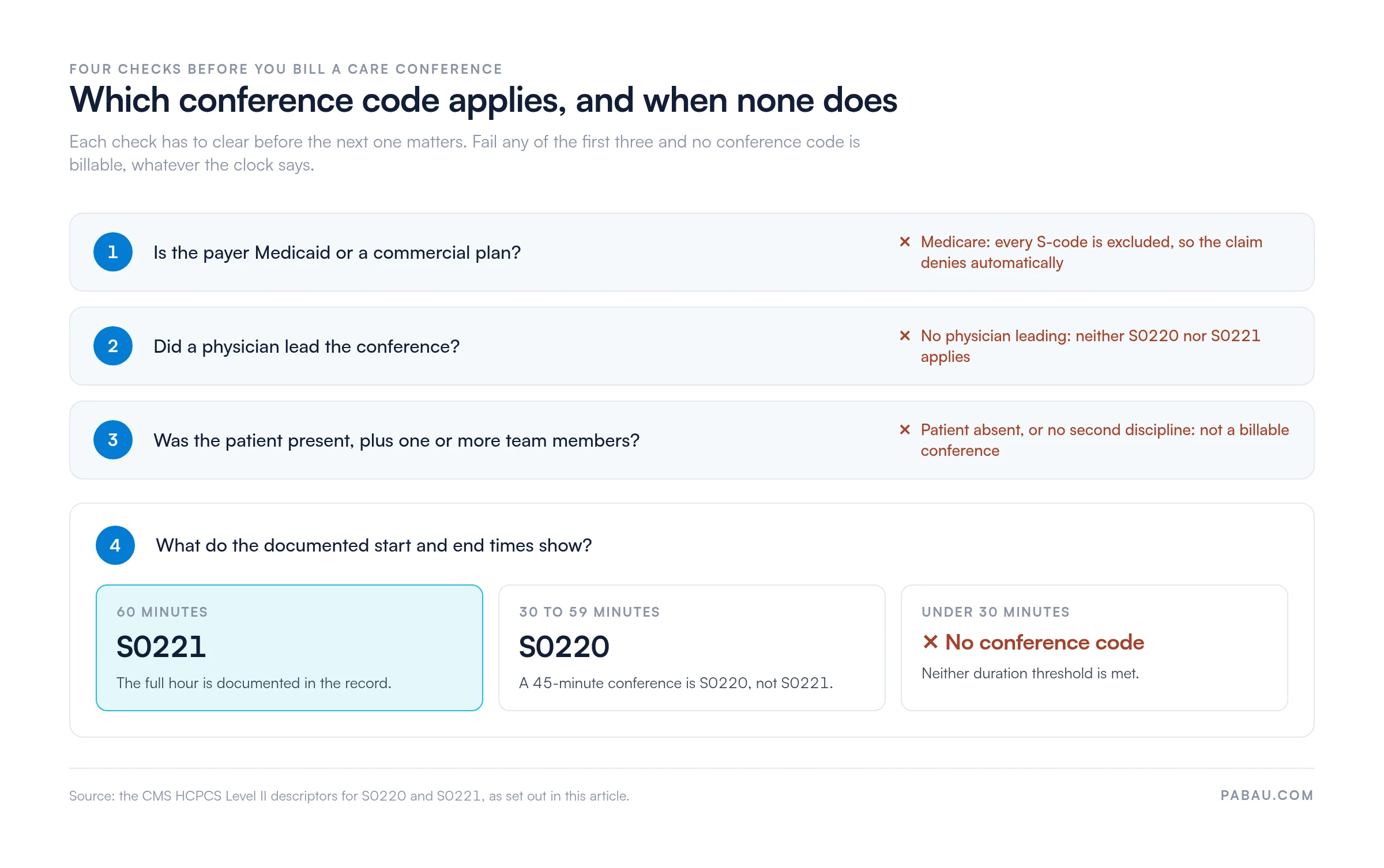
S0221 has one genuine companion in the S-code series, and that is S0220. Billers working with interdisciplinary team encounters need both, because the pair differs only on documented time.
The S-code sequence runs straight from S0221 to S0250, so there is no third conference code to reach for. Both codes sit in the miscellaneous provider services range. The wider HCPCS codes library covers the other Level II ranges that turn up on the same claim.
Every claim for HCPCS code S0221 requires at least one supporting ICD-10 diagnosis code. The diagnosis must reflect the clinical condition that necessitated the physician-led conference. No single ICD-10 code is required, so the appropriate diagnosis depends on the patient’s presentation. The codes below are among those commonly paired with S0221 in care coordination and complex case management.
Always select the diagnosis that most accurately describes the condition driving the conference, rather than a generic catch-all code. Pairing a vague Z-code with an S0221 claim risks a medical necessity denial when the patient’s primary condition is a specific chronic disease. For reference, the CDC’s ICD-10-CM web tool provides the official US code set with full tabular detail.
Documentation is where many S0221 claims fall apart at audit. Because the code requires a specific meeting structure, the medical record must prove that structure existed. Payers reviewing S0221 claims look for the same core elements every time. Strong documentation means clean claim submission with far fewer follow-up requests.
A conference documentation template built into the clinical record can pre-populate all five elements as structured fields, which reduces the risk of omission. Storing that documentation alongside the billing encounter creates a straightforward audit trail.
S0221 attracts a predictable set of claim errors. Knowing them in advance means you can build process checkpoints that stop them before submission.
Tracking denial reasons by code is a straightforward way to see which of these errors your practice is encountering. A dashboard that groups rejections by HCPCS code shows quickly whether one payer is behind most of your S0221 denials.
Run a quarterly denial audit on all S0221 claims. Pull every denied claim by reason code, group the results by payer, and identify whether the pattern is documentation-related, payer-coverage-related, or time-threshold-related. Each pattern has its own fix, and none of them needs a new process.
A HCPCS reference database tells you what the code means. It cannot tell you whether your team documented the conference correctly or routed it to a payer that covers it. It also cannot tell you whether anyone caught the denial in time to appeal. Those three questions decide whether the work gets paid for.
Practice management software like Pabau closes that loop. Pabau’s claims management software connects the clinical encounter directly to the billing claim. When a physician documents a 60-minute interdisciplinary conference, the billing team can assign S0221 in the same workflow. They check the payer against the coverage rules and submit without re-entering data.
The platform also surfaces denial patterns by code. A practice manager sees an S0221 problem with one commercial plan while it is still a handful of claims.
For practices carrying complex care coordination caseloads across several payers, three checkpoints do most of the work. Put the payer-eligibility check in the scheduling workflow, the documentation template in the clinical record, and the denial tracking in the billing dashboard. Reference tools are a starting point, and connected systems are what produce clean claims at volume.

Pabau connects scheduling, clinical documentation, and claims in one platform. Billers can assign HCPCS codes like S0221 straight from the encounter record, and check payer coverage rules before submission.

S0221 is worth billing only where the payer already pays it, so check that before the conference is scheduled. Get the payer question right and the rest is documentation your clinical team should be producing anyway.
Two habits carry most of the value here. Record the start and end time of every conference, and name every discipline in the room. Practices that do both stop guessing between S0220 and S0221, and their appeals get much shorter.
Pabau’s claims tools help practices close the loop between clinical documentation and clean HCPCS claim submission. To see how that fits your care coordination billing, book a demo.

Need to understand how denials get resolved? Denial codes in medical billing covers the most common reason codes and how to respond to them for faster reimbursement.
Wondering how electronic claims reach payers? Understanding the 837 file explains the EDI claim transaction format used to submit HCPCS codes to Medicaid and commercial payers.
Want to reduce claim rejections from the start? Electronic remittance advice (ERA) explains how to read payer responses and trace denial reasons back to the original claim.
HCPCS code S0221 is a medical conference code that describes a physician-led meeting with interdisciplinary team members, conducted with the patient present, lasting 60 minutes. It belongs to the HCPCS Level II S-code series and is used primarily by Medicaid and commercial payers, not Medicare.
No. Medicare does not reimburse S0221 or any HCPCS S-code. CMS excludes the entire S-code series from Medicare payment. Submitting S0221 to Medicare will result in an automatic denial regardless of documentation or clinical circumstances.
S0220 covers a physician-led medical conference with interdisciplinary team members and the patient present at 30 minutes. S0221 covers the identical service at 60 minutes. All other requirements (physician leadership, team presence, patient attendance) are the same. Bill S0220 when the conference lasted at least 30 but less than 60 minutes, and S0221 when the full 60 minutes was reached.
Coverage varies by state. Each state Medicaid program sets its own fee schedule and covered services list. Some states cover S0221 for complex chronic care populations. Others do not include S-codes in their fee schedules at all. Check the current fee schedule with your state Medicaid agency before billing.
The medical record must document five elements. Record the precise start and end time, plus the name and role of every team member present. Then confirm that the patient attended, summarize the clinical discussion and the decisions made, and state the follow-up plan. Missing any element increases the risk of a medical necessity denial.
Modifier 95 (synchronous telemedicine) or GT (interactive audio and video) may apply if the conference was conducted via live video. Check the payer’s telehealth policy first. Modifier 59 may be needed if S0221 is billed on the same date as another service and the payer requires distinct service documentation. Always confirm modifier requirements with the specific billing payer before submission.



