



HCPCS code E0198: Water pressure pad billing guide
HCPCS code E0198 is a water pad for a standard mattress HCPCS code E0198 is the ...

Last Updated: Oct 13, 2026
HCPCS code S0114 is a HCPCS Level II temporary code for injectable treprostinil. Its official descriptor reads “Injection, treprostinil, 0.5 mg,” so one billed unit is half a milligram of the drug.
Treprostinil is a prostacyclin analog used to treat pulmonary arterial hypertension, and most prescribers know the injectable form by its brand name, Remodulin. The drug also has a permanent J-code of its own, J3285. That second code drives most of the billing decisions on this page. S0114 is an alternative billing format for a drug that already carries an assigned code.
Most coders meet S0114 when a Medicaid managed care or commercial plan asks for the S-code instead of J3285. The friction starts immediately: Medicare fee-for-service denies S0114 outright, prior authorization rules differ by plan, and the NDC must be attached or the claim bounces.

HCPCS code S0114 is the temporary S-code for injectable treprostinil, billed in 0.5 mg units
Treprostinil already has a permanent J-code, J3285, which is billed in 1 mg units
The crosswalk carries a conversion: 2 units of S0114 equal 1 unit of J3285
J3490 and J3590 are the wrong codes here, because they are reserved for drugs with no assigned HCPCS code
Inhaled treprostinil is a separate product billed under J7686, so confirm the route before you code
Medicare fee-for-service denies S-codes; Medicaid managed care and commercial plans are the payers that accept S0114
NDC reporting is mandatory for most Medicaid and many commercial payer drug claims billed under S0114
Pabau’s claims management software tracks HCPCS code fields, NDC attachment, and payer-specific rules in one billing workflow
HCPCS code S0114 sits in the HCPCS Level II S-series, a set of temporary codes maintained outside the standard Medicare fee schedule. Its official descriptor is “Injection, treprostinil, 0.5 mg,” which fixes both the drug and the billing unit. S-codes were originally developed by the Blue Cross Blue Shield Association. They capture drugs, supplies, and services that Medicare does not cover but that Medicaid managed care and private payers still need to track. According to CMS’s HCPCS overview, S-codes are not valid for Medicare fee-for-service claims and will be automatically denied.
The quick-reference table below shows the key attributes coders need before submitting any claim under this code.
Coders can verify the current descriptor against the annual CMS Alpha-Numeric HCPCS file or through the AAPC HCPCS code lookup.
S0114 covers injectable treprostinil, in 0.5 mg increments, when the claim goes to a payer that accepts S-series codes. That means the subcutaneous and intravenous forms of the drug, which are usually delivered by continuous infusion pump. Inhaled treprostinil is a different product with a different code, so confirm the route before coding the encounter. The inclusion scope depends on four factors.
Medical necessity must be documented in the clinical record before the claim is submitted. The chart note must name the pulmonary hypertension diagnosis being treated and confirm the physician order. It must also record the dose and the lot number from the NDC label.
Several scenarios fall outside S0114’s coverage even when the drug or supply is otherwise appropriate. Understanding these exclusions prevents avoidable denials.
Payer acceptance of HCPCS code S0114 varies significantly across program types. The table below maps coverage status by payer category to help coders route claims correctly before submission.
S-code acceptance is contractual rather than statutory, so the payer’s own contract decides it. Verify the patient’s benefits and the plan’s S-code position before each encounter. Run that check ahead of the appointment, not after the drug has been administered.
Prior authorization (PA) for HCPCS code S0114 is not universal. Whether a plan requires it depends on the payer’s formulary tier, the patient’s diagnosis, and the practice’s provider contract. These steps reflect standard PA workflow for S-code drug claims; confirm the specific payer’s requirements before submission.
Verify prior authorization requirements at the plan level, not the payer level. A single commercial payer may operate multiple plans with different PA lists for the same HCPCS code S0114. Checking the plan ID on the insurance card rather than the payer name alone prevents misrouted PA requests.
Accurate claim submission for HCPCS code S0114 requires correct field-level data on the CMS-1500. Each field below maps to a common source of denial when completed incorrectly.
Submit the claim electronically where possible. Paper claims for drug codes are processed more slowly and are more prone to transcription errors. An encounter record captured at the point of care populates these fields before the claim reaches the clearinghouse.
The ICD-10-CM diagnosis code paired with HCPCS code S0114 must reflect the condition driving the infusion. For treprostinil that is pulmonary arterial hypertension, the indication the injectable form is approved to treat. Payers use diagnosis codes to validate medical necessity. A mismatch between the diagnosis and the drug is one of the top denial triggers for S-code claims.
The codes coders reach for sit in the I27 range:
Check the payer’s policy before assuming any of these will pay. Several plans restrict treprostinil coverage to WHO Group 1 disease and deny the Group 3 and Group 4 codes outright.
General rules for ICD-10 pairing with S0114 claims:
Practices should maintain a reference list of payer-approved diagnosis codes for each drug billed under S-series codes, treprostinil included. That list belongs in the compliance documentation package that supports internal audits.
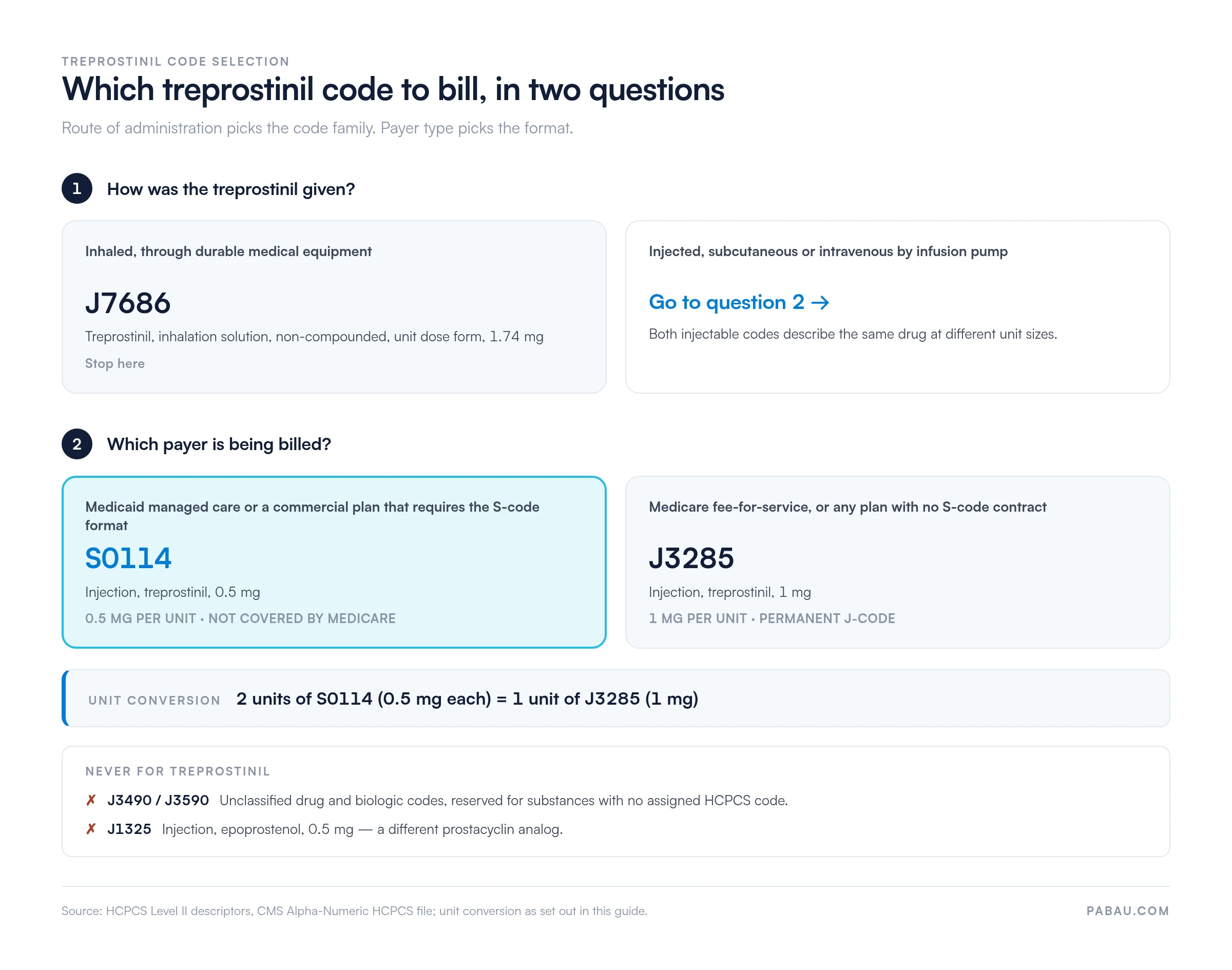
Coders frequently meet HCPCS code S0114 alongside the J-codes for the same drug. The choice between them turns on payer format and route of administration, not on whether a code exists. Treprostinil has a permanent injectable J-code, J3285, whose descriptor reads “Injection, treprostinil, 1 mg.”
S0114 and J3285 describe the same drug at different unit sizes, so the crosswalk carries a conversion. Two units of S0114 equal one unit of J3285, because the S-code counts 0.5 mg per unit and the J-code counts 1 mg.
This is where a common error creeps in. J3490 and J3590 are the unclassified drug and unclassified biologic codes, and they exist only for substances that have no HCPCS code assigned to them. Treprostinil has one, so billing it as an unclassified drug is simply incorrect. It also slows the claim down with an invoice review and often ends in a denial.
Convert the quantity before you rebill. A claim that went out as 40 units of S0114 becomes 20 units of J3285, and leaving the count untouched doubles the billed amount. Units-based edits catch that mismatch quickly, so the corrected claim usually comes back as a denial rather than an overpayment.
Route of administration decides the rest. S0114 and J3285 both describe injectable treprostinil, given subcutaneously or intravenously by infusion pump. The inhaled product is billed under J7686, the non-compounded inhalation solution supplied through durable medical equipment. The diagram below reduces the whole choice to two questions.
Medicare does not publish an allowed amount for HCPCS code S0114 because the code is not covered by Medicare fee-for-service. Reimbursement is determined entirely by each accepting payer’s contract or fee schedule. Three situations apply depending on which payer is being billed.
When a claim crosswalks to J3285, check the quarterly Medicare Part B ASP drug pricing file. It publishes the Medicare payment limit per 1 mg unit. Compare it against an S0114 rate carefully: The J-code unit covers twice as much drug, so a per-unit rate that looks higher may not be. For S0114 specifically, reconcile expected against paid amounts on the remittance advice after each payment posting cycle.
Denial patterns for HCPCS code S0114 cluster around four root causes: Wrong payer, missing NDC, absent prior authorization, and diagnosis mismatch. The table below maps the most common denial codes to their corrective actions.
For a full reference of CARC denial codes paired with next-step actions, see the medical billing denial codes guide. Practices with recurring CO-50 denials on S0114 usually find the fix sits in the documentation rather than in the claim. The chart note must explicitly link the diagnosis to the drug.
Documentation for HCPCS code S0114 claims must withstand payer audit. A claim that passes automated edits can still be recouped months later if the clinical record does not support the service billed. These are the elements auditors look for.
Practices that build documentation templates into their intake and encounter workflows catch deficiencies before the claim is submitted rather than after a payer audit. Digital encounter forms that prompt for NDC entry and PA number at the time of service reduce downstream errors significantly.
Run a quarterly internal audit of a random sample of S0114 claims. Pull the remittance advice alongside the chart note. Confirm that every billed unit represents 0.5 mg of the documented dose. Then check that every NDC matches the vial record and every PA number in Box 23 matches the approval letter on file. Where a claim was rebilled to J3285, check that the unit count was halved. Catching discrepancies internally is far less costly than a payer recoupment.
A practice billing S0114 usually assembles the claim from three separate places. The payer’s S-code position sits in a spreadsheet, the NDC is copied off the vial by hand, and the prior authorization number arrives by email. Every handoff is a chance for the claim to go out one field short.
Practice management software like Pabau holds those fields on the patient record instead. The HCPCS code, the unit count, the NDC from the vial and the prior authorization number are all captured at the point of service. Pabau’s clean claims management workflow then assembles the claim from that record, not from a retyped summary.
The crosswalk sits in the same place. When a plan turns out not to accept S-codes, the units are already stored in 0.5 mg increments. Moving the line to J3285 is arithmetic rather than a rebuild. Fewer drug claims come back for a field that was in the chart all along.

Pabau’s claims management tools help practices track HCPCS code fields, attach NDCs, and manage prior authorization numbers in one workflow. Fewer claims come back denied.

The S0114 decision is made before the drug is drawn up, not after the denial arrives. Check whether the plan accepts S-codes, confirm the prior authorization, and record the NDC while the vial is still in hand.
Get that order right and the crosswalk stops being risky. A plan that refuses the S-code gets J3285 with the units halved. The claim then goes out the same week, rather than three weeks later on appeal.
One point is worth holding on to. Treprostinil is a classified drug, so J3490 and J3590 are never the answer, however unfamiliar the payer’s preferred format looks. Book a demo to see how Pabau keeps the code, the units and the NDC together on a drug claim.

Need a framework for managing claim rejections systematically? Denial management in healthcare covers the end-to-end process for tracking, appealing, and reducing recurring payer denials.
Want to understand how the 837 transaction connects to your clearinghouse? 837 electronic claim file explains the EDI format used for electronic claim submission and how errors are flagged before they reach the payer.
Looking for a reference on clean claim standards? Clean claim submission outlines the field-level requirements that prevent automatic rejections on drug and supply claims.
Need the point-of-care record that feeds these claim fields? Superbill documentation sets out what belongs on an encounter record before a drug claim is built from it.
Want to catch a non-accepting payer before the drug is given? Insurance eligibility verification walks through the pre-visit check that decides which code format the claim needs.
HCPCS code S0114 covers injectable treprostinil, a prostacyclin analog used to treat pulmonary arterial hypertension and sold under the brand name Remodulin. Its official descriptor is “Injection, treprostinil, 0.5 mg,” so one billed unit is half a milligram. The code is accepted by Medicaid managed care and commercial payers, not by Medicare fee-for-service.
The J-code equivalent is J3285, “Injection, treprostinil, 1 mg.” Because J3285 counts 1 mg per unit and S0114 counts 0.5 mg, 2 units of S0114 equal 1 unit of J3285. Halve the unit count whenever you move a claim from the S-code to the J-code, and double it when you move the other way.
No. J3490 and J3590 are unclassified drug and unclassified biologic codes, reserved for substances that have no HCPCS code assigned to them. Treprostinil has one, so the correct crosswalk is J3285. Billing treprostinil as an unclassified drug triggers an invoice review at best and a denial at worst.
No. Medicare fee-for-service does not reimburse HCPCS S-codes, including S0114. Claims submitted to traditional Medicare will be denied, typically with a CO-4 or PR-96 reason code. Bill J3285 instead for those patients. Some Medicare Advantage plans do accept S-codes under their individual provider contracts, so verify with the specific plan before submitting.
The ICD-10-CM code paired with S0114 must reflect the pulmonary hypertension diagnosis the treprostinil is treating. It must also appear in the physician order and the chart note. I27.0 is the most common pairing, with I27.21, I27.24 and I27.29 used where the disease is secondary. Use the most specific code available, and check the payer’s policy, since several restrict coverage to WHO Group 1 disease.
No. Inhaled treprostinil is billed under J7686, the code for the non-compounded inhalation solution supplied through durable medical equipment. S0114 and J3285 describe the injectable form, given subcutaneously or intravenously by infusion pump. Confirm the route in the chart before selecting a code.
Most S0114 denials come from five causes. The payer does not accept S-codes (PR-96), the NDC is missing or badly formatted (CO-4), or the prior authorization number is absent (CO-15). The other two are a diagnosis that does not support treprostinil (CO-11 or CO-50) and bundling with a same-day global service (CO-97). An unconverted unit count on a claim rebilled to J3285 adds a sixth. Reviewing the remittance advice CARC code identifies which applies.
Medicaid managed care organizations and commercial managed care plans are the primary acceptors of HCPCS S-codes. Acceptance is contractual, not statutory, so verify with each plan individually. State Medicaid fee-for-service programs vary: Some include S-codes in their drug fee schedules; others do not. Medicare fee-for-service never accepts S-codes.



