CPT code 21011: Excision of soft tissue tumor of the face
CPT code 21011: Official descriptor and procedure overview CPT code 21011, as pu...

Last Updated: Oct 8, 2026
Q4178 is the HCPCS Level II code for floweramniopatch, per square centimeter (add-on, list separately in addition to primary procedure).
Every Q4178 claim also needs a CPT application code from the 15271 to 15278 range. Missing wound-size documentation and the wrong payment classification drive most denials on this code.
Let Pabau's smart automation suggest the right codes, reduce claim denials, and keep your practice compliant—effortlessly.
Automate repetitive tasks and focus on what matters most—your patients.
Reduce coding errors and ensure compliance with the latest regulations.
Clean claims, fewer denials, and faster reimbursements.
Powerful insights and reporting to help your practice thrive.
HIPAA compliant SOC 2 certified GDPR-compliant Trusted by 4,000+ clinics worldwide

HCPCS code Q4178 describes Floweramniopatch, an amniotic membrane skin substitute billed per square centimeter of wound surface area.
Every Q4178 claim must pair with a CPT application code from 15271 to 15278. Q4178 submitted alone is denied automatically.
The CY2026 OPPS final rule retired the high-cost and low-cost tiers. Q4178 now pays under APC 6002 at about $127.14 per sq cm.
Documentation must capture wound type, exact dimensions in square centimeters, prior treatment failure, and the product lot number.
Pabau keeps wound care notes and HCPCS code capture in one workflow, so measurements are never retyped into the claim.
HCPCS code Q4178 describes Floweramniopatch, per square centimeter. The product is an amniotic membrane allograft, classified under Medicare’s bioengineered skin and soft tissue substitute category. The code sits in the Q4100-series of HCPCS Level II codes, maintained annually by the Centers for Medicare and Medicaid Services (CMS).
The “per square centimeter” unit descriptor is not incidental. The number of units billed must match the wound surface area measured at the time of application. The size of the product package used does not set the unit count. Rounding and unit-calculation errors are among the top denial triggers for this code.
CMS updates HCPCS Level II codes annually in October, so the descriptor and the effective dates are worth re-checking each code year. A practice that stocks several skin substitutes should confirm the assigned code before the first application, not after the first denial.
Floweramniopatch is an amniotic membrane allograft derived from human placental tissue. It belongs to the same product family as other amniotic skin substitutes in the Q4100 series. Its tissue composition and processing method set it apart, and both affect its clinical application profile.
Floweramniopatch differs from the acellular dermal matrices billed under Q4107 or Q4128. Those products are processed from donated human dermis rather than amniotic tissue. The distinction matters for coverage review, because some MAC policies treat amniotic membrane allografts differently when they assess medical necessity.
Medicare Part B covers Q4178 applications when providers meet the medical necessity criteria in CMS Billing and Coding Article 54117.
The applicable Medicare Administrative Contractor (MAC) Local Coverage Determination (LCD) adds its own criteria. Coverage is not automatic on submission. The claim has to show that standard wound care failed before the skin substitute was applied.
The core eligibility criteria are consistent across most MAC jurisdictions, though the LCD language varies. Pull the active LCD from your own MAC before billing, because coverage restrictions differ by region.
Medicare no longer classifies skin substitutes as high-cost or low-cost. The CY2026 OPPS final rule (CMS-1834-FC) retired that tier system and the ASP plus 6% methodology on January 1, 2026. Payment now follows the product’s FDA regulatory pathway, through three new ambulatory payment classifications (APCs).
Floweramniopatch is an amniotic membrane allograft regulated as a Section 361 HCT/P, so Q4178 falls under APC 6002. For 2026, all three APCs pay the same flat rate of approximately $127.14 per square centimeter.
CMS issued that figure as a technical correction on November 26, 2025, revising the $127.28 rate published in the final rule. The diagram below traces the old tiers to the category Q4178 now sits in.
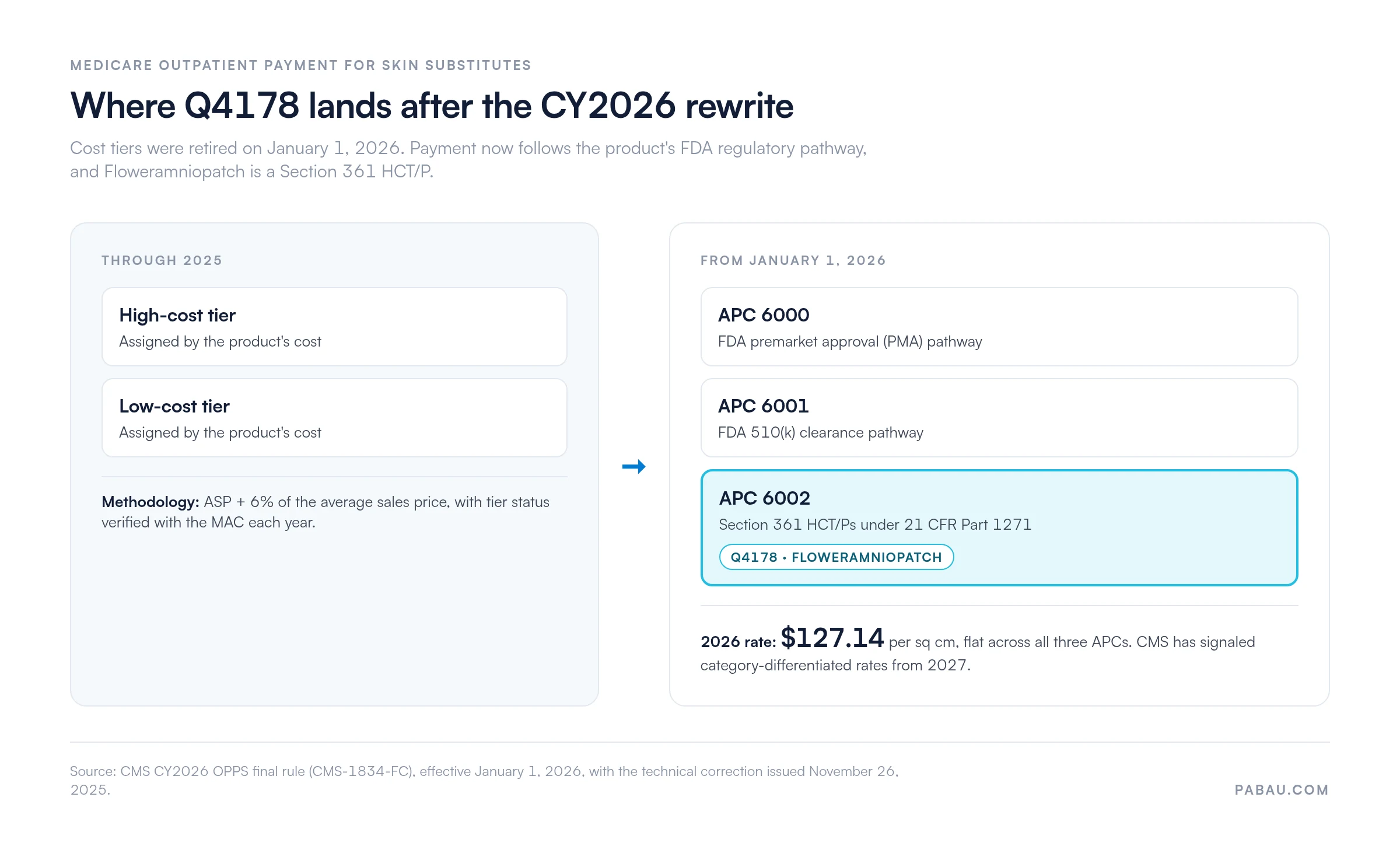
CMS has signaled that the three categories will carry different rates from 2027 onward, so the flat rate applies to a transition year. Office-based claims follow the Physician Fee Schedule, so check the current non-facility rate in the CMS Physician Fee Schedule lookup tool before submitting. Billing Q4178 under the wrong APC category delays payment and can trigger post-payment review.
Q4178 cannot be submitted as a standalone code. Per CMS Billing and Coding Article 54117, every Q4178 claim must pair with a CPT application code describing how the skin substitute was applied. The CPT code is selected on two axes: the anatomic site of the wound, and its total surface area.
Trunk, arm, and leg wounds use 15271 to 15274. Specialty sites such as the face, scalp, hands, and feet use 15275 to 15278. Within each pair, the lower code covers a total wound area under 100 sq cm and the higher code covers 100 sq cm or more.
Verify the application code against the current AMA CPT codebook and CMS Article 54117. The American Medical Association maintains the CPT code set, and description details can change between code years. Pairing Q4178 with an outdated application code is a common error that ends in denial.
Units for Q4178 are based on the wound surface area in square centimeters, measured at the time of application. Each unit equals one square centimeter. The unit count must reflect the documented wound measurement, not the size of the product applied.
Standard calculation method: Multiply wound length (cm) by wound width (cm) to get surface area in square centimeters. Bill that number as the unit count. For irregular wounds, use the longest diameter multiplied by the widest perpendicular diameter.
Worked example (single wound): A venous leg ulcer measuring 4.2 cm long by 3.0 cm wide has a surface area of 12.6 sq cm. Bill 13 units of Q4178, rounding up to the nearest whole number per standard billing practice.
Worked example (multiple wounds, same session): A patient presents with two diabetic foot ulcers. One measures 3.5 cm x 2.0 cm (7.0 sq cm). The other measures 2.1 cm x 1.8 cm (3.78 sq cm), so the total is 10.78 sq cm. Bill 11 units of Q4178. Document each wound measurement separately, because auditors may ask for wound-specific records.
Document wound measurements at every application visit with a photograph and a physical ruler in frame. Auditors reviewing Q4178 claims look specifically for measurement discrepancies between visits. A wound that shrinks by more than 40% between applications without corresponding clinical notes signals inconsistent documentation and triggers manual review.
Place of service (POS) directly affects the reimbursement rate for Q4178 claims. Medicare pays differently depending on whether the application happens in a physician office or a hospital outpatient department. Each setting carries a different overhead cost structure.
Under the Physician Fee Schedule (PFS), office-based providers receive a higher reimbursement rate for the product component. The facility overhead is bundled into the professional payment.
In a hospital outpatient setting the facility bills separately under the OPPS and receives a facility payment, while the physician bills only the professional component. Billing Q4178 with POS 11 for a service that happened in an outpatient hospital is a common error that leads to overpayment and recoupment.
Every Q4178 claim needs a supporting ICD-10-CM diagnosis code that establishes medical necessity for the skin substitute application. The diagnosis code must match the wound type documented in the clinical record.
It must also appear on the applicable MAC LCD’s covered diagnosis code list. A diagnosis code that is absent from that list triggers automatic denial, even when the clinical documentation is complete.
This table covers commonly used codes rather than every option, and acceptability varies by MAC jurisdiction. Cross-reference the active LCD for your MAC before submitting. Where two codes describe the same ulcer, the one on the LCD list is the one that pays.
Documentation failures are the primary driver of Q4178 claim denials. CMS Billing and Coding Article 54117 requires providers to demonstrate medical necessity through the clinical record, not the claim form alone. Missing a single required element, such as the product lot number, can sink an otherwise valid claim.
The checklist below reflects requirements from CMS Article 54117 and standard MAC LCD language. Capturing each field on a structured form during the visit keeps the note and the claim in agreement. Nobody has to reconstruct a measurement at billing time.

Practices that keep structured wound care notes see fewer audit requests and faster payment cycles. For skin substitute codes, first-pass payment depends on documentation completeness as much as on code accuracy. A denial that has to be reworked and resubmitted adds around 30 days to the payment timeline.
HCPCS and CPT modifiers may be required on Q4178 claims depending on the clinical circumstances and payer policy.
Modifier requirements vary by MAC. Check the applicable LCD for modifier-specific instructions before submitting. Some MACs require KX as a condition of payment, and a claim without it is denied even when the documentation is complete.
Q4178 denials follow a predictable pattern. Knowing the top causes lets billing staff build pre-submission checks that catch errors before the claim reaches the payer.
Each Q4178 rejection carries a CARC reason code on the remittance advice. Matching it against a denial code reference shows which correction the payer expects before you resubmit.
National CMS policy sets the framework for Q4178 coverage. Medicare Administrative Contractors (MACs) can also publish Local Coverage Determinations (LCDs) that add restrictions within their jurisdictions. A Q4178 claim that meets national CMS criteria may still be denied under a stricter MAC LCD.
Finding the applicable LCD for a specific patient takes three steps.
First, identify the MAC jurisdiction from the provider’s MAC assignment. Second, search the Medicare Coverage Database or your MAC’s provider portal for active LCDs covering bioengineered skin substitutes. Third, confirm that Q4178 appears on the covered code list inside that LCD. Policies change, so this check belongs in the pre-authorization workflow rather than in initial setup only.
CMS rebuilt skin substitute payment in the CY2026 Outpatient Prospective Payment System (OPPS) final rule. That rule, CMS-1834-FC, was finalized on November 21, 2025 and took effect on January 1, 2026.
The Federal Register published it on November 25, 2025, and a technical correction followed the next day. The changes affect how Q4178 and every other Q-series skin substitute is classified and paid.
MACs are still issuing local guidance on the new APC structure, so confirm Q4178’s assignment and rate before you bill. Reference material published before November 2025 still describes the retired tier system, so check the date on any billing guide you use.
Q4178 belongs to the Q4100-series of HCPCS skin and soft tissue substitute codes. Knowing the neighboring codes helps billing staff pick the right one when a practice stocks several products. Cygnus, another amniotic membrane allograft, bills under Q4170 and follows the same per-square-centimeter unit rule.
Using the wrong Q-series code for a product in stock is a compliance risk. Each code is specific to a named product, so billing Q4107 for a Floweramniopatch application is an incorrect code submission regardless of intent.
Verify the product’s assigned code against the manufacturer’s billing guide and the AAPC HCPCS code lookup before stocking any new skin substitute.
Most Q4178 denials start where the clinical note hands off to the claim form. Wound measurements are written on paper, HCPCS codes are keyed separately into a billing system, and the two versions stop agreeing. A wound recorded at 12.6 sq cm goes out as 12 units instead of 13. Or the lot number never travels from the package label to the note.
Practice management software like Pabau gives wound care teams claims management without re-entry. Providers record wound dimensions, treatment history, and product details in the patient record during the visit. That data feeds the claim directly, so the measurement in the note is the measurement on the claim.
The same setup helps practices that stock a mix of skin substitutes. Each product’s HCPCS code sits inside the encounter, so a clinician picks it during the visit rather than checking an external reference afterward. Fewer code lookups after the fact means fewer rejections to rework.

Pabau keeps HCPCS code capture and wound care documentation in one place, so billing staff never have to reconstruct measurements from clinical notes. See it in a live demo.

Q4178 pays cleanly for practices that treat documentation as a billing task, not just a clinical one. Wound dimensions, prior treatment failure, and the product lot number belong in the record before the claim leaves. Adding them during an appeal is too late to protect the payment cycle.
The trade-off worth remembering is that 2026 is a transition year. The flat $127.14 rate hides the fact that the three APCs are expected to diverge from 2027, and MAC guidance is still landing. Re-check the assignment and the rate each code year rather than trusting the setup you built in January.
To see how Pabau keeps wound measurements and HCPCS codes in step from the encounter to the claim, book a demo.

Need to understand how clean claims reduce skin substitute denials? Clean claim submission guide covers the core elements that decide whether a claim pays on first submission.
Want a structured approach to managing Q4178 appeal workflows? Denial management in healthcare outlines the tracking and appeal process for complex billing denials.
Looking to see how HCPCS codes fit the broader billing picture? Revenue cycle management overview explains how skin substitute codes flow from clinical encounter to final payment.
Setting up charge capture before the first application? Superbill preparation guide shows how to keep the product code and the application code together at the point of service.
Need the compliance checks that sit around skin substitute claims? Medical billing compliance guide sets out the audit-facing rules that apply to high-cost wound care codes.
HCPCS code Q4178 is the billing code for Floweramniopatch, an amniotic membrane skin substitute billed per square centimeter. It falls under Medicare Part B policy for bioengineered skin and soft tissue substitutes. It belongs to the Q4100-series of HCPCS Level II codes, and must be paired with a CPT application code (15271-15278) when submitting claims.
No. That classification ended on January 1, 2026. The CY2026 OPPS final rule replaced the high-cost and low-cost tiers with three APCs based on FDA regulatory pathway. Floweramniopatch is a Section 361 HCT/P, so Q4178 now pays under APC 6002 at about $127.14 per square centimeter for 2026. CMS has signaled category-differentiated rates from 2027 onward, so confirm the assignment with your MAC each year.
Q4178 pairs with CPT codes 15271-15278, selected by wound location and total wound surface area. Codes 15271 and 15272 cover trunk, arm, and leg wounds under 100 sq cm. Codes 15273 and 15274 cover those same sites at 100 sq cm or more. Specialty sites such as the face, scalp, hands, and feet use 15275 and 15276 under 100 sq cm. Codes 15277 and 15278 apply to those specialty sites at 100 sq cm or more. Submitting Q4178 without a CPT application code results in automatic denial.
Units for Q4178 equal the wound surface area in square centimeters, calculated as length x width. Round up to the nearest whole number. For example, a wound measuring 4.2 cm x 3.0 cm equals 12.6 sq cm, billed as 13 units. For multiple wounds treated in the same session, add the surface areas together and bill the combined total as the unit count.
Required documentation includes the wound type and ICD-10-CM diagnosis. You also need exact wound dimensions in centimeters at each visit and documented failure of standard wound care for at least 4 weeks. Add a physician order, the Floweramniopatch product lot number, and a description of the application technique. Missing any single element can result in full claim denial or post-payment audit.
The most common Q4178 denial reason is a missing CPT application code. Others are a unit count that does not match documented wound dimensions, no evidence of prior treatment failure, and an incorrect place of service code. A diagnosis code that is absent from the MAC’s covered list and a missing product lot number also trigger denials. APC category misclassification is a growing denial driver since the CY2026 OPPS rule replaced the old cost tiers.