

CCSD code G5100: Bypass of duodenum billing guide
CCSD code G5100 bills a bypass that leaves the duodenum in place CCSD code G5100...

Last Updated: Oct 16, 2026
HCPCS code Q4158 is the Level II supply code for Kerecis Omega3, an acellular fish-skin graft billed per square centimeter. It's an add-on code, so it only pays alongside a skin substitute application code from 15271-15278 on the same claim.
The key fact for 2026 is price. Medicare now pays Q4158 at a flat $127.14 per sq cm as an incident-to supply. That makes every unit worth checking, because a miscounted wound, a missing partner code or the wrong Kerecis code can cost the whole line. The sections below show how to pair, count and document it so the claim clears on the first pass.
Let Pabau's smart automation suggest the right codes, reduce claim denials, and keep your practice compliant—effortlessly.
Automate repetitive tasks and focus on what matters most—your patients.
Reduce coding errors and ensure compliance with the latest regulations.
Clean claims, fewer denials, and faster reimbursements.
Powerful insights and reporting to help your practice thrive.
HIPAA compliant SOC 2 certified GDPR-compliant Trusted by 4,000+ clinics worldwide

HCPCS code Q4158 covers Kerecis Omega3 fish-skin graft, billed per square centimeter as an add-on to a 15271-15278 application code.
Choose the application code by wound site and total wound area, since 15275-15278 cover the feet, hands, face and scalp.
Bill one unit per square centimeter applied, round up to a whole number, and record the raw measurement in the chart.
Since January 1, 2026, Medicare pays Q4158 at a flat $127.14 per sq cm as an incident-to supply.
Novitas L35041 and First Coast L36377 cover diabetic foot ulcers and venous leg ulcers after standard care fails.
HCPCS code Q4158 is the supply code CMS assigns to Kerecis Omega3, a fish-skin graft billed per square centimeter. It never stands alone on a claim.
Instead, it rides on a skin substitute application code from the 15271-15278 range, and Medicare pays a flat rate for each unit in 2026.
Here are the core billing facts to confirm before you build the claim.
Kerecis Omega3 is an acellular matrix made from Atlantic cod skin. Both the HCPCS Level II descriptor and Kerecis’s own reimbursement documents map the product to Q4158.
It’s classed as a bioengineered skin and soft tissue substitute, so the same billing article A54117 governs it as other advanced wound care products.
Under the two LCDs this guide follows, coverage applies to diabetic foot ulcers and venous leg ulcers that haven’t responded to standard wound care. Sizing matters too. Kerecis sheets come in several sizes, and your units must reflect the graft area applied rather than the sheet you opened.
Q4158 is an add-on code, so it needs a primary application code from the 15271-15278 series on the same claim and date of service. Send it alone and expect a CO-B15 or CO-97 denial.
Two details pick the partner code: where the wound is and how large the total wound area is. According to the AMA CPT code set, 15271-15274 cover the trunk, arms and legs. Meanwhile, 15275-15278 cover the face, scalp, hands, feet and similar sites.
Within each site group, the split falls at 100 sq cm, as the grid below shows.
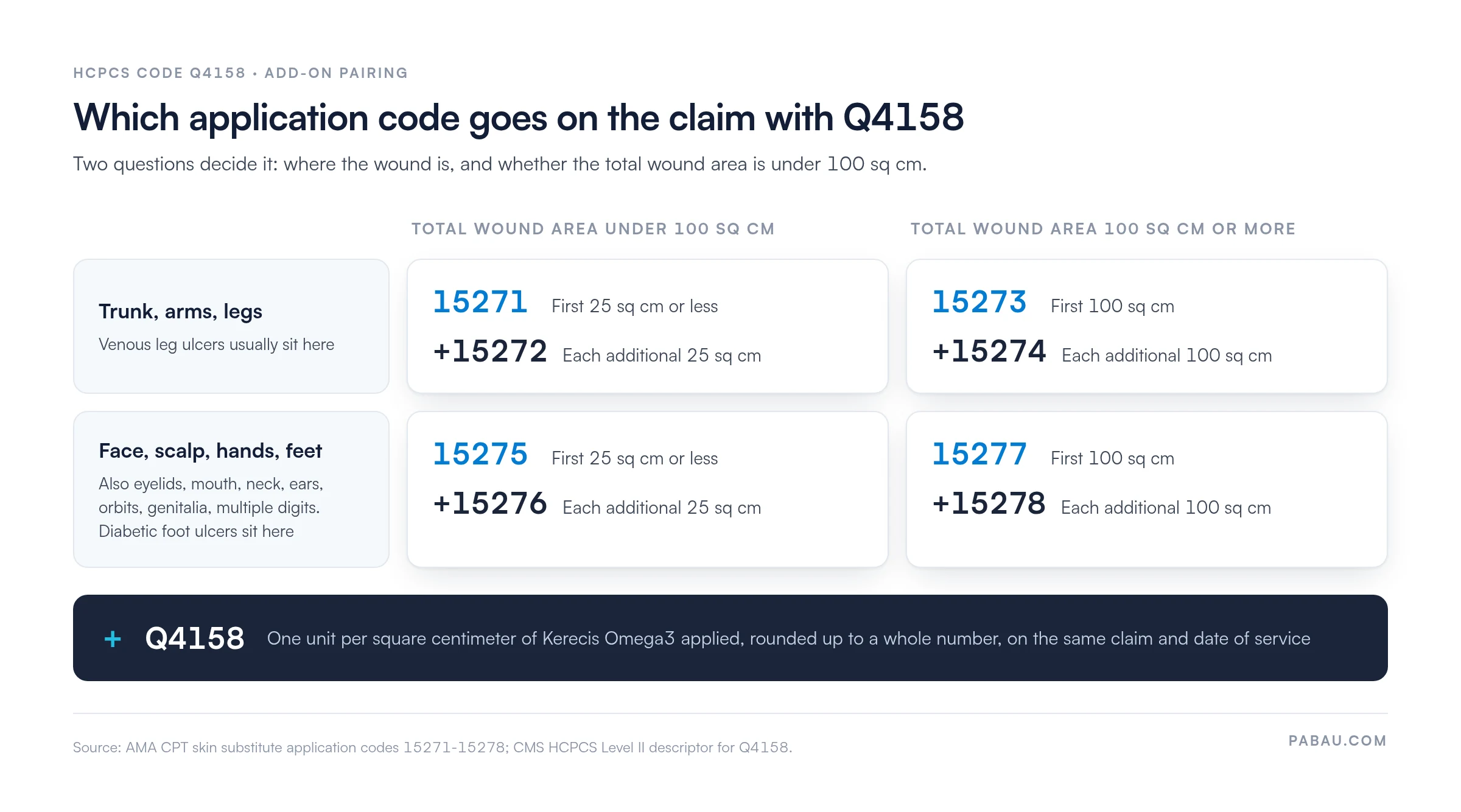
Treating several wounds on one date of service? Report a primary code for each wound location. Payers differ on whether Q4158 units go on one combined line or on separate lines per wound. Confirm the approach with the MAC or commercial plan first.
Each unit of Q4158 is one square centimeter, and a fraction rounds up to the next whole number. So a 6.3 sq cm wound bills as seven units, not six. Billing the decimal instead is a common mismatch between the chart and the claim, and it triggers edits.
Work through the count in this order:
Here’s how that plays out. A patient has a diabetic foot ulcer on the heel that measures 3.0 cm by 2.1 cm. That’s 6.3 sq cm, so the claim carries 15275 with one unit and Q4158 with seven. At the 2026 Medicare rate, those seven units pay $889.98 for the graft, and the application code pays separately.
With several wounds, measure each one on its own and then add the areas together. Some payers want separate claim lines per wound instead, so check their policy before you combine units.
Medicare fee-for-service covers Q4158 when a patient meets the criteria in your MAC’s skin substitute policy. Novitas uses LCD L35041 with billing article A54117. First Coast uses LCD L36377 with article A57680. Criteria vary between contractors, so confirm the active LCD for your jurisdiction before you bill.
New skin substitute LCDs for diabetic foot ulcers and venous leg ulcers were due on January 1, 2026. These were L39756, L39760, L39764, L39806, L39828 and L39865. However, CMS withdrew them on December 24, 2025, before they took effect, so the existing MAC policies stayed in place.
Payment changed too. Since January 1, 2026, Medicare has paid Q4158 at a flat national rate of $127.14 per square centimeter. The CY2026 Physician Fee Schedule and OPPS final rules reclassified most skin substitutes, Q4158 included, as incident-to supplies. That flat rate replaces the older Average Sales Price (ASP) and MAC-priced methods, and Kerecis’s reimbursement materials list the same figure.
According to the CMS HCPCS overview, Q-codes are temporary codes that CMS updates every quarter. For that reason, check the current rate in the CMS Physician Fee Schedule lookup tool for the service year. Published rate tables can miss mid-year changes.
Place of service still shapes the primary code’s payment. Facility rates apply in a hospital outpatient department or ambulatory surgical center (ASC), while non-facility rates apply in a physician office. Because 15271-15278 pay differently in each setting, confirm the place-of-service code before you submit.
Medicare covers Q4158 only when the encounter meets the medical necessity conditions in your MAC’s LCD. Under Novitas L35041 and First Coast L36377, that means documenting each patient against specific clinical thresholds before the graft goes on.
The core criteria typically include:
LCD criteria differ by MAC jurisdiction and can change between annual coding cycles. So check the current version of your MAC’s LCD before treating a patient with this product. Auditors regularly flag claims built on last year’s criteria.
Every Q4158 claim needs an ICD-10-CM diagnosis code that supports medical necessity, and it must match the wound type in the chart. The table below lists the main categories that support Q4158 under L35041 and L36377.
Pressure injuries and traumatic wounds fall outside the scope of L35041 and L36377. If a payer covers Kerecis Omega3 for those wounds, its own policy decides the rules. In every case, check that the billed code appears on your MAC’s covered diagnosis list. A plausible but unlisted code is a common denial trigger.
Original Medicare needs no formal prior authorization (PA) for Q4158, but most other payers vary widely and change often. The table shows general patterns only. Eligibility checks confirm coverage, yet PA for the specific product still needs its own confirmation.
Commercial coverage is less uniform than Medicare’s. UnitedHealthcare has a commercial skin and soft tissue substitute policy that likely includes Q4158. Similarly, BCBS plans, Aetna and Cigna keep category-level policies for advanced wound care, and terms vary by local plan.
Before you apply the product under any commercial plan, get answers to three questions:
Log the PA number, approval date and authorized units in the record. That trail protects the practice during audits and appeals.
Q4158 and A2019 both describe Kerecis fish-skin products, but not the same one. Q4158 is the Q-code for Kerecis Omega3, while A2019 is the A-code for Kerecis Omega3 MariGen Shield. Both bill per square centimeter as add-on codes.
Q4178 sometimes shows up as a Kerecis code in error. Its descriptor is Floweramniopatch, an amniotic membrane product from another manufacturer. Since CMS can add, revise or retire codes each quarter, check the current HCPCS Level II file. The AAPC HCPCS code lookup also shows each code’s current descriptor.
Q4159 is the next code up, and it belongs to Affinity rather than any Kerecis product. Affinity is a human amniotic membrane allograft billed per square centimeter as an add-on, so reporting it for a fish-skin graft draws a denial.
The practical rule is simple: read the label on the package you opened. If it names Kerecis Omega3 MariGen Shield, bill A2019. A standard Kerecis Omega3 wound graft label maps to Q4158. Never assign a code from the product family name alone.
Before billing any Kerecis product, pull the product label from the medical record and match the exact name to the current HCPCS descriptor. CMS updates Q-codes quarterly, so a descriptor that matched last quarter may not match now. A quarterly code check in your billing workflow catches reassignments before claims go out.
Q4158 claims stack three risks on one line: an add-on rule, a unit count and LCD medical necessity. That’s why they fail more often than most supply codes. Knowing the common denial codes behind these rejections helps billers fix them faster and stop repeats.
Several of these start in the chart, long before anyone opens the claim form. That’s where the next section picks up.
Documentation decides whether a Q4158 claim survives an audit. A reviewer who has never met the patient should be able to confirm the wound type, size, product and treatment history from the chart alone. A clean claim for this code starts with complete notes at the time of service.
Record these elements at every Q4158 encounter:
Build this capture into the clinical visit rather than leaving it for billing. Teams that photograph wounds each visit and log measurements in structured fields already have the audit trail. When a remittance does come back short, its reason code shows which element was missing.
A Q4158 claim moves from the bedside note to charge entry, then through a scrub, submission and remittance. Most errors slip in at charge entry, so pause there and confirm each item below.
Once every box is ticked, the claim is ready to send. Doing this at charge entry takes a minute, whereas an appeal can take weeks.
Many wound care teams still build a Q4158 claim by hand. Someone copies the application code, units and diagnosis from the chart into a claim form. Then they chase the authorization number by email. Each copy step is another chance to drop a unit or miss a field.
Practice management software like Pabau removes the retyping. Its claims software for practices pre-fills the CMS-1500 from the patient record, so the visit’s codes land on the claim. Built-in CPT, HCPCS and ICD-10 lookup libraries help coders confirm Q4158 and its partner code. And the claim won’t send until required fields, like the authorization number, are complete.
US practices submit through Claim.MD, which adds real-time eligibility checks before the visit. After submission, your team can track each claim’s status and post remittances as payments land. That way, a denial shows up the day it posts, while the notes are still fresh.
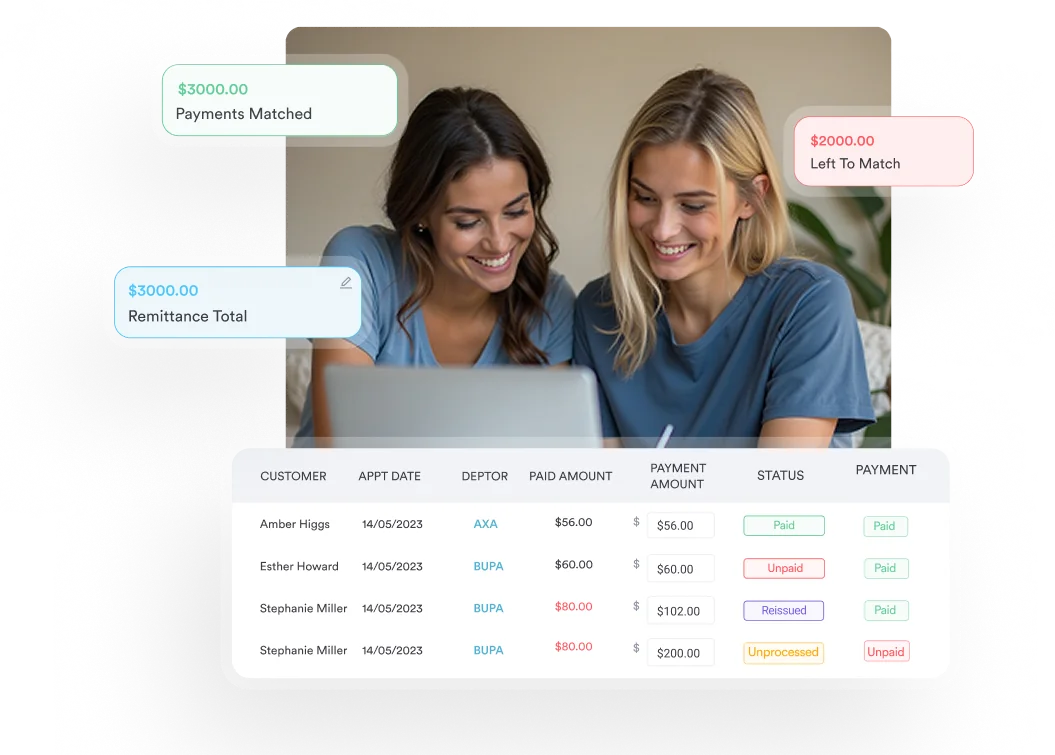

Pabau pre-fills wound care claims from the patient record and checks required fields before they send. Then it tracks each claim through to payment.

Q4158 pays well when three details line up. You need the right partner code for the site and a unit count the chart can prove. The diagnosis also has to be a DFU or VLU code the LCD accepts. Get those right at the point of care, and the claim rarely needs a second pass.
The trade-off is time at the bedside. Measuring, photographing and logging the lot number add a few minutes to each visit. Still, those minutes cost far less than appealing a denied graft worth hundreds of dollars.
To see how practice management software like Pabau pre-fills and tracks wound care claims from the patient record, book a demo with our team.

Seeing Q4178 on a Kerecis claim? HCPCS code Q4178 covers Floweramniopatch, the amniotic product behind that code.
Billing another skin substitute this week? HCPCS code Q4101 walks through Apligraf billing for chronic wounds.
Comparing 2026 payment across grafts? HCPCS code Q4124 explains Oasis Ultra billing under the new flat rate.
Want fewer denials across every code? Denial management in healthcare shows how to track, appeal and prevent claim rejections.
Checking coverage before the graft goes on? Insurance eligibility verification sets out what to confirm with each payer before the visit.
Q4158 covers Kerecis Omega3, an acellular fish-skin graft billed per square centimeter. Under Novitas L35041 and First Coast L36377, Medicare covers it for diabetic foot ulcers and venous leg ulcers that haven’t healed with standard care.
It’s an add-on code, reported with a primary application code from 15271-15278 on the same claim and date of service. Use 15271-15274 for the trunk, arms and legs, and 15275-15278 for the face, scalp, hands, feet and similar sites. Within each group, the size tier splits at 100 sq cm of total wound area.
No. The CMS JW and JZ modifier FAQ, updated December 22, 2025, limits those modifiers to Part B drugs and biologicals. Skin substitutes billed as incident-to supplies, like Q4158, must not carry them.
No. From January 1, 2026, Medicare pays only for the skin substitute applied to the patient. The practice absorbs any discarded portion of the sheet, whatever the package size.
Yes. Kerecis received FDA 510(k) clearance in November 2013 for its fish-skin graft to manage chronic wounds, including diabetic and vascular ulcers.
Novitas Solutions publishes L35041 for its JH and JL jurisdictions. First Coast Service Options publishes L36377 for jurisdiction JN, which covers Florida, Puerto Rico and the US Virgin Islands. Other MACs apply their own skin substitute policies.



