CCSD Code G3100: Laparoscopic biliary gastric bypass billing guide
CCSD Code G3100: Definition and Surgical Scope CCSD Code G3100 is the Classifica...

Last Updated: Nov 25, 2026
Q4126 is the HCPCS Level II code for MemoDerm, DermaSpan, TranZgraft or InteguPly, per square centimeter. It is an add-on code, so it is always reported with a skin substitute application code from CPT 15271-15278. One unit equals one square centimeter of product applied.
The January 2027 CMS HCPCS file lists Q4126 as active, with no termination date. For 2026, Medicare pays these products as incident-to supplies at one flat national rate, and discarded product is not payable. Coverage still depends on your MAC's policy and a documented wound history.
Let Pabau's smart automation suggest the right codes, reduce claim denials, and keep your practice compliant—effortlessly.
Automate repetitive tasks and focus on what matters most—your patients.
Reduce coding errors and ensure compliance with the latest regulations.
Clean claims, fewer denials, and faster reimbursements.
Powerful insights and reporting to help your practice thrive.
HIPAA compliant SOC 2 certified GDPR-compliant Trusted by 4,000+ clinics worldwide

HCPCS code Q4126 reports MemoDerm, DermaSpan, TranZgraft or InteguPly, and one unit equals one square centimeter of product.
It is an add-on code, so every Q4126 line needs a skin substitute application code from CPT 15271-15278 on the same claim.
The January 2027 CMS HCPCS file lists Q4126 as active, with no termination date.
In 2026, Medicare pays these products as incident-to supplies at one flat rate, and discarded product is not payable.
Use JC or JD where a payer asks for them, and keep JW and JZ for drugs, not for this code.
HCPCS code Q4126 reports MemoDerm, DermaSpan, TranZgraft or InteguPly, per square centimeter. The January 2027 file in the CMS HCPCS quarterly update lists it as active, with no termination date. Its official long descriptor ends with “add-on, list separately in addition to primary procedure.”
Q4126 has been in the CMS HCPCS file since January 1, 2012. Its descriptor has carried the add-on wording since January 1, 2026, so the code now always travels with an application code.
So the brand on the product label decides the code, not the wound. If your practice applied Cytal, you need HCPCS code Q4166 instead.
That “carrier judgment” coverage code matters. It means your Medicare Administrative Contractor (MAC) decides when the product is reasonable and necessary.
Q4126 pays for the product. The application itself is a separate service, reported with a CPT code from 15271-15278. Those codes turn on two facts: where the wound is and how large the total wound surface area is.
Most diabetic foot ulcers land on 15275, because the foot sits in the second site group. Venous leg ulcers usually land on 15271. The plus sign marks the add-on codes, which never stand alone.
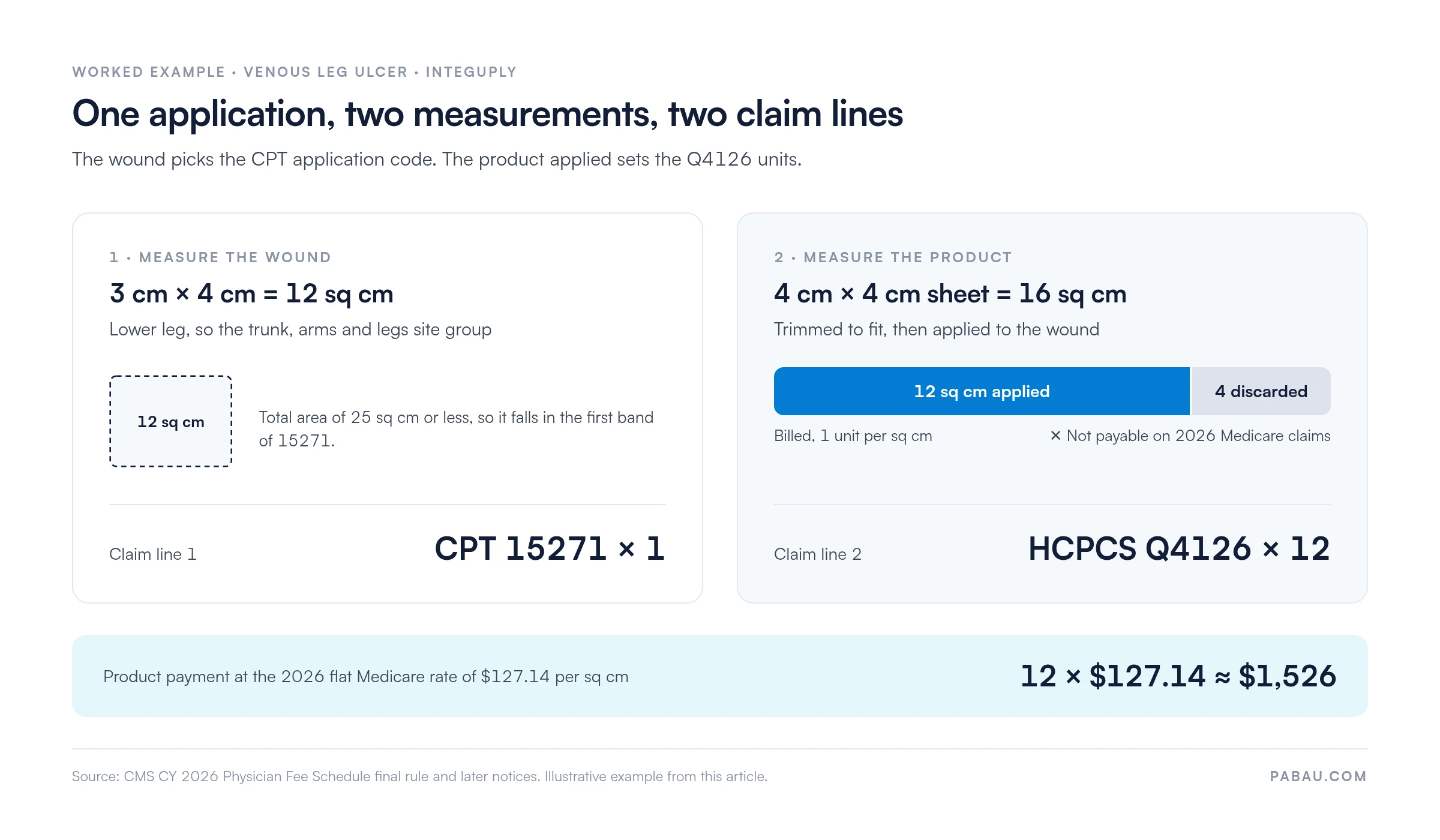
Two different measurements go on the claim, and mixing them up is the classic Q4126 error. The wound size picks the CPT code. The product size sets the Q4126 units.
Say a patient has a venous ulcer on the lower leg measuring 3 cm by 4 cm. That gives 12 sq cm of wound, so the application code is 15271 with one unit.
Next, look at the product. You open a 4 cm by 4 cm InteguPly sheet, which is 16 sq cm. You trim it and apply 12 sq cm to the wound.
For 2026 Medicare claims, you report 12 units of Q4126. CMS now treats discarded skin substitute as non-payable, so the 4 trimmed sq cm are not billed. Record the sheet size, the amount applied and the amount discarded in the procedure note.
Laid side by side, the two measurements turn into two separate claim lines.
One habit helps here. Stock the smallest sheet sizes that fit your typical wounds, so less product ends up in the bin.
Skin substitutes have their own pair of HCPCS modifiers. JC means the skin substitute was used as a graft. JD means it was not used as a graft. Some payers expect one of them on every Q4126 line, so check your payer manual.
JW and JZ are a different story. Their HCPCS descriptors cover drug amounts discarded, or zero drug discarded. CMS limits them to Part B drugs and biologicals that are paid separately. Its JW and JZ FAQ adds that they are not appropriate for incident-to supplies.
From January 1, 2026, CMS pays skin substitutes without a biologics license (BLA) as incident-to supplies. So for Medicare, leave JW and JZ off Q4126 unless the product holds a BLA. Commercial payers may set their own rules, so confirm before you change a long-standing habit.
Site modifiers are simpler. Add RT or LT where the payer asks for laterality, and keep them consistent across the CPT and Q4126 lines.
A skin substitute claim needs a diagnosis that explains why the wound exists and how deep it goes. That usually takes two codes, not one.
Payers read the diagnosis against their coverage policy. A vague code, such as an unspecified ulcer site, gives a reviewer an easy reason to deny.
CMS planned new skin substitute LCDs for diabetic foot ulcers and venous leg ulcers from January 1, 2026. It withdrew them on December 24, 2025, before they took effect. Coverage now follows whatever policy each MAC already had in place.
Where a legacy LCD applies, its rules govern Q4126. These policies typically require a documented period of standard wound care that failed first. Without a product-specific LCD, claims face the general reasonable-and-necessary test, reviewed case by case.
Prior authorization is changing too. Under the CMS WISeR model, six states run prior authorization for selected services from 2026. Skin substitutes are included only in WISeR states with an active skin substitute LCD. Medicare Advantage and commercial plans often require prior authorization anyway.
Before the first application, pull the current LCD for your jurisdiction. Then build your note template around its exact wording.
Until 2025, skin substitute payment followed each product’s average sales price. The CY 2026 Physician Fee Schedule final rule replaced that with a single rate. CMS published it at about $127.28 per square centimeter, and later notices cite a corrected $127.14.
The rate applies in the physician office, where the product is paid as an incident-to supply under the fee schedule. Hospital outpatient departments receive separate payment under the outpatient payment system. Check your MAC’s fee schedule for the figure in your locality.
Using the example above, 12 units at roughly $127 comes to about $1,526 for the product. The application code is paid on top of that.
Give steps 3 and 4 the closest look. A missing lot number or a wound-based unit count is enough to trigger a records request.
If a claim does deny, the remark code points you to the fix. Our guide to denial codes in medical billing explains how to read them.
The Q4101-Q4440 range lists skin substitutes brand by brand. Codes next to each other do not describe larger sheets or more applications. Here are a few neighbors that often get confused with Q4126.
When in doubt, match the brand on the packaging to the long descriptor in the current CMS file.
Skin substitute claims fail on detail. A unit count taken from the wound, a missing lot number or a lost application code can each stall payment.
Pabau, a practice management and billing platform, keeps those details on one patient record. Wound measurements, the product used and the amount applied sit in the clinical note. With Pabau’s claims management, you can then see each claim’s codes and status in one place, from submission to payment.
When a payer asks for records, the procedure note sits on the same record as the claim. Your team spends less time rebuilding the story behind each application.

Pabau keeps wound notes, product details and claim status on one record, so your team can answer a records request without digging.

Q4126 is a narrow code with a clear job. It bills four dermal allograft brands, by the square centimeter applied, alongside an application code. Get the brand right first, then let the wound pick the CPT code and the product set the units.
The bigger shift is 2026 payment. With a flat Medicare rate and no payment for discarded product, careful sheet sizing and clean documentation now protect revenue directly. Check your MAC’s current policy before each new episode of care.
Book a demo to see how Pabau keeps wound notes and skin substitute claims in step.

Want every claim to pass payer edits the first time? Clean claim submission covers the elements a claim needs before it leaves your practice.
Billing a Cytal application instead? HCPCS code Q4166 explains units, pairing and payment for Cytal.
Comparing another skin substitute brand? HCPCS code Q4127 walks through Talymed billing under the 2026 flat rate.
Need a process for denied claims? Denial management in healthcare sets out how to track, appeal and prevent denials.
Tightening documentation for audits? Medical billing compliance explains the documentation standards that hold up in review.
No. Q4126 covers MemoDerm, DermaSpan, TranZgraft or InteguPly. Cytal has its own code, Q4166. Bill the code that matches the brand you applied.
Yes. The January 2027 CMS HCPCS file, posted in November 2026, lists Q4126 as active, with no termination date. Check each quarterly update, since CMS terminates skin substitute codes from time to time.
There is no national limit in the code itself. Frequency limits come from your MAC’s LCD or the payer’s policy, so check the number of applications it allows per wound episode.
Not automatically. Commercial and Medicare Advantage plans pay under their own contracts and policies. Confirm the rate, prior authorization rules and modifier requirements with each plan.
The descriptor names no wound type, so coverage depends on the payer. Many policies focus on chronic diabetic and venous ulcers. Check yours before you apply the product to another wound type.