CPT code 93503: Swan-Ganz catheter billing and modifiers
CPT code 93503: Official descriptor and procedure overview In the AMA CPT code s...

Last Updated: Oct 23, 2026
Q4166 is the HCPCS Level II code for Cytal Wound Matrix, reported per square centimeter as an add-on code. It always sits on the claim beside a CPT application code from 15271-15278. Cytal is a porcine urinary bladder matrix made by ACell, now part of Integra LifeSciences.
Each unit is one square centimeter of Cytal placed on the wound. Since January 1, 2026, Medicare pays it as an incident-to supply at one flat national rate. Discarded product isn't payable, and a JW or JZ modifier gets the line rejected. The sections below follow a Q4166 claim from coverage check to remittance.
Let Pabau's smart automation suggest the right codes, reduce claim denials, and keep your practice compliant—effortlessly.
Automate repetitive tasks and focus on what matters most—your patients.
Reduce coding errors and ensure compliance with the latest regulations.
Clean claims, fewer denials, and faster reimbursements.
Powerful insights and reporting to help your practice thrive.
HIPAA compliant SOC 2 certified GDPR-compliant Trusted by 4,000+ clinics worldwide

HCPCS code Q4166 reports Cytal Wound Matrix, a porcine urinary bladder matrix from ACell, billed per square centimeter of product applied.
Since January 1, 2026, Q4166 is an add-on code, so it always sits on the claim with a CPT 15271-15278 application code.
Medicare now pays skin substitutes as incident-to supplies at one flat national rate of about $127 per square centimeter.
Bill only the Cytal applied, because discarded product isn’t payable and JW or JZ modifiers get the line rejected.
Pabau’s claims management pre-fills the claim from the patient record, checks required fields, and submits it through Claim.MD.
HCPCS code Q4166 is the Level II code for Cytal Wound Matrix, reported per square centimeter of product. The 2026 CMS descriptor reads: “Cytal, per square centimeter (add-on, list separately in addition to primary procedure).”
Cytal is made by ACell, Inc., which Integra LifeSciences acquired in 2021. It’s a porcine urinary bladder matrix (UBM), an animal-derived scaffold rather than human amnion or chorion tissue. The FDA cleared it through the 510(k) pathway for wounds that include diabetic, venous and pressure ulcers.
The add-on wording is the only descriptor change for 2026. It spells out how the code already worked. Q4166 reports the product, and a separate CPT code reports the application.
Medicare stopped paying most skin substitutes as biologicals on January 1, 2026. Under the CY 2026 Physician Fee Schedule final rule (CMS-1832-F), products like Cytal are paid as incident-to supplies. Quarterly average sales price (ASP) figures no longer set the Q4166 allowance.
Instead, CMS pays one national rate per square centimeter, whatever the brand. The CY 2026 OPPS and ASC final rule lists that rate as $127.14 per square centimeter. Product payment stays separate from the application procedure, so Q4166 still pays on its own line.
In a hospital outpatient department, CMS sorts sheet products into three APCs by FDA pathway. APC 6000 covers PMA products, APC 6001 covers 510(k) products, and APC 6002 covers 361 HCT/Ps. Cytal’s 510(k) clearance places it in APC 6001, under the new status indicator S1.
Q4148 sits in that last category. It covers Neox Cord and Clarix Cord, amniotic umbilical cord allografts regulated as 361 HCT/Ps rather than animal-derived scaffolds like Cytal.
The waste rules changed too. Medicare pays only for product applied to the patient, never for discarded portions. Claims carrying the JW or JZ modifier on a skin substitute line are rejected for dates of service from January 1, 2026.
Coverage depends on your Medicare Administrative Contractor (MAC). The A/B MACs withdrew the new skin substitute LCDs that were due to start on January 1, 2026. CMS announced the withdrawal on December 24, 2025.
Three MACs still apply older policies. CGS uses LCD L36690, “Wound Application of Cellular and/or Tissue Based Products (CTPs), Lower Extremities,” in Kentucky and Ohio. Novitas applies L35041, and First Coast applies L36377. Elsewhere, each claim is judged against the reasonable-and-necessary standard.
L36690 sets limits worth building into your wound care workflow:
Commercial and Medicare Advantage plans set their own rules, and many require prior authorization before the first application. Check each plan’s skin substitute policy before you book the visit.
Every Q4166 claim needs diagnoses that name the wound type and its site. Under L36690, that usually means a diabetic foot ulcer or a venous ulcer of the lower extremity. For a type 2 diabetic foot ulcer, E11.621 leads, and an L97 code adds the site.
L97 codes build detail in stages. The fourth character gives the site, the fifth gives laterality, and the sixth gives severity. L97.422, for example, is a chronic ulcer of the left heel and midfoot with fat layer exposed.
Code to the deepest severity the chart supports. An unspecified severity weakens the medical necessity case when a reviewer reads the claim.
Because Q4166 is an add-on code, it can’t stand alone on a claim. The application is reported with CPT 15271-15278, chosen by wound site and total wound surface area.
CPT 15273 and CPT 15274 aren’t pediatric-only codes. They cover large wounds of 100 sq cm or more at any age. The body-area option applies to infants and children.
Feet sit in the second site group. So a diabetic foot ulcer usually takes 15275, while a calf ulcer takes CPT 15271.
Each Q4166 unit equals one square centimeter of Cytal applied. The CPT code counts the wound surface area instead. Both numbers belong in the procedure note, side by side.
Here’s how that looks on a claim. A 5 cm by 4 cm heel ulcer measures 20 sq cm. The clinician trims a larger Cytal sheet and applies 20 sq cm of it. The claim shows 15275 for one unit and Q4166 for 20 units, and the practice absorbs the offcut. The diagram below keeps those two counts side by side.
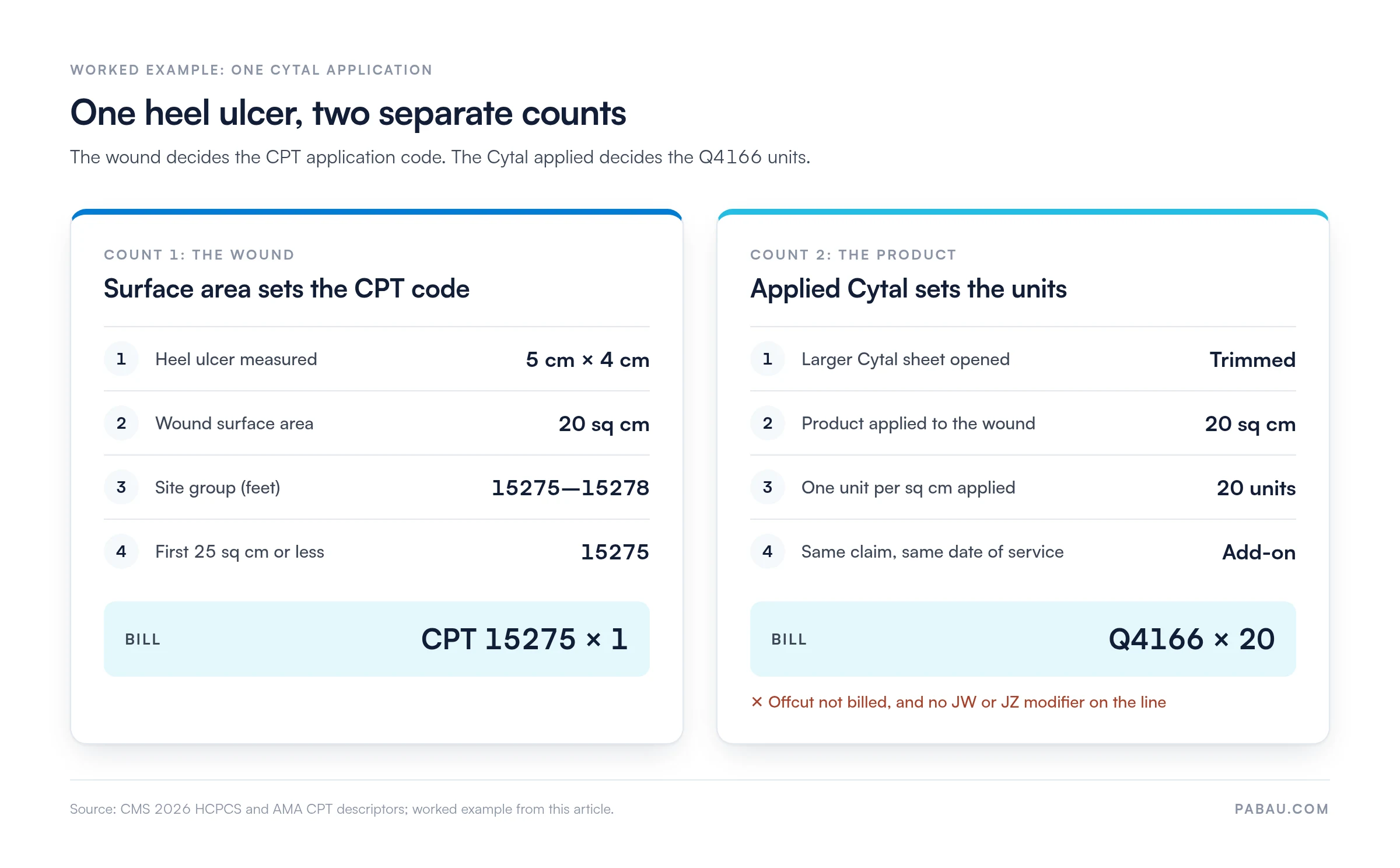
Q4166 has no size tier, so no cut-off hands a large wound to another code. A bigger wound simply means more units.
When a line comes back denied, read the claim adjustment reason code (CARC) before you appeal. It tells you whether to correct the claim or argue medical necessity.
Q4166 is a single product code, not one size band in a family. Neighboring codes report other brands, each with its own descriptor.
HCPCS code Q4167 sits next to Q4166 numerically, but it reports Truskin, a separate product. Amnioband, a human amniotic membrane product, uses Q4151 for sheets and Q4168 for the 1 mg form.
The code follows the brand, so check the descriptor against the product packaging at every application. If a different product went on the wound, find its code in our HCPCS billing guides before you bill.
A DermaPure application, for example, belongs on Q4152. It’s a decellularized human dermal allograft, so Cytal’s code never covers it.
Skin substitute claims carry a lot of detail, and retyping it is where errors creep in. Many practices chart in one system and submit through a separate clearinghouse portal.
Pabau, the practice management and billing platform we build, keeps those steps together. Its claims management software pre-fills the claim form from the patient record. Codes attached to the service land on the charge lines. Searchable ICD-10-CM, CPT and HCPCS libraries sit inside the form.
Before a claim goes out, Pabau checks that required fields are complete, such as membership numbers and authorization codes. Claims then go to the payer through Claim.MD, with real-time eligibility checks, claim-status tracking and ERA posting.
Pabau doesn’t choose codes or judge medical necessity. Your coder keeps those decisions, and Pabau gets the finished claim out without a second round of data entry.

Pabau pre-fills Q4166 claims from the patient record, checks required claim fields, and submits through Claim.MD. See how it fits your wound care billing.

Q4166 billing got simpler in 2026, but also less forgiving. One flat rate replaced shifting ASP figures. Waste and modifier errors, meanwhile, now lead straight to unpaid product or rejected lines.
The claims that pay keep two measurements apart: wound surface area for the CPT code, applied product for Q4166. Track application counts per wound, and check your MAC’s policy before the first sheet is opened.
If your team still copies wound notes into claim forms by hand, start there. Book a demo to see how Pabau carries Q4166 claims from the patient record to submission.

Billing a lower-leg application? CPT code 15271: Skin substitute graft billing guide covers the first 25 sq cm on the trunk, arms and legs.
Wound bigger than 25 sq cm? CPT code 15272: Skin substitute graft add-on billing guide explains how each additional 25 sq cm is reported.
Treating a large wound? CPT code 15273: Skin substitute graft billing guide sets out the 100 sq cm threshold.
Past the first 100 sq cm? CPT code 15274: Skin substitute graft billing guide walks through the large-wound add-on.
Using Truskin instead? HCPCS code Q4167: Truskin units, CPT pairing and prior auth covers the neighboring product code.
No. Cytal is made from porcine urinary bladder matrix, so it’s animal-derived. Some patients decline porcine materials for religious or personal reasons. Mention the source during consent and record the patient’s agreement.
Not automatically. The flat 2026 rate is a Medicare figure. Commercial plans pay what your contract sets, which may differ. Check each fee schedule before you quote a patient’s share.
Cytal’s FDA clearance covers second-degree burns, post-Mohs wounds and dehisced surgical wounds. Coverage is narrower than clearance, though. L36690 addresses lower-extremity chronic wounds, so confirm the payer’s policy before using Q4166 elsewhere.
Add the applied area from every sheet and report the total as Q4166 units on one line. Record each sheet’s size and lot number so an auditor can trace the units.