HCPCS code P9058: Red blood cells, leukocytes reduced, CMV-negative, irradiated
HCPCS code P9058: Official descriptor and key attributes HCPCS code P9058 report...

Last Updated: Oct 26, 2026
P9612 is the HCPCS Level II code for catheterization for collection of specimen, single patient, all places of service. It covers inserting a catheter only to obtain a urine specimen when the patient cannot provide a voided sample. The catheter comes out right after collection.
Medicare pays P9612 on the Clinical Laboratory Fee Schedule at one national rate. Therapeutic or diagnostic catheterization is reported with CPT 51701 instead, and a catheter left in place with CPT 51702.
Let Pabau's smart automation suggest the right codes, reduce claim denials, and keep your practice compliant—effortlessly.
Automate repetitive tasks and focus on what matters most—your patients.
Reduce coding errors and ensure compliance with the latest regulations.
Clean claims, fewer denials, and faster reimbursements.
Powerful insights and reporting to help your practice thrive.
HIPAA compliant SOC 2 certified GDPR-compliant Trusted by 4,000+ clinics worldwide

HCPCS Code P9612 is the Level II code for catheterizing one patient to collect a urine specimen, not for therapeutic catheterization or catheter supplies.
CPT 51701 covers non-indwelling catheter insertion for therapeutic or diagnostic purposes. P9612 applies only when specimen collection is the sole reason for the catheter.
Medicare pays P9612 on the Clinical Laboratory Fee Schedule at one national rate, $9.34 for CY2026, with no facility or non-facility split.
The note must explain why a clean-catch voided specimen was not feasible. Without that rationale, payers deny the claim.
Pabau’s claims management software keeps the procedure note and the diagnosis pairing together, so P9612 is supported before the claim leaves the practice.
HCPCS Code P9612 is the HCPCS Level II code for catheterizing a single patient to collect a urine specimen. The Centers for Medicare and Medicaid Services (CMS) maintains it. Its official descriptor is Catheterization for collection of specimen, single patient, all places of service.
The code sits in the pathology and laboratory section (P-codes). It covers only the insertion of a urinary catheter to obtain a urine specimen when a voided sample is not clinically possible. Its sibling, P9615, covers the same collection across multiple patients.
The table below summarizes the reference points billers check most often.
P9612 applies in one clinical scenario. A straight catheter goes into the bladder only to collect a urine specimen, and it comes out right after collection. This happens most in urology and primary care, when the patient cannot give a clean-catch midstream sample.
Common reasons include urinary retention, altered consciousness, severe obesity, anatomical factors, and neurogenic bladder.
Knowing what the code does not cover prevents the most common filing errors:
Two questions settle the code: why the catheter went in, and whether it stayed in. The guide below maps each answer to the code that fits.
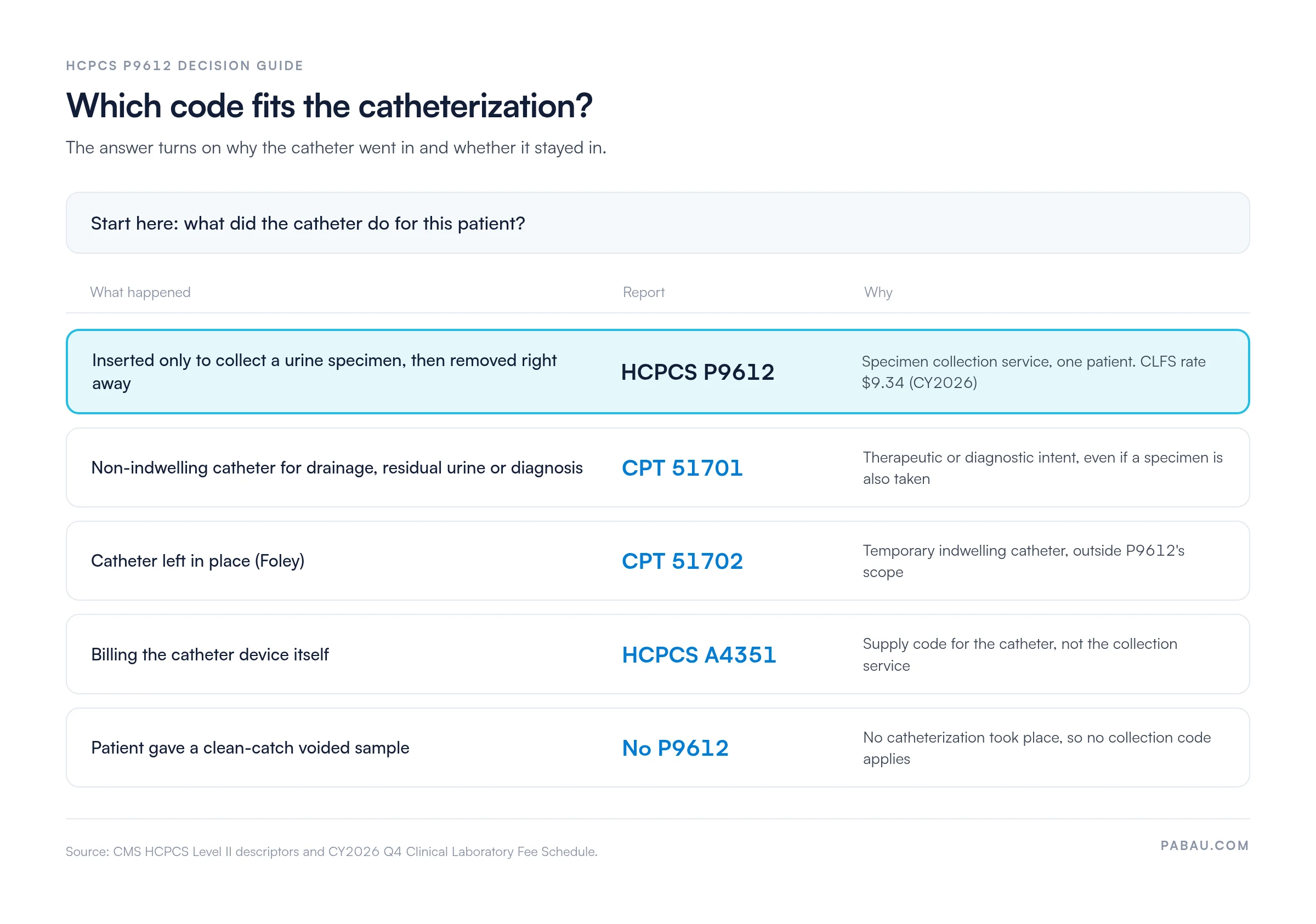
P9612 and CPT 51701 both involve urinary catheter insertion, but they serve different purposes and belong to different coding systems. Filing 51701 when only a specimen was collected is one of the most auditable errors in urology billing. The table below shows when each code applies:
According to the American Medical Association (AMA), CPT 51701 carries a work RVU. It describes a procedure with therapeutic or diagnostic intent beyond specimen collection. Using CPT 51701 for a straight catheter inserted purely to collect a sample is a code-system mismatch that invites post-payment audit.
Coders working with HCPCS Code P9612 regularly encounter several adjacent codes. Knowing each code’s scope prevents bundling errors and duplicate billing:
Documentation decides whether a P9612 claim survives post-payment review. Payers routinely deny the code when the note does not explain why a catheter was needed instead of a voided specimen. Solid medical billing compliance starts with the note, before the claim is built.
Every clinical note supporting HCPCS Code P9612 should include these elements:
Run a documentation audit on a sample of recent P9612 claims. Pull 10 charts where P9612 was billed and confirm each note contains a voiding-failure rationale. If more than 2 lack that sentence, update your nursing documentation template to require it as a mandatory field.
Three variables decide whether a P9612 claim pays: the modifier when a bundling edit applies, the place-of-service code, and each payer’s coverage policy.
P9612 may be billed on the same date as CPT 51701, or as a procedure that includes catheterization. In that case, NCCI edits may bundle the codes and pay only the higher-value procedure. Modifier 59 (distinct procedural service) on P9612 shows the specimen collection was separate from any same-day therapeutic catheterization.
Modifier 59 should only be used when the clinical record supports that the catheterization for specimen collection was separate from any other catheter procedure. According to community coding guidance, blanket use of modifier 59 without that documentation exposes the claim to audit. The note must explicitly describe two distinct catheterization events.
Place of service decides whether P9612 is separately payable. It does not change the Medicare rate, because the Clinical Laboratory Fee Schedule sets one amount for every setting. P9612 is most commonly billed from these settings:
Medicare Administrative Contractors (MACs) publish Local Coverage Determinations (LCDs) that govern whether specific HCPCS codes are covered in their jurisdiction. Always verify the applicable MAC’s LCD for catheterization and specimen collection codes before billing.
Commercial payers may have separate policies that differ from Medicare’s, and some may require prior authorization for repeated specimen collections. Verify each payer’s policy annually. A well-structured claims management workflow surfaces payer-specific edits before submission rather than after a denial.
Medicare pays HCPCS Code P9612 through the Clinical Laboratory Fee Schedule (CLFS), not the Medicare Physician Fee Schedule. The CLFS sets one national rate, which is $9.34 for CY2026. That rate applies in every place of service, as the code’s descriptor suggests.
Key reimbursement considerations for P9612:
Check the current rate in the CMS CLFS files before you forecast revenue. CMS publishes updated CLFS files each quarter.
A mismatched or insufficiently specific ICD-10-CM diagnosis code is one of the leading denial triggers for HCPCS Code P9612. The diagnosis must establish medical necessity for catheter collection rather than a voided sample. The following ICD-10-CM codes commonly support P9612 claims:
Select the most specific ICD-10-CM code available. Using an unspecified code (e.g., R33.9) when a more specific code exists may prompt a payer to question medical necessity. When multiple diagnoses apply, sequence the primary condition first.
Understanding the denial patterns for HCPCS Code P9612 is central to sustainable denial management in healthcare. Reviewing denial codes in medical billing alongside the specific P9612 claim helps RCM teams trace the root cause accurately. The top denial categories and their prevention steps are:
Practices with a high volume of urinary catheterization claims benefit from a clean claim submission checklist specific to P9612. It covers five checkpoints:
Those checkpoints answer every denial reason in the table above before the claim leaves the clearinghouse. The superbill used at the point of care is the natural place to embed them.
Cross-reference your HCPCS Code P9612 denials against the AAPC HCPCS code lookup. Check whether the payer’s NCCI edit table changed this quarter. CMS updates NCCI edits quarterly, and a bundling edit that did not exist in January may appear by April.
In many practices, the voiding-failure note, the diagnosis and the modifier live in different places. The coder rebuilds the story from the chart after the visit, which is where a 51701 swap or a missing rationale slips through.
Pabau, the practice management platform we build, keeps the treatment note, the diagnosis codes and the claim in one patient record. A note template can carry a voiding-failure field that nurses complete at the bedside. The coder then sees why the catheter went in before choosing the code.
The claim goes out with the code, the diagnosis pairing and the documentation already lined up. You work fewer denials on a code where one round of rework can cost more than the $9.34 it pays.

Pabau helps urology and primary care practices capture the clinical detail behind HCPCS billing at the point of care. Claims go out clean the first time.

At $9.34 a claim, P9612 is never worth appealing. The money is made or lost before submission, so the fix belongs in the note, not in the denial queue.
Start with the nursing note template. Once the voiding-failure reason is a required field, the medical-necessity denial goes away and the coder has what they need to choose P9612 over 51701.
Book a demo to see how Pabau ties the catheterization note, the diagnosis and the claim together for urology and primary care practices.

Need to understand clean claim standards before submission? Clean claim submission covers the elements every claim must contain to pass payer edits on first pass.
Looking for an overview of medical billing workflows? Medical billing workflows explains the end-to-end billing cycle from patient encounter to payment posting.
Need to report the catheter itself? HCPCS code A4351 explains the supply code for intermittent straight-tip urinary catheters.
HCPCS Code P9612 covers catheterizing one patient with a straight (non-indwelling) catheter inserted only to obtain a urine specimen. It does not cover therapeutic catheterization, indwelling catheter placement, or catheter supplies, which are reported with separate CPT or HCPCS supply codes.
Use P9612 when the catheterization’s only purpose is urine specimen collection and the catheter is removed immediately after. Use CPT 51701 when the catheterization is therapeutic, such as draining a full bladder or measuring post-void residual. That holds even if a specimen is collected during the same insertion.
Modifier 59 (distinct procedural service) is the modifier most often appended to P9612. It applies when the specimen collection is a separate service from a same-day therapeutic catheterization. Modifier 59 should only be used when the clinical note documents two distinct catheterization events; blanket use without supporting documentation commonly invites audit.
Commonly paired ICD-10-CM codes include R33.9 (urinary retention), N39.0 (urinary tract infection), R31.9 (hematuria), and N31.9 (neurogenic bladder). The diagnosis must explain why a clean-catch voided specimen was not clinically feasible; a vague or unrelated diagnosis is a leading cause of P9612 denials.
Yes. Medicare pays P9612 through the Clinical Laboratory Fee Schedule at one national rate, $9.34 for CY2026. There is no facility or non-facility split. Check the current rate in the CMS CLFS files, which CMS updates each quarter.
Yes. P9612 covers the catheterization service itself, while urinalysis codes such as CPT 81000 (urinalysis with microscopy) cover the laboratory analysis of the collected specimen. The two codes address different services and are generally separately reportable, provided both are supported by the clinical record and ordered by the treating provider.