CCSD code L6530: Revision femoral bypass graft
CCSD code L6530: Definition and clinical scope CCSD code L6530 carries the offic...

Last Updated: Nov 13, 2026
P9011 is the HCPCS Level II code for blood, split unit. It reports part of one unit of blood or a blood component that was divided. The other parts go to different patients, or to the same patient at a later time.
The revenue code names the product: 0389 for red cells or whole blood, 0383 for plasma and 0384 for platelets. Each splitting procedure is reported separately with CPT 86985.
Let Pabau's smart automation suggest the right codes, reduce claim denials, and keep your practice compliant—effortlessly.
Automate repetitive tasks and focus on what matters most—your patients.
Reduce coding errors and ensure compliance with the latest regulations.
Clean claims, fewer denials, and faster reimbursements.
Powerful insights and reporting to help your practice thrive.
HIPAA compliant SOC 2 certified GDPR-compliant Trusted by 4,000+ clinics worldwide

HCPCS Code P9011 means blood, split unit: part of one unit of blood or a blood component divided between patients or transfusions.
P9011 names the split, and the revenue code names the product: 0389 for red cells or whole blood, 0383 for plasma, 0384 for platelets.
Report CPT 86985 for each split done for a specific patient. Leave it off the last portion of a unit, which needed no new split.
Under the October 2026 OPPS Addendum B, P9011 has status indicator R and APC 9520, with a national unadjusted rate of $155.84 per unit.
Fresh frozen plasma has its own codes, P9017, P9059 and P9060, so a whole unit of plasma is never billed as P9011.
HCPCS Code P9011 is the code for blood, split unit. It reports a portion of one unit of blood or a blood component that the blood bank divided. The other portions go to different patients, or to the same patient at a later time.
P9011 belongs to the HCPCS Level II code set that the Centers for Medicare & Medicaid Services (CMS) maintains. It sits in the P section, which covers pathology and laboratory services, inside the blood and blood products group P9010-P9100.
Blood components themselves are manufactured and labeled under FDA rules, including 21 CFR Part 606. HCPCS only assigns the billing code. A split unit keeps the identity of the parent unit in the blood bank record, so the source unit number follows each portion.
P9011 covers the transfused portion of a unit that was divided. CMS created the code for one situation, set out in the Medicare Claims Processing Manual, chapter 4, section 231.4.
A whole unit of plasma frozen within 8 hours of collection is billed as P9017. One frozen between 8 and 24 hours is billed as P9059. P9011 only applies once a unit has been physically divided.
P9011 tells the payer that the product was a split unit. It does not say which product. On an institutional claim, the revenue code carries that information.
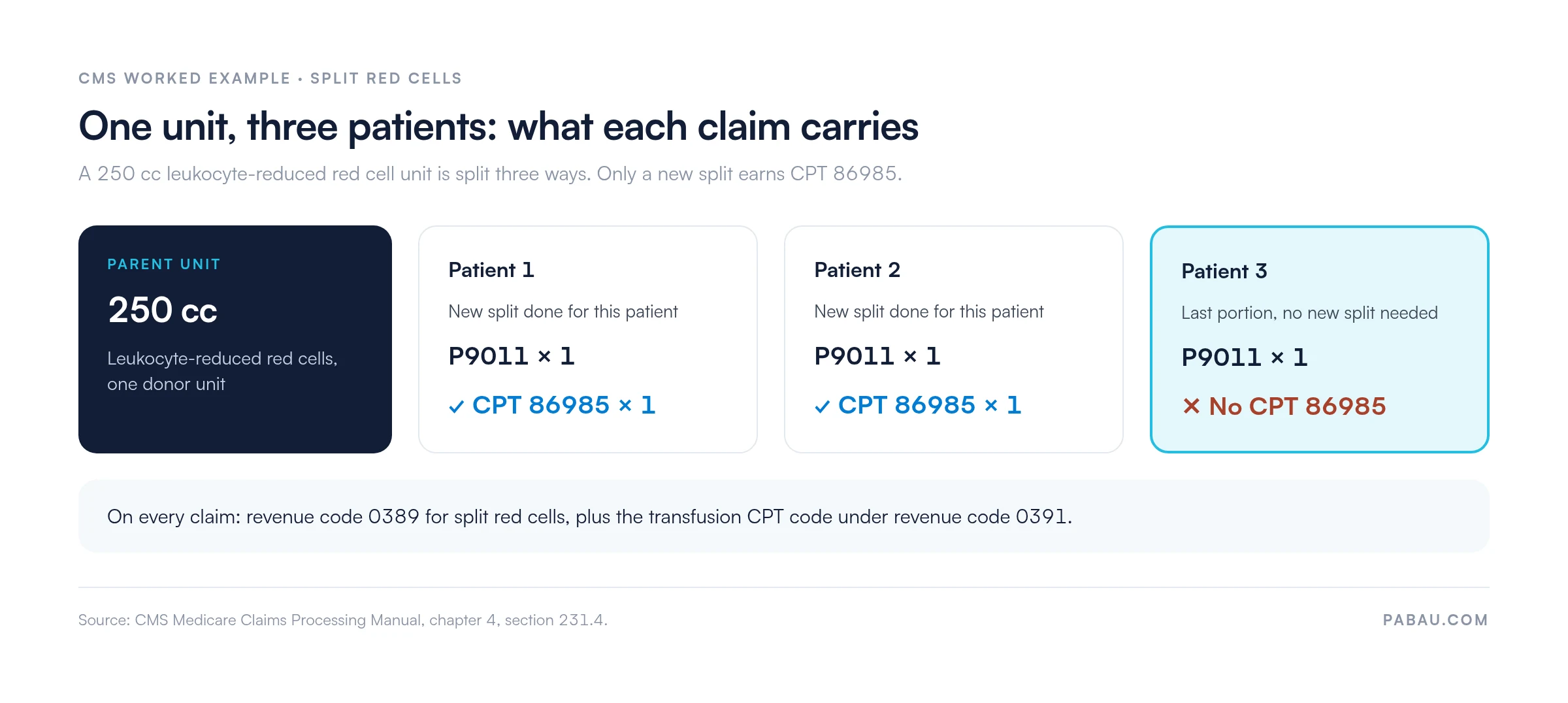
CPT 86985 pays for the work of dividing the unit. Report it once for each splitting procedure performed to prepare a portion for a specific patient. The last portion of a unit needs no new split, so that patient gets P9011 and the transfusion code, usually 36430, with no 86985.
CMS gives a worked example in section 231.4. A 250 cc leukocyte-reduced red cell unit is split three ways. The first two patients each get P9011 plus 86985, while the third patient gets P9011 alone. Laid out claim by claim, the split looks like this.
Check how 86985 pays before you forecast revenue from it. In the October 2026 Addendum B it carries status indicator Q1. It is packaged when a status S, T or V service, such as transfusion code 36430, is on the same claim.
The descriptors below come from the CMS October 2026 HCPCS file. The status indicators, APCs and rates come from the October 2026 OPPS Addendum B.
P9011 pays one flat rate, whatever product was split. A split portion of plasma and a split portion of irradiated red cells both map to APC 9520.
Solvent/detergent-treated pooled plasma has its own code, P9023, and is not the same product as pathogen-reduced pooled plasma, P9070. Check the descriptor on the blood bank label before you choose between them.
Medicare pays P9011 in the hospital outpatient setting under the Outpatient Prospective Payment System (OPPS). The October 2026 OPPS Addendum B lists the code with status indicator R, APC 9520 and a relative weight of 1.7047.
Status indicator R marks standard separate payment for blood and blood products. Transitional pass-through payment uses indicator G for drugs and biologicals, or H for devices. Rates change quarterly, so check the current Addendum B before you quote a figure.
The Medicare blood deductible covers whole blood and packed red cells only. That is why CMS sends split red cells and split whole blood to revenue code 0389. JW and JZ are drug-waste modifiers for single-dose drug containers, so neither belongs on a P9011 line.
A split unit claim needs a record that links each portion to its parent unit and to the patient who received it. Keep these items in the chart or blood bank system before the claim goes out.
P9011 is a product code, so the diagnosis comes from the reason for the transfusion. Split units are common in neonatal and pediatric care, where small aliquots limit donor exposure. The codes below are examples rather than a coverage list.
Code the most specific diagnosis the record supports. Confirm current code status in the CDC/NCHS ICD-10-CM files before you submit.
Most P9011 errors come from treating the split like a whole unit, or from the wrong revenue code. Our guide to medical billing denial codes explains how to read the remittance codes that follow.
A denial management review that groups these errors by cause finds the fix faster than reworking each claim one at a time.
A clean claim for a split unit is one where the HCPCS code, revenue code, splitting code and unit count all tell the same story. A superbill that lists P9011, 86985 and the transfusion code together makes that easier to get right.
Split-unit billing depends on several codes that must agree with one another. When the charge, the revenue code and the transfusion line are keyed by hand, small mismatches slip through and come back as denials weeks later.
Pabau, the practice management and billing platform we build, keeps the patient record, charges and claims in one place. Its electronic claims management submits insurance claims and tracks each one through to payment. Your team sees a rejected or denied claim in one queue and can correct it quickly.
The coding decisions still sit with your billing team and blood bank. Pabau gives them one view of what was billed, what was paid and what came back, so a denied split-unit line is easy to trace.

Pabau’s claims management submits insurance claims electronically and tracks their status. Your billing team spots a rejected or denied claim early and corrects it quickly.

P9011 is a narrow code with a precise job. It only applies once a unit has been physically divided, and it always needs the revenue code to say what the product was.
Build the check into your blood bank handoff rather than your denial queue. Ask whether the unit was split, which product it was, and whether this patient needed a new split. Those three answers settle P9011, the revenue code and 86985.
Book a demo to see how Pabau helps your billing team submit claims and track every payment in one place.

Billing a whole unit of plasma instead? HCPCS code P9017 covers single-donor fresh frozen plasma frozen within 8 hours of collection.
Splitting leukocyte-reduced red cells? HCPCS code P9016 explains the code for a whole unit of leukocyte-reduced red blood cells.
Need a framework for recurring denials? Denial management in healthcare covers root-cause analysis for claims that keep coming back.
Billing a whole, undivided red cell unit? HCPCS code P9021 covers a standard unit of red blood cells with no further processing.
HCPCS code P9011 covers a split unit of blood or a blood component. It reports the portion transfused when one unit is divided between patients, or for the same patient at different times. It does not cover the splitting procedure, which is CPT 86985.
No. The CMS descriptor for P9011 is blood, split unit. Fresh frozen plasma is billed with P9017, P9059 or P9060, depending on freezing time and donor retesting. A split portion of plasma is billed with P9011 and revenue code 0383.
It depends on the product that was split. CMS directs split red cells and split whole blood to revenue code 0389. Split plasma goes to 0383 and split platelets to 0384.
Bill 86985 once for each splitting procedure done to prepare a portion for a specific patient. When the last portion of a unit is transfused and no new split was needed, report P9011 and the transfusion code only.
In the October 2026 OPPS Addendum B, P9011 has status indicator R and APC 9520. The national unadjusted payment rate is $155.84 per unit before wage adjustment. Check the current quarterly Addendum B, because rates change each quarter.