

CCSD code G5100: Bypass of duodenum billing guide
CCSD code G5100 bills a bypass that leaves the duodenum in place CCSD code G5100...

Last Updated: Oct 16, 2026
M0300 is the HCPCS Level II code for iv chelation therapy (chemical endarterectomy).
Coverage splits on the indication behind the infusion. Medicare and the major commercial payers pay M0300 for heavy metal poisoning backed by lab evidence, and deny it for atherosclerosis.
Let Pabau's smart automation suggest the right codes, reduce claim denials, and keep your practice compliant—effortlessly.
Automate repetitive tasks and focus on what matters most—your patients.
Reduce coding errors and ensure compliance with the latest regulations.
Clean claims, fewer denials, and faster reimbursements.
Powerful insights and reporting to help your practice thrive.
HIPAA compliant SOC 2 certified GDPR-compliant Trusted by 4,000+ clinics worldwide

HCPCS Code M0300 describes IV chelation therapy (chemical endarterectomy), the HCPCS Level II code for intravenous infusion of chelating agents such as EDTA.
Medicare covers M0300 for heavy metal poisoning with laboratory evidence, and treats chelation for atherosclerosis as experimental and non-covered.
Documentation errors are the top denial driver, so every M0300 claim needs a physician order, lab evidence of toxicity, and a written treatment rationale.
A non-covered indication still gets billed, with the GY modifier and a signed ABN, because the denial record is what makes the patient billable.
Practice management software like Pabau tracks payer-specific coverage rules and flags incomplete documentation before claims reach the clearinghouse.
M0300 sits in the Miscellaneous Medical Services group of HCPCS Level II. It covers administration of a chelating agent, primarily EDTA, given to bind and remove heavy metals. The same code carries the off-label cardiovascular use, where chelation is given to treat atherosclerosis.
The Centers for Medicare and Medicaid Services (CMS) maintains HCPCS Level II codes and issues quarterly updates. M0300 has remained active through the most recent quarterly release and carries no termination date for the 2026 coding year.
IV chelation therapy is the intravenous infusion of a chelating agent, most commonly EDTA, that binds heavy metal ions in the bloodstream.
Once bound, the metal-chelate complex leaves the body through the kidneys. The term “chemical endarterectomy” reflects the historical cardiovascular use, where proponents argued that chelation could clear arterial plaques.
Two distinct patient populations receive this treatment, and the billing path differs sharply between them. Practices offering chelation in integrative or functional medicine settings see mostly the second and third groups below.
Verify the patient’s clinical indication before assigning M0300. Heavy metal poisoning requires documented lab values showing elevated blood or urine metal concentrations. Without that evidence, the claim will be denied however well the rest of the record is completed.
Medicare fee schedule rates for M0300 vary by locality and carrier. Because Medicare treats chelation for cardiovascular indications as non-covered, the published rate in most localities reflects that status rather than a payable amount.
For the covered heavy metal poisoning indication, check the current rate in the CMS Physician Fee Schedule lookup tool. Rates differ between facility and non-facility settings and change annually.
For practices billing commercial insurance, the contracted rate and the coverage determination both sit in the plan’s own medical policy bulletin. Confirm reimbursement eligibility before administering the infusion.
Coverage for M0300 is payer-specific and indication-driven. Medicare states plainly that chelation therapy for atherosclerosis or cardiovascular disease is non-covered, and most major commercial payers hold the same position.
Before billing M0300, confirm the coverage status with the specific payer and plan. Some payers also require physician supervision of the infusion, so record the credentials of whoever administered it. Auditors ask for proof of provider qualifications more often on chelation claims than on routine infusions.
When billing a Medicare patient for a non-covered indication, issue an Advance Beneficiary Notice of Non-coverage (ABN) before administering the service.
Without a valid ABN, the practice cannot collect from the patient once Medicare denies the claim. The diagnosis code, the modifier, and the consent step all follow from that same lab result.
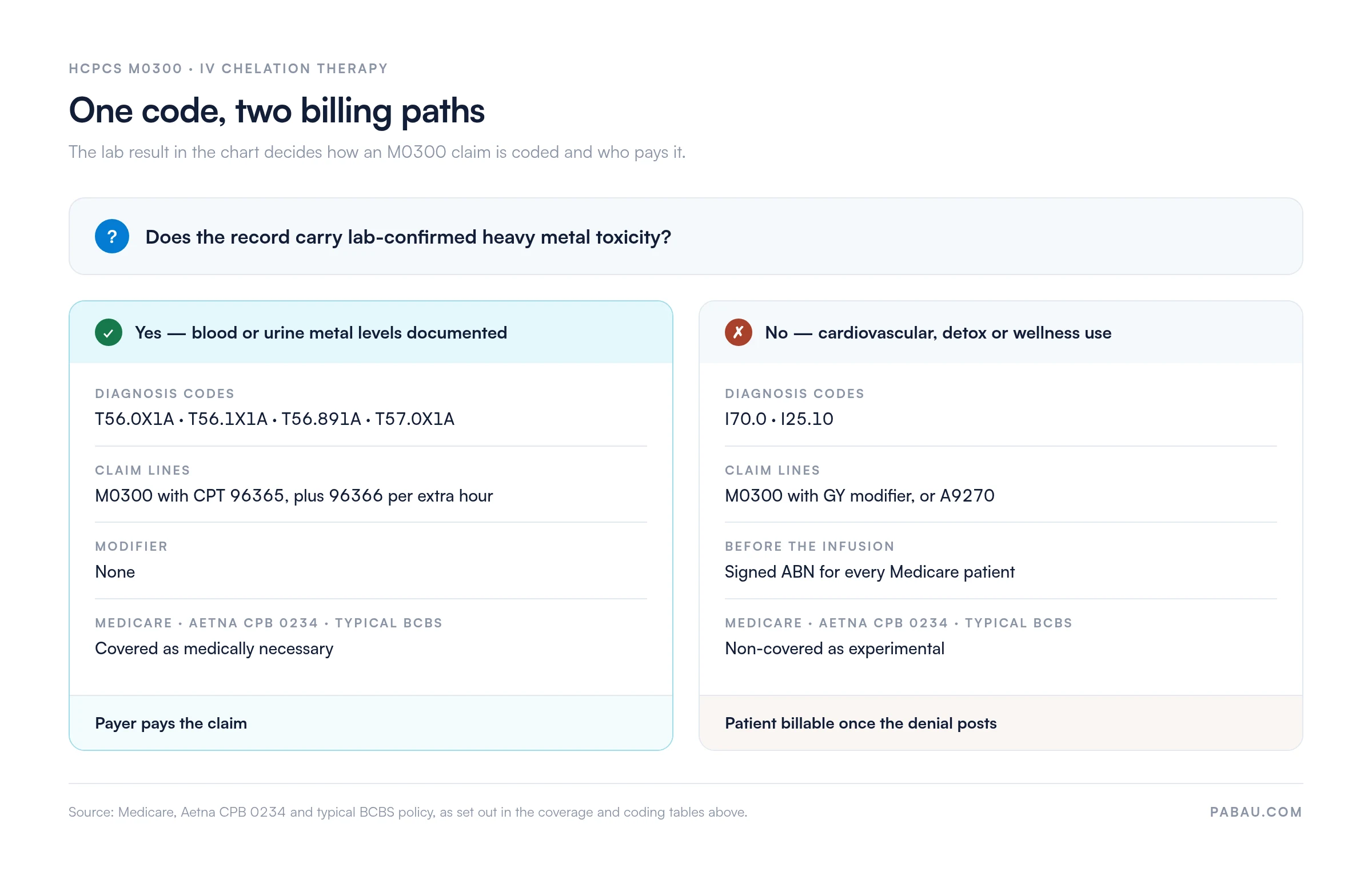
Pairing M0300 with the correct ICD-10 diagnosis code decides whether a claim is approved or denied. The applicable codes depend entirely on the clinical indication. Only use diagnosis codes that the patient’s record and laboratory findings support.
The T56 and T57 series codes for toxic effects of metals are the most commonly paired diagnoses on covered M0300 claims. Always use the most specific code available, including the seventh character for encounter type. That character is A for an initial encounter, D for a subsequent one, and S for sequela.
Full descriptions for each of these codes sit in the ICD-10-CM code index, and the AAPC HCPCS code lookup cross-references them against current payer policies.
M0300 rarely travels alone on a claim. Several CPT and HCPCS codes are billed alongside it, or take its place, depending on how the service is structured.
For the infusion administration itself, bill CPT 96365 for the first hour and CPT 96366 for each additional hour. Some payers will not reimburse M0300 separately if they treat it as bundled into those administration codes. Confirm the bundling rules with the MAC or the commercial payer before submitting.
Clean M0300 claims have their documentation assembled before the infusion begins, not after the denial. The checklist below is what a payer or auditor asks for on a chelation claim, and the order in which the record should carry it.
The laboratory evidence named in the first item is a billable service of its own. A quantitative blood lead test bills under 83655.
Prior authorization requirements vary by payer. Most commercial plans that cover M0300 for heavy metal poisoning require it, particularly for a multi-session course. Check the payer’s provider portal or call the authorization line before scheduling the first infusion.
CMS issues HCPCS code updates quarterly. M0300 has been an active code for several years. The October 2025 quarterly update published by CGS Medicare (Jurisdiction C) confirmed it as active. No revision or deletion action was taken on M0300 in that update cycle.
Check the code status against the CMS annual HCPCS update file before you bill, and again after each quarterly release. A quarterly update can change a code’s status, its description, or the coverage notes attached to it.
Most practices billing chelation keep the pieces of an M0300 claim in separate places. Lab results arrive by fax or portal. The physician order sits in the chart and the ABN goes in a paper folder. The coder then assembles all three at submission. A missing lab result is only discovered when the denial posts, weeks later.
Practice management software like Pabau keeps the payer rules and the record in the same system. Pabau’s claims management software checks each claim against payer-specific rules before it goes out. It flags the missing lab evidence or physician order that M0300 claims consistently need. Intake, consent, lab results, and the infusion note live on one patient record, so an audit request is answered from one screen.
The result is a shorter path from infusion to payment. Coverage rules get applied before the appointment rather than after the denial, so your team spends its time on the appeals worth filing.

Audit your M0300 submissions before the quarter closes. Pull every chelation claim from the past 90 days and flag any that reached adjudication with no lab result on file. Then build that check into the pre-submission workflow so the next quarter needs no audit.

Pabau tracks payer-specific coverage rules and flags incomplete documentation before M0300 claims reach the clearinghouse. See how integrated billing keeps infusion revenue moving.

M0300 pays on one condition, and that condition is a lab result. Practices that collect on chelation decide the billing path at booking. At that point there is still time to order the test, write the rationale, or get the ABN signed. Deciding it at submission means the claim is already coded wrong.
The trade-off worth remembering is that a non-covered chelation claim is still worth submitting. The GY modifier turns a denial into the record that makes the patient billable, so the revenue survives even where coverage does not. Book a demo to see how Pabau applies payer coverage rules to infusion claims before they leave your practice.

Want fewer denials across every code you bill? Denial management in healthcare sets out how to work a denial queue and stop repeat rejections.
New to the mechanics of a claim? What is medical billing walks through the path from encounter to payment, including modifiers and non-covered services.
Looking at the whole revenue cycle, not one code? What is revenue cycle management explains how end-to-end RCM cuts claim errors and speeds up reimbursement.
HCPCS Code M0300 is used to bill for IV chelation therapy, also described as chemical endarterectomy. It covers intravenous infusion of chelating agents, primarily EDTA, administered to treat heavy metal poisoning or, in off-label use, cardiovascular conditions such as atherosclerosis.
Medicare covers M0300 for heavy metal poisoning when laboratory evidence of toxicity is documented. Medicare considers chelation therapy for cardiovascular disease or atherosclerosis experimental and non-covered. Providers must issue an ABN before administering non-covered services to Medicare patients.
For covered claims, use the T56 or T57 series codes for toxic effects of specific metals (e.g. T56.0X1A for lead toxicity, T56.1X1A for mercury toxicity). Cardiovascular codes such as I70.0 (atherosclerosis of aorta) do not support medical necessity and will result in denial from Medicare and most commercial payers.
No. M0300 is an HCPCS Level II code, not a CPT code. CPT codes 96365 and 96366 are used to bill the IV infusion administration service alongside M0300. Providers sometimes use CPT infusion codes alone for chelation billing, but M0300 is the specific code that identifies the chelation therapy itself.
Required documentation includes laboratory evidence of heavy metal toxicity and a signed physician order specifying the agent and dose. The record also needs a clinical note with the treatment rationale and an infusion log with start and stop times. For a Medicare patient receiving a non-covered service, the ABN must be signed before service delivery.
Coverage varies by payer and plan. Medicare and major commercial payers including Aetna and most BCBS plans cover M0300 for confirmed heavy metal poisoning with lab evidence. All major payers deny coverage for cardiovascular or atherosclerosis indications. Always verify the specific plan’s medical policy before scheduling treatment.



