HCPCS Code Q4185: Cellesta flowable amnion billing guide
HCPCS Code Q4185: definition and official descriptor HCPCS Code Q4185 is the Lev...

Last Updated: Nov 20, 2026
L2020 is the HCPCS Level II code for a double-upright knee ankle foot orthosis (KAFO), custom fabricated. Its full descriptor adds a free ankle, a solid stirrup and thigh and calf bands or cuffs. CMS calls it a double bar 'AK' orthosis.
The orthosis runs from the thigh to the foot on two uprights, with a knee joint between the thigh and calf sections. It is made for one patient. It has no dorsiflexion assist or calf lacer, and it is never prefabricated.
Let Pabau's smart automation suggest the right codes, reduce claim denials, and keep your practice compliant—effortlessly.
Automate repetitive tasks and focus on what matters most—your patients.
Reduce coding errors and ensure compliance with the latest regulations.
Clean claims, fewer denials, and faster reimbursements.
Powerful insights and reporting to help your practice thrive.
HIPAA compliant SOC 2 certified GDPR-compliant Trusted by 4,000+ clinics worldwide

HCPCS code L2020 is a custom-fabricated knee ankle foot orthosis (KAFO) with two uprights, a knee joint, a free ankle and a solid stirrup.
It is not an ankle-foot orthosis: the base code has no dorsiflexion assist or calf lacer, and it is never prefabricated.
LCD L33686 covers it for ambulatory patients who qualify for an AFO, need extra knee stability and meet one custom-fabrication criterion.
Every L2020 line needs RT or LT plus KX, GA or GZ, and Policy Article A52457 publishes no covered ICD-10 list for it.
HCPCS code L2020 describes a custom-fabricated knee ankle foot orthosis (KAFO) built on two uprights, one on each side of the leg. ‘
Medicare’s LCD L33686 lists L2020 among its knee ankle foot orthosis codes. It has a free ankle, a solid stirrup that fixes it to the shoe, and thigh and calf bands or cuffs.
CMS calls it a double bar ‘AK’ orthosis. It sits in the L2000-L2038 KAFO range of the HCPCS Level II code set. CMS prices it on the fee schedule for orthotics and prosthetics.
Some code summaries describe L2020 as a prefabricated ankle-foot orthosis with a dorsiflexion assist and a calf lacer. That description belongs to no part of this code. An L2020 device reaches above the knee, is made for one patient, and has neither feature in its base code.
Medicare pays for L2020 under the braces benefit. Coverage rules sit in LCD L33686 and Policy Article A52457. The patient must walk, qualify for an ankle-foot orthosis and need extra knee stability, and the record must justify custom fabrication.
Each phrase in the descriptor names a component the delivered orthosis must have. When one of them differs, a neighboring code usually describes the device better.
What L2020 does not cover:
Evaluation, measurement, casting and fitting are part of the L2020 allowance. Policy Article A52457 allows no separate payment for those services.
The L2000-L2038 codes split on four features: uprights, knee joint, material and fabrication. The descriptors below come from the CMS HCPCS Level II file, shortened.
The closest neighbor is L2030. Both have two uprights, a free ankle, a solid stirrup and thigh and calf bands, but only L2020 has a knee joint.
L2000 is the single-upright version, and L2036 is the full plastic double-upright version.
Check the delivered device in a fixed order: knee control, then material, then the upright count, then the knee joint. The first check it fails names the code to bill instead.
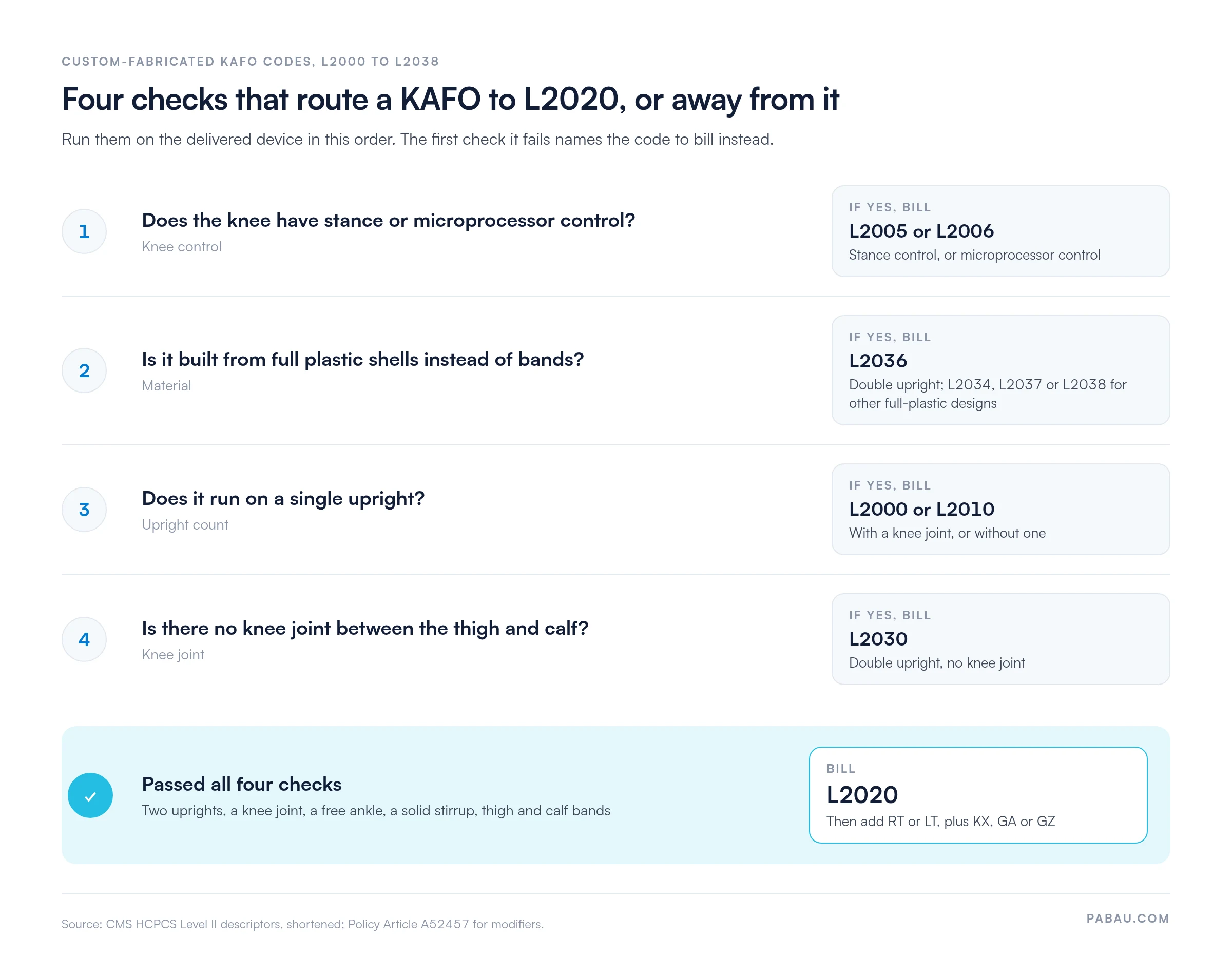
LCD L33686 covers a KAFO for an ambulatory patient who qualifies for an ankle-foot orthosis and needs additional knee stability. The ankle-foot orthosis test has three parts:
When those basic criteria are not met, the LCD denies the orthosis as not reasonable and necessary. A two-upright KAFO also needs a reason in the notes for the extra knee stability it provides.
Because L2020 is custom fabricated, the record must also meet one of these five LCD criteria:
A custom orthosis that meets the basic criteria but none of these five is still denied. The treating practitioner’s notes carry the justification, and the orthotist’s functional evaluation should back it up.
Policy Article A52457 does not list covered ICD-10 codes for L2020. Its diagnosis groups apply only to L4392, L4396, L4397 and L4631. For every other code, it states that diagnoses are not specified.
The claim still carries the ICD-10-CM code for the condition behind the weakness and knee instability. These conditions often lead to a KAFO:
These codes name the condition, but they do not prove coverage. The record still has to show how the condition affects walking, the ankle and the knee. Treat any third-party table of covered L2020 diagnoses with caution, because neither the LCD nor the policy article publishes one.
LCD L33686 and Policy Article A52457 set out what must exist before the claim goes out. Medical billing compliance for custom orthotics starts with this file:
General rules for every DME MAC claim sit in the Standard Documentation Requirements Article, A55426. A clean claim has this file complete before it leaves the billing queue.
Confirm the custom-fabrication criterion before casting starts, not after delivery. A KAFO built for one patient cannot go back into stock, so a file that falls short leaves the supplier holding the cost.
Policy Article A52457 requires two modifiers on every L2020 line: a side modifier and a coverage-status modifier.
A line without KX, GA or GZ is rejected as missing information. For a pair, bill two lines with one unit each, one with RT and one with LT. A single line with RTLT and two units is rejected as incorrect coding.
The same RT and LT rule covers additions and replacement parts. Bill every orthosis code for the same date of service on one claim.
Medicare pays L2020 from the CMS DMEPOS fee schedule. CMS releases DMEPOS fee schedule files quarterly, with the annual update each January. After the Part B deductible, Medicare pays 80% of the allowed amount and the patient owes 20% coinsurance.
Look up the current allowable for your state in the latest file. Competitive bidding reaches only off-the-shelf orthotics, so a custom-fabricated KAFO is paid from the fee schedule.
Policy Article A52457 also folds payment into a hospital or Part A skilled nursing facility stay in some situations. Check its timing rules when the orthosis is delivered around an inpatient admission or discharge.
Repairs have their own codes. L4205 covers repair labor in 15-minute units, and it covers adjustments only when they happen more than 90 days after delivery. Load each new fee schedule file into your billing system, so expected payments match the current allowable.
Most L2020 denials trace back to the coverage file or the choice of base code. Denial management in healthcare works best when you sort them by cause:
Rebuild the file around the stated denial reason before you file. Medicare appeals then move through five levels:
For a coverage denial, show where the record meets each LCD criterion, including the custom-fabrication one. For a coding denial, map the delivered device to each part of the L2020 descriptor. The denial codes reference guide explains the CARC and RARC codes on your remittance.
L2020 is a base code. Knee locks, extra straps and other components are billed as additions on their own lines, each with RT or LT.
Bill the base code and every addition for the same date of service on one claim. Splitting them across claims is a common cause of rejected addition lines.
Custom orthotic claims usually stall on paperwork spread across systems. The order arrives in one inbox, the casting notes sit in another, and the delivery receipt is scanned weeks later.
Pabau, a practice management and billing platform, keeps those records on the patient file. Its claims management software opens each claim pre-filled from the invoice, using the insurer details stored on the patient record.
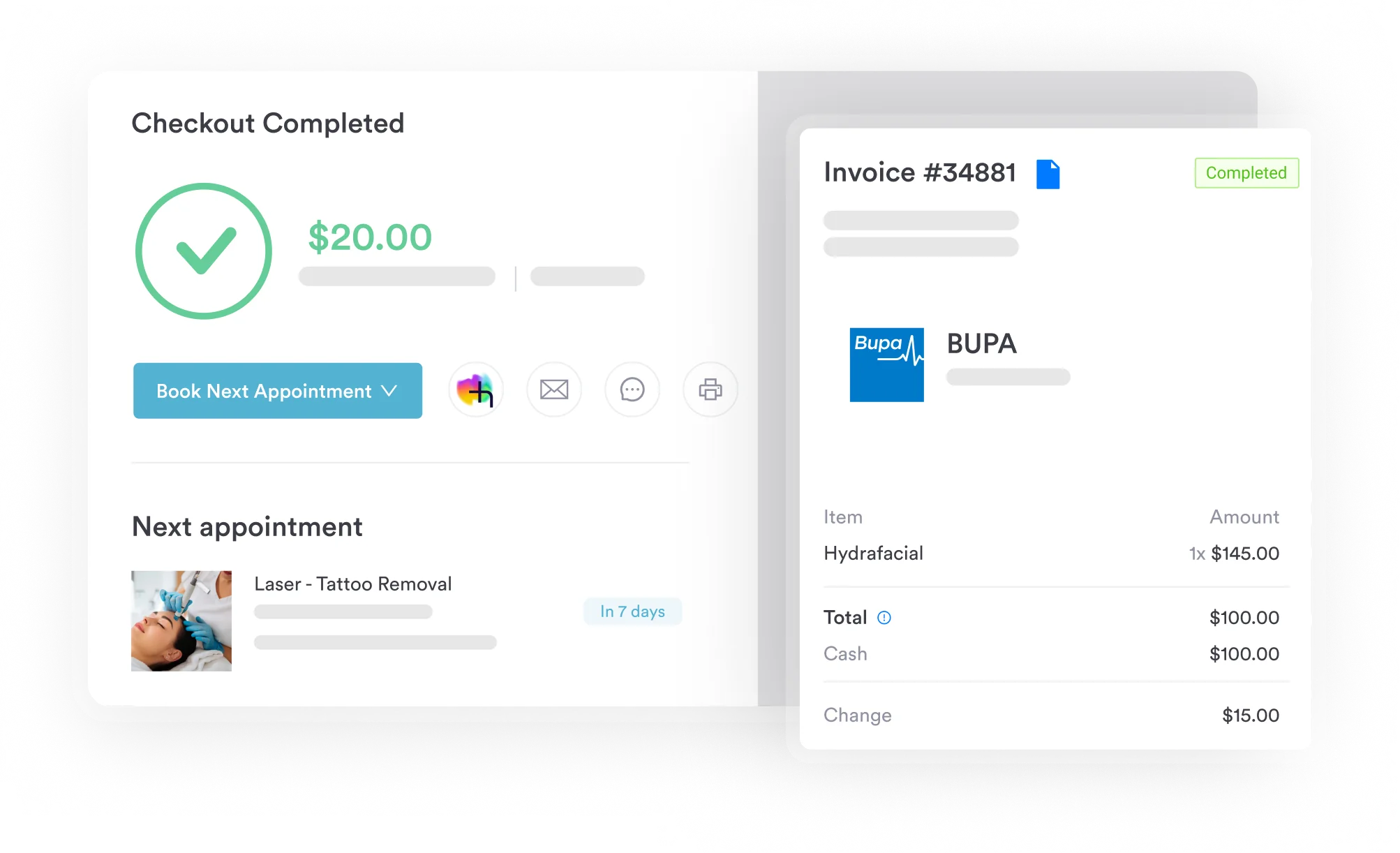
Before submission, Pabau scrubs the claim for missing or invalid details and flags any claim that needs correcting. US claims go out as CMS-1500s through the Claim.MD clearinghouse, and the dashboard tracks each one from pending to paid.
Your team still chooses the code, the modifiers and the diagnosis. Pabau makes sure what they chose reaches the payer complete, so fewer L2020 claims come back for missing information.

Pabau’s claims management software keeps orders, notes and delivery records on the patient file and scrubs each claim before it goes out.

L2020 fits one device: a custom-fabricated KAFO with two uprights, a knee joint, a free ankle and a solid stirrup. It is not an ankle-foot orthosis, and a dorsiflexion assist is an addition, not part of the code.
Once the descriptor matches the device, the claim turns on two questions. Does the record show an ambulatory patient who needs knee stability beyond an AFO? Does it show one of the five reasons for custom fabrication?
Answer both in the treating practitioner’s notes before casting starts, and the KX modifier becomes a statement you can defend. Book a demo to see how Pabau keeps orthotic claims complete from the first order to the final payment.

Billing a KAFO without a knee joint? HCPCS code L2030 covers the double-upright KAFO without a knee joint, the closest neighbor to L2020.
Need the single-upright version? HCPCS code L2000 explains the single bar AK orthosis with a free knee and free ankle.
Need a denial management framework? Denial management in healthcare covers the systematic approach to reducing claim rejection rates across DMEPOS and specialty billing.
Looking for a clean claim checklist? Clean claim submission outlines the documentation and coding steps that prevent remittance errors before they reach the payer.
Want to understand the broader billing landscape? Medical billing fundamentals explains the end-to-end claims cycle from patient encounter to payment posting.
HCPCS code L2020 describes a custom-fabricated knee ankle foot orthosis with two uprights, a knee joint, a free ankle and a solid stirrup. Thigh and calf bands or cuffs hold it to the leg. CMS calls it a double bar ‘AK’ orthosis.
No. L2020 is a knee ankle foot orthosis that reaches above the knee, and it is always custom fabricated. Its base code has no dorsiflexion assist or calf lacer. A dorsiflexion assist is billed as an addition, such as L2210.
L2020 includes a knee joint, and L2030 has no knee joint. Otherwise the descriptors match: double upright, free ankle, solid stirrup, thigh and calf bands or cuffs, custom fabricated. Bill the code that matches the delivered device.
Yes, when LCD L33686 criteria are met. The patient must be ambulatory, qualify for an ankle-foot orthosis and need additional knee stability. Because L2020 is custom fabricated, the record must also meet one of five custom-fabrication criteria.
Every line needs RT or LT and one of KX, GA or GZ. Use KX when every LCD criterion is met and documented. Use GA with a valid ABN or GZ without one when a criterion is not met.
No. Policy Article A52457 lists covered diagnoses only for L4392, L4396, L4397 and L4631. For L2020 it states that diagnoses are not specified, so coverage depends on documented function.