

CCSD code G5100: Bypass of duodenum billing guide
CCSD code G5100 bills a bypass that leaves the duodenum in place CCSD code G5100...

Last Updated: Oct 16, 2026
L1945 is the HCPCS Level II code for ankle foot orthosis, plastic, rigid anterior tibial section (floor reaction), custom-fabricated. The front shell uses ground reaction force to push the knee into extension, which is why it's prescribed for crouch gait.
Coders most often confuse it with L1940, the general custom plastic AFO, and L1960, the posterior solid-ankle AFO. Neither descriptor includes an anterior tibial section. Medicare covers L1945 under LCD L33686 when a signed prescriber order, custom fabrication records, and a covered diagnosis support the claim.
Let Pabau's smart automation suggest the right codes, reduce claim denials, and keep your practice compliant—effortlessly.
Automate repetitive tasks and focus on what matters most—your patients.
Reduce coding errors and ensure compliance with the latest regulations.
Clean claims, fewer denials, and faster reimbursements.
Powerful insights and reporting to help your practice thrive.
HIPAA compliant SOC 2 certified GDPR-compliant Trusted by 4,000+ clinics worldwide

HCPCS Code L1945 covers a custom-fabricated plastic ankle foot orthosis with a rigid anterior tibial section (floor reaction). Prefabricated devices use separate codes such as L1932.
Medicare coverage follows LCD L33686, and the KX modifier goes on the claim line only when every LCD criterion is documented.
Custom fabrication must be backed by measurements, casting or scanning records, and a signed prescriber order before the claim goes out.
L1940 and L1960 are the neighbors most often billed in its place, and neither descriptor includes an anterior tibial section.
Practice management software like Pabau keeps orders, fabrication records, and claim status in one patient file, so audits don’t become a paper chase.
The Centers for Medicare and Medicaid Services (CMS) defines HCPCS Code L1945 as “Ankle foot orthosis, plastic, rigid anterior tibial section (floor reaction), custom-fabricated.” It belongs to the L-series of HCPCS Level II orthotic codes maintained by CMS. DMEPOS suppliers bill it, not the prescribing physician.
In practice, L1945 is the code for a patient-specific brace whose front shell uses ground reaction force to push the knee into extension. Medicare covers it under LCD L33686 when the medical necessity criteria are documented.
The table below sums up the reference data for the code.
A floor reaction AFO uses ground reaction force during stance phase to create an extension moment at the knee. That reduces crouch and prevents excessive knee flexion. The L1945 device has three defining construction features that distinguish it from other AFO codes.
Missing any one of these three elements is enough for a MAC to deny the claim as incorrectly coded. DMEPOS suppliers should retain written fabrication specifications with each device record.
A floor reaction AFO is indicated when a patient has a functional deficit that causes crouch gait or excessive knee flexion in mid-stance. Common underlying conditions include cerebral palsy with spastic diplegia, incomplete spinal cord injury, and muscular dystrophy. Post-stroke hemiplegia qualifies too, where quadriceps weakness dominates.
Physical therapy practices often order orthotics for patients recovering from stroke or living with neurological gait disorders. The prescriber’s notes must then document the specific gait deviation and explain why a floor reaction design beats a standard posterior AFO. Vague documentation (“patient has foot drop”) rarely satisfies LCD L33686 criteria and leads to denial.
LCD L33686 defines the diagnosis codes that establish medical necessity for the AFO/KAFO family. Below are the ICD-10-CM codes most often used to support L1945 claims. The full covered list lives in the LCD and may vary by MAC jurisdiction.
Diagnoses not covered by LCD L33686 still require an Advance Beneficiary Notice (ABN) when supplying the device to a Medicare beneficiary. Never submit without confirming coverage status for the specific diagnosis code selected.
Selecting the wrong AFO code is the fastest route to a coding denial. The comparison below shows how L1945 differs from the three codes most frequently confused with it.
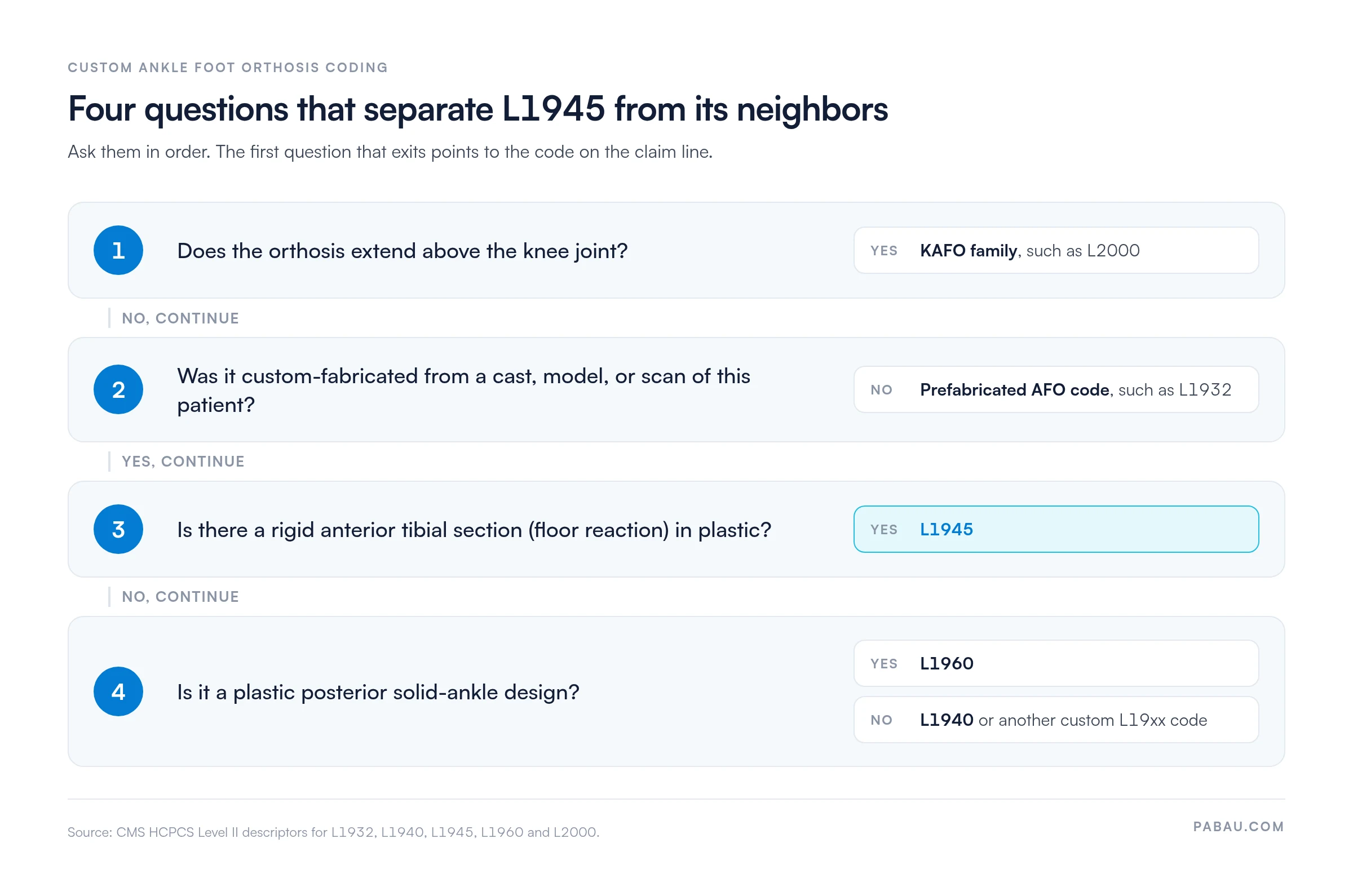
The practical test is whether the device has a rigid anterior tibial shell and a floor-reaction geometry that levers the knee into extension. If both are present and the device was individually fabricated, L1945 is correct.
A posterior shell points to L1960 or L1940 instead, and a device that extends above the knee belongs in the KAFO family. A custom metal brace built with double uprights and a solid stirrup falls under L1990. The flow below puts those checks in the order a coder should ask them.
Medicare coverage for HCPCS Code L1945 is governed by Local Coverage Determination L33686, administered by the relevant Medicare Administrative Contractor (MAC). Coverage isn’t automatic. The beneficiary must meet specific medical necessity criteria before fabrication begins.
Confirming insurance eligibility verification before ordering any custom device saves a costly surprise. Otherwise a supplier can fabricate and deliver an L1945, then learn the beneficiary has exceeded their benefit or carries a non-covered diagnosis.
The core LCD L33686 medical necessity criteria for the AFO/KAFO family include:
Verify which MAC jurisdiction covers the beneficiary’s state before checking LCD criteria. CGS Administrators (Jurisdictions B and C) and Noridian (Jurisdictions A and D) both use LCD L33686, but policy articles and contractor-specific guidance can differ. Always pull the policy article from the specific MAC’s website, not a generic CMS summary.
Medicare does not universally require prior authorization for HCPCS Code L1945, but this varies by MAC jurisdiction and state Medicaid programs. Some MACs have implemented pre-claim review programs for high-cost orthotics, under which the supplier submits documentation before delivering the device. Check the specific MAC’s website for active pre-claim review requirements in the relevant state.
Private commercial payers often do require prior authorization. Confirm coverage and authorization requirements before committing to fabrication.
Billing compliance for L1945 depends on having every required document on file before submission. For HCPCS Code L1945, Medicare and most commercial payers expect the following records on file.
Capturing the prescriber order and signed forms digitally, against the patient record, makes them easy to produce at audit. Paper files make it harder to find an order or delivery slip when a MAC post-payment review asks for it.
The Medicare allowable for HCPCS Code L1945 is set in the DMEPOS fee schedule, which CMS updates each year. For current rates, check the CMS DMEPOS fee schedule. Published amounts change each January and vary by state.
Comparing each payment against the expected allowable shows when a DMEPOS claim paid short. A shortfall often means a modifier was missing or the wrong state’s fee schedule was applied.
Two pricing factors apply to L1945:
Private commercial payers typically price relative to the Medicare allowable, often at 100-200% of Medicare, though contract rates vary significantly. Electronic remittance advice data from each payer is the most reliable way to track payment performance against expected allowables across your payer mix.
A complete billing workflow for HCPCS Code L1945 follows these stages. Skipping or reversing a step leaves records missing, which leads to denial or post-payment recoupment.
Modifiers communicate additional claim context to the payer. Using the wrong modifier, or omitting a required one, is a direct route to denial.
Most L1945 denials are preventable. Knowing the specific denial reason, and having a documented corrective action for it, is the basis of sound denial management for DMEPOS suppliers.
For appeals, the denial codes returned on the remittance advice identify the specific reason for non-payment. Match each reason code to the corrective action above before resubmitting. Medicare redetermination requests are typically due within 120 days of receiving the initial determination.
Audit a random sample of 10 L1945 claims per month against the denial reason table above. If KX modifier absence shows up on more than one claim, treat it as a workflow problem. Flag it for a coder training session and update the claim preparation checklist.
Coders and billers working with HCPCS Code L1945 regularly need to cross-reference the official descriptor, check the fee schedule, and verify coverage policy. Three sources cover those needs.
Many orthotic suppliers still assemble an L1945 claim from several places. The prescriber order arrives by fax, the scan sits on a fabrication workstation, and the delivery slip lives in a paper folder.
Practice management software like Pabau keeps those records in one patient file. Orders, signed forms, and delivery confirmations sit on the patient record. Pabau’s claims software for suppliers then submits the claim and tracks its status in the same system.
When a MAC asks for records, staff pull one file instead of searching three systems. A denied claim can be corrected and resubmitted without rebuilding the paperwork.

Store orders, fabrication records, and delivery proof against the patient record, then submit and track L1945 claims from the same system.

Code selection for L1945 turns on one descriptor element, the rigid anterior tibial section (floor reaction). Confirm it on the fabrication specs before anyone fills in the claim, and the most common coding denial is off the table.
The trade-off is time up front. Collecting the order, scan records, and delivery proof before fabrication feels slow. It still costs far less than a post-payment recoupment on a custom device you can’t resell.
Book a demo to see how Pabau keeps orthotic orders, fabrication records, and claims in one patient file.

Need to understand how medical billing workflows connect to claim submissions? What is medical billing covers the end-to-end revenue cycle from patient encounter to payment.
Managing DMEPOS denials and appeals across multiple claim types? Denial management in healthcare outlines strategies for identifying root causes and reducing repeat denials.
Want to understand how electronic remittance works after claim adjudication? Electronic remittance advice explains ERA data, adjustment reason codes, and payment reconciliation.
Billing a spiral design instead of an anterior shell? HCPCS code L1950 covers the custom spiral AFO and what its claims need.
Fitting a prefabricated anterior-shell AFO? HCPCS code L1932 explains the prefabricated carbon fiber alternative to L1945.
HCPCS Code L1945 covers a custom-fabricated plastic ankle foot orthosis with a rigid anterior tibial section (floor reaction). It’s prescribed when a patient needs a front shell that controls crouch gait or excessive knee flexion during walking. It does not cover prefabricated AFOs, which require separate L-series codes.
Yes, Medicare Part B covers HCPCS Code L1945 when the beneficiary meets the medical necessity criteria in LCD L33686. The prescribing physician must have completed a Certificate of Medical Necessity, and the claim needs the KX modifier confirming that every LCD criterion is documented. Coverage may vary by MAC jurisdiction for specific diagnosis codes.
Yes. A Certificate of Medical Necessity completed and signed by the prescribing physician is required before submitting an L1945 claim to Medicare. The supplier cannot complete this section. The CMN must document the patient’s diagnosis, functional limitations, and the clinical rationale for a floor reaction AFO specifically.
The most frequent reasons are a missing KX modifier, a missing or unsigned CMN, and a diagnosis code outside the LCD L33686 covered list. Claims also fail when fabrication records can’t be produced, or when the device matches a different code such as L1940. Review the denial reason code on the remittance advice and address the specific issue before resubmitting.



