HCPCS code A4714: Treated water for peritoneal dialysis billing guide
HCPCS code A4714: Official descriptor, code type, and payment status HCPCS code ...

Last Updated: Oct 15, 2026
L1685 is the HCPCS Level II code for hip orthosis, abduction control of hip joint, postoperative hip abduction type, custom fabricated.
Custom fabricated is the phrase that decides the claim. The device has to be built from raw materials to the patient's cast, model, or direct measurements. A stocked brace fitted to the patient belongs under L1686 instead. Medicare pays L1685 from the DMEPOS fee schedule, so the casting record, the signed order, and the medical necessity statement carry the claim through review.
Let Pabau's smart automation suggest the right codes, reduce claim denials, and keep your practice compliant—effortlessly.
Automate repetitive tasks and focus on what matters most—your patients.
Reduce coding errors and ensure compliance with the latest regulations.
Clean claims, fewer denials, and faster reimbursements.
Powerful insights and reporting to help your practice thrive.
HIPAA compliant SOC 2 certified GDPR-compliant Trusted by 4,000+ clinics worldwide

HCPCS code L1685 covers a custom-fabricated postoperative hip abduction orthosis, never a prefabricated one.
Custom fabrication has to be proved with measurements, a casting record, and an order signed before the build.
Billing L1685 for a stocked device is upcoding, so use L1686 when the brace came off the shelf.
Modifier KX belongs on the claim line only once the LCD documentation set is complete.
Medicare pays L1685 from the DMEPOS fee schedule, and the allowable moves by DME MAC jurisdiction.
HCPCS code L1685 is the Level II code for a custom-fabricated postoperative hip abduction orthosis. The Centers for Medicare and Medicaid Services (CMS) assigns and maintains it.
The code sits inside the L1600-L1690 hip orthosis range, which belongs to the wider L-code series. That series runs from L0112 to L9900 and spans spinal, upper-limb and lower-limb orthotics as well as prosthetics.
Custom fabricated is the operative qualifier. Under CMS rules, a custom-fabricated orthosis is constructed from raw materials for one patient. It is built from a cast, a model, or direct measurements taken by a qualified practitioner.
Custom-fitted describes something different. A custom-fitted device starts life prefabricated and is then adjusted to the patient, and that single distinction separates L1685 from L1686.
L1685 is billed when a physician orders a custom-fabricated hip abduction orthosis after hip surgery. The device also has to be built for that patient from raw materials.
The usual trigger is total hip arthroplasty (THA), where the implant’s stability protocol calls for controlled abduction positioning during early recovery. Surgical correction of hip dysplasia and femoral osteotomy are the other common indications.
For orthotists and practices managing post-surgical patients, L1685 captures the custom device dispensed at or shortly after discharge. The ordering physician states medical necessity in the written order. The fabricating supplier keeps proof that the device was built to patient-specific measurements rather than pulled from stock.
Diagnosis linkage is where an otherwise clean file falls over, so work from the chart rather than from habit. The ICD-10 codes below commonly support an L1685 claim, and each one has to reflect findings a physician recorded:
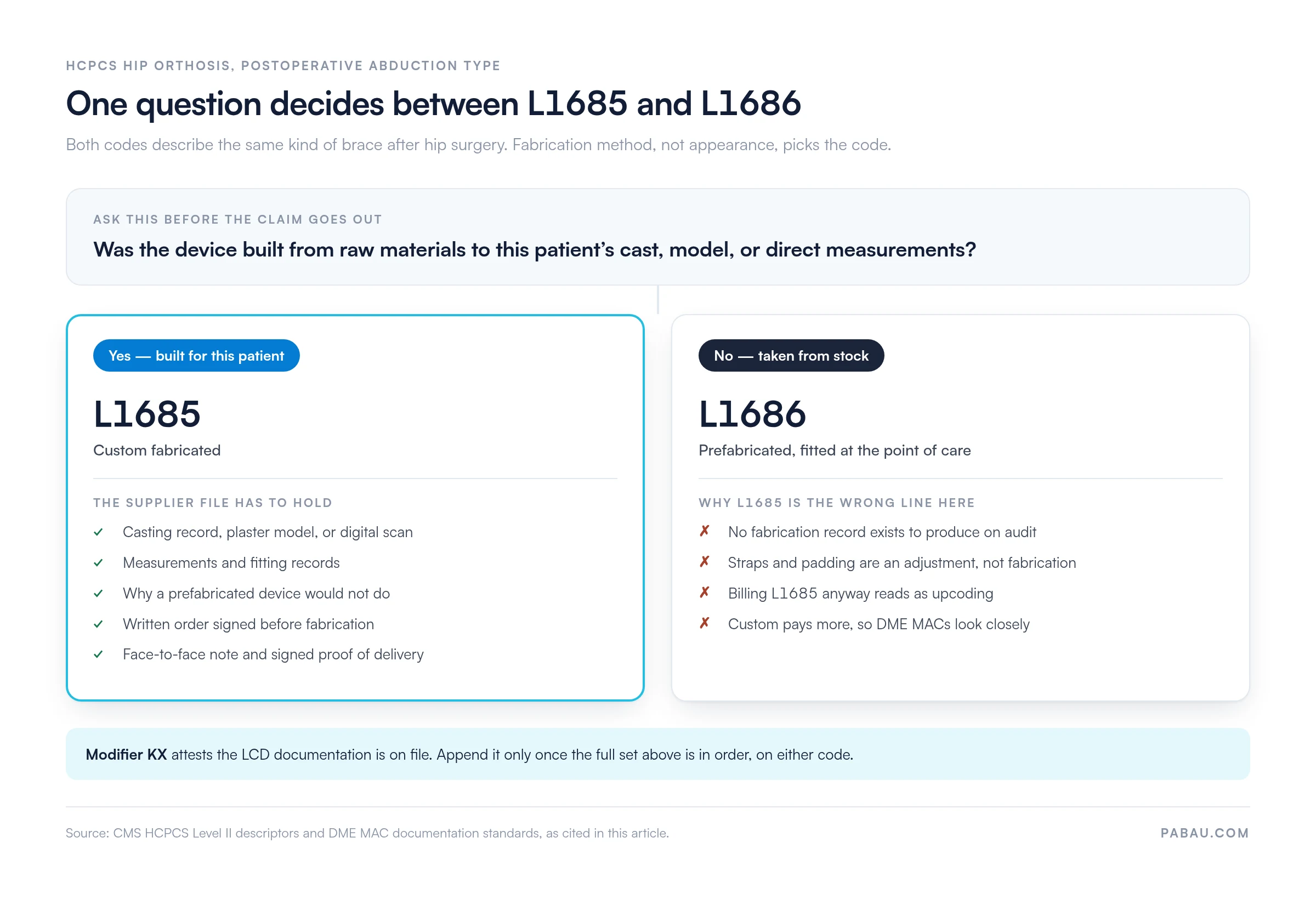
These two codes get confused constantly, because both describe a postoperative hip orthosis with abduction control. The deciding variable is how the device was made, not how it looks on the patient.
Moving a claim from L1686 to L1685 raises reimbursement for what may be a lower-cost device, which is where the fraud risk comes from.
Key rule: a device taken from a storeroom and adjusted with straps and padding is prefabricated, and it belongs under L1686. Only a device fabricated from raw materials using the patient’s cast, model, or direct measurements qualifies for L1685. The fabrication record has to exist, and it has to stay in the supplier file.
Run the question below before the claim leaves the building. It also shows what each answer commits the file to.
L1685 is reimbursed under the Medicare DMEPOS fee schedule, which CMS updates each year. Rates vary by DME MAC jurisdiction, and by whether the claim falls inside a competitive bidding area (CBA).
Verify current allowable amounts in the CMS Physician and DMEPOS Fee Schedule lookup tool before billing. Third-party databases routinely miss local adjustments and mid-year corrections.
Tracking those payments is the part suppliers tend to underestimate. Practice management software like Pabau keeps DME lines beside the rest of the day’s billing.
Its claims management software shows where each submission sits across payers. For a supplier running high orthotic volume, that removes most of the manual reconciliation.
Medicare Part B covers L1685 as durable medical equipment when the device meets the medical necessity criteria in the applicable Local Coverage Determination (LCD). DME MACs publish LCDs for lower limb orthoses that set out clinical indications, documentation standards, and supplier requirements.
Coverage is never automatic. The claim has to show that this patient needed a custom-fabricated device rather than a cheaper prefabricated one.
Confirming Part B DME coverage before fabrication starts protects the supplier from absorbing the cost of a device that fails review afterwards. An eligibility check is a short task at intake and an expensive one after delivery.
Coverage criteria for L1685 generally require:
Modifier KX goes on the claim line to attest that the medical necessity documentation is on file and meets the LCD criteria. Using KX when the file does not actually support those criteria is a false attestation, and a potential False Claims Act violation. Add it last, after the documentation review, never as a reflex.
Custom fabrication commands a higher allowable than the prefabricated alternative, so DME MACs read these files closely. The documentation burden is heavier than it is for prefabricated codes. Records also have to survive a retrospective audit, sometimes years after the claim was paid.
Custom orthotic billing sits in the OIG work plan, which is why medical billing compliance standards bite harder here than on a routine office visit. Errors bring repayment demands. A consistent pattern of miscoding can bring a referral for investigation.
A compliant L1685 file holds:
Capturing the diagnosis code, the procedure code, and the ordering provider at the point of care keeps those pieces together from the start. Build that into the dispensing workflow, and most administrative denials never get written.
Retain casting records and measurement worksheets in the patient file permanently, not just for the standard retention period. DME MACs can audit paid claims years after payment, and custom fabrication documentation is the first thing requested. A missing casting record on a paid L1685 claim creates a repayment obligation, even when the device itself was clinically appropriate.
L1685 produces a short and predictable list of denials. Most trace back to documentation or to code selection, so a structured pre-billing review catches them. Reading the denial codes a DME MAC actually returns is worth an hour of the billing team’s time before a batch goes out.
Here are the errors that repeat, with the fix for each:
None of this needs a new system. It takes about two minutes per file, and it catches the denials above while they are still cheap to fix.
Read the whole range before settling on L1685, particularly when the device is not postoperative or not custom fabricated. Several codes here describe infant devices, which have no bearing on adult post-surgical bracing. L1600 is the clearest example, a flexible Frejka-type orthosis used for infant hip dysplasia.
L1620 is the other infant code to rule out, a prefabricated Pavlik harness for hip dysplasia.
The AAPC HCPCS code lookup carries descriptions across the full L-code series for cross-referencing.
Two neighbours cause most of the trouble. L1690 is not a hip abduction brace at all, and L1650 stays prefabricated despite its adjustable hardware. L1660 deserves the same check. It covers a static plastic prefabricated abduction orthosis, which puts it outside postoperative custom bracing.
For programmatic lookup, the NLM Clinical Tables HCPCS API gives free structured access to the whole Level II set. That helps when a billing platform validates codes on entry.
When a patient moves from the postoperative phase to a long-term maintenance brace, check whether L1685 or L1686 still applies. Any new device needs a new clinical order and updated medical necessity documentation, even when the diagnosis has not changed. Never rebill L1685 for a replacement without confirming that the replacement meets the custom fabrication standard on its own.
Most orthotic suppliers keep the clinical file and the billing file apart. The casting record lives in the workshop, the signed order sits in the patient chart, and the claim goes out of a separate billing system. When a DME MAC asks for that file three years later, somebody has to rebuild it by hand.
Pabau holds the order, the measurements, the delivery confirmation and the claim on one patient record. Documents attach to the encounter that produced them, so the billing team never has to match them up later. Claim status, payer responses and outstanding balances sit next to them, which turns an audit request into a lookup.
For a practice billing L1685 alongside clinical procedure codes, one system means one audit trail. The billing team stops chasing the workshop for a casting record, and the claim goes out with its evidence already attached.

Pabau holds the written order, the measurements, the delivery proof and the claim status on one patient record. An L1685 audit request becomes a lookup rather than a rebuild.

L1685 is a high-documentation code, and the custom fabrication requirement is the whole point of it. Treat the casting record and the medical necessity statement as part of the claim rather than as paperwork that follows it. Suppliers who work that way find DME MAC audits dull, which is exactly the goal.
The trade-off is worth stating plainly. L1685 pays more than L1686, and it asks for more proof in return. Bill it when the device was genuinely built for the patient, and bill L1686 when it was not. Book a demo to see how Pabau keeps DME orders, fabrication records and claim status on one patient file.

Need to understand how claims get rejected? Denial codes in medical billing covers the remittance codes that show up on DME rejections, and how to answer each one.
Checking coverage before fabrication starts? Insurance eligibility verification explains how to confirm Part B DME coverage before a device is built and dispensed.
Want a broader view of billing compliance? Medical billing compliance outlines the documentation and audit standards that apply across DME and clinical billing.
Losing time to reworked submissions? What makes a clean claim sets out the fields a payer checks first, so fewer DME lines come back for correction.
Capturing codes at the point of care? How a superbill works shows how the diagnosis, the procedure code and the ordering provider get recorded together.
As a purchase. Medicare pays orthoses as a lump-sum purchase under the DMEPOS fee schedule, so there is no capped rental period to track. The supplier bills one line on the date of delivery. A replacement device later needs its own order and its own medical necessity documentation, even when the diagnosis has not changed.
No. L1685 is not on the CMS Required Prior Authorization List for DMEPOS, so no authorization number is needed before the device is dispensed. Commercial plans are a different matter. Many require prior authorization for any custom-fabricated device, and the request usually has to name the fabrication method, so check the plan before casting begins.
Issue an Advance Beneficiary Notice before delivery whenever you expect Medicare to deny the device. The usual triggers are a thin medical necessity statement, or a diagnosis the LCD does not list. Append modifier GA to the claim line once the signed notice is on file. Without it, the supplier absorbs the cost instead of the patient.
Seven years from the date of service. That retention standard covers the proof of delivery, the written order and the fabrication evidence. DME MACs can request a file long after the payment cleared. Storing the casting record with the claim, rather than in a workshop folder, is what makes that request easy to answer.