Inpatient billing cheat sheet
An inpatient billing cheat sheet is a quick reference for the codes and claim ru...

Last Updated: Oct 19, 2026
L0629 is the HCPCS Level II code for lumbar-sacral orthosis, flexible, provides lumbo-sacral support, posterior extends from sacrococcygeal junction to t-9 vertebra, produces intracavitary pressure to reduce load on the intervertebral discs, includes straps, closures, may include stays, shoulder straps, pendulous abdomen design, custom fabricated.
HCPCS code L0629 bills a custom-fabricated, flexible lumbar-sacral orthosis (LSO) that extends from the sacrococcygeal junction to T-9. Two words in that descriptor do most of the work. The brace is flexible rather than rigid-panelled, and it is fabricated for one named patient rather than pulled off a shelf.
Suppliers routinely bill L0629 as though it were a stock rigid brace, which is a different code and a different payment rule. It also covers the documentation a DME MAC will ask for, and the four codes L0629 is mistaken for.
Let Pabau's smart automation suggest the right codes, reduce claim denials, and keep your practice compliant—effortlessly.
Automate repetitive tasks and focus on what matters most—your patients.
Reduce coding errors and ensure compliance with the latest regulations.
Clean claims, fewer denials, and faster reimbursements.
Powerful insights and reporting to help your practice thrive.
HIPAA compliant SOC 2 certified GDPR-compliant Trusted by 4,000+ clinics worldwide

HCPCS code L0629 bills a custom-fabricated, flexible lumbar-sacral orthosis whose posterior runs from the sacrococcygeal junction to T-9.
L0629 is not a prefabricated rigid-panel brace. Its mechanism is intracavitary pressure that takes load off the intervertebral discs.
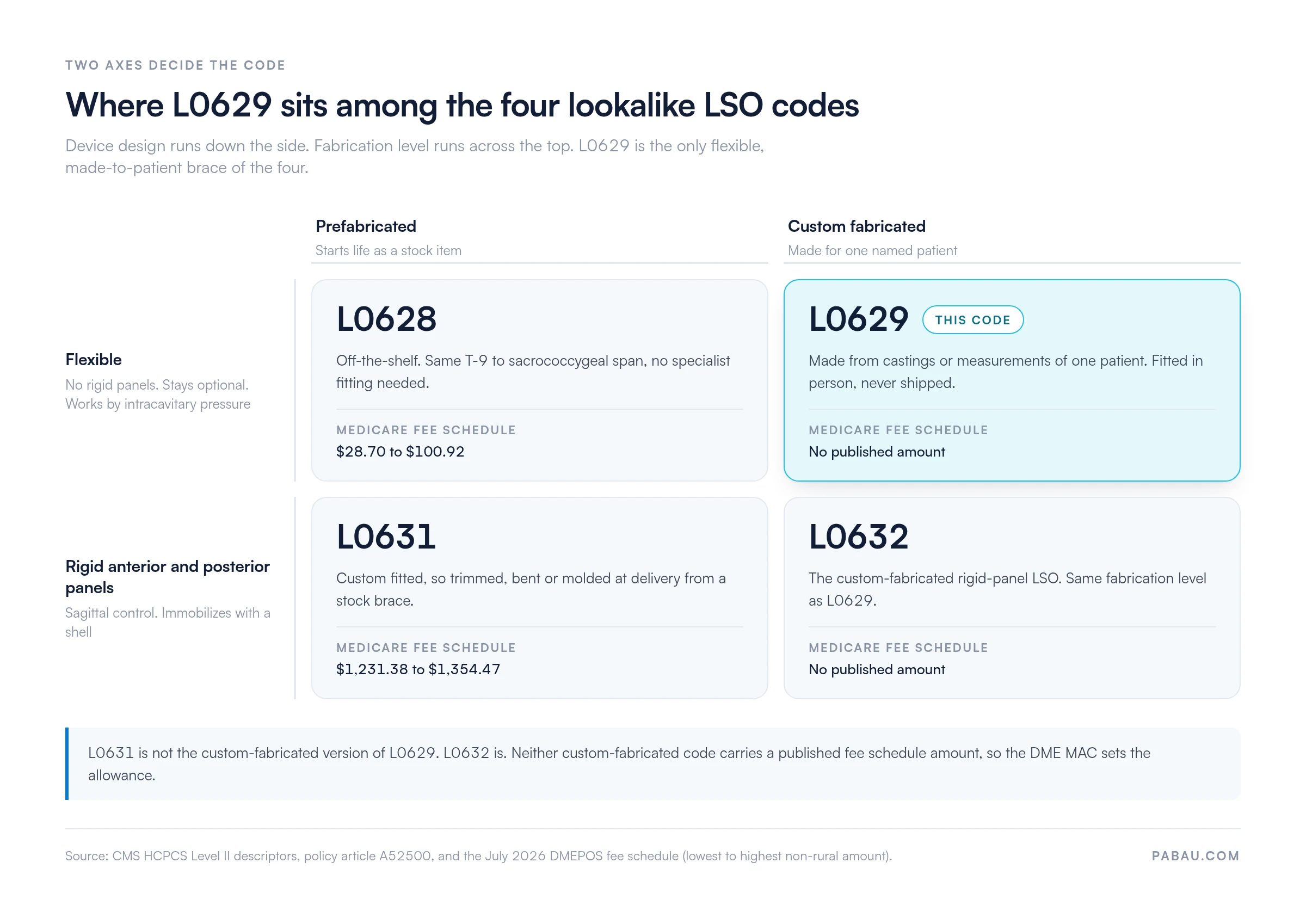
L0631 is not the custom-fabricated version of L0629. L0631 is a prefabricated, custom-fitted brace, and L0632 is the custom-fabricated rigid-panel LSO.
CMS publishes no fee schedule amount for L0629. Every pricing field on its July 2026 record is zero, so the DME MAC sets the allowance.
Prior authorization and the face-to-face list skip L0629, but they catch its lookalikes L0631, L0637, L0648 and L0650.
L0629 is a Healthcare Common Procedure Coding System (HCPCS) Level II code maintained by the Centers for Medicare and Medicaid Services. It has been effective since January 1, 2006, and its short descriptor is Lso flex w/rigid stays cust.
The official CMS long descriptor reads clause by clause as follows.
That text never mentions rigid anterior or posterior panels, sagittal-coronal control, or lateral frames. Those clauses belong to other codes in the L06xx range. Stays are optional here, and they are the only firm element the descriptor allows.
The mechanism clause is the part people paraphrase wrongly. L0629 does not immobilize the trunk with a shell. It compresses the abdomen through its closures, and that pressure shifts load off the lumbar discs.
Medicare sorts spinal orthoses into three fabrication levels, and L0629 sits at the top one. Policy article A52500 names L0629 in its list of custom-fabricated spinal orthoses, alongside L0452, L0622, L0632, L0634 and others.
L0629 is the third kind. That has a practical consequence at delivery, because a custom-fabricated orthosis has to be fitted in person. The DME MAC documentation checklists state plainly that custom-fitted and custom-fabricated items cannot be shipped to the beneficiary.
If your L0629 orders are going out by courier, you have a coding problem rather than a shipping problem. A brace that can be posted and self-adjusted is an off-the-shelf item, and the flexible off-the-shelf LSO in this family is L0628. Check what your fitters do at delivery before you check the claim.
Lumbar-sacral orthoses are covered under the Medicare braces benefit at section 1861(s)(9) of the Social Security Act. That benefit only reaches a rigid or semi-rigid device. The device has to support a weak or deformed body part, or restrict motion in a diseased or injured one.
A flexible code therefore sits close to the edge of the benefit. Policy article A52500 draws the line by material rather than by the code you would prefer to bill.
So a custom-made neoprene or spandex back support is not an L0629, however carefully it was measured. The device has to be capable of supporting the lumbo-sacral spine before the L-code is available at all.
These four codes account for most L0629 miscoding, and one myth drives a lot of it. L0631 is often described as the custom-fabricated version of L0629, which reverses the facts on both codes.
L0629 is already custom fabricated. L0631 is a prefabricated brace that has been trimmed, bent, molded or assembled to fit one patient, which Medicare calls custom fitted. The custom-fabricated rigid-panel LSO is L0632. The off-the-shelf flexible brace of the same design is L0628.
Read the table as a two-by-two. The rows split by device design, flexible against rigid-panel, and by fabrication level, stock against made-to-patient. L0629 is the flexible, made-to-patient corner, and it is the smallest of the four. The grid below places all four on those two axes and shows which of them Medicare prices.
Two families sit next to each other in this range and are easy to blur. Lumbar orthoses (LO) run from L-1 to below L-5. Lumbar-sacral orthoses (LSO) run from the sacrococcygeal junction to T-9, which is where L0629 sits.
Every descriptor below is summarized from the current CMS HCPCS Level II file. Check the full text before you commit a code, because the summaries drop the shared clauses.
L0650 deserves a second look, because its descriptor is the one most often pasted under L0629 in third-party code lists. L0650 is a prefabricated, off-the-shelf brace with rigid anterior, posterior and lateral frames. It shares no clause with L0629 beyond the vertebral span.
Medicare Part B pays L0629 under the DMEPOS benefit, and the governing policy is LCD L33790, Spinal Orthoses: TLSO and LSO. The LCD covers a spinal orthosis when it is ordered for one of four purposes.
One of those four purposes has to be visible in the treating practitioner’s records. If none is, the item is denied as not medically necessary, whatever the diagnosis code says.
Four DME MAC jurisdictions apply the policy, and only two contractors run them. Noridian Healthcare Solutions administers Jurisdictions A and D. Jurisdictions B and C belong to CGS Administrators. Your jurisdiction follows the beneficiary’s permanent address, not the supplier’s location.
Meeting the four purposes gets you a covered spinal orthosis. It does not get you L0629. Policy article A52500 adds a second test that applies only to the custom-fabricated codes.
Section 1834(h)(5) of the Social Security Act helps here. It makes the orthotist’s notes part of the beneficiary’s medical record for medical necessity purposes. Those notes support the practitioner’s documentation, though they cannot stand in for it.
There is no CMS-published list of covered diagnoses for spinal orthoses. Both the ICD-10-CM sections of policy article A52500 read “N/A”, so no code automatically qualifies and none is automatically excluded. The diagnosis has to connect the patient to one of the LCD’s four purposes.
The ICD-10-CM codes below are the ones that most often carry that connection on a lumbo-sacral claim. Each is billable at the specificity shown.
A diagnosis code alone never establishes medical necessity for a spinal orthosis. It points the reviewer at the clinical story, and the practitioner’s notes have to tell it.
Look L0629 up in the CMS DMEPOS fee schedule and you will find an empty record. On the July 2026 public use file, every pricing field on the L0629 row is zero. That covers the ceiling, the floor, and both the rural and non-rural amounts for all fifty states.
This is not a data error, and it is not new. The July 2025 file reads the same way. Three other custom-fabricated spinal codes behave identically: L0624, L0632 and L0634.
Amounts are from the July 2026 DMEPOS public use file published by CMS. Three points follow for anyone quoting a patient or forecasting revenue.
Competitive bidding is not the reason for the blank row. Round 2021 covered off-the-shelf back braces such as L0648 and L0650, and those contracts expired on December 31, 2023. Custom-fabricated codes were never part of it.
Documentation failures cause most L0629 denials, and a custom-fabricated code carries two more file items than a stock brace does. Every item below has to exist before the claim goes out.
Keep the file for seven years from the date of service. That is the DMEPOS retention rule, and post-payment review often arrives well after the brace has been forgotten.
CMS discontinued Certificates of Medical Necessity and DME Information Forms for dates of service from January 1, 2023. No DME MAC accepts one now, and claims that arrive with one attached are returned. The standard written order and the medical record carry what a certificate used to.
If your intake workflow still has a step for chasing a signed CMN, delete it. The time is better spent on the custom fabrication justification, which is the item reviewers ask for.
The spinal orthoses policy is unusually quiet on modifiers. It names exactly one code-specific modifier, CG, and L0629 is not on the list of codes that take it. Neither LCD L33790 nor policy article A52500 defines a KX attestation for spinal orthoses.
Most L0629 claims therefore go out with no modifier at all. That surprises billers who have moved across from knee or ankle orthoses, where KX does a lot of work.
L0629 requires no prior authorization and no face-to-face encounter under Final Rule 1713. It appears on neither CMS list. That is worth knowing precisely, because four of the codes it gets confused with appear on both. L0637 is one of them, and a brace with rigid lateral frames is coded there instead.
Both lists are updated periodically, so confirm the current version before each order rather than trusting a saved copy. What L0629 does attract instead is coding verification, and the rule depends on who made the brace.
Pull your L0629 product catalog and check each item against the PDAC Product Classification List today, not at audit. Central-fab products that never got a coding verification review are the quiet failure here, because the claim pays first and gets recouped later.
The errors below are the ones that recur on L0629 specifically. Treat each as a workflow problem rather than a one-off, because a denial pattern around one of them usually means a step is missing upstream.
When a claim does come back denied, a redetermination has to be filed within 120 days of the initial determination. Working the appeal from a complete file is far quicker than rebuilding one after the fact.
An L0629 file is assembled by four different people. A practitioner writes the order and the justification, and an orthotist records the functional evaluation. A fabricator supplies the materials list, and a fitter collects the signature. Those four pieces often end up in four separate places, from the patient chart to an email thread and a supplier portal.
Practice management software like Pabau keeps them on one patient record instead. The order, the clinical notes, the orthotist’s evaluation, the fabrication paperwork and the signed delivery receipt all attach to the same file. A reviewer’s request is then answered from one screen.
Pabau’s claims tools for suppliers then check the file before the claim leaves. Custom forms capture the custom fabrication justification at the order stage, and the delivery receipt records the in-person fitting that this code requires. The result is a shorter denial list and a stronger position on appeal.

Pabau gives orthotic and DMEPOS teams one place for the order, the custom fabrication justification, the orthotist’s evaluation and the signed delivery receipt. See how that shortens the denial list.

HCPCS code L0629 bills a flexible, custom-fabricated lumbar-sacral orthosis. Almost every error on this code starts with reading it as something firmer or more mass-produced. Match the device to the verbatim descriptor first. Then document why a prefabricated brace would not have worked, and confirm the allowance with your DME MAC, because CMS publishes none.
Get those three things right and the rest of the file follows. If your team is assembling L0629 documentation across several systems, book a demo and we will show you what it looks like on one record.

Need to understand why HCPCS claims deny? Denial management in healthcare walks through the most common denial reason codes and how to build a systematic appeals process.
Want to lift your first-pass acceptance rate? Submitting a clean claim covers the elements that keep DME and procedural claims from bouncing back.
Looking at a neighboring lumbar code? HCPCS code L0641 covers the off-the-shelf lumbar orthosis with one rigid posterior panel.
HCPCS code L0629 is the billing code for a custom-fabricated, flexible lumbar-sacral orthosis. Its posterior extends from the sacrococcygeal junction to the T-9 vertebra, and it produces intracavitary pressure that reduces load on the intervertebral discs. The descriptor includes straps and closures, and it may include stays, shoulder straps and a pendulous abdomen design. The code has been effective since January 1, 2006.
L0629 is custom fabricated. CMS policy article A52500 lists it among the custom-fabricated spinal orthoses. The brace is individually made for one named patient, and no other patient could use it. A prefabricated flexible lumbar-sacral orthosis of the same design is billed as L0628 instead.
They differ on both device design and fabrication level. L0629 is a flexible, custom-fabricated brace with no rigid panels. L0631 is a rigid anterior and posterior panel brace. It starts as a prefabricated item and is then trimmed, bent or molded to fit, which Medicare calls custom fitted. L0631 is not the custom-fabricated version of L0629. That code is L0632.
You need a standard written order before you bill. You also need clinical notes tying the patient to one of the four purposes in LCD L33790. Add detailed practitioner documentation of why a prefabricated brace will not do. Add the orthotist’s functional evaluation, evidence of how the item was fabricated, and a signed proof of delivery from the in-person fitting. Keep the file for seven years from the date of service.
No. L0629 appears on neither the CMS Required Prior Authorization List nor the Required Face-to-Face Encounter and Written Order Prior to Delivery List. Several codes it is confused with do appear on both, including L0631, L0637, L0648 and L0650. Check the current version of each list before you order, because CMS updates them periodically.
There is no CMS list of covered diagnoses for spinal orthoses. The diagnosis has to connect the patient to one of the four purposes in LCD L33790. Codes that commonly do so include M54.50, M54.40 to M54.42, M51.16, M47.816, M43.16, M53.2X7, M48.061 and M96.1. Note that the parent code M54.4 is not billable, so use one of its laterality subcodes.
You cannot, because CMS does not publish one. L-codes price from the DMEPOS fee schedule rather than the Physician Fee Schedule. On the July 2026 DMEPOS public use file, every pricing field on the L0629 record is zero. Contact your DME MAC for the allowance before you dispense, and never substitute the published amount for a neighboring code.