

CCSD code G5100: Bypass of duodenum billing guide
CCSD code G5100 bills a bypass that leaves the duodenum in place CCSD code G5100...

Last Updated: Oct 16, 2026
L0469 is the HCPCS Level II code for tlso, sagittal-coronal control, rigid posterior frame and flexible soft anterior apron with straps, closures and padding, extends from sacrococcygeal junction over scapulae, lateral strength provided by pelvic, thoracic, and lateral frame pieces, restricts gross trunk motion in sagittal and coronal planes, produces intracavitary pressure to reduce load on intervertebral disks, prefabricated, off-the-shelf.
That last word does most of the work on a claim. L0469 pairs with L0468, which describes the same brace supplied as a custom-fitted device. The two codes share every clinical element and differ only in what happened at delivery.
Billers who reach for L0469 because the brace came out of a box are coding it correctly. The audit exposure in this pair runs the other way, toward suppliers who bill L0468 for a brace the patient adjusted themselves.
Let Pabau's smart automation suggest the right codes, reduce claim denials, and keep your practice compliant—effortlessly.
Automate repetitive tasks and focus on what matters most—your patients.
Reduce coding errors and ensure compliance with the latest regulations.
Clean claims, fewer denials, and faster reimbursements.
Powerful insights and reporting to help your practice thrive.
HIPAA compliant SOC 2 certified GDPR-compliant Trusted by 4,000+ clinics worldwide

HCPCS code L0469 is the prefabricated, off-the-shelf TLSO with sagittal-coronal control. It is not the custom-fitted code.
L0468 is the custom-fitted counterpart, and its device description is otherwise identical. CMS split the pair effective January 1, 2014.
L0469 fits a brace that needs only minimal self-adjustment at delivery. No certified orthotist has to shape it.
January 2026 non-rural fees run $169.55 to $384.93 for L0469 and $526.74 to $693.80 for L0468. That spread is why reviewers check fitting records.
Pabau’s claims management software helps DME suppliers and orthotists hold the order, the delivery record, and the code choice in one claim file.
L0469 sits in the thoracic-lumbar-sacral orthosis (TLSO) range of HCPCS Level II. Its official long descriptor is set out below, clause by clause.
Read end to end, those clauses are the CMS long descriptor word for word. Three of them decide whether the code fits the device in front of you.
The straps, closures and padding named in the descriptor are part of the code. Do not bill them separately.
Whether a second item belongs on its own line is decided code by code. HCPCS code S0142 is submitted apart from the nebulizer equipment code, since payers receiving them combined may pay one bundled amount that underpays the drug.
Off-the-shelf has a regulatory definition, not a colloquial one. Under 42 CFR 414.402, an OTS orthosis needs only “minimal self-adjustment” for appropriate use. That means an adjustment the patient, their caretaker, or the supplier can perform.
The test turns on who has to be in the room. If final fitting does not require a certified orthotist or someone with specialized orthotic training, the item is off-the-shelf and L0469 is the code. Certification here means the American Board for Certification in Orthotics and Prosthetics or the Board for Orthotist/Prosthetist Certification.
One practical consequence follows from this. Custom-fitted and custom-fabricated braces have to be fitted at the time of delivery, so they cannot be shipped to the patient. An L0469 brace can be shipped, because it arrives ready to wear.
L0468 and L0469 are the same brace on paper. Both descriptors run word for word through the sagittal-coronal control, the rigid posterior frame, the flexible soft anterior apron and the intracavitary pressure. They part company in the final clause.
L0469 ends “prefabricated, off-the-shelf”. L0468 ends “prefabricated item that has been trimmed, bent, molded, assembled, or otherwise customized to fit a specific patient by an individual with expertise”. Everything a reviewer wants to see in an L0468 file describes that customization work.
The split is not a quirk of the code book. CMS created L0469 in Transmittal 2836 (Change Request 8531), effective January 1, 2014, alongside 21 other new OTS codes. Attachment B of that transmittal lists L0468 as the existing code and L0469 as its new off-the-shelf partner.
L0468 was revised on the same date to describe only custom-fitted devices. L0469 has never carried a custom-fitted descriptor at any point in its history. For CY 2014 the L0468 fee amounts were crosswalked across to the new code. The pair started life priced alike and has drifted apart since.
The money explains the scrutiny. In California the January 2026 non-rural amount is $169.55 for L0469 and $693.80 for L0468, a difference of more than four times. A reviewer who sees L0468 with no fitting narrative in the file has an obvious question to ask.
Decide the code at delivery, not at the order. Have the person handing over the brace record one line. Did final fitting need only strap and closure adjustment, or was the frame trimmed, bent or molded? That single line picks L0469 or L0468 for you, and it is the same line a reviewer will look for later.
The TLSO range is organized on two axes: how much motion the brace controls, and how it was supplied. Get the second axis wrong and the claim is miscoded even when the device is right. The table below places L0469 among the codes it is most often confused with.
Two habits keep this range straight. Read the last clause of the descriptor before the code goes on the claim, because that is where off-the-shelf, custom-fitted and custom fabricated live. Then check the motion planes, since sagittal-only and triplanar braces sit in adjacent code pairs.
A triplanar brace that keeps the rigid posterior frame and flexible soft anterior apron bills as L0470, which CMS classes as custom fitted.
Construction separates the triplanar codes. A prefabricated triplanar brace built from three rigid plastic shells bills as L0462 rather than any frame-and-apron code.
The CG modifier is worth a separate note. It attaches only to L0450, L0454, L0455, L0621, L0625 and L0628. Even there it applies only to items made primarily of nonelastic material or with a rigid posterior panel. It has no role on an L0469 claim.
Medicare pays L0469 from the annual DMEPOS fee schedule, and the amount follows the state where the beneficiary lives rather than where the supplier sits. Two features of this code’s pricing trip billers up.
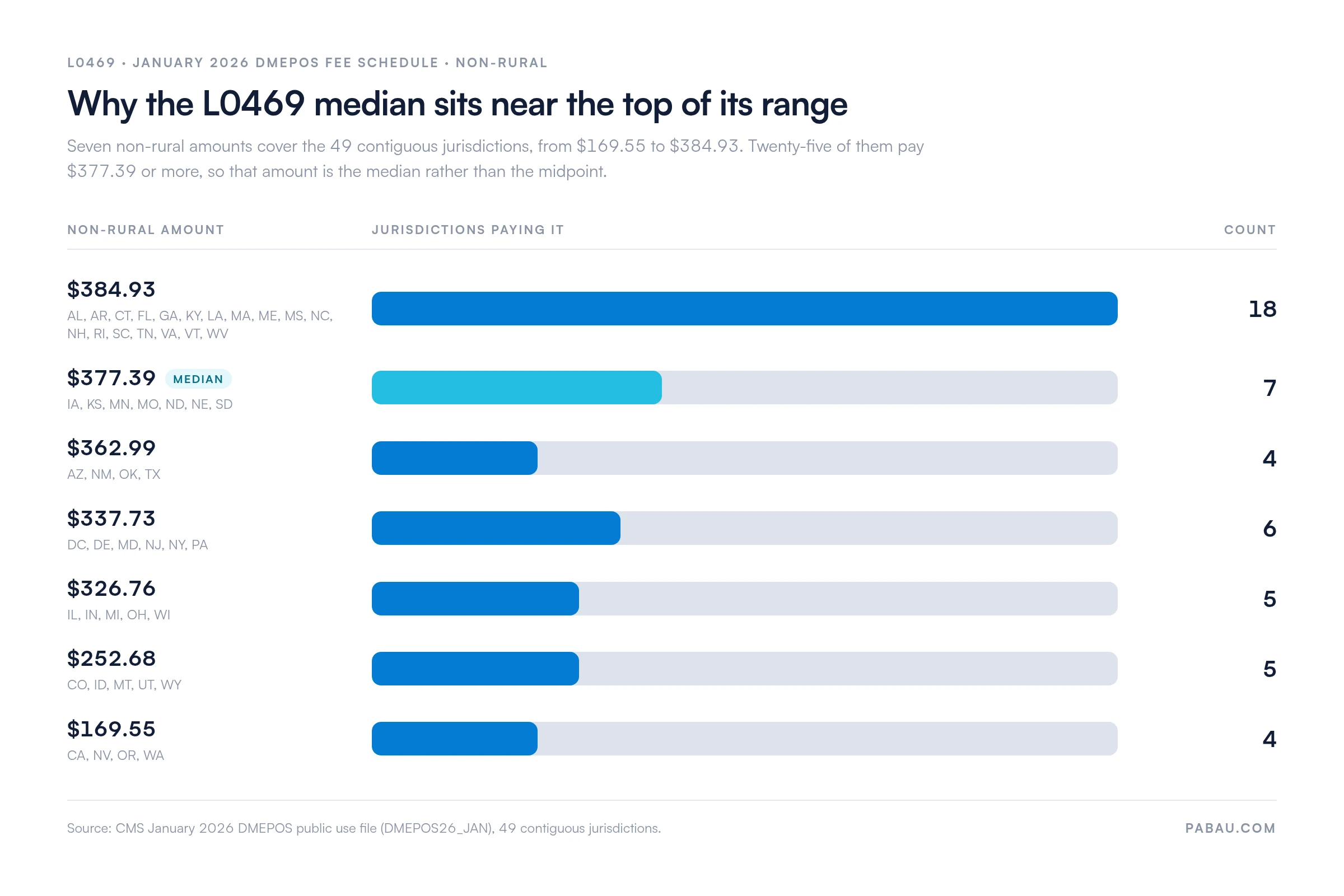
First, L0469 carries separate rural and non-rural amounts because its fees were adjusted using competitive bidding information. Second, the rural amount is higher than the non-rural amount in every state. The figures below come from the January 2026 DMEPOS public use file published by CMS.
Across the 49 contiguous jurisdictions the non-rural amount takes one of seven values, from $169.55 to $384.93. The median is $377.39, because 25 of those jurisdictions pay that amount or more. The chart below shows how the 49 jurisdictions split across those seven tiers.
Medicare pays 80% of the lesser of the supplier’s charge or the fee amount, once the deductible is met. On the median that is $301.91 from the program and $75.48 from the patient.
Rural amounts range from $455.83 to $539.37. The non-continental areas sit outside the ceiling and floor calculation entirely, which is why Puerto Rico is priced at $925.99. Always confirm the current quarter’s file before you bill, because CMS refreshes these amounts in January, April, July and October.
Competitive bidding is the reason the rural columns exist, but no contract applies to L0469 today. Round 2021 covered off-the-shelf back braces L0648 and L0650 and knee braces L1833 and L1851, and those contracts expired on December 31, 2023. CMS has run a temporary bidding pause since January 1, 2024.
Coverage sits in LCD L33790 and Policy Article A52500, Spinal Orthoses: TLSO and LSO. The braces benefit reaches rigid and semi-rigid devices that support a weak or deformed body part. It also reaches devices that restrict motion in a diseased or injured one. An L0469 brace qualifies on construction.
The medical record has to show the orthosis was ordered for one of four indications:
Three further conditions apply specifically because L0469 is an off-the-shelf code:
Telehealth satisfies the encounter requirement where the telehealth service and payment rules are met. Medicaid is a separate question, since state programs set their own prior authorization rules and fee schedules for orthoses. Check with the state agency before you assume Medicare criteria carry across.
The spinal orthoses policy does not publish a covered-diagnosis list for TLSO codes. Coverage is decided on the four indications above and on the record as a whole. No single diagnosis from the ICD-10-CM code set makes an L0469 claim payable on its own.
The codes below are the ones that commonly appear on L0469 claims, because they describe the conditions a sagittal-coronal TLSO is used to manage. Vague or unrelated diagnosis coding is a recurring audit finding on DMEPOS claims, so confirm the code with the prescribing clinician.
Some L0469 claims fail on the setting rather than the clinical picture:
A DME MAC will pay for a brace delivered during a facility stay in one narrow case. The orthosis has to be medically necessary after discharge, and the patient has to receive it within the two days before going home. Inpatient care must not require it.
An L0469 file is shorter than an L0468 file, because it carries no justification for fitting work. What remains still has to be complete. Four items carry the claim.
The CGS Medicare spinal orthoses documentation checklist sets out six required elements. Missing any one of them puts the claim at risk:
Delivery documentation follows one of two patterns. A direct handover needs the signature of whoever accepted the brace, their relationship to the patient, and the delivery date. A shipment needs a tracking slip and an invoice linked by a shared reference number.
No L0469 claim needs a Certificate of Medical Necessity. CMS discontinued CMNs and DME Information Forms for all claims with dates of service on or after January 1, 2023. Submitting one now gets the claim rejected and returned.
The standard written order carries the ordering requirement instead, and the clinical record carries medical necessity. Retain both, along with proof of delivery, and keep them available for a review contractor’s request. Older guidance that still refers to a CMN or a detailed written order predates the current rules.
Run a four-point check before an L0469 claim leaves the queue. Confirm the SWO carries all six elements and pre-dates delivery. Check that the encounter falls inside the six-month window. Confirm the delivery record is signed, or that the shipment is linked by reference number. Then check the fitting note supports the off-the-shelf code. A five-minute review beats a post-payment recoupment.
Modifiers tell the DME MAC about device status, upgrades and your medical necessity attestation. KX does the most work on this code, and omitting it is a common reason an otherwise clean L0469 claim denies.
Most initial claims go out as L0469 with KX and NU. Two modifiers you will not need are CG and the competitive bidding set KV, J4 and J5. CG is limited to a short list of other spinal codes. The bidding modifiers belong to the OTS back and knee brace codes bid in Round 2021.
Spinal orthoses are one of Medicare’s worst-performing DMEPOS categories. CMS compliance data puts the improper payment rate for lumbar-sacral orthoses at 54.4% in the 2024 reporting period. The projected improper payment amount was $47.8 million.
The reasons behind those errors are almost entirely clerical. Insufficient documentation accounted for 64.4% of the improper payment rate and no documentation for a further 20.1%. Medical necessity accounted for 0.3%. Other errors, including duplicates and non-covered services, made up the remaining 15.1%.
Read against that data, the biggest risk on an L0469 claim is a thin file rather than a wrong clinical judgment. Good denial management for this code starts with the paperwork you gather before the brace leaves the building.
Preventing these denials is a workflow problem shared between the prescriber, the supplier and the billing team. Software that keeps the order, the encounter note, the delivery record and the code rationale in one file removes the handoff where errors collect.
After any L0469 denial, pull the reason code from the remittance advice and match it against the six triggers above before you refile. Most of these denials are recoverable inside the timely filing window. Attaching the delivery record and adding KX resolves the majority of documentation-based rejections.
In most orthotic practices the four documents that decide an L0469 claim live in four places. The order sits in the EMR and the encounter note with the prescriber. The delivery receipt is in a paper folder, and the code choice is in someone’s memory. Reviewers ask for all four at once.
Practice management software like Pabau holds them against the patient record instead. The order, the encounter note, the signed delivery document and the fitting note attach to the same file. The HCPCS and ICD-10 codes then carry through to the claim without retyping.
Pabau’s audit-ready claims management then tracks each submission through to payment. A missing KX or an unsigned delivery record surfaces while you can still fix it. When a review contractor writes, the file is already assembled, so the response takes minutes instead of days.

Pabau helps DME suppliers and orthotic practices hold the order, the delivery record and the code rationale in one claim file. Follow every submission through to payment. See how it works for your practice.

L0469 is the straightforward half of a two-code pair. If the brace came out of a box and your staff or the patient adjusted the straps, this is the code. The file behind it is an order, an encounter note, a delivery record and one line about the fitting.
The risk lives one code over. L0468 pays several hundred dollars more per claim, and it asks you to prove that a certified orthotist shaped the device. Bill it only when your record shows that work, and let L0469 carry the rest.
If you want to see how Pabau keeps orthotic documentation and claims in one place, book a demo with the team.

Need the diagnosis side of the claim? Our ICD-10-CM code library covers the spinal and post-surgical codes that pair with a TLSO order.
Seeing more DMEPOS rejections than expected? Denial management in healthcare explains how to build a structured appeals and recovery workflow.
Want the claim to go out clean the first time? Clean claim submission outlines the elements every DMEPOS claim has to carry to clear front-end edits.
L0469 is the Level II HCPCS code for a prefabricated, off-the-shelf thoracic-lumbar-sacral orthosis (TLSO) with sagittal-coronal control. The brace has a rigid posterior frame and a flexible soft anterior apron, and it needs only minimal self-adjustment at delivery. Medicare pays it under the DMEPOS benefit.
L0469 is off-the-shelf. Its descriptor has ended in “prefabricated, off-the-shelf” since CMS created the code effective January 1, 2014, and it has never described a custom-fitted device. The custom-fitted counterpart is L0468, which covers the same brace when someone with expertise trims, bends, molds or assembles it for a specific patient.
Only the final clause of the descriptor. L0469 is supplied off-the-shelf and needs minimal self-adjustment, so the patient, a caretaker or the supplier can fit it. L0468 requires a certified orthotist or someone with specialized training to customize the item at delivery. The record then has to describe what was modified and why.
No. CMS discontinued Certificates of Medical Necessity and DME Information Forms for claims with dates of service on or after January 1, 2023. A submitted form is now rejected and returned. What L0469 needs instead is a standard written order dated before delivery, a practitioner encounter note from the previous six months, and proof of delivery.
It depends on where the beneficiary lives. In the January 2026 DMEPOS fee schedule the non-rural amount runs from $169.55 to $384.93 across the contiguous states. The median is $377.39, because 25 of the 49 contiguous jurisdictions pay that amount or more. Rural amounts run from $455.83 to $539.37. Medicare pays 80% of the lesser of your charge or that amount once the deductible is met.
No. The spinal orthosis codes on the required prior authorization list are all lumbar-sacral codes. They are L0648 and L0650, with L0631, L0637 and L0639 added effective August 12, 2024. The face-to-face and written-order-prior-to-delivery list is also limited to LSO codes, so neither requirement reaches L0469.
The spinal orthoses policy has no covered-diagnosis list, so coverage rests on the four LCD indications and the record as a whole. Codes that commonly appear include S22.009A for a thoracic vertebral fracture and M41.20 for idiopathic scoliosis. Z98.1, M48.061 and M47.816 cover arthrodesis status, lumbar stenosis and lumbar spondylosis.



