HCPCS Code E0272: Foam rubber mattress billing guide
HCPCS Code E0272: official descriptor and code overview HCPCS Code E0272 is the ...

Last Updated: Nov 6, 2026
K0008 is the HCPCS Level II code for custom manual wheelchair/base. It describes a manual wheelchair base uniquely built or substantially modified for one patient whose needs no other base and accessories can meet.
K0008 has no frame-weight criterion, so it is not a custom version of the ultralightweight K0005. Medicare expects the file to show how the base was built, alongside the clinical case for it.
Let Pabau's smart automation suggest the right codes, reduce claim denials, and keep your practice compliant—effortlessly.
Automate repetitive tasks and focus on what matters most—your patients.
Reduce coding errors and ensure compliance with the latest regulations.
Clean claims, fewer denials, and faster reimbursements.
Powerful insights and reporting to help your practice thrive.
HIPAA compliant SOC 2 certified GDPR-compliant Trusted by 4,000+ clinics worldwide

HCPCS code K0008 is a custom manual wheelchair base, uniquely built or substantially modified for one patient whose needs no other base can meet.
K0008 has no frame-weight criterion. Custom construction qualifies a base for the code, not how light its frame is.
Medicare covers K0008 under LCD L33788 when the general manual wheelchair criteria are met and the record shows why no other base works.
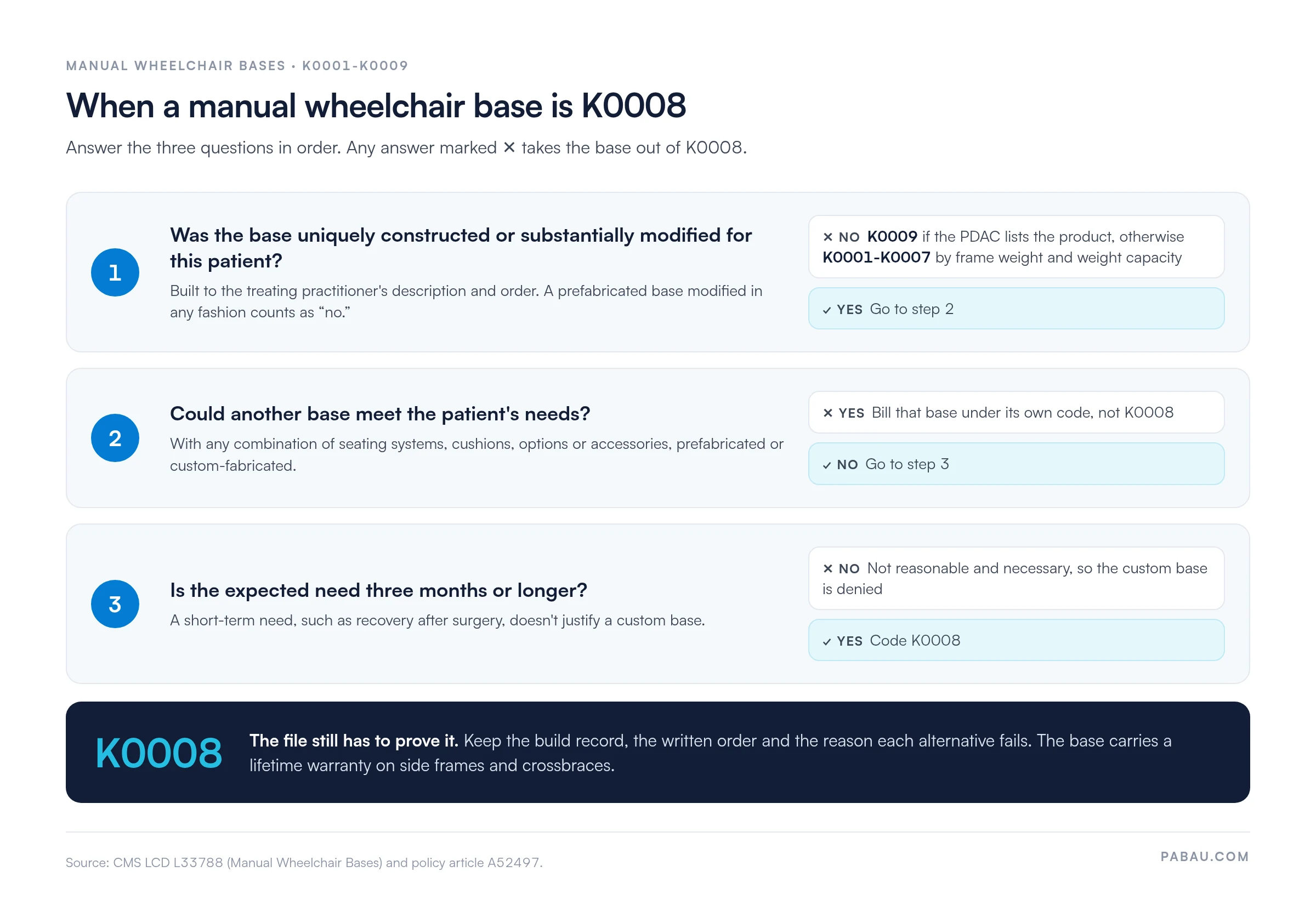
A custom base isn’t reasonable and necessary when the expected need is under three months, such as recovery after surgery.
Each K0008 claim line needs a KX, GA, GY or GZ modifier, and the file needs a description of how the base was built.
HCPCS code K0008 is a Level II code in the K0001-K0195 manual wheelchair range, maintained by the Centers for Medicare & Medicaid Services (CMS). It describes a device rather than a service, so the code has to match how the dispensed base was made. It sits alongside the other HCPCS Level II codes for durable medical equipment.
The word that carries the billing weight is “custom.” Policy article A52497 says the base must be “uniquely constructed or substantially modified” for a specific patient. That work follows the treating practitioner’s description and orders.
Weight plays no part in the code. K0003, K0004 and K0005 are defined partly by frame weight, but K0008 has no weight threshold at all. A K0008 base qualifies through its construction and the patient’s documented needs.
K0008 covers the custom wheelchair base. Seating, cushions, options and accessories are billed with their own HCPCS codes on the same claim.
The line between a configured stock chair and a custom base decides most K0008 claims. Medicare’s test is whether the base is “so different from another wheelchair base that the two items cannot be grouped together for pricing purposes.”
Adjustable features don’t pass that test on their own. Axle position, wheel camber, and seat and back angles appear in the coverage criteria for K0005. A base that only uses those adjustments belongs under a stock code.
The K0001-K0009 codes split manual bases by frame weight, weight capacity, and construction. K0008 is the one defined by construction, plus a lifetime frame warranty, as the table shows.
Two comparisons raise most coding questions. A carefully fitted ultralightweight base billed as K0005 is still a K0005, because individual fitting is part of that code’s own criteria. A heavier patient points to K0006 or K0007 first, not to K0008.
The other comparison is with K0009, which applies only to products the PDAC has listed under it. K0008 rests on documentation that this base was built or substantially modified for this patient.
Put together, the criteria form three questions asked in a fixed order, and a single wrong answer moves the base to another code.
Medicare covers K0008 under the DMEPOS benefit when the patient meets two sets of criteria in LCD L33788 (Manual Wheelchair Bases). The first set applies to every manual base, and the second applies to K0008 alone.
The general criteria cover use in the home:
K0008 then adds two specific criteria:
A prefabricated base billed as K0008 is denied for incorrect coding, even one that has been modified in any fashion.
A chair used only outside the home is denied as non-covered, because the DME benefit requires use in the home. If the base is denied, every accessory billed with it is denied too.
When a physical or occupational therapist performs the seating evaluation, their findings should match the supplier’s description of the base. The DME MAC for the patient’s region then adjudicates the claim. Noridian handles Jurisdictions A and D, and CGS handles Jurisdictions B and C.
K0008 is not on the CMS Required Prior Authorization List. The update that took effect on October 28, 2026, added the ultralightweight K0005, not K0008.
Some manual wheelchair codes also sit on the Required Face-to-Face Encounter and Written Order Prior to Delivery List. CMS changes both lists through rulemaking, so check them for K0008 before each new order.
Medicaid plans and commercial insurers often set their own approval rules for custom wheelchairs. Follow the payer’s prior authorization process before the base is built, because a custom base can’t be reissued to another patient if approval is refused.
K0008 needs more evidence than a stock base, because the custom element has to be proven twice. The clinical record proves the need, and the supplier’s record proves the build.
The DME MAC must be able to tell from the file that the delivered item is customized. Keep the records for seven years, and assemble them before delivery rather than after a records request.
No diagnosis qualifies a patient for K0008 on its own. The diagnosis has to explain a lasting mobility limitation, and the notes must show why it calls for a custom base.
Code each diagnosis to its highest specificity. ICD-10-CM updates every October 1, so check codes against the current tabular list before submission.
A diagnosis of multiple sclerosis, for example, doesn’t justify K0008 by itself. The notes still have to show the specific limitation and why another base can’t address it.
Every K0008 claim line needs one of four modifiers set out in policy article A52497. A line billed without KX, GA, GY or GZ is rejected as missing information.
Add KX only when the file supports every criterion, including the two K0008-specific ones. Payers outside Medicare may also expect purchase modifiers such as NU, so check each plan’s billing rules.
Without a signed ABN, the supplier can’t bill the patient for a denied K0008 base. If the file might not meet every criterion, get the ABN before the build starts, not at delivery.
K0008 has no fixed national amount on the DMEPOS fee schedule. Medicare pays a customized item as a lump-sum purchase, and the DME MAC sets the amount through individual consideration.
That puts the price in the supplier’s hands to justify. Send an itemized description of materials and labor, because the DME MAC prices the base from what the file shows.
Most K0008 denials come from three weak points: The case for a custom base, the record of how it was built, and the claim’s modifiers. The table maps each denial reason to a prevention step.
Each row is a check your team can run before the claim goes out. Good denial management starts with that pre-submission review, not with the appeal.
A denied K0008 claim goes through Medicare’s five-level appeals process. The first two levels are where missing evidence is easiest to add.
For K0008, the strongest addition to an appeal is a signed letter from the treating practitioner. It should explain why this patient needs a uniquely built base and why each alternative fails.
Read the remittance advice before you draft a K0008 appeal. CARC 50 (not medically necessary), CARC 16 (missing information) and CARC 4 (modifier problem) each need a different response. A single cover letter for every denial wastes an appeal level.
Medicare sets the most widely cited rules for K0008, but many custom bases are billed to Medicaid or commercial plans. Their requirements can differ a great deal.
A K0008 claim draws on records from several people. They include the practitioner’s notes, the therapist’s seating evaluation, the written order, the build record and the proof of delivery.
When those records sit in separate systems, someone rebuilds the file every time a claim is queried. Pabau, the practice management and billing platform we build, keeps them on one patient record instead. Notes, signed forms and claims management sit together, so the file behind each claim is easy to check.
Your team can then confirm the build record and the modifier before submission, instead of hunting for them after a denial. That makes a clean claim more likely the first time.

Pabau keeps notes, signed forms and claims on the patient’s record, so your team can check a K0008 file before it goes out.

Code K0008 only when the base itself was built for one patient. Frame weight doesn’t decide it, and neither does a long list of options on a stock frame.
If a K0001-K0007 base with the right accessories would serve the patient, Medicare expects that code instead. When K0008 is right, the file needs a clinical case and a manufacturing record, both in place before delivery.
Book a demo to see how Pabau keeps custom wheelchair documentation and claims together for your team.

Billing a chair that is fitted but not custom built? HCPCS code K0005 covers the ultralightweight wheelchair and the specialty evaluation its claims need.
Is the product listed by the PDAC instead? HCPCS code K0009 explains when the other manual wheelchair base code applies.
Need to read the codes on a denied claim? Denial codes in medical billing covers the CARC and RARC codes that appear on rejected DMEPOS claims.
Working with a payer that requires approval first? The prior authorization process walks through each step from request to decision.
HCPCS code K0008 covers a custom manual wheelchair base. The base is uniquely constructed or substantially modified for one patient whose needs no other manual base can meet. Cushions and accessories are billed separately under their own codes.
No. K0008 has no frame-weight criterion. The ultralightweight wheelchair is K0005, which weighs under 30 lbs. K0008 is defined by custom construction, whatever the base weighs.
Yes, when the patient meets the general manual wheelchair criteria in LCD L33788 and the K0008-specific criteria. The record must describe the custom build and show that no other base meets the patient’s needs.
K0008 is a base custom built or substantially modified for one patient. K0009 is the other manual wheelchair base code, billable to Medicare only for products the PDAC has verified and listed under it.
Common pairings include multiple sclerosis (G35.-), cerebral palsy (G80.-), paraplegia (G82.20-G82.22), quadriplegia (G82.50-G82.54) and spina bifida (Q05.-). The notes must still show why the condition calls for a custom base.
The usual reasons are a file that describes a configured stock chair and no explanation of why alternatives fail. A missing manufacturing description or a missing KX, GA, GY or GZ modifier also causes denials.
There is no fixed national rate. Medicare pays a customized item as a lump-sum purchase, priced by the DME MAC through individual consideration. Part B then pays 80% of the allowed amount after the deductible.