

CCSD code G5100: Bypass of duodenum billing guide
CCSD code G5100 bills a bypass that leaves the duodenum in place CCSD code G5100...

Last Updated: Oct 16, 2026
K0891 is the HCPCS Level II code for power wheelchair, group 5 pediatric, multiple power option, sling/solid seat/back, patient weight capacity up to and including 125 pounds.
DME suppliers bill it under Medicare Part B as durable medical equipment. Medicare requires an approved prior authorization before the chair reaches the patient.
Let Pabau's smart automation suggest the right codes, reduce claim denials, and keep your practice compliant—effortlessly.
Automate repetitive tasks and focus on what matters most—your patients.
Reduce coding errors and ensure compliance with the latest regulations.
Clean claims, fewer denials, and faster reimbursements.
Powerful insights and reporting to help your practice thrive.
HIPAA compliant SOC 2 certified GDPR-compliant Trusted by 4,000+ clinics worldwide

HCPCS Code K0891 covers a group 5 pediatric power wheelchair with multiple power options and a sling or solid seat and back. The frame is rated for patients up to and including 125 pounds.
K0891 differs from K0890 only in the number of powered functions, since K0890 covers the single power option version of the same pediatric chair.
Medicare requires an approved prior authorization before the supplier delivers a K0891 chair to the patient.
A face-to-face examination by the ordering physician and a detailed written order are both mandatory before billing K0891.
Pabau’s claims management software helps DME suppliers track claim status and submit clean claims for K0891 and related power mobility device codes.
HCPCS Code K0891 is a Level II Healthcare Common Procedure Coding System (HCPCS) code. Suppliers use it to bill for durable medical equipment (DME) under Medicare Part B coverage.
The official long description reads: Power wheelchair, group 5 pediatric, multiple power option, sling/solid seat/back, patient weight capacity up to and including 125 pounds.
Each element of that description carries billing weight. Breaking it down:
K0891 falls within the K0800-K0899 HCPCS code range, which covers power wheelchairs broadly. Within that range, group 5 codes represent the most complex, highest-cost power mobility devices. Code status for K0891 is active as of the 2026 HCPCS code set, and the wider HCPCS code library lists the neighboring K-series entries.
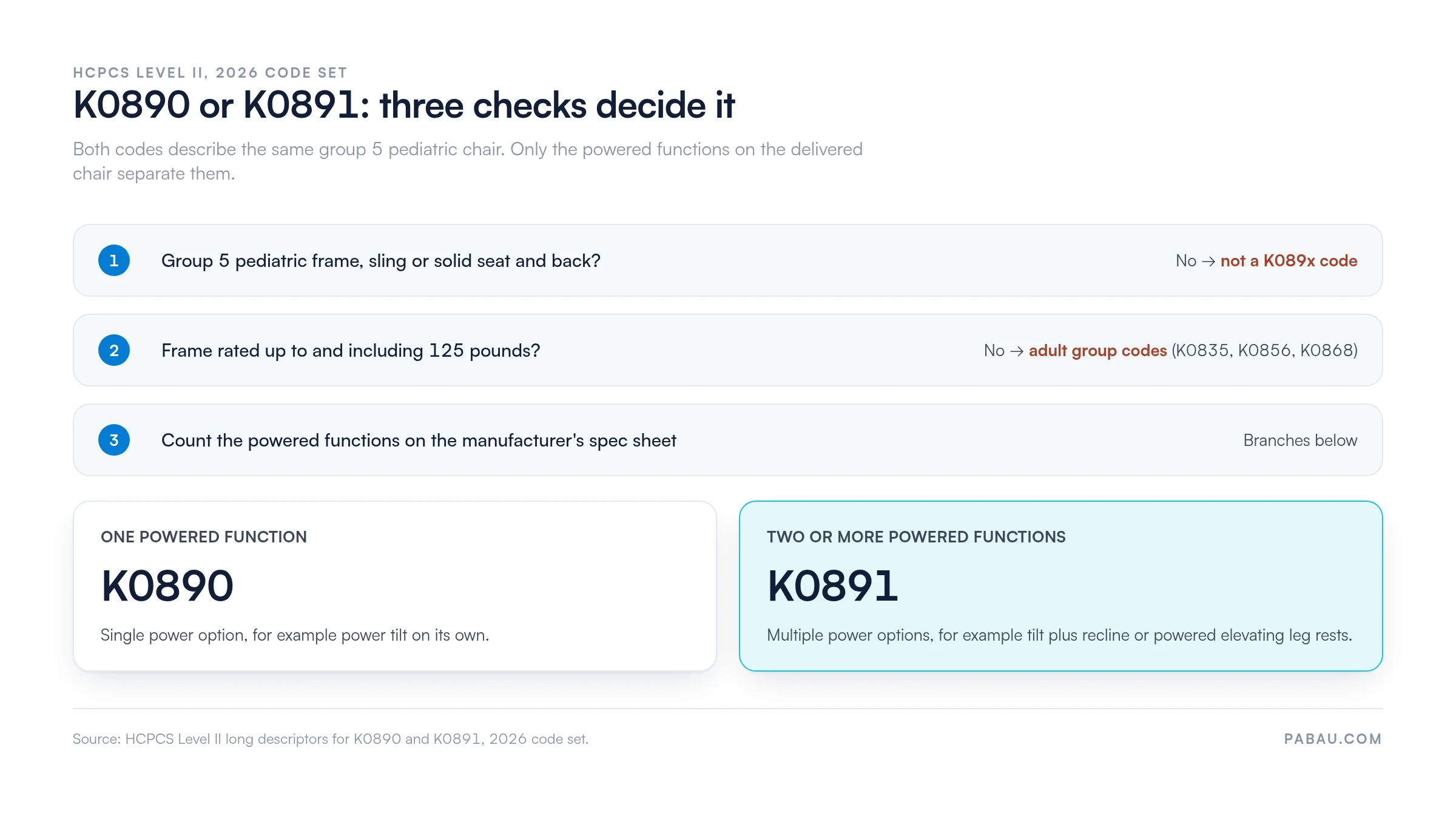
K0890 and K0891 are sibling codes, and both are pediatric. Each describes a group 5 pediatric power wheelchair with sling/solid seat/back and a patient weight capacity of up to and including 125 pounds.
The only distinction is the number of powered functions on the chair. K0890 covers a single power option, and K0891 covers multiple power options. Patient size does not separate them, and neither code describes an adult heavy-duty frame.
Billing K0890 for a chair that carries two or more powered functions understates the equipment delivered, and billing K0891 for a single-option chair is upcoding. Either mismatch is a direct path to a denial or a payment adjustment on audit. The powered functions listed on the manufacturer’s specification sheet must match the code billed.
Three checks settle the code selection, in the order a supplier meets them:
The Centers for Medicare and Medicaid Services (CMS) sets the coverage criteria for K0891. Medicare Part B covers the chair as durable medical equipment when the claim meets all of them. Coverage requires more than a physician’s preference.
The beneficiary must meet specific medical necessity thresholds, and the supplier must hold proper DMEPOS enrollment. Confirming the patient’s Part B status before the process starts avoids late-stage surprises.
According to CMS Medicare Learning Network guidance, the core coverage requirements for power mobility devices including K0891 are:
The face-to-face examination is not optional. CMS policy requires it to occur before the detailed written order is generated. The documentation from that examination must support the medical necessity of a group 5 pediatric power wheelchair specifically, not just any mobility aid.
Group 5 power wheelchairs, including K0891, are included in CMS’s prior authorization program for power mobility devices. Prior authorization is required before the supplier delivers the chair.
Delivering without an approved prior authorization and then seeking reimbursement typically results in denial, with limited appeal options. The sequence below applies the standard prior authorization process to a power mobility device order.
MAC-specific requirements vary. Noridian Healthcare Solutions (JD DME MAC) and CGS Administrators (JC DME MAC) each publish their own prior authorization checklists and timelines. Always verify against the beneficiary’s assigned MAC before submission.
Inadequate documentation is the leading cause of K0891 claim denials, according to CMS’s wheelchair compliance resources. The file has to answer three questions. Why this patient, why this chair, and why no simpler device would suffice. Capturing each required element at the time of service prevents the most common omissions, and every item below must be on file before billing:
The Local Coverage Determination (LCD) for power mobility devices is the governing policy document. Each MAC may have slightly different LCD requirements, so suppliers billing across multiple MAC jurisdictions need jurisdiction-specific documentation checklists.
K0891 is billed on a CMS-1500 claim form, or its electronic equivalent, the 837P. The supplier must be enrolled as a DMEPOS supplier with an active Medicare billing number.
Practice management software like Pabau routes 837P claims through the Claim.MD clearinghouse, which connects DMEPOS suppliers to CMS and thousands of US payers. That connection also covers real-time eligibility verification and electronic remittance (ERA/835) processing.
Key billing rules for K0891:
A pre-transmission checklist catches the front-end errors that delay payment. The usual three are a missing modifier, an absent prior authorization number, and a code that does not match the delivered equipment. Clearinghouse scrubbing then flags format problems and missing required fields before the claim reaches the MAC.
Medicare reimbursement for K0891 is set by the DMEPOS fee schedule published annually by CMS. Rates vary by geographic locality and are updated each calendar year, so the figures here are directional.
Always verify the current rate through the CMS DMEPOS fee schedule for the beneficiary’s zip code before you quote a patient’s cost share.
Check each monthly rental payment against the remittance advice as it arrives. That comparison catches underpayments, sequestration adjustments, and coordination-of-benefits reductions early, which keeps those amounts out of aged receivables.
K0891 sits within a broader family of HCPCS power wheelchair codes. Selecting the correct code from this group prevents the most common upcoding and downcoding errors. Use the AAPC HCPCS code lookup tool to verify current descriptions if you are unsure which code matches the equipment delivered.
A descriptor from a secondary lookup does not always match the CMS file. Several reference sites list HCPCS code C1756 as a short-tip intravascular catheter, while the CMS code set defines it as a transesophageal pacing catheter.
K0868 covers the group 4 standard adult frame with no powered seating function. Adding a single power option to that frame moves the claim to HCPCS code K0877.
The full HCPCS code set is maintained by CMS. The CMS HCPCS overview explains the Level II code structure and the annual update process for K-series DME codes.
Before billing K0891, pull the chair manufacturer’s product specification sheet. Confirm it lists the pediatric frame classification, a weight capacity of up to and including 125 pounds, and two or more powered functions. Keep this document in the patient file alongside the delivery receipt. MAC auditors frequently request manufacturer specifications as part of post-payment review for group 5 power wheelchairs.
CMS’s wheelchair compliance resources identify improper coding and missing documentation as the leading causes of denied power wheelchair claims. For K0891, the errors cluster around a small set of avoidable mistakes. Tracking every submission in one claims management workspace shows which of those mistakes is costing you the most, by MAC jurisdiction.
Each returned K0891 claim carries a denial code that names the error category. Reading it points you at the fix faster than working through the full remittance advice by hand. For CGS jurisdictions, the CGS coding verification notice sets out the PDAC verification steps for DMEPOS products.
Most DME suppliers run a K0891 order through three disconnected systems. The face-to-face notes sit with the referring practice, and the prior authorization approval lives in an email thread. The rental months are counted in a spreadsheet. When a claim comes back, someone has to rebuild that trail from all three before anyone can correct it.
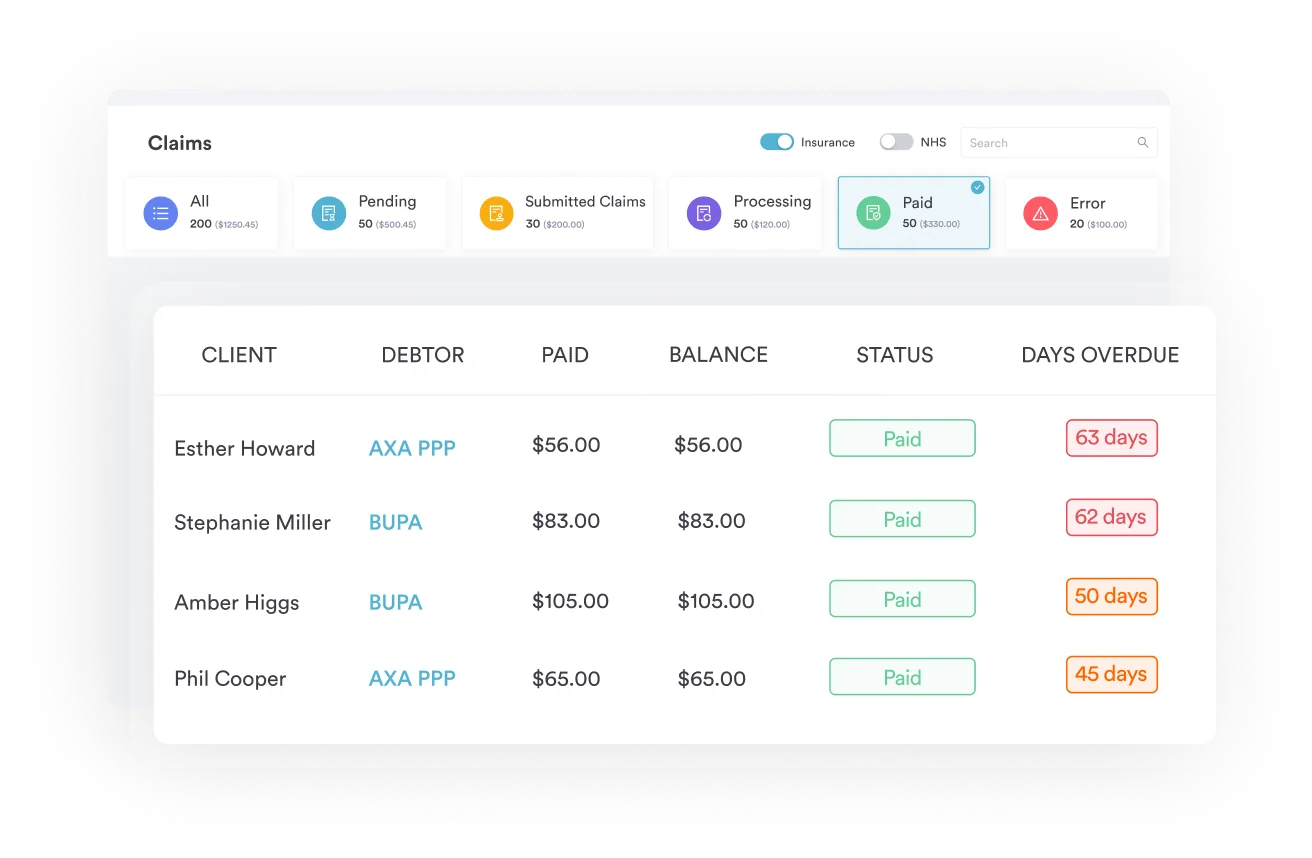
Pabau holds the patient record, the supporting documentation, and the claim in one place. Claims go out electronically through the Claim.MD clearinghouse, and each one carries a status your billing team can see: pending, submitted, processing, paid, or error. The written order, the home assessment, and the signed delivery receipt stay attached to the patient record.
So the path from order to payment gets shorter. Your team can see which K0891 rental claims are still open and which came back with an error. They can also see what each file is missing, without opening a second system.

Pabau helps DMEPOS suppliers and healthcare administrators submit clean claims, track claim status, and manage patient records for power mobility devices including K0891.

HCPCS Code K0891 carries more billing complexity than its single-line descriptor suggests. Two requirements decide most outcomes. The prior authorization has to be approved before the chair is delivered, and the powered function count has to match the code you bill.
The rest is documentation discipline. When the face-to-face notes, the written order, the home assessment, and the delivery receipt are complete before submission, the capped-rental cycle runs on schedule. The file also holds up under a post-payment review months later.
Build that checklist once, apply it to every group 5 order, and denials stop arriving as a monthly surprise. Book a demo to see how Pabau keeps K0891 claims, documentation, and rental months in one workspace.

Need to understand how clearinghouse submissions work? How a medical claims clearinghouse works explains the role clearinghouses play in routing 837P claims to Medicare and commercial payers.
Want to reduce claim rejections across your DME billing operation? Best medical billing software for US practices covers the platforms that handle DMEPOS claim submissions with built-in code validation.
Looking to streamline how you handle insurance billing end to end? Getting credentialed with insurance companies outlines the enrollment steps DMEPOS suppliers need to complete before billing Medicare for K0891.
HCPCS Code K0891 describes a power wheelchair, group 5 pediatric, multiple power option, sling/solid seat/back. The patient weight capacity is up to and including 125 pounds, which is a ceiling on the frame rating rather than a minimum. It is a Level II HCPCS code used to bill Medicare Part B and other insurers for this specific category of durable medical equipment.
Both K0890 and K0891 are group 5 pediatric power wheelchairs with sling/solid seat/back and the same weight capacity of up to and including 125 pounds. The only difference is the number of powered functions: K0890 covers a single power option, and K0891 covers multiple power options. Patient size is not the differentiator, and a frame rated for 300 pounds belongs to the adult heavy-duty codes rather than either of these.
Yes. Group 5 power wheelchairs including K0891 are subject to Medicare’s prior authorization program for power mobility devices. The supplier must receive an approval from the beneficiary’s MAC before delivering the chair. Delivering without prior authorization approval and then submitting a claim typically results in a denial that cannot be appealed retroactively.
Required documentation includes face-to-face examination notes from the ordering physician and a detailed written order specifying K0891 by code. You also need a functional assessment of mobility-related activities of daily living, a medical necessity statement, and a home assessment. The home assessment must confirm that the patient’s environment accommodates power wheelchair use. Finally, retain signed proof of delivery and the prior authorization approval number. All documentation must align with the applicable MAC’s Local Coverage Determination.
Yes, K0891 is covered under Medicare Part B as durable medical equipment. Coverage requires that all medical necessity criteria are met, that prior authorization is obtained, and that an enrolled DMEPOS supplier submits the claim. Medicare pays 80% of the lesser of the submitted charge or the fee schedule amount after the beneficiary’s deductible is satisfied.
The Medicare reimbursement rate for K0891 varies by geographic locality and is updated annually by CMS through the DMEPOS fee schedule. K0891 is billed under a capped-rental arrangement: Medicare pays monthly for up to 13 months, after which ownership transfers to the beneficiary. Use the CMS fee schedule search tool with the patient’s zip code to obtain the current locality-adjusted rate.



