

CCSD code G5100: Bypass of duodenum billing guide
CCSD code G5100 bills a bypass that leaves the duodenum in place CCSD code G5100...

Last Updated: Oct 16, 2026
K0885 is the HCPCS Level II code for a group 4 standard power wheelchair with a captains chair. The full CMS descriptor reads: power wheelchair, group 4 standard, multiple power option, captains chair, patient weight capacity up to and including 300 pounds.
Seat type is the only difference between K0885 and K0884, which has a sling or solid seat and back. Both are multiple power option chairs.
Medicare denies every group 4 power wheelchair for use in the home under LCD L33789. The beneficiary still gets the chair. The supplier bills K0885 as an upgrade, with a covered code such as K0861 on a second claim line, and payment follows that second line.
Let Pabau's smart automation suggest the right codes, reduce claim denials, and keep your practice compliant—effortlessly.
Automate repetitive tasks and focus on what matters most—your patients.
Reduce coding errors and ensure compliance with the latest regulations.
Clean claims, fewer denials, and faster reimbursements.
Powerful insights and reporting to help your practice thrive.
HIPAA compliant SOC 2 certified GDPR-compliant Trusted by 4,000+ clinics worldwide

HCPCS code K0885 covers a group 4 standard power wheelchair with multiple power options, a captains chair, and a 300 pound capacity.
K0884 and K0885 differ only by seat type, with a sling or solid seat and back on K0884 and a captains chair on K0885.
Both codes are multiple power option chairs, so no single versus multiple controller distinction separates them.
Medicare’s Power Mobility Devices LCD (L33789) denies every group 4 chair as not reasonable and necessary for use in the home.
Suppliers bill K0885 as an upgrade, pairing it with a covered code such as K0861 on a second claim line.
K0885 is not on the CMS Required Prior Authorization List, though the covered group 3 code billed beside it is.
The official CMS long descriptor reads: power wheelchair, group 4 standard, multiple power option, captains chair, patient weight capacity up to and including 300 pounds. In fact, every element in that string is a billing condition.
K0885 sits in the K0800 to K0899 block, which covers wheelchairs and power mobility devices. Specifically, the DME MACs maintain the K-code series for durable medical equipment, prosthetics, orthotics, and supplies (DMEPOS).
Multiple power option means the base carries powered seating functions beyond drive control. For example, power tilt, power recline, and powered elevating legrests are typical.
A captains chair is a molded seat and back supplied as one integrated unit with the base. A sling or solid seat and back is the alternative, and that is the configuration K0884 describes. Otherwise, the two descriptors match on every other element.
Still, neither wording is a judgment call at billing time. As CGS Medicare’s PDAC coding verification guidance sets out, the chair model has to appear on the PDAC product classification list first. Only then can a supplier bill it under K0885.
Meeting every element of the descriptor still will not get the line paid. That is where K0885 stops behaving like an ordinary code.
The Power Mobility Devices LCD (L33789) names all eleven group 4 codes. Those are K0868, K0869, K0870, K0871, K0877, K0878, K0879, K0880, K0884, K0885, and K0886.
The LCD says their added capabilities are not needed for use in the home. As a result, any claim for one of them is denied as not reasonable and necessary.
That is a coverage rule rather than a documentation problem, so a thicker file will not reverse it. No prior authorization pathway makes K0885 payable on its own either.
The beneficiary still receives the chair. Instead, payment flows through the covered equipment the practitioner would otherwise have ordered, billed on a second claim line.
In general, for a beneficiary at or under 300 pounds who needs multiple power options, that covered code is usually K0861.
The covered code on the second claim line carries the full weight of the LCD. In other words, every criterion below applies to it, not to the group 4 chair the beneficiary takes home.
LCD language varies slightly by jurisdiction, so check the version published by the contractor that serves your region. That is Noridian for Jurisdictions A and D, or CGS for Jurisdictions B and C.
K0885 is not on the CMS Required Prior Authorization List. Specifically, the power mobility codes on that list are K0800 to K0802, K0806 to K0808, K0813 to K0829, K0835 to K0843, and K0848 to K0864.
Group 4 and group 5 chairs are absent from it. However, that absence is easy to read as good news, and it is not.
K0861 is the covered code most often billed beside K0885, and it has required prior authorization nationwide since July 17, 2017. So the request still has to go in. Instead, it attaches to the covered chair rather than to the upgrade.
First, the request goes to the DME MAC for the beneficiary’s region, and the file has to be complete before it lands.
Confirm the beneficiary’s Part B enrollment before the request goes in, not after.
The detailed written order became the standard written order (SWO) for dates of service on or after January 1, 2020. Certificates of Medical Necessity were discontinued for dates of service on or after January 1, 2023. As a result, a CMN no longer belongs in a power wheelchair file.
Meanwhile, the face-to-face window moved as well. CMS now requires the encounter within the 6 months preceding the date of the SWO, not within 45 days. Plenty of supplier templates still carry the 45 day version.
Proof of delivery is the document most often cited as missing in power wheelchair audits. Therefore, capture the signature at dispensing, record the serial number, and confirm the address on file still matches.
Keep a copy of the prescriber’s clinical notes in the supplier’s own file rather than relying on the practice to hold them. A supplier who cannot produce documentation during a post-payment audit owes the money back, wherever the original records sit. Indeed, the same principle governs medical billing compliance across DMEPOS.
Price the same configuration under the covered group 3 code before you bill the group 4 chair. Show the beneficiary both numbers on the ABN, because the difference is what they are agreeing to pay. Putting it in writing at fitting prevents the collections argument that follows a denied upgrade.
Run this the day the claim goes out, not the week after it denies. After all, each line is something an auditor asks for.
The first decision is the upgrade pair. Specifically, it tells the DME MAC which line holds the denied chair and which holds the covered one. The second is the rental or purchase modifier on the covered line.
An upgrade is an item with features beyond what the practitioner ordered and beyond what the LCD covers. For example, a group 4 chair is exactly that. The supplier bills two lines at full charge, one for the chair provided and one for the chair Medicare will pay for.
Take a beneficiary at 260 pounds who needs multiple power options and takes a captains chair base. The first-month claim would read K0885 GA on line one, then K0861 KX GK on line two. K0885 never carries KX, because a group 4 chair cannot meet the LCD’s criteria by definition. In short, the diagram below maps each modifier to the line it belongs on.
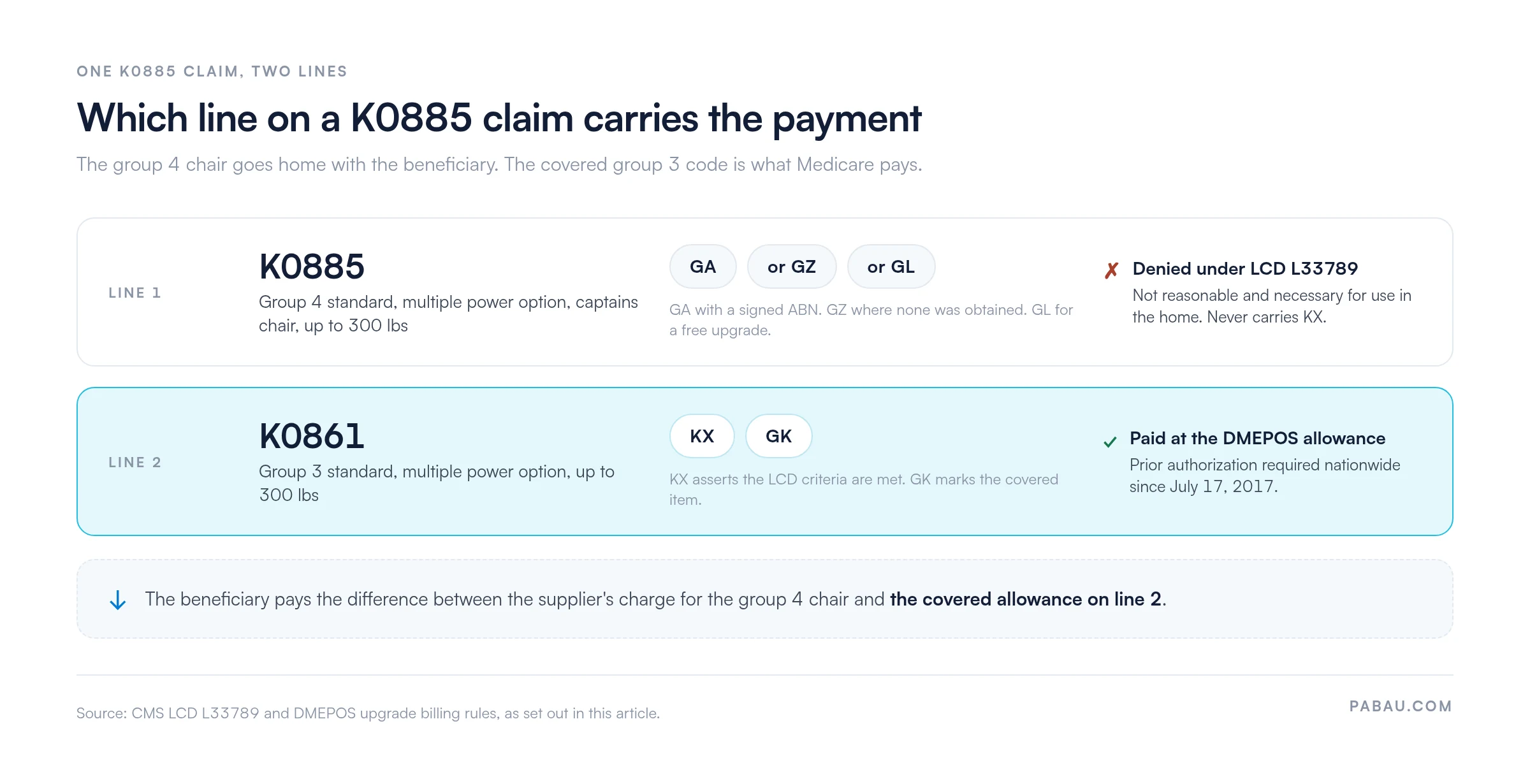
The GA and GZ choice matters legally, not just administratively. Specifically, GA requires a signed Advance Beneficiary Notice in the file, and GZ does not. Appending GA with no ABN on hand is a compliance violation, so the modifier belongs in a pre-billing checklist rather than in the submission screen.
Once the covered code is on the claim, it needs the modifier set that matches how the beneficiary took the chair. Accordingly, the supplier records that decision at the first furnishing.
KJ is often written up as covering months four to fifteen. That is the parenteral and enteral nutrition pump usage. A power wheelchair is capped-rental equipment, so KJ runs from month four through month 13 and no further.
The KH modifier is no longer required on purchased wheelchairs and accessories for dates of service on or after October 1, 2018. Instead, a purchase now reads NU and BP, plus whatever the LCD requires.
The fee schedule holds no usable allowance for K0885, because the group 4 line is denied. Instead, Medicare’s payment is based on the covered code billed with the GK modifier. As a result, the beneficiary covers the difference between the supplier’s charge for the group 4 chair and that allowance.
The covered chair is where the fee schedule work happens. Accordingly, use the CMS DMEPOS fee schedule to find the current allowed amount for that code in the specific service location. K0885 is durable medical equipment, so the physician fee schedule does not price it at all.
Rates vary by state and change with each annual update, so never quote a fixed figure in patient-facing material. Complex rehabilitative power wheelchairs are excluded from the DMEPOS Competitive Bidding Program. As a result, a supplier inside a bid area uses the same DME MAC fee schedule amount as one outside it.
The supplier has to offer the purchase option for the covered complex rehabilitative chair when it is first furnished. No rental payment is made for the first month until the DME MAC is told the option was given.
Rental payment for a power wheelchair runs on its own percentages. Specifically, months 1 through 3 pay 15% of the purchase price, and months 4 through 13 pay 6%. As a result, payment stops after the thirteenth month, and title transfers to the beneficiary.
The group 4 family turns on three variables: the power option count, the seating system, and the weight tier. Overall, eleven codes cover every combination CMS recognizes.
Read down the power option column and the K0884 question answers itself. Both K0884 and K0885 are multiple power option chairs, so the single power option line falls between K0877 and K0878 instead.
K0877 and K0878 are the single power option pair in this group, split by exactly the same seating choice. Therefore, anyone using a controller specification sheet to pick between K0884 and K0885 is reading the wrong document.
Specifically, these are the codes that turn up most often on a K0885 claim or in a K0885 mix-up.
The group 3 multiple power option codes mirror the same weight tiers, and one of them carries the payment on every K0885 claim.
Categorize every K0885 denial by root cause, then trace it back to the workflow step that produced it. In fact, our guide to denial codes explains the adjustment reason codes these claims return.
A K0885 claim depends on paperwork created weeks earlier by different people. Five documents have to be findable on the day the claim goes out. Specifically, those are the encounter note, the specialty evaluation, the ATP record, the signed ABN, and the proof of delivery.
Most teams keep those in a shared drive, an email thread, and a filing cabinet. Practice management software like Pabau keeps them against the patient record instead, so the file is assembled before anyone goes looking for it.
In fact, our claims management software holds the billing documentation and submits the claim from that same record. It is general billing software rather than a DMEPOS tool, so the DME MAC prior authorization portal and PDAC verification stay outside it.
What that removes is the searching. Each month’s rental claim on the covered code pulls from the same record, so staff are not rebuilding the documentation set from scratch. As a result, the audit trail stays in one place.

Pabau, our practice management software, stores clinical documentation against the patient record and submits the claim from the same place. See how that shortens the file hunt before a DMEPOS claim goes out.

K0885 is one of the few codes where getting the coding right still produces a denial, by design. Two facts keep the claim straight. The captains chair is what separates K0885 from K0884, and LCD L33789 denies the line either way.
Before the chair leaves the warehouse, confirm the PDAC coding, the covered code for line two, and the signed ABN. After that, the file is what defends the claim. Finally, keep the encounter note, the evaluation, and the delivery record current under the 6 month and SWO rules.
If your practice bills these every month, holding the documentation and the claim in one record removes most of the searching. Book a demo to see how Pabau keeps the K0885 file together, from the encounter note through to the remittance.

Need a broader overview of how DMEPOS medical billing works? What is medical billing explains the end-to-end claims process from code selection through payment posting.
Struggling with HCPCS claim rejections before adjudication? Submitting a clean claim outlines the elements every DME claim needs to pass the first pass.
Want a routine for the denials these claims generate? Denial management in healthcare covers how to investigate adjustment reason codes and build an appeals workflow.
Looking for a full reference on DMEPOS denial codes? Denial codes in medical billing sets out the most common claim adjustment reason codes and how to respond.
Checking whether the beneficiary is in traditional Medicare? Insurance eligibility verification walks through confirming coverage and plan rules before the equipment is ordered.
K0885 bills a power wheelchair, group 4 standard, multiple power option, captains chair, with a patient weight capacity up to and including 300 pounds. A DMEPOS-enrolled supplier submits it under Medicare Part B as durable medical equipment. The line is denied for use in the home, so it is billed as an upgrade beside a covered code.
K0877 and K0878. K0877 is the group 4 standard single power option chair with a sling or solid seat and back. K0878 is the same chair with a captains chair. Both carry a patient weight capacity up to and including 300 pounds.
No. K0885 is not on the CMS Required Prior Authorization List. The covered group 3 code billed on line two usually is, and K0861 has required prior authorization nationwide since July 17, 2017. Submit that request before the chair is delivered.
Not on its own. LCD L33789 denies every group 4 power wheelchair as not reasonable and necessary, because the added capabilities are not needed in the home. Suppliers bill K0885 with GA or GZ, then bill a covered code such as K0861 with GK on a second line. Payment flows to that second line.
GA or GZ goes on the K0885 line, and GK goes on the covered code line that carries the payment. GL replaces GA when the upgrade is supplied at no extra charge. On the covered line, rental months run KH for month one, KI for months two and three, and KJ from month four through month 13.



