HCPCS code L0638: Custom fabricated LSO billing guide
HCPCS code L0638 is a brace built for one patient HCPCS code L0638 is the Level ...

Last Updated: Nov 2, 2026
K0733 is the HCPCS Level II code for a 12 to 24 amp hour sealed lead acid battery that powers a wheelchair, billed per battery. It covers gel cell and absorbed glass mat (AGM) batteries in that range.
DME suppliers bill K0733 with a covered power wheelchair base or on its own as a replacement, usually for one or two units. Medicare coverage follows the Wheelchair Options/Accessories LCD (L33792) and policy article A52504, and the code has been active since July 1, 2006.
Let Pabau's smart automation suggest the right codes, reduce claim denials, and keep your practice compliant—effortlessly.
Automate repetitive tasks and focus on what matters most—your patients.
Reduce coding errors and ensure compliance with the latest regulations.
Clean claims, fewer denials, and faster reimbursements.
Powerful insights and reporting to help your practice thrive.
HIPAA compliant SOC 2 certified GDPR-compliant Trusted by 4,000+ clinics worldwide

K0733 bills one 12 to 24 amp hour sealed lead acid battery for a power wheelchair, so two batteries means two units.
Medicare pays for a sealed battery separately from the power wheelchair base and allows up to two batteries at any one time.
Non-sealed batteries are denied as not reasonable and necessary, and group-size batteries such as U-1 or 22NF have their own E codes.
A replacement battery takes the RB modifier, but a battery supplied with a new wheelchair base never does.
Every K0733 line needs one of KX, GA, GY or GZ, or the DME MAC rejects it as missing information.
HCPCS code K0733 is the Level II code for a power wheelchair accessory: a 12 to 24 amp hour sealed lead acid battery, billed each. Gel cell and absorbed glass mat (AGM) batteries both fall under it, as long as the rating sits inside that range.
CMS added the code on July 1, 2006, in the K range of temporary codes used by the DME MACs. It sits in the inexpensive or routinely purchased (IN) payment category, so suppliers bill it as a purchase. Coverage comes from the Wheelchair Options/Accessories LCD (L33792) and its policy article, A52504.
The word “each” sets the units. A chair that runs on two batteries gets one K0733 line with two units, never one unit for the pair.
Wheelchair battery codes in the HCPCS code set split by seal, chemistry and size, so the label on the battery picks the code. K0733 is the capacity-range code for smaller sealed batteries. Larger sealed batteries are coded by their group size instead, and lithium has a code of its own.
K0108, the not-otherwise-specified wheelchair component code, is the wrong home for any of these. The DME MACs published a correct coding notice in July 2018 after suppliers billed K0108 for battery replacements.
Under policy article A52504, a sealed battery is separately payable from a power wheelchair base. That covers the batteries shipped with a new chair and the ones that replace them later. The charger works the other way, because its cost sits inside the base allowance.
These are the rules that decide whether a K0733 line gets paid:
The battery also inherits the chair’s coverage. A battery line can only carry KX when the wheelchair base meets the Power Mobility Devices LCD criteria. The battery has to meet its own criteria too.
Many K0733 claims are replacements, because sealed batteries wear out well before the chair does. Policy article A52504 reserves RB for an accessory that replaces the same part after wear or damage.
Two limits apply. RB never goes on an upgrade, and it never goes on a battery supplied at the same time as the base. That holds even when the beneficiary had the same battery on a previous chair.
Here is how the modifiers line up on a battery claim:
KX, GA, GY and GZ are never combined on one line. A line that carries none of them is rejected as missing information.
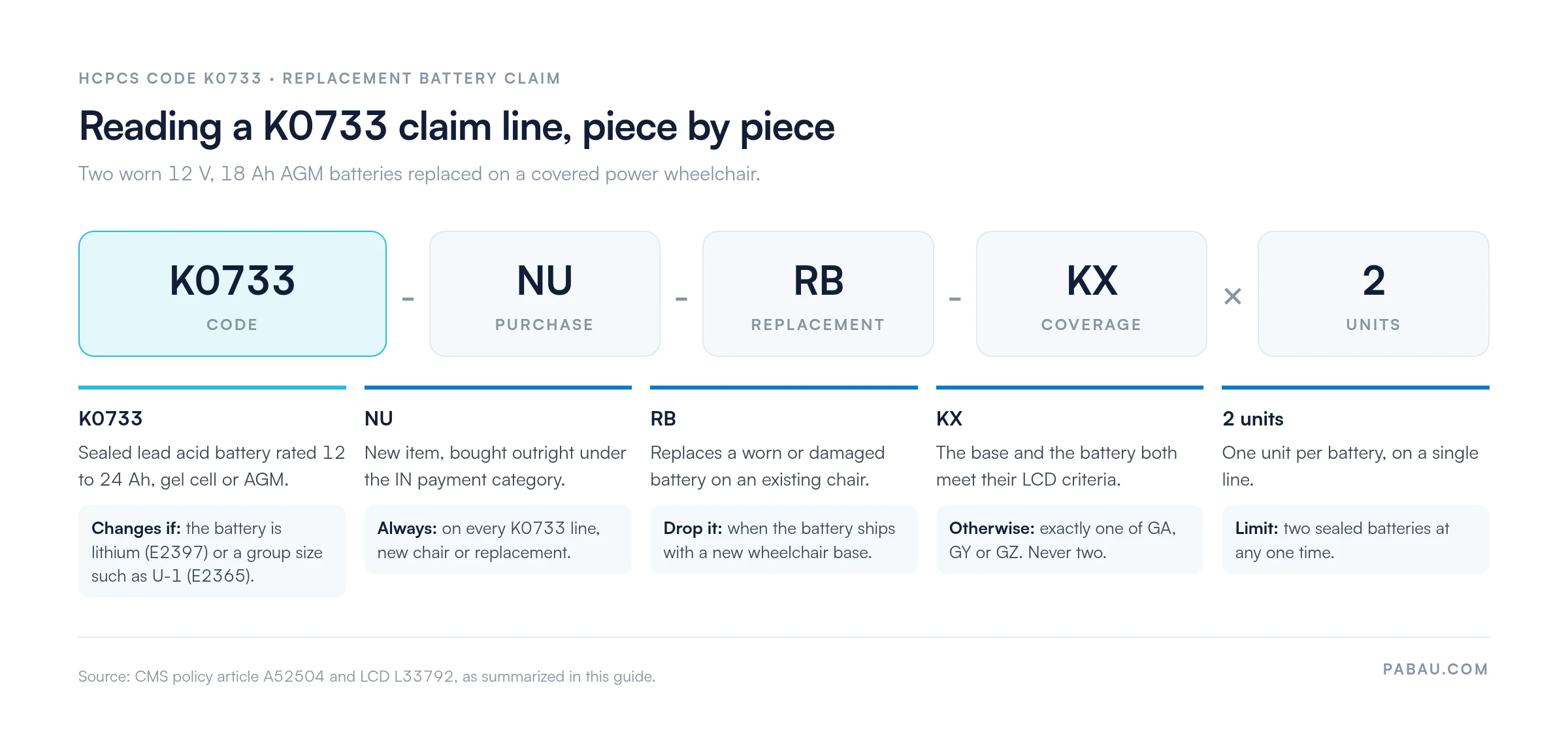
Take a beneficiary who owns a covered power wheelchair that runs on two 12 V, 18 Ah AGM batteries. The chair stops holding a charge, both batteries fail a load test, and the supplier replaces the pair.
The claim line reads K0733-NU-RB-KX, 2 units, and each piece answers a different question. Had the chair shipped new with those batteries, the line would drop RB and sit beside the base on the same claim.
K0733 is priced on the CMS DMEPOS fee schedule, which CMS updates quarterly with amounts by state. Rural and non-rural areas can carry different amounts, so pull the figure for the beneficiary’s address.
Because the code sits in the IN category, the NU modifier pulls the purchase amount. Medicare pays 80% of the lower of the fee schedule amount or your charge, after the Part B deductible.
Medicare Advantage and Medicaid plans set their own rates and authorization rules. Run an insurance eligibility check before delivery rather than after the denial.
A battery claim is reviewed against the same record any DMEPOS item needs, plus a few battery details. Keep these together for every K0733 delivery:
An auditor will compare those records with the claim line. The broader rules are in our guide to medical billing compliance.
Most battery denials come from a handful of coding slips rather than coverage disputes. These are the ones that show up again and again:
A rejection is fixed and resubmitted, while a denial goes through redetermination. Our guide to denial management in healthcare covers how to track both.
Five minutes against this list catches most of the denials above:
Is K0733 a Group 3 power wheelchair code? No. Group 3 bases run from K0848 to K0864, under the Power Mobility Devices LCD (L33789).
Are K0734 to K0738 related wheelchair bases? No. K0734 to K0737 are skin protection seat cushions, and K0738 is a portable gaseous oxygen system.
Battery claims are small and frequent, so a rejected line can sit unnoticed until the beneficiary’s next order. Many offices track those lines in a spreadsheet beside the billing system.
Pabau, the practice management platform we build, includes claims management software that pre-fills the claim from the patient record. It checks required fields before a claim can be sent.
In the US, claims go through Claim.MD, with eligibility checks, claim status tracking and remittance posting in one place.
Code choice and modifiers stay with your billing team. Pabau keeps each K0733 line visible from submission to payment, so a rejection gets reworked while the order is still fresh.
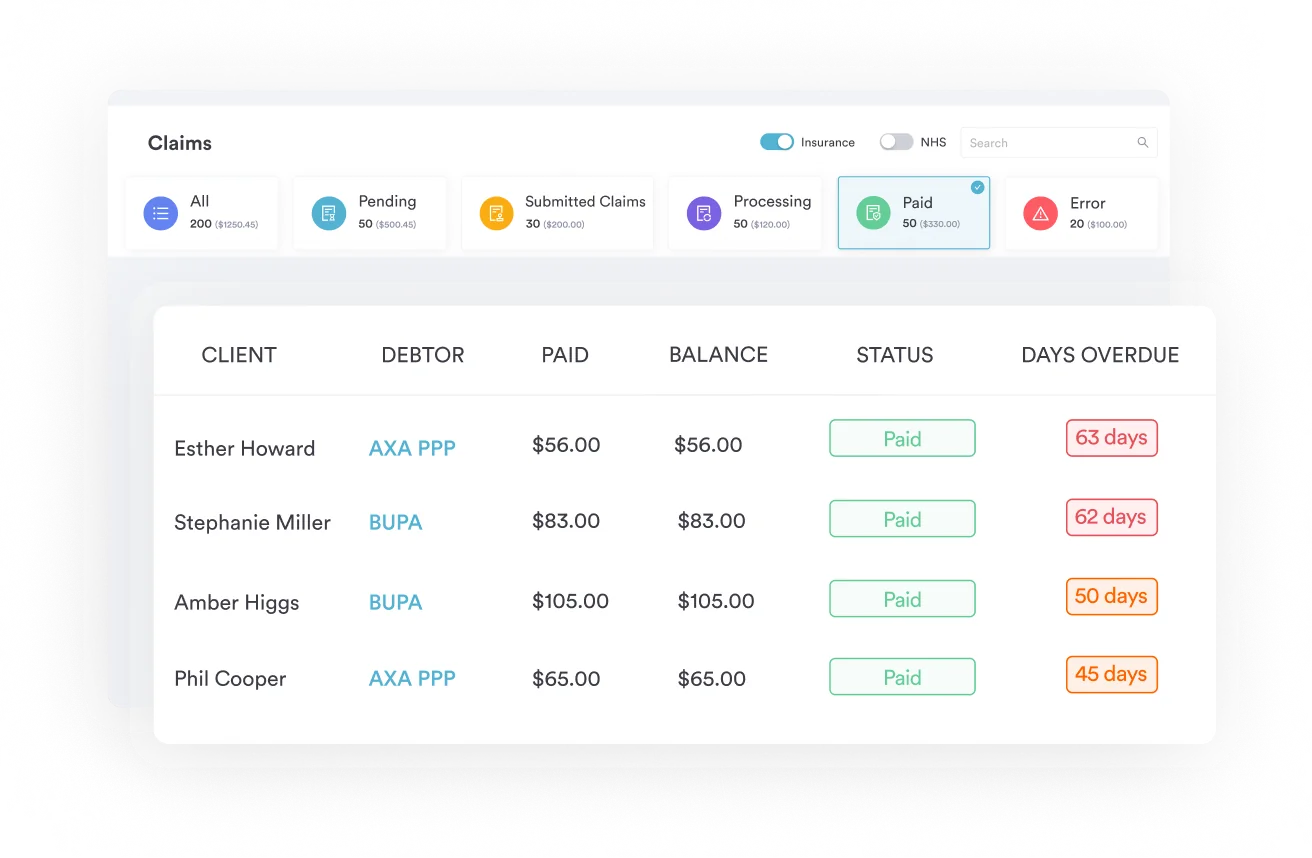

Pabau’s claims management software pre-fills claims from the patient record, checks required fields, and tracks each claim through to remittance.

K0733 is a narrow code, which is exactly why it trips suppliers up. Confirm the battery is sealed and rated 12 to 24 Ah, bill one unit per battery, and keep RB for replacements.
Get those three right and any remaining risk moves to the wheelchair base. Confirm its coverage before delivery, because a battery line can only carry KX when the chair qualifies.
Book a demo to see how Pabau tracks DME accessory claims from submission to payment.

Need to understand how clean claims reduce denial rates? Submitting a clean claim walks through the pre-submission requirements that apply across DMEPOS billing.
Looking for denial prevention best practices? Denial codes in medical billing explains the most common CARC and RARC codes and how to respond to each.
Want a broader foundation in revenue cycle management? What is revenue cycle management covers the end-to-end billing cycle from eligibility through payment posting.
Bill one unit per battery. Medicare allows up to two sealed batteries at any one time for a power wheelchair, so a claim line usually carries one or two units.
Yes. CMS added K0733 on July 1, 2006, and its descriptor has not changed since. Check each quarterly HCPCS update anyway, because K codes are temporary and can be replaced.
No. A lithium-based power wheelchair battery is billed with E2397, which Medicare usually allows once every 3 years. K0733 is limited to sealed lead acid batteries rated 12 to 24 Ah.
K0733 covers sealed lead acid batteries rated 12 to 24 amp hours. E2365 covers the U-1 group size, so the size printed on the battery decides the code.
Not at initial issue, because a POV allowance includes its batteries. A medically necessary replacement for a covered, beneficiary-owned POV is billed with a wheelchair accessory code.
The Wheelchair Options/Accessories LCD, L33792, with policy article A52504. Both are published by every DME MAC.