CPT code 14001: Adjacent tissue transfer on the trunk
CPT code 14001: Definition and official descriptor The American Medical Associat...

Last Updated: Nov 3, 2026
K0051 is the HCPCS Level II code for cam release assembly, footrest or legrest, replacement only, each. It covers the latch that locks a swing-away footrest or legrest to the wheelchair frame, supplied as a replacement part.
The code applies only when that assembly is replaced on a wheelchair the patient already uses, billed one unit per assembly. A footrest supplied with a new wheelchair is part of the base code instead. Medicare pays K0051 under the Part B DMEPOS benefit, and only enrolled DMEPOS suppliers may bill it.
Let Pabau's smart automation suggest the right codes, reduce claim denials, and keep your practice compliant—effortlessly.
Automate repetitive tasks and focus on what matters most—your patients.
Reduce coding errors and ensure compliance with the latest regulations.
Clean claims, fewer denials, and faster reimbursements.
Powerful insights and reporting to help your practice thrive.
HIPAA compliant SOC 2 certified GDPR-compliant Trusted by 4,000+ clinics worldwide

HCPCS code K0051 bills one replacement cam release assembly for a wheelchair footrest or legrest, one unit per assembly.
The code is replacement only, so a footrest or legrest supplied with a new wheelchair base is never billed with K0051.
Coverage follows the Wheelchair Options/Accessories LCD (L33792) and its policy article (A52504), not the power mobility device policy.
Replacement claims carry the RB modifier, plus KX, GA, GZ or GY depending on whether coverage criteria are met.
Most K0051 denials trace back to the wrong footrest code, a missing modifier, or no record of why the old latch failed.
HCPCS code K0051 describes a cam release assembly, footrest or legrest, replacement only, each.
It is a Level II code in the K-series, which CMS maintains for durable medical equipment billed to the DME Medicare Administrative Contractors (MACs).
The code pays for one latch assembly when it fails on the footrest or legrest of a wheelchair the patient already uses. As a part code, it sits in the K0001-K0195 range for wheelchairs, components and accessories, and it never bills the chair itself.
A cam release assembly is the latch that locks a swing-away or detachable footrest or legrest to the wheelchair frame. Operating the release frees the hanger, so the rigging can swing aside or lift off for transfers.
When the cam wears or breaks, the footrest either won’t lock in place or won’t release. A rigging that won’t lock can swing out under the patient’s legs, and one that won’t release makes every transfer harder.
K0051 replaces that latch on its own. The rest of the footrest or legrest stays on the chair, and the code says nothing about the wheelchair base itself.
K0051 covers one part. The code applies only when a cam release assembly is supplied on its own to replace the same part on an existing wheelchair.
Covered under K0051:
Excluded from K0051:
If the technician replaced the whole footrest rather than the latch, bill the code for the part that went on the chair. Billing K0051 for a complete footrest is wrong code assignment and invites recoupment on review.
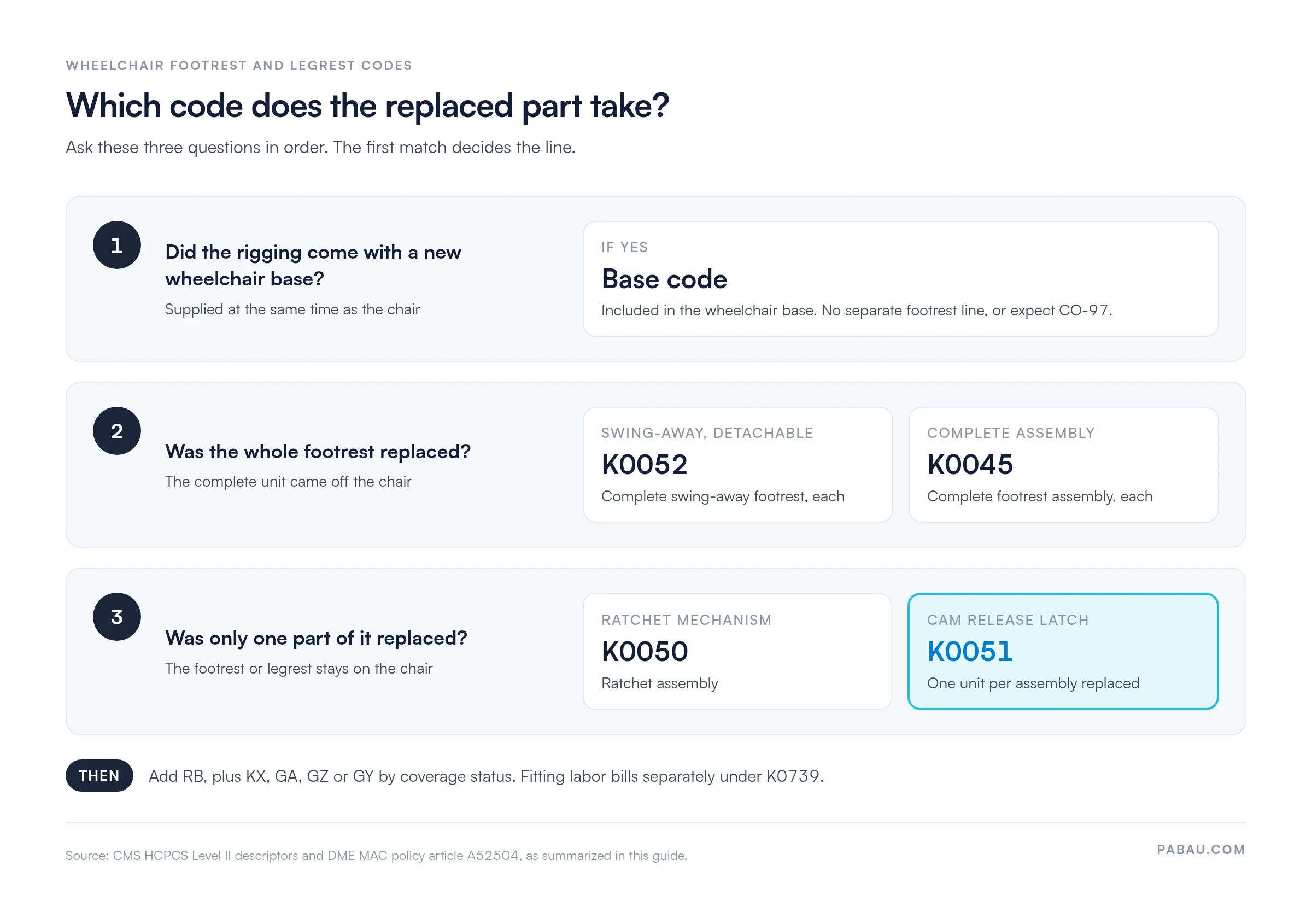
Most K0051 coding errors come from the codes on either side of it. Each code names one physical part, so the choice turns on what came off the chair and what replaced it.
K0051 and K0052 are the pair most often mixed up, because both concern swing-away rigging. K0051 is the latch alone, while K0052 is the whole detachable footrest. Our guides to HCPCS code K0050 and HCPCS code K0052 explain how those neighbors are billed.
Three questions, asked in order and starting with whether the chair is new, settle the code before the claim is built.
If the descriptor match is unclear, check the part’s coding with the manufacturer or the Pricing, Data Analysis and Coding (PDAC) contractor before you bill.
Medicare Part B covers K0051 under the DMEPOS benefit as a replacement part for a covered wheelchair. Coverage follows the Wheelchair Options/Accessories LCD (L33792) and its policy article, A52504, which the DME MACs publish jointly.
Medicare pays for replacement parts that keep a covered wheelchair working. A typical K0051 claim meets these conditions:
Some patients need the wheelchair only for mobility outside the home. Policy article A52504 then tells suppliers to add the GY modifier to every accessory code, and the claim denies as outside the benefit.
Power mobility device (PMD) rules don’t apply to a K0051 claim. LCD L33789, NCD 280.3 and the PMD prior authorization program govern new power wheelchairs.
Documentation for K0051 has to be in the file before the claim goes out. The table reflects the standard DME MAC rules for a wheelchair replacement part, so check the policy article for contractor-specific additions.
Reviewers look for the repair justification first on a part like this. A note that reads “latch replaced” records the work, but it doesn’t show why Medicare should pay for it.
Modifier choice on K0051 decides whether Medicare pays the line, holds it, or denies it. Policy article A52504 sets the rules, and RB carries the most weight on a replacement part.
GY can’t sit on the same line as KX, GA or GZ. Adding KX without documentation behind it is a false attestation, so check the current policy article before each claim cycle.
Enrolled DMEPOS suppliers bill K0051 on the CMS-1500 form or its electronic equivalent, the 837P transaction. The claim goes to the DME MAC for the patient’s state.
Structured claims management software catches field-level errors before they trigger automated edits at the DME MAC.
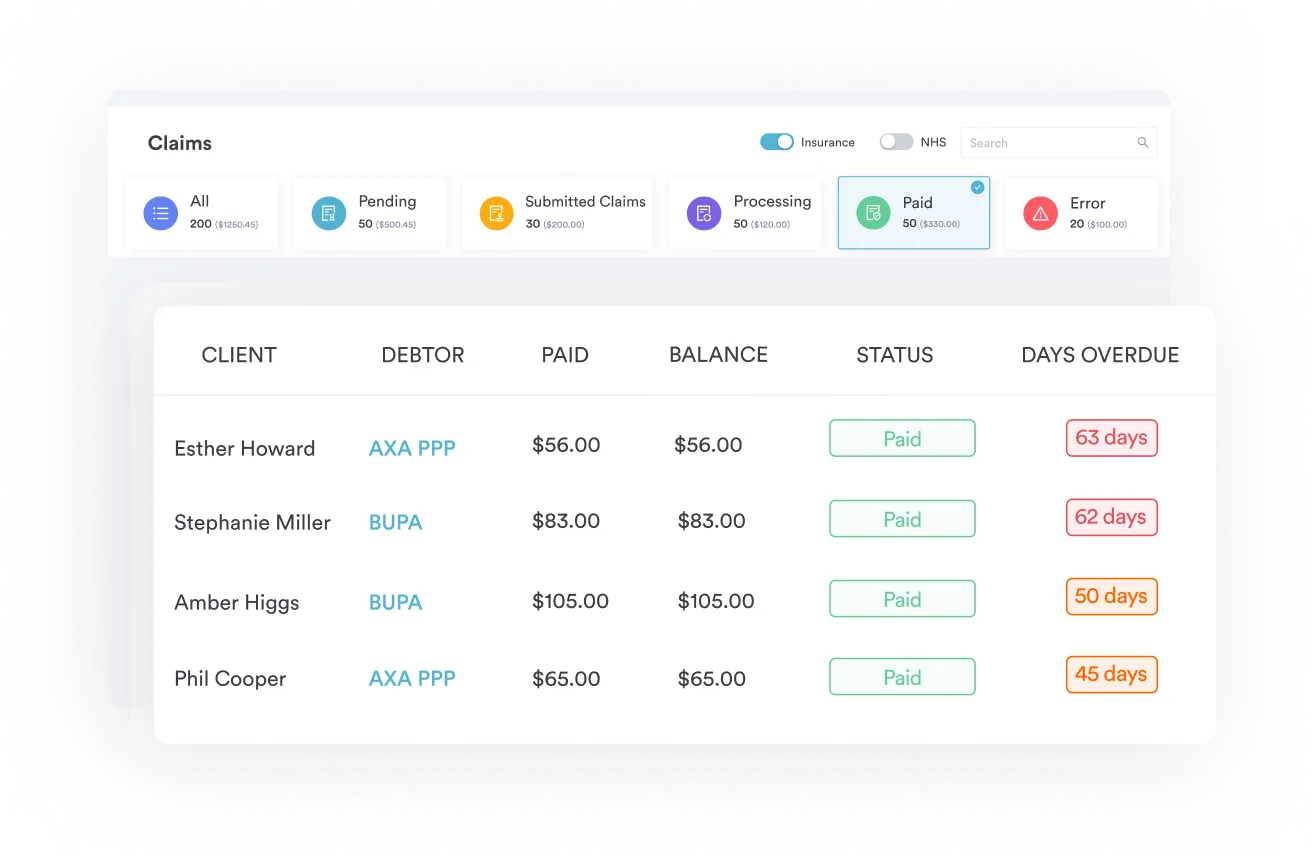
Submitting a clean claim from the start, with modifiers, units and diagnosis codes checked before transmission, removes the most common rejection triggers.
Medicare reimburses K0051 under the DMEPOS fee schedule, which CMS updates each year. The allowable amount varies by state, and rural and non-rural rates can differ.
Download the current file from the CMS DMEPOS fee schedule page before you quote or bill. The Physician Fee Schedule doesn’t price DMEPOS items, so a search there won’t return a K0051 rate.
Medicare pays 80% of the allowable after the Part B deductible, and the patient or a secondary payer owes the 20% coinsurance. Where a competitive bidding program covers the product category, the contract rate replaces the fee schedule amount.
Check the current-year DMEPOS fee schedule file for the patient’s state before you submit a K0051 claim. Billing at last year’s rate creates adjustment risk on post-payment review.
K0051 denials cluster around three causes. They are the wrong footrest code, a missing or wrong modifier, and no record of why the old latch failed.
Our guide to decoding denial codes explains the claim adjustment reason codes (CARCs) and remark codes (RARCs) on a remittance. Read them before you decide whether to correct or appeal.
Medicare Part B appeals run through five levels, and each one has its own deadline. A minor clerical error can often be fixed by reopening the claim instead, which is quicker than a formal appeal.
For a K0051 appeal, send the order, the repair justification, the proof of delivery and the product record together. The CMS fee-for-service appeals page lists the current thresholds.
Log each K0051 denial by reason code before you appeal. A repeating pattern, such as repair notes that never say what failed, is fixed faster in the workflow than claim by claim.
Replacement-part claims are small, so they often get the least attention. The order sits in one folder, the repair note in a technician’s inbox, and the modifier rule in someone’s head.
Pabau handles insurance billing for practices in the US, UK, Australia and Canada. Its claims management raises each claim from the patient’s invoice, on the same record as their notes and files.
Claim validation checks for missing or invalid details before the claim leaves Pabau. A rejected claim is flagged Needs action, with a link to the field that needs fixing. Your team follows every claim from Pending to Paid on one dashboard.

Pabau raises claims from the patient’s invoice, checks them before submission and flags rejections for a quick fix. Your team spends less time reworking small part claims.

K0051 is a narrow code, and that is where its risk sits. It pays for one latch on one footrest or legrest, so the claim succeeds only when the part, the modifier and the repair record agree.
Treat the technician’s note as part of the claim. A cam release logged with what failed, and why it couldn’t be fixed, rarely draws a denial. If you’re weighing tools for this work, our roundup of the best medical billing software in the US compares the options.
Book a demo to see how Pabau keeps replacement-part claims documented, validated and tracked to payment.

Need a process for handling denials? Denial management in healthcare covers root-cause analysis, appeals and how to build a denial prevention workflow.
Want a cleaner claims submission process? Submitting a clean claim explains the field-level checks that decide whether a claim processes on first pass.
Only the ratchet failed? HCPCS code K0050 explains how to bill a replacement ratchet assembly.
Replacing the whole swing-away footrest? HCPCS code K0052 covers swing-away, detachable footrests, with their own modifiers and documentation rules.
Replacing a complete footrest assembly? HCPCS code K0045 shows how the full footrest unit is coded and billed.
HCPCS code K0051 covers a cam release assembly for a wheelchair footrest or legrest, replacement only, billed per assembly. It applies when that latch alone is replaced on a wheelchair the patient already uses.
No. K0051 is a replacement part code for the latch on a footrest or legrest. Whole power wheelchairs are billed under their own base codes, which start at K0813.
K0051 follows the Wheelchair Options/Accessories LCD (L33792) and its policy article, A52504. The DME MACs publish both jointly, and the policy article sets the modifier and bundling rules.
Add RB because the assembly replaces the same part. Then add KX when coverage criteria are met, or GA or GZ when they may not be. Use GY when the chair is needed only outside the home.
K0051 is the cam release assembly, the latch that locks and releases a footrest or legrest. K0052 is a complete swing-away, detachable footrest. Bill the code that matches the part fitted on the chair.
No. A footrest or legrest supplied with a new wheelchair base is included in the base code, and K0051 is replacement only. Billing both on the same claim usually returns a CO-97 bundling denial.
Start with a redetermination at the DME MAC within 120 days, with the repair record attached. If that fails, the claim can move to reconsideration, an ALJ hearing, Medicare Appeals Council review and judicial review.