HCPCS Code E0272: Foam rubber mattress billing guide
HCPCS Code E0272: official descriptor and code overview HCPCS Code E0272 is the ...

Last Updated: Nov 6, 2026
J9318 is the HCPCS Level II code for injection, romidepsin, non-lyophilized, 0.1 mg. Each billing unit equals 0.1 mg of romidepsin solution, so 1 mg bills as 10 units. The solution needs no reconstitution, but it is diluted in 0.9% sodium chloride before infusion.
Lyophilized romidepsin (Istodax) bills under J9319 instead, and the deleted J2796 code was for romiplostim, not romidepsin. J9318 is paired with chemotherapy infusion codes 96413 and 96415.
Let Pabau's smart automation suggest the right codes, reduce claim denials, and keep your practice compliant—effortlessly.
Automate repetitive tasks and focus on what matters most—your patients.
Reduce coding errors and ensure compliance with the latest regulations.
Clean claims, fewer denials, and faster reimbursements.
Powerful insights and reporting to help your practice thrive.
HIPAA compliant SOC 2 certified GDPR-compliant Trusted by 4,000+ clinics worldwide

HCPCS code J9318 describes non-lyophilized romidepsin injection, a solution that needs no reconstitution, billed per 0.1 mg administered.
One mg of romidepsin equals 10 units of J9318, so a 25.2 mg dose bills as 252 units.
Lyophilized romidepsin (Istodax) bills under J9319, not J9318. J2796 is a deleted romiplostim code and never applies to romidepsin.
Romidepsin’s FDA-labeled indication is cutaneous T-cell lymphoma after at least one prior systemic therapy. The PTCL indication was withdrawn in 2021, and FDA approval for it ended in May 2022.
Pair J9318 with chemotherapy infusion codes 96413 and 96415, and add JW or JZ on Medicare single-dose vial claims.
HCPCS code J9318 is defined by CMS as “injection, romidepsin, non-lyophilized, 0.1 mg,” with each billing unit representing 0.1 mg administered.
The code sits in the J9000-J9999 chemotherapy drug range of HCPCS Level II. It has been effective since October 1, 2021.
Romidepsin is a histone deacetylase (HDAC) inhibitor, given as an intravenous infusion over four hours. “Non-lyophilized” means the drug is a solution that needs no reconstitution, but it is diluted in 0.9% sodium chloride before infusion.
Amneal announced FDA approval of a romidepsin injection solution, 27.5 mg/5.5 mL in single-dose vials, in June 2026. Amneal’s product is non-lyophilized, so it bills under J9318 (Amneal’s own product information sheet lists NDC 70121-2250-01 under J9318). Confirm it against the current CMS file. Teva had earlier withdrawn its own romidepsin solution. Check which product your pharmacy stocks before you pick the code.
The formulation in the vial decides the code, not the brand on the order. CMS split romidepsin into two codes in October 2021, both at 0.1 mg per unit.
J2796 shows up on romidepsin claims because the drug names look alike. Romiplostim treats immune thrombocytopenia, and from 2025 it bills under J2802 at 1 microgram per unit. A romidepsin line coded J2796 will deny as an invalid or deleted code.
Watch the unit change too. Under the old J9315, one unit meant 1 mg. Under J9318 and J9319, the same 1 mg is 10 units, so legacy charge masters often under-report the dose tenfold.
Romidepsin dosing is based on body surface area (BSA). The Istodax label sets the CTCL dose at 14 mg/m², infused over four hours on days 1, 8 and 15 of a 28-day cycle.
Worked example: A patient with a BSA of 1.8 m² receives 14 mg/m², which is 25.2 mg. That dose bills as 252 units of J9318. A 27.5 mg vial leaves 2.3 mg unused, so a second line reports 23 units with modifier JW. The vial splits between those two lines like this.
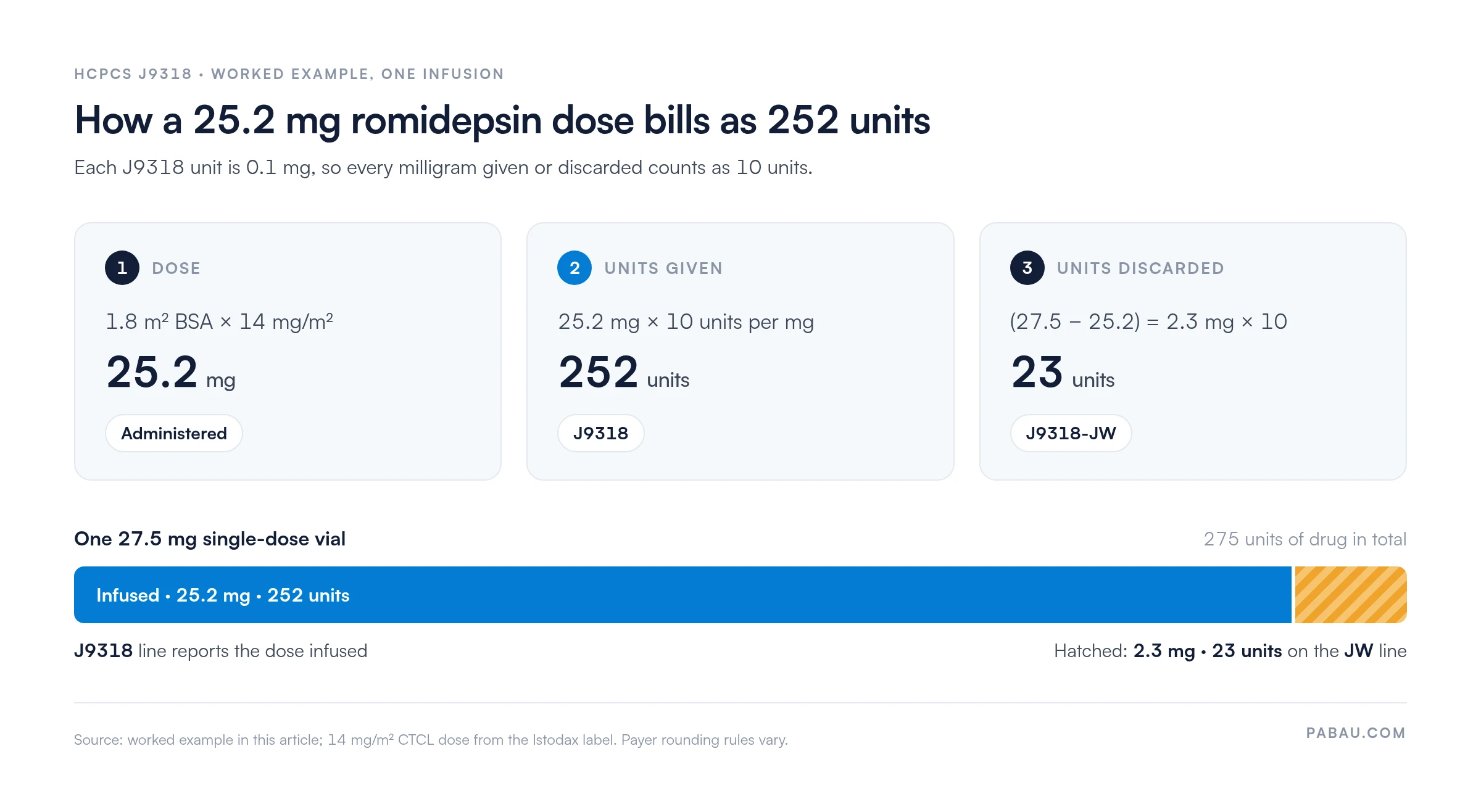
On the claim, the drug lines sit beside the infusion codes for the same session.
Bill the dose administered, not the vial size. The administration record must show the exact milligrams given, because that figure supports the unit count. Payer rules on partial units vary, so confirm rounding with each payer before you submit.
Romidepsin’s FDA-labeled indication is cutaneous T-cell lymphoma (CTCL) in adults who have received at least one prior systemic therapy. Bristol Myers Squibb withdrew the peripheral T-cell lymphoma (PTCL) indication in August 2021 (FDA formally withdrew approval in May 2022). A confirmatory trial did not meet its primary endpoint.
Most CTCL claims map to three ICD-10-CM categories. Code to the full number in the current tabular, including site and remission characters.
Some payer policies still list PTCL as an accepted diagnosis, often through compendia support. Others treat it as off-label. Read the patient’s plan policy before you schedule the first cycle.
J9318 reports the drug only, so the claim also needs an administration code. Romidepsin is an antineoplastic agent, which places its infusion in the chemotherapy administration codes.
Record the infusion start and stop times. Those times are what support the 96415 units, and auditors check them against the claim.
Medicare Part B generally pays physician-administered drugs at the Average Sales Price (ASP) plus 6%. CMS updates the payment limit for each code every quarter in the ASP pricing files.
Because the unit is only 0.1 mg, the per-unit payment limit looks small next to older 1 mg codes. Multiply the current limit by your unit count to estimate the line, then check it against the remittance. Strong revenue cycle management tracks these quarterly changes by payer.
Download the CMS ASP pricing file each quarter and look up J9318 and J9319 side by side. The two codes carry separate payment limits, so a formulation swap in the pharmacy changes your expected payment.
Medicaid requires the 11-digit National Drug Code (NDC) on physician-administered drug claims, and many commercial payers do too. Report the NDC from the vial used, with its qualifier and quantity.
The NDC also proves the formulation. A lyophilized Istodax NDC on a J9318 line is a mismatch that payer edits catch, and the reverse applies to J9319.
Prior authorization for romidepsin depends on the payer. Original Medicare does not generally require it for Part B drugs, but Medicare Administrative Contractors (MACs) can set coverage criteria.
Check that the authorization names the right code. An approval written for J9319 may not cover a J9318 claim, even for the same patient.
Most J9318 denials trace back to the code, the units or the diagnosis. A short pre-submission check catches each of them, and denial management covers the appeal side.
Medicare requires JW on any discarded amount from a single-dose container. Since July 1, 2023, it also requires JZ when no drug is discarded. CMS sets out both rules in its JW and JZ modifier FAQs.
Commercial payer policies on waste vary. Some follow the Medicare rule, while others do not pay for discarded drug at all.
The administration record is what supports every number on a J9318 claim. Keep these details in each infusion note:
These records also support medical billing compliance if a MAC or payer reviews the claim later.
On many billing teams, a romidepsin claim passes through several manual steps. A biller copies the dose, works out the units and keys the claim into a separate portal. Each hand-off is a chance for the 10-units-per-mg conversion to slip.
In Pabau’s claims management software, each claim is checked for missing or invalid details before it leaves the system. A flagged claim links straight to the field that needs fixing. US claims then go to payers electronically through Claim.MD.
Prior authorizations are stored as cases and attached at booking, so the authorization follows the appointment to the claim. That matters for romidepsin, which runs on a fixed infusion schedule across each cycle.
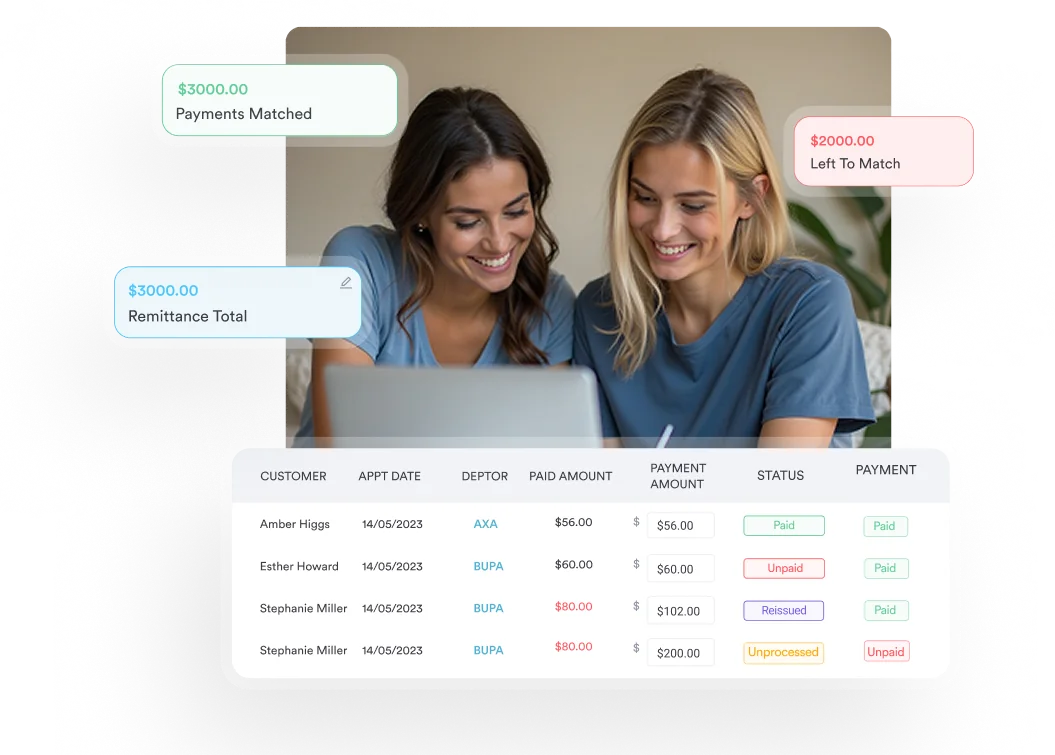
You can also verify insurance eligibility before the visit and settle payments from electronic remittance advice files. A short-paid drug line shows up when the remittance posts, not months later.

Pabau checks claim details before you send them, submits US claims electronically and settles payments from ERA files. Your team spends less time resubmitting oncology drug claims.

With romidepsin, the code follows the vial. Romidepsin solution bills as J9318, lyophilized Istodax bills as J9319, and J2796 belongs to a different drug.
The trade-off is the small unit. At 0.1 mg per unit, every milligram becomes 10 units, and an old 1 mg habit under-bills the dose tenfold. Build that conversion into your pre-submission checklist once, so a denial isn’t the first place you find it.
Book a demo to see how Pabau checks claim details before submission and tracks each drug claim through to payment.

Pairing the infusion code? CPT code 96413 explains the first-hour chemotherapy infusion code billed with J9318.
Need guidance on denial codes and appeals? Denial management in healthcare covers CARC-based denial workflows and appeal strategies for drug claims.
Working through the 837P claim format? The 837 file explained details the segments where drug units and NDCs are reported.
Want fewer first-pass rejections? What makes a clean claim walks through the elements payers check before processing a drug code.
Browsing other drug codes? HCPCS Level II codes lists the J-code guides for other injectable and infused drugs.
HCPCS code J9318 covers non-lyophilized romidepsin injection, billed per 0.1 mg administered. It is a solution that needs no reconstitution, but is diluted in 0.9% sodium chloride before infusion. Lyophilized romidepsin, sold as Istodax, bills under J9319 instead.
One mg of romidepsin equals 10 units of J9318, because each unit is 0.1 mg. A 25.2 mg dose therefore bills as 252 units.
No. J2796 was the code for romiplostim, 10 micrograms, and CMS deleted it at the end of 2024. Romiplostim now bills under J2802. Romidepsin bills under J9318 or J9319.
Both codes describe romidepsin at 0.1 mg per unit. J9318 is the non-lyophilized solution, while J9319 is the lyophilized powder that is reconstituted before use.
No. Bristol Myers Squibb withdrew the US PTCL indication in August 2021 (FDA formally withdrew approval in May 2022). The FDA-labeled indication is CTCL after at least one prior systemic therapy, though some payers still cover PTCL through compendia support.
Bill 96413 for the first hour of chemotherapy infusion and 96415 for each additional hour. A standard four-hour romidepsin infusion is one unit of 96413 and three units of 96415.