CCSD Code W1640: Simple pelvic osteotomy and fixation
CCSD Code W1640: Definition and procedure scope CCSD Code W1640 covers a simple ...

Last Updated: Nov 26, 2026
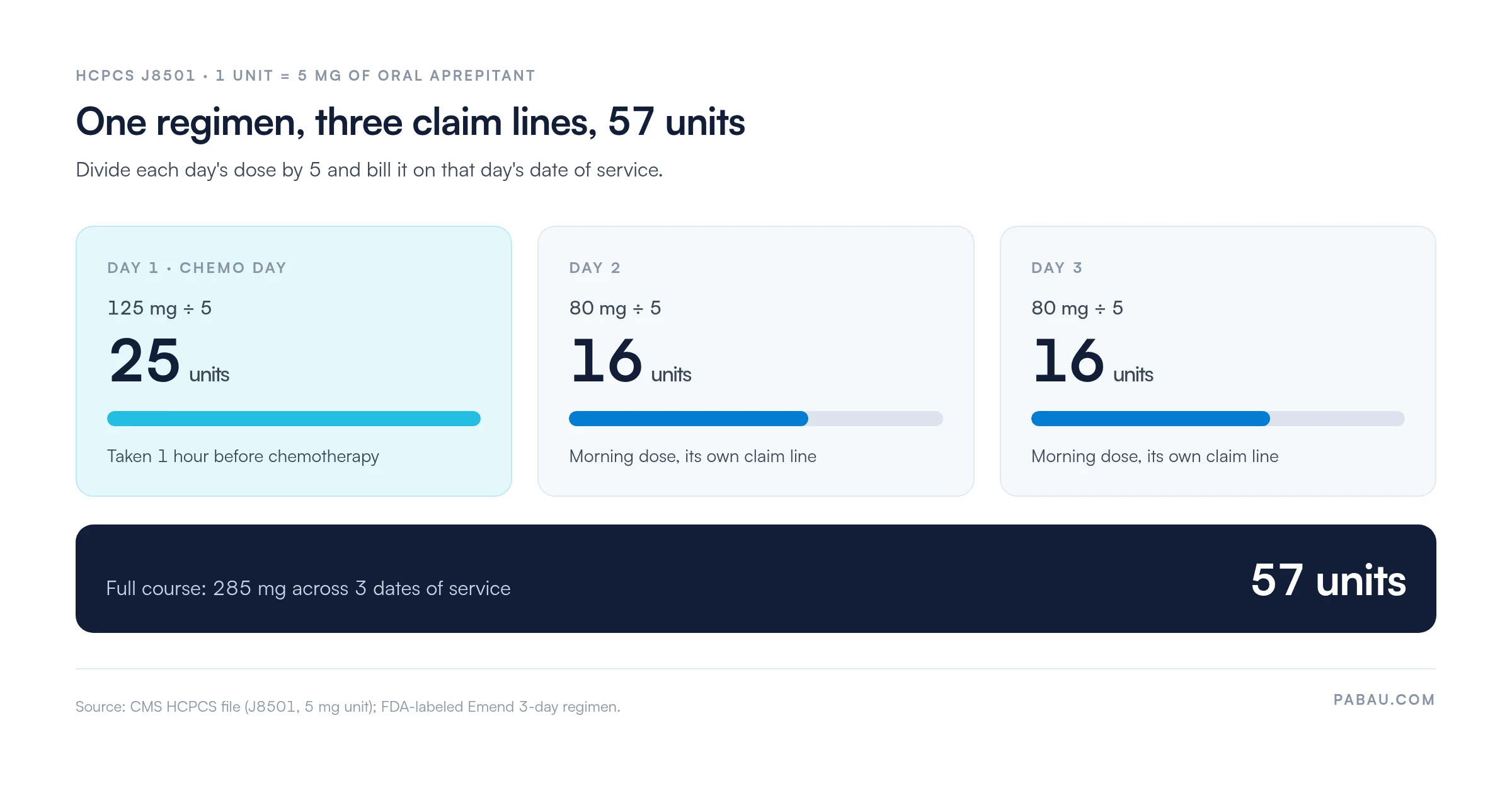
J8501 is the HCPCS Level II code for aprepitant, oral, 5 mg. One unit equals 5 mg, so the standard 3-day regimen of 125 mg, 80 mg and 80 mg bills as 25, 16 and 16 units.
Medicare Part B covers it when it fully replaces an IV antiemetic at the time of chemotherapy. Other prescriptions route to Part D. Common J8501 denials involve unit counts, NDC reporting and Part B/D routing.
Let Pabau's smart automation suggest the right codes, reduce claim denials, and keep your practice compliant—effortlessly.
Automate repetitive tasks and focus on what matters most—your patients.
Reduce coding errors and ensure compliance with the latest regulations.
Clean claims, fewer denials, and faster reimbursements.
Powerful insights and reporting to help your practice thrive.
HIPAA compliant SOC 2 certified GDPR-compliant Trusted by 4,000+ clinics worldwide

HCPCS Code J8501 covers oral aprepitant only, billed per 5 mg unit. IV fosaprepitant bills as J1453 and Cinvanti as J0185.
The standard regimen is 125 mg on Day 1 and 80 mg on Days 2 and 3, which bills as 25, 16 and 16 units.
Medicare Part B covers oral aprepitant when it replaces an IV antiemetic at the time of chemotherapy, and stand-alone prescriptions route to Part D.
Medicaid and many commercial payers require the National Drug Code (NDC) on J8501 claims, so confirm the rule with each payer.
Pabau, a practice management platform, helps oncology practices submit and track J8501 claims and remittances, and flags a missing prior authorization.
HCPCS Code J8501 is the Healthcare Common Procedure Coding System Level II code for aprepitant, oral, 5 mg. The Centers for Medicare and Medicaid Services (CMS) lists that exact descriptor and coverage code D in its quarterly alpha-numeric HCPCS file. Aprepitant is a neurokinin-1 (NK1) antagonist that prevents chemotherapy-induced nausea and vomiting (CINV) by blocking substance P signaling in the brain.
Coders new to oncology billing sometimes confuse J8501 with adjacent codes. Aprepitant comes in oral and IV forms, and its prodrug fosaprepitant is given intravenously. Only the oral capsule form of aprepitant maps to J8501. Mixing up the routes is a frequent source of wrong-code submissions for this drug class.
J8501 covers oral aprepitant capsules dispensed as part of a CINV prophylaxis regimen accompanying highly emetogenic chemotherapy (HEC) or moderately emetogenic chemotherapy (MEC). The code applies when aprepitant is the drug being billed, delivered orally, dosed in 5 mg increments.
Covered scenarios:
Not covered by J8501:
Units for J8501 are reported per 5 mg of aprepitant dispensed. Divide the total milligrams administered by 5 to get the billable unit count. The standard FDA-approved 3-day aprepitant regimen produces three separate unit counts, one per date of service, and each one goes on its own claim line.
NDC reporting: Medicaid and many commercial payers require the National Drug Code (NDC) on a J8501 claim. Medicare Part B does not generally require one on J-code claims. Where it is required, report the 11-digit 5-4-2 NDC in Loop 2410 of the 837P claim or the equivalent CMS-1500 field. For a clean claim, use the NDC of the product dispensed, never a generic placeholder.
Common unit calculation errors: Billing the full 3-day course on a single date of service instead of splitting across three claim lines. Rounding 80 mg to 15 or 20 units rather than the correct 16. Billing 25 units for Days 2 and 3 (using the Day 1 dose) when the patient received the standard 80 mg follow-on dose.
Always confirm the dispensed dose against the chemotherapy order before calculating J8501 units. Some payers audit unit counts against the prescribing physician’s order and question claims where reported units exceed the ordered dose. Document the dispensed quantity in the clinical record on each day of service.
Medicare’s Part B versus Part D routing for aprepitant is one of the most frequently misunderstood coverage rules in oncology billing. The default for most oral drugs is Part D, but aprepitant qualifies for a Part B exception under specific conditions. Getting the routing wrong sends the claim to the wrong payer, and the denial has to be refiled with the correct one.
The Part B exception is authorized under the Medicare Benefit Policy Manual (Pub. 100-02, Chapter 15), which covers oral antiemetics used as a full substitute for an IV antiemetic that would otherwise be covered. Local Coverage Determinations from Medicare Administrative Contractors (MACs) such as Noridian, CGS, and Palmetto specify additional medical necessity criteria. Always check the applicable MAC’s LCD before submitting J8501 under Part B, particularly for Days 2 and 3 of the regimen.
J8501 covers oral aprepitant capsules, while J1453 covers injectable fosaprepitant, 1 mg. The two codes are mutually exclusive for the same dose. Billing J8501 when the patient received IV fosaprepitant draws a wrong-code denial, and a repeated pattern can trigger an overpayment audit.
J8597 is the catch-all code for oral antiemetic drugs not otherwise specified. When the drug has its own HCPCS code, J8597 is incorrect. CMS coding specificity rules require the most specific applicable code. Billing J8597 for aprepitant when J8501 is the correct code constitutes a specificity-hierarchy error.
Prior authorization for J8501 aprepitant varies by payer and plan year. Medicare fee-for-service does not require prior authorization for J8501 when documentation supports medical necessity. Medicare Advantage plans and commercial insurers frequently do. Failing to obtain PA when a plan requires it results in a CO-197 denial (precertification or authorization absent).
Typical PA criteria required by commercial payers:
PA timeframes typically run 3 to 5 business days for standard review. Urgent or expedited review (24 to 72 hours) is available when the chemotherapy cycle is imminent. Always confirm whether the PA covers only the first cycle or the full treatment course, as some plans require cycle-by-cycle reauthorization.
A J8501 claim without adequate supporting documentation is vulnerable to denial on audit even if the initial claim processes. Medicare’s Local Coverage Determinations and commercial plan policies specify minimum medical record elements. Drug claims priced from quarterly ASP files draw MAC audits, so billing compliance documentation has to hold up on every date of service.
A superbill that carries the HCPCS code, NDC, unit count and linked diagnosis codes simplifies claim preparation. It also cuts the risk of missing fields before submission.
J8501 denials cluster around a handful of root causes, and each has a corrective path. The fastest fix is preventing the error at claim preparation rather than working appeals. Pabau’s built-in claims management software helps practices prepare, submit and track insurance claims. Systematic denial management workflows help practices track J8501 denial patterns by code and payer over time.
For appeals, read the ERA remittance alongside the full set of CARC denial codes. Patterns then show up across every drug claim, not just J8501.
Run a monthly J8501 denial report filtered by denial code and payer. If CO-16 keeps returning from payers that require an NDC, fix the NDC field in your claim template. That stops the denial at the source instead of claim by claim.
Medicare reimburses J8501 under the Average Sales Price (ASP) methodology. CMS publishes updated ASP-based payment rates quarterly in the Medicare Part B Drug Pricing Files. The payment amount equals ASP plus 6% (ASP + 6%), where the 6% add-on sits on top of the drug’s average sales price. Any figure cited in a coding reference reflects a specific quarter and may not reflect the current rate.
To look up the current J8501 payment limit, open the quarterly file on the CMS ASP pricing files page. Select the applicable quarter and filter by HCPCS code J8501. The payment is per unit (per 5 mg), so multiply by the total units billed to calculate the expected reimbursement for a full 3-day course. Good revenue cycle management tracks ASP changes every quarter. Payment variances are then expected before they show up as underpayments on the ERA.
Commercial payers negotiate separate contract rates for J8501 that may be higher or lower than the Medicare ASP rate. Contracted rates are plan-specific and are not publicly published. If a commercial ERA shows payment well below the Medicare rate, review the contract’s J-code drug reimbursement method. Some plans pay Average Wholesale Price (AWP) less a percentage rather than ASP plus 6%.
Oncology billing teams routinely bill multiple antiemetic codes on the same date of service. J8501 often appears alongside 5-HT3 antagonist codes and dexamethasone on Day 1 of the regimen. Understanding the companion codes prevents bundling errors and supports accurate multi-code claim preparation. The CMS HCPCS Level II code set and AAPC’s HCPCS code lookup are the two primary resources for verifying code descriptors and coverage notes.
When billing multiple antiemetic codes on the same date of service, verify that each code corresponds to a separately documented drug administration. Some payers bundle companion antiemetics into the chemotherapy administration codes. Check the CMS NCCI edits and your payer’s bundling policy before submitting companion codes.
A J8501 claim often passes through three tools. The order lives in the chart, the prior authorization in a spreadsheet, and the claim in a separate clearinghouse portal. Each handoff is a chance to lose a unit count or an authorization number.
In Pabau, the authorization code, its dates and its sessions are tracked on the patient’s case, with a warning when one is missing. US claims go out through Claim.MD as CMS-1500/837P claims, with eligibility checks and secondary claims in the same workflow.
ERA remittances post back against the claim, so your team sees which J8501 lines paid and which came back with a CARC. Fewer claims go out without their authorization, and denials surface while they can still be refiled.
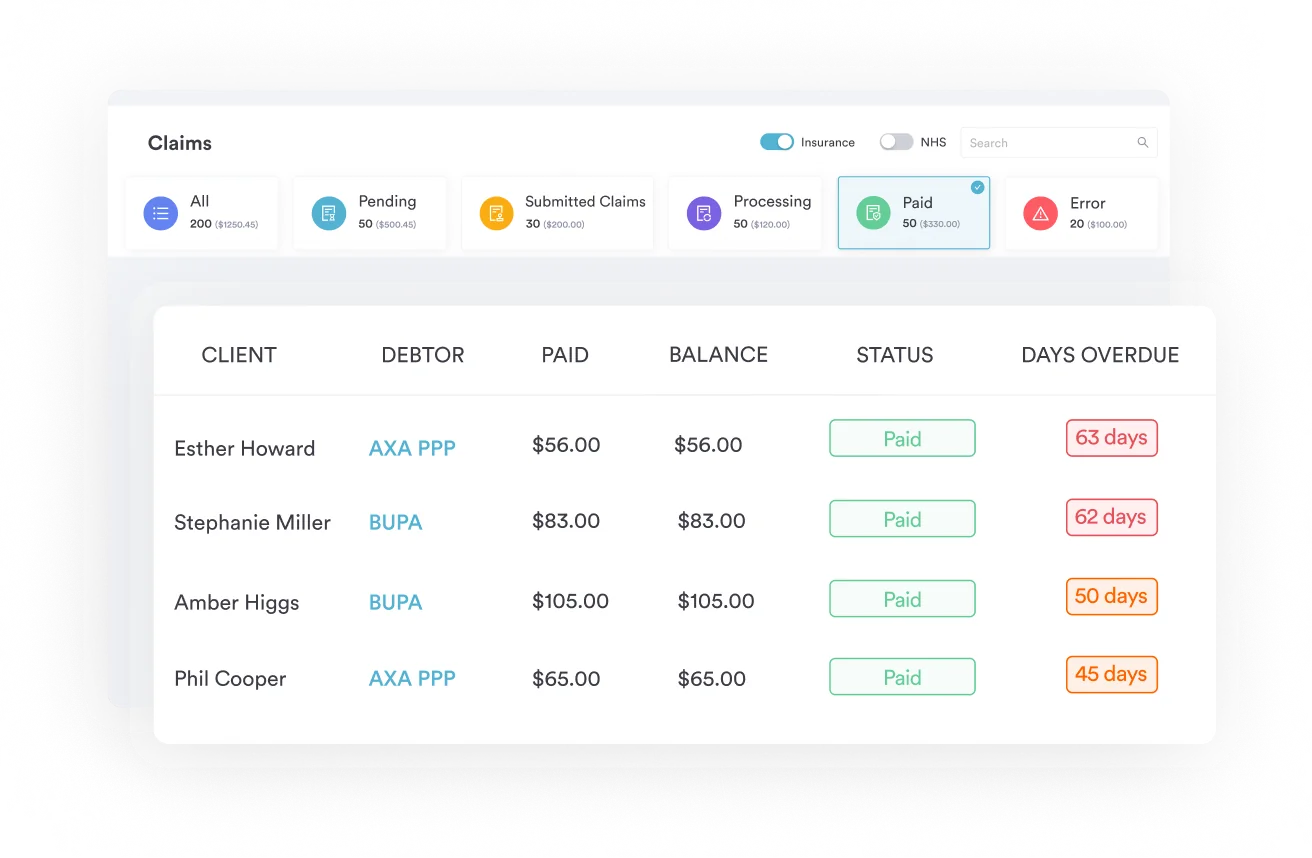

Pabau’s claims management sends CMS-1500/837P claims, checks eligibility and posts ERA remittances. Prior authorizations sit on the case, so a missing one is flagged before the chemotherapy cycle.

J8501 rewards billers who settle two questions before the first dose. Which payer owns the drug on this date, and does that payer want an NDC? Answer both up front, and the unit math is the easy part.
Build the three-line, 25-16-16 pattern into your claim template and check the authorization before Day 1. That removes the rework behind the common denials. Pabau helps practices submit and track electronic claims and remittances, so each J8501 line has a status your team can see. Book a demo to see how Pabau keeps oncology drug claims moving from order to payment.

Billing the IV form instead? HCPCS code J1453 covers fosaprepitant injection, billed per 1 mg.
Billing Cinvanti? HCPCS code J0185 covers injectable aprepitant emulsion, billed per 1 mg.
Adding the Day 1 steroid? HCPCS code J8540 covers oral dexamethasone, the steroid often paired with aprepitant.
Need the clearinghouse side of drug claims? Our Claim.MD clearinghouse guide explains how drug-code claims route through electronic payer networks.
Working a backlog of J-code denials? Denial management in healthcare covers root-cause workflows for high-volume denial codes.
HCPCS Code J8501 covers oral aprepitant capsules billed per 5 mg unit, used to prevent chemotherapy-induced nausea and vomiting with highly or moderately emetogenic regimens. The code applies only to the oral form. IV fosaprepitant bills as J1453.
Divide the milligrams dispensed by 5 to get units. The standard 3-day regimen bills 25 units on Day 1 (125 mg) and 16 units on each of Days 2 and 3 (80 mg). That totals 57 units across three separate claim lines.
Aprepitant qualifies for Medicare Part B when dispensed within 48 hours of a covered Part B chemotherapy administration. Retail prescriptions with no qualifying chemotherapy encounter route to Medicare Part D. Days 2 and 3 coverage under Part B depends on your MAC’s LCD.
Yes, when each antiemetic is separately documented as administered or dispensed. J8501 is often billed alongside a 5-HT3 antagonist such as J2405 (ondansetron) or J2469 (palonosetron), plus dexamethasone, on Day 1. Check NCCI and payer bundling edits first to avoid CO-97 denials.
Required elements include a signed chemotherapy order with its emetogenicity classification and the aprepitant dispensing record. Add the linked ICD-10-CM cancer diagnosis and dates that align dispensing with the chemotherapy encounter. Medicaid and many payers also require the NDC of the product dispensed, in Loop 2410 of the 837P.