Inpatient billing cheat sheet
An inpatient billing cheat sheet is a quick reference for the codes and claim ru...

Last Updated: Oct 19, 2026
Billable Code Specific Code
J7665 is the HCPCS Level II code for mannitol, administered through an inhaler, 5 mg. One unit is one 5 mg capsule the patient inhales during a bronchial challenge test. The code covers the drug alone, not the procedure.
Three errors cause most J7665 denials. Practices bill the kit quantity instead of the capsules administered, or omit the required 11-digit National Drug Code. The third is pairing J7665 with a diagnosis that does not support a bronchial challenge test.
Let Pabau's smart automation suggest the right codes, reduce claim denials, and keep your practice compliant—effortlessly.
Automate repetitive tasks and focus on what matters most—your patients.
Reduce coding errors and ensure compliance with the latest regulations.
Clean claims, fewer denials, and faster reimbursements.
Powerful insights and reporting to help your practice thrive.
HIPAA compliant SOC 2 certified GDPR-compliant Trusted by 4,000+ clinics worldwide

HCPCS code J7665 represents mannitol inhalation powder (Aridol), 5 mg per capsule, used for the bronchial provocation challenge test rather than therapeutic mannitol.
Bill J7665 per capsule administered, not per kit, and include the 11-digit NDC on every Medicare Part B claim.
Pair J7665 with CPT 94070 for the bronchospasm provocation procedure and with ICD-10 J45.x or R06.2 to establish medical necessity.
J7699, not J7799, is the unclassified inhalation fallback, and it denies whenever the specific code J7665 applies.
Practice management software like Pabau carries an NDC field on the charge line, so buy-and-bill drug claims leave complete.
HCPCS code J7665 covers mannitol administered through an inhaler, defined at 5 mg per capsule. It is a Level II J-series drug code maintained by the Centers for Medicare and Medicaid Services (CMS). The code covers the drug itself, not the administration procedure or professional interpretation of results.
J7665 is a product-specific code assigned to Aridol. There is no equivalent code for other mannitol formulations used in bronchial challenge testing. Billers who reach for the unclassified inhalation drug code J7699 in place of J7665 risk denial. J7699 requires manufacturer pricing documentation that does not apply once a specific J-code exists.
J7665 covers the mannitol inhalation powder (Aridol) dispensed during a bronchial provocation challenge test. That test assesses airway hyperresponsiveness in patients with suspected or poorly controlled asthma. The code applies when a physician or qualified provider administers graded doses of mannitol via a dry-powder inhaler. Spirometry is performed between doses to detect a significant drop in FEV1.
Only the drug component falls within J7665. The pulmonary function testing and physician interpretation services are billed separately under companion CPT codes.
A complete mannitol challenge test claim requires both the J7665 drug code and at least one CPT procedure code. Billing J7665 alone, without an accompanying procedure code, is a leading cause of claim denial. The drug charge appears unsupported by a billable clinical service.
CPT 94070 is the standard companion code confirmed in Methapharm Respiratory’s US coding guide for the Aridol mannitol challenge protocol. Whether CPT 94617 applies to mannitol, as distinct from physical exercise, should be verified against your MAC’s local coverage guidance before routine use. See the AAPC HCPCS code lookup for current companion code edits and bundling rules.
Correct unit billing and NDC documentation are the two technical elements a J7665 claim lives or dies on. Getting either wrong results in an automatic denial. A paid claim line carries five elements in total, and each one has a remark code waiting behind it.
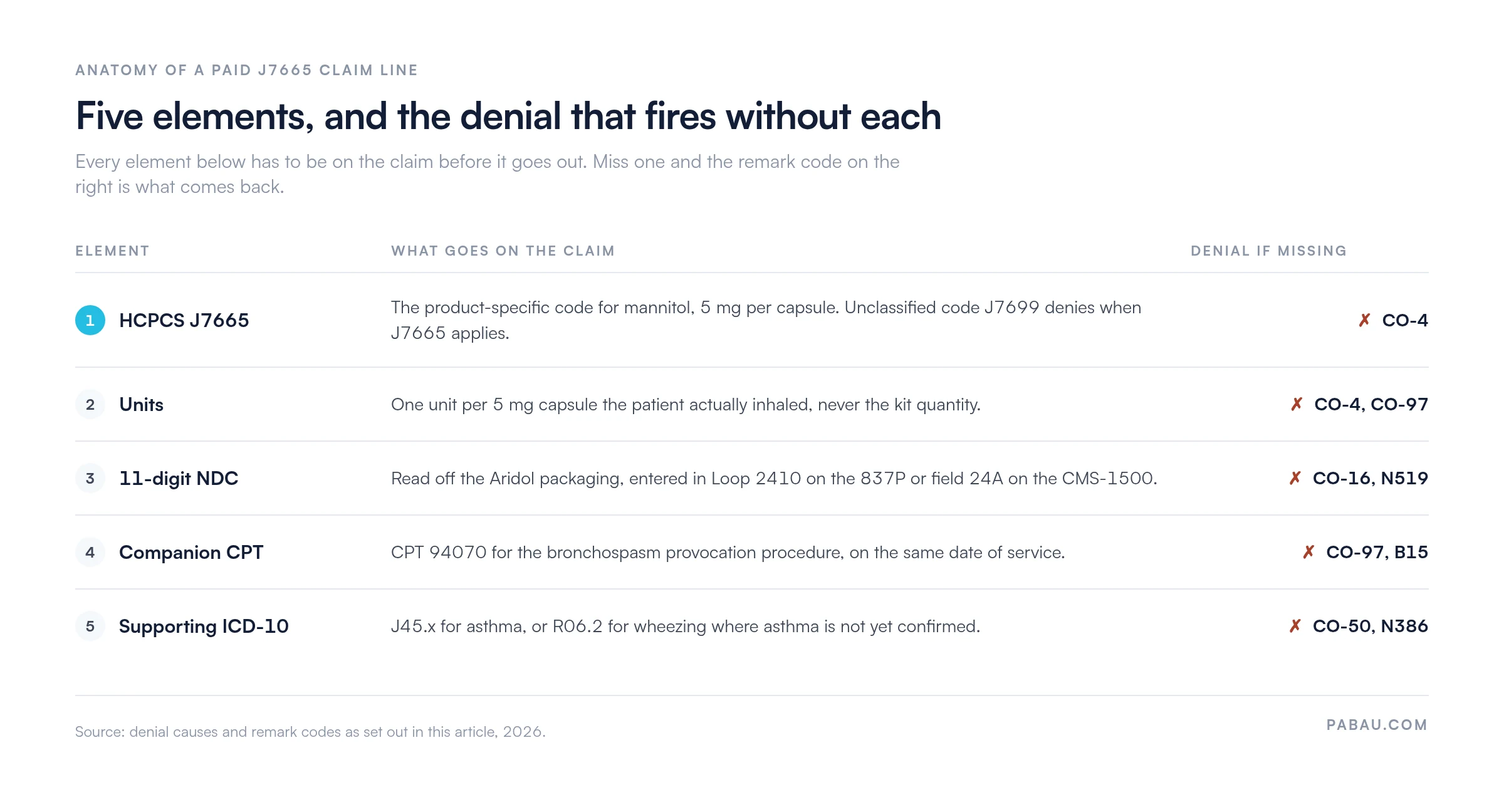
J7665 is billed per 5 mg capsule administered, not per kit. The Aridol bronchial challenge kit contains capsules of several strengths, from 0 mg up to 40 mg. J7665 covers only the 5 mg capsules. Bill one unit of J7665 for each 5 mg capsule actually inhaled during the test. Do not bill the entire kit quantity, and document the exact number of capsules used in the procedure note.
Medicare requires the 11-digit National Drug Code on all Part B drug claims. Submitting a J7665 claim without the NDC is a guaranteed denial. Record the NDC from the Aridol packaging at the time of administration. Verify it against the product label before each claim submission, because NDC numbers can change with packaging updates. Place the NDC in field 24A on the CMS-1500 or Loop 2410 on the 837P electronic claim file.
For physician office billing, J7665 follows a buy-and-bill model. The practice acquires Aridol from the distributor, administers it during the challenge test, and bills Medicare for reimbursement. Drug acquisition records belong in the audit file alongside the procedure note.
Transcribing the NDC at claim time, days after the test, is where it most often goes missing. Practice management software like Pabau pairs claims management software with an NDC field on the charge line. The number is captured once and travels with the claim.
Document the exact capsule count administered in your procedure note before closing the encounter. Build a checklist into your pulmonology workflow: capsule count recorded, NDC captured from packaging, CPT 94070 linked, ICD-10 J45 or R06.2 confirmed. Running this checklist before claim submission catches most J7665 denial triggers before they reach the payer.
Every J7665 claim requires a supporting ICD-10-CM diagnosis code that establishes medical necessity for the bronchial provocation test. Submitting J7665 with an unspecified or unrelated diagnosis code is among the most frequent denial triggers. Confirm the diagnosis against the procedure note before the claim goes out, not after the denial arrives.
Verify against any active Local Coverage Determination from your Medicare Administrative Contractor before relying on secondary symptom codes as the primary diagnosis. MAC policies on acceptable ICD-10 pairings for bronchial provocation testing vary.
Medicare reimburses J7665 under Average Sales Price (ASP) methodology, the standard payment model for physician-administered Part B drugs. The allowed amount is calculated as ASP plus 6%, updated quarterly by CMS from manufacturer-reported sales data. No static dollar figure published in an article stays accurate beyond the quarter it was written in. Pricing a J7665 claim therefore means reading the current quarter’s file rather than a stored fee.
For the current quarter’s rate, access the CMS Physician Fee Schedule search tool or the CMS ASP drug pricing files published at CMS.gov. Review the remittance advice after each paid claim to confirm the allowed amount, and catch any rate discrepancy before the filing deadline.
Medicare Part B covers J7665 as a physician-administered drug used in a diagnostic procedure. Coverage applies when the mannitol challenge test is ordered by a physician or qualified non-physician practitioner. The test must also be medically necessary for the diagnosis or management of a respiratory condition, primarily asthma evaluation. Coverage for this code then turns on the distinction between traditional Medicare’s rules and a Medicare Advantage plan’s own restrictions.
Confirm whether an active LCD from your MAC governs bronchial provocation testing. Search the CMS Medicare Coverage Database by code and by contractor, then check your own MAC’s website for anything it has not yet posted there.
Most J7665 denials fall into a small number of repeatable patterns. Reading the denial codes on your remittance advice against the table below shows which pattern is driving rejections in your practice. Catching them early matters, because a denial that ages past the timely filing window stops being appealable.
Fixing these at the point of submission costs less than appealing them. A corrected claim restarts the payer’s processing clock, and the practice carries the drug acquisition cost until it finishes.
Missing or insufficient documentation is the root cause of most J7665 medical necessity denials. The medical record has to support every element of the claim before it is submitted.
Each documentation element maps to a specific audit risk area. A missing physician order creates a medical necessity vulnerability, and a missing procedure note leaves the unit count unsupported. Practices performing frequent bronchial challenge tests should use a standardized template that captures all required elements at the point of care.
J7665 is frequently confused with several adjacent codes. Using the wrong code results in denial or, worse, overpayment recoupment during audit. The table below maps the coding errors that show up most often in bronchial provocation billing.
Flag J7699 claims involving pulmonary diagnostic testing during your coding review. If the drug administered was Aridol (mannitol), J7665 is the correct code and J7699 is an automatic error. Payers deny J7699 when a specific code exists, and that denial cannot be appealed successfully until the code is corrected.
In most pulmonology practices the J7665 claim is assembled twice. A clinician records the capsule count in the procedure note. Days later a biller reopens the chart and retypes the units, the NDC and the diagnosis into the claim form. Each transfer is a chance for the kit quantity to replace the capsule count, or for the NDC to be skipped entirely.
Pabau removes the second pass. The charge line is built from the encounter itself. The capsule count recorded during the challenge test becomes the billed quantity, and the NDC field sits on that same line. Companion CPT and ICD-10 codes attach to the same encounter, so a claim missing one of them is visible before it goes out.
Every Pabau subscription includes the full platform, so a single-site pulmonology practice runs the same billing workflow as a multi-location group. For buy-and-bill drugs, that means fewer corrected claims and a shorter wait between administering Aridol and being paid for it.

Pabau’s claims management tools support NDC capture, buy-and-bill documentation, and HIPAA-compliant record keeping for physician-administered drug codes like J7665.

J7665 is a narrow code with one clinical job, and that narrowness is what makes it forgiving. Set the five elements of the claim line up correctly once, and the same pattern holds for every mannitol challenge test the practice runs. The work is front-loaded into the encounter, not repeated at submission.
The trade-off worth remembering is the drug cost. Under buy-and-bill the practice has already paid for the Aridol kit before the claim goes anywhere. A denial therefore leaves money sitting on a shelf rather than in transit. That is the argument for a pre-submission check rather than a strong appeals process.
Book a demo to see how Pabau carries the capsule count, the NDC and the companion codes from the challenge test straight onto the claim.

Need to understand medical billing fundamentals for drug codes? What is medical billing covers the end-to-end workflow from charge capture through payment posting.
Working through a high denial rate on physician-administered drugs? Denial management in healthcare outlines the structured approach to identifying root causes and reducing first-pass rejection rates.
Want to understand how remittance data can guide your billing process? Electronic remittance advice explains how to read ERA files and use denial reason codes to fix recurring claim errors.
HCPCS code J7665 covers mannitol inhalation powder (brand name Aridol), 5 mg per capsule, administered during a bronchial provocation challenge test to assess airway hyperresponsiveness. The code covers the drug only. The procedure and professional interpretation are billed separately using CPT 94070.
Bill one unit of J7665 for each 5 mg capsule actually inhaled by the patient during the test. Do not bill the entire Aridol kit quantity. The unit count must match the number of 5 mg capsules documented in the procedure note.
Yes, Medicare Part B covers J7665 when the mannitol bronchial challenge test is medically necessary and ordered by a physician. Medicare Advantage plans may require prior authorization even when traditional Medicare does not, so verify with the specific plan before scheduling the test.
Medicare requires the 11-digit National Drug Code from the Aridol packaging on every Part B drug claim. Record it from the specific lot administered. Enter it in Loop 2410 on the 837P electronic claim, or field 24A on the CMS-1500 paper form. Verify the NDC against current labeling, because it can change with packaging updates.
Traditional Medicare typically does not require prior authorization for J7665 when it is administered as a physician-office diagnostic drug. Medicare Advantage plans and most commercial payers commonly do require it. Verify with the specific plan before performing the test to avoid non-covered service denials.
J7665 (mannitol/Aridol) and methacholine challenge testing use different agents and different codes. Methacholine challenge is billed under CPT 95070, which covers inhalation bronchial challenge with antigens or methacholine. Using CPT 95070 for a mannitol challenge is incorrect, because the mannitol drug component requires J7665 paired with CPT 94070 for the procedure.
No. J7799 reads “NOC drugs, other than inhalation drugs, administered through DME”, so it excludes inhalation drugs by its own descriptor. The unclassified fallback for an inhalation drug is J7699. Neither one applies to Aridol, because J7665 is the specific code for mannitol.