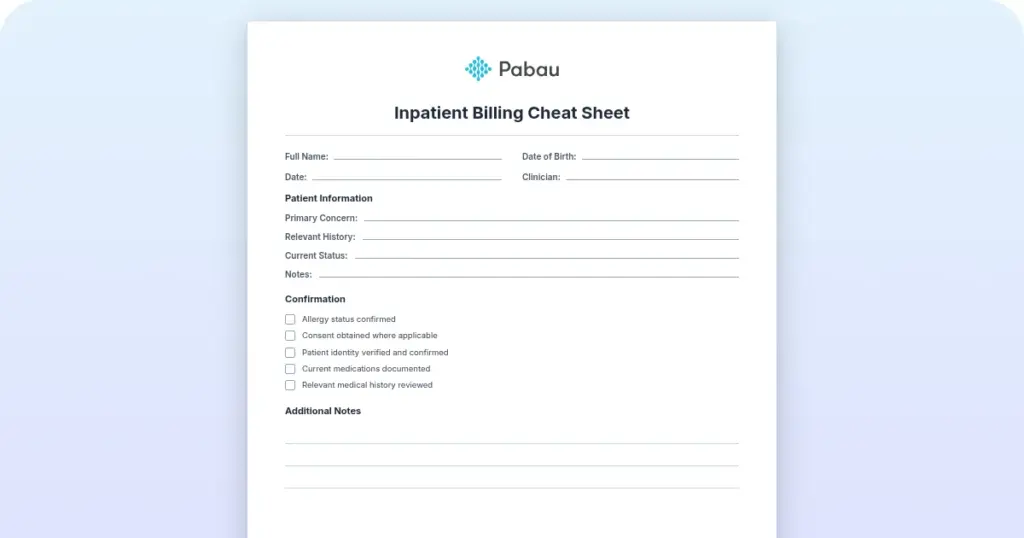
Inpatient billing cheat sheet
An inpatient billing cheat sheet is a quick reference for the codes and claim ru...

Last Updated: Oct 19, 2026
J3265 is the HCPCS Level II code for injection, torsemide, 10 mg/ml.
One billing unit covers 10 mg/ml administered. Three entries decide whether the claim pays first time: the unit count, the waste modifier, and the NDC of the package that was opened.
Let Pabau's smart automation suggest the right codes, reduce claim denials, and keep your practice compliant—effortlessly.
Automate repetitive tasks and focus on what matters most—your patients.
Reduce coding errors and ensure compliance with the latest regulations.
Clean claims, fewer denials, and faster reimbursements.
Powerful insights and reporting to help your practice thrive.
HIPAA compliant SOC 2 certified GDPR-compliant Trusted by 4,000+ clinics worldwide

HCPCS code J3265 is the Level II J-code for “Injection, torsemide, 10 mg/ml” under Medicare Part B.
One billing unit equals 10 mg/ml administered, so a 20 mg dose bills as 2 units.
Torsemide injection is supplied in single-dose vials only, so every claim carries modifier JZ or JW.
The NDC goes in the shaded portion of field 24A with qualifier N4, never in field 24D.
Practice management software like Pabau keeps the drug code, the units and the NDC on one billing record.
Torsemide is a loop diuretic that inhibits sodium-potassium-chloride cotransport in the ascending loop of Henle, promoting urinary excretion of fluid. According to FDA drug labeling, torsemide is approved for edema associated with congestive heart failure (CHF), chronic renal failure, and hepatic cirrhosis. It is also approved for hypertension.
The injectable form is used when oral administration is not feasible. It turns up mostly in inpatient and outpatient infusion settings where rapid diuresis is required, usually heart failure management or an acute fluid overload protocol.
A J3265 claim turns on three entries: the unit count, the applicable modifiers, and the place of service (POS) code. Each one affects reimbursement separately. An error in any of them can trigger a denial or an audit flag.
The billing unit for J3265 is per 10 mg/ml administered. If a physician administers 20 mg, bill 2 units. If 30 mg is administered, bill 3 units. Bill only what was actually administered, not what was drawn or wasted from the vial.
CMS implemented mandatory drug waste modifier reporting for single-dose vials. Two modifiers apply to J3265 claims depending on the circumstances:
The JW/JZ modifier requirement applies to single-dose vials. Every torsemide injection product on the market is single-dose, so one of the two modifiers belongs on every J3265 claim. Submitting the code without either one may draw a denial from your Medicare Administrative Contractor (MAC).
Non-facility rates are generally higher because the practice bears the overhead cost of drug administration. Facility rates apply when the hospital or ASC is billing for the facility component separately. Confirm the correct POS with your MAC before submitting, since POS mismatches are among the most common causes of J-code denials.
Cross-check three entries before a J3265 claim goes out. The units billed must equal the milligrams administered divided by 10. Modifier JW or JZ must be on the line. The NDC from the package opened must sit in field 24A with qualifier N4. Those three checks catch most first-submission denials for torsemide claims.
Medicare Part B requires a National Drug Code (NDC) on every claim for a physician-administered drug, including claims submitted under HCPCS code J3265. This requirement is governed by CMS transmittals on outpatient drug claim reporting and applies to all MAC jurisdictions.
The NDC belongs in the shaded portion of field 24A on the CMS-1500, or the equivalent loop on an 837P electronic claim. Field 24D carries the HCPCS code and its modifiers, so the NDC never goes there. Capture the number at the point of administration rather than at billing time, because the package opened is the one that must be reported.
Claims submitted without a valid NDC, or with an NDC in the wrong format, are rejected at the clearinghouse before they reach the MAC. A format check before the claim leaves the practice removes most of those rejections.
The four entries below sit on the same service line, and each carries a different part of the torsemide claim.
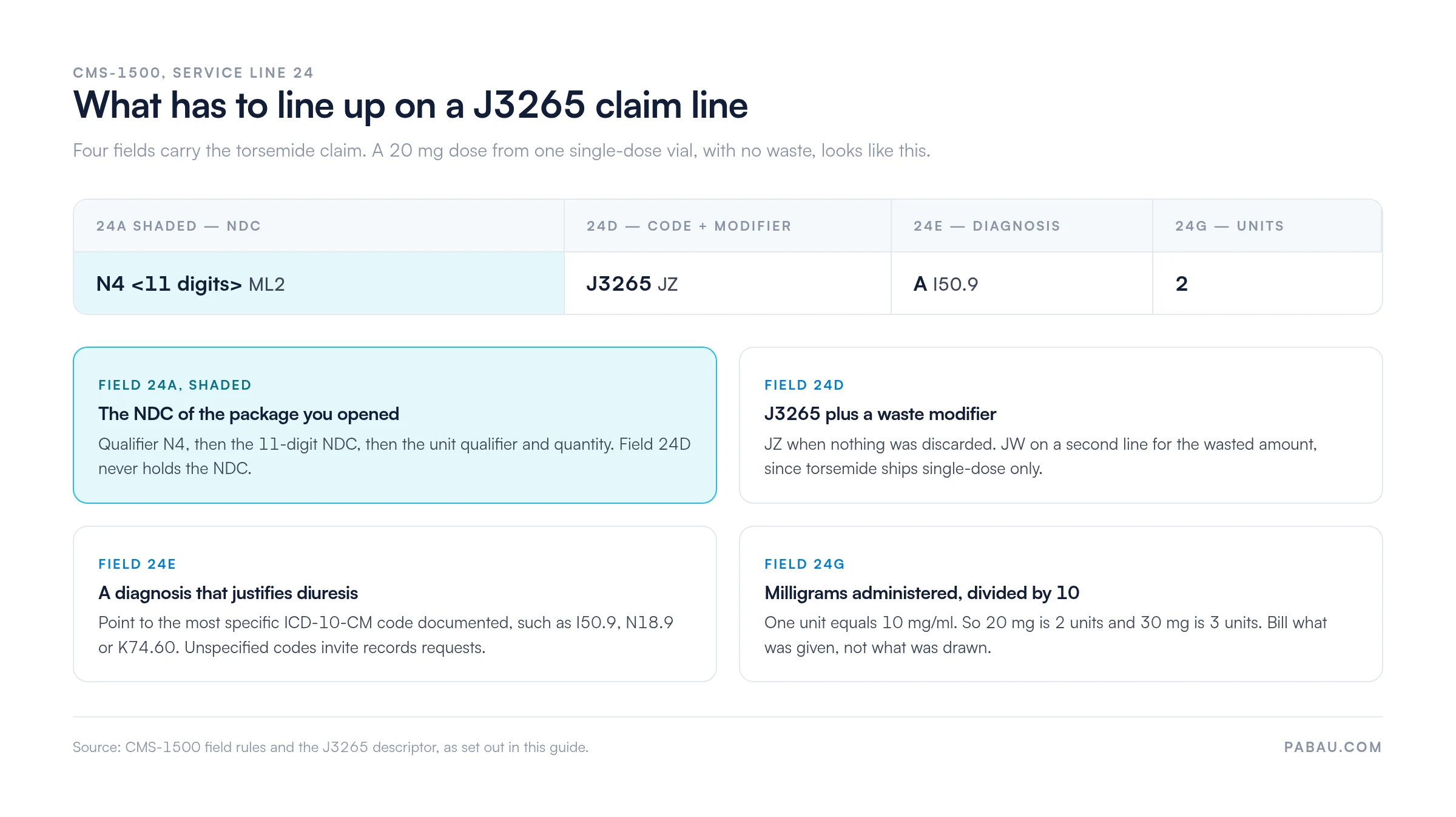
Nothing on that line is optional. A missing modifier, a stale NDC, or a unit count taken from the vial size will each stop the claim.
Medicare reimburses J3265 based on the Average Sales Price (ASP) methodology. CMS publishes ASP-based payment rates quarterly in the Medicare Part B Drug and Biological Allowances file. Rates change each January, April, July, and October, so any specific dollar figure can be outdated within 90 days.
To look up the current rate, use the CMS Physician Fee Schedule search tool and filter by HCPCS code J3265. The ASP payment limit is typically set at ASP plus 6% for most Part B drugs, though sequestration adjustments apply. MAC-specific rates may differ slightly from the national rate depending on regional fee schedule adjustments.
Torsemide injection must be supported by a medically necessary diagnosis. Medicare MACs require that at least one ICD-10-CM code on the claim demonstrates clinical justification for the drug. The following codes are most commonly paired with J3265, based on approved torsemide clinical indications and MAC local coverage determinations.
Use the most specific ICD-10-CM code available. “Heart failure, unspecified” (I50.9) is billable but may trigger additional documentation requests. Check whether the chart documents systolic or diastolic heart failure, and the acuity level. Report the matching specific code to reduce medical necessity denials. Specificity is also the cheapest defense against the denial codes that follow a weak medical necessity link.
A J3265 claim is only as good as the record behind it. On review, a MAC compares the units billed against what the chart says was given. The medication administration record therefore has to state the dose in milligrams.
Two records have to agree before submission: the administration note and the claim line. Where they disagree on milligrams, the claim is wrong even when the arithmetic on the claim itself is right.
Retain the documentation for as long as your MAC’s record retention policy requires. Payers ask for it during post-payment review, and a missing waste note turns an otherwise clean claim into a repayment.
J3265 was referenced in January 2026 HCPCS code update notices published by CGS Medicare (MAC Jurisdiction B and J) and Noridian Medicare. Based on available information from those MAC publications, J3265 remains an active, continuing code with no descriptor change or retirement for the 2026 code year. Verify the current status against the CMS HCPCS Level II official code files. Those files are the authoritative source for status, effective dates, and descriptor language.
The January 2026 HCPCS update cycle added new drug injection codes and revised descriptors for several existing J-codes. Practices billing J-codes adjacent to J3265, such as the unclassified drug code J3490, should confirm those are still valid before submitting 2026 claims. Use the AAPC HCPCS code lookup to cross-reference descriptor language and effective dates quickly.
Set a calendar reminder at the start of each quarter to download the updated CMS Medicare Part B Drug and Biological Allowances file. Quarterly rate changes for J-codes like J3265 are easy to miss. Billing at last quarter’s ASP rate creates underpayments or overpayments that take months to reconcile.
Medicare Part B covers J3265 when torsemide injection is medically necessary and administered by or under the direct supervision of a qualified provider. Coverage is subject to MAC local coverage determinations (LCDs), which vary by jurisdiction. Check your specific MAC’s coverage articles for J3265 to confirm whether a separate LCD governs loop diuretic injections in your region.
Medicaid coverage for J3265 varies by state. Most state Medicaid programs follow Medicare Part B payment methodology for physician-administered drugs, but prior authorization requirements differ. Contact the state Medicaid program directly or check the payer portal for J3265-specific PA requirements before administering.
Commercial payers do not uniformly follow Medicare’s J-code structure. Some commercial plans require a prior authorization for injectable loop diuretics, while others process the claim using their own drug fee schedule. Practices billing commercial payers for torsemide injection should verify benefit coverage and authorization requirements before treatment.
Coders working with J3265 should know the codes that sit next to it. Choosing the wrong one is how upcoding errors start, and the right choice depends on which drug was actually administered.
J3490 is the unclassified drug fallback, and it should never be used when a specific code exists for the drug administered. Billing it for torsemide is an incorrect code selection and can draw audit attention.
Keeping a drug-to-J-code crosswalk for every physician-administered drug on formulary is what stops that substitution happening under time pressure.
Injectable drug billing requires tight coordination between the point of administration and claim submission. The NDC must be captured at the time the vial is used. The unit count must match what was administered, and the modifier must reflect the waste disposition. These steps typically happen across different staff members and systems, which is where errors creep in.
Pabau’s claims management software provides structured billing fields that support J-code claim preparation, including drug code entry, unit calculation, and modifier selection. Practices with a steady volume of injectable drug claims benefit from having those fields inside the billing workflow. The alternative is manual lookups and paper crosswalks.
Pabau also holds scheduling, clinical documentation, and claim preparation in one platform. The administration note and the claim line draw on the same record, which removes the handoff where injectable drug details usually get lost.

Pabau’s claims management software keeps the drug code, the unit count and the NDC on one record. J3265 claims leave the practice complete, so fewer of them come back.

Torsemide injection is a low-dollar drug with a high-friction claim. What decides the outcome is whether the units, the waste modifier, and the NDC leave the practice together on one line.
Capture those three while the vial is still in hand and the rest of the claim follows. Rebuild them at billing time and you are guessing at which package was opened, which is where the resubmission cycle starts.
Pabau’s claims management tools standardize J-code billing so the data is recorded at the point of administration. To see how that works on injectable drug claims, book a demo.

Need help building a clean claim checklist for injectable drugs? Clean claim submission guide covers the documentation fields that prevent first-submission denials for J-code drug claims.
Want to understand how denial patterns affect J-code revenue? Denial management in healthcare explains how to track, categorize, and reduce claim denials across drug injection codes.
Need the NDC captured before the claim is built? Superbill documentation shows which drug fields to record at the point of care.
HCPCS code J3265 is a Level II HCPCS J-code used to bill torsemide administered by injection at a concentration of 10 mg/ml. Physicians and outpatient facilities use it to report this loop diuretic to Medicare Part B, Medicaid, and commercial payers. It applies when the drug is given in a clinical setting.
Medicare reimburses J3265 based on the Average Sales Price (ASP) plus 6%, updated quarterly by CMS. The exact dollar figure changes each January, April, July, and October. Check the current CMS Medicare Part B Drug and Biological Allowances file for the quarter’s allowable rate. The CMS Physician Fee Schedule search tool carries the same figure.
Yes. Medicare Part B requires an NDC on all claims for physician-administered drugs, including J3265. Report it in 11-digit format with the qualifier N4 in the shaded portion of field 24A on the CMS-1500. On an 837P claim, use the equivalent loop. Claims submitted without a valid NDC are typically rejected at the clearinghouse before reaching the MAC.
Use modifier JZ when the entire single-dose vial was administered with no waste. Use modifier JW when a portion of the vial was discarded. Report the administered units under J3265 and the wasted amount on a separate line carrying JW. Torsemide injection is supplied only in single-dose presentations, so one of the two modifiers applies to every claim.
J3265 can be billed in multiple settings. Office (POS 11) and independent infusion center (POS 19) use non-facility rates. Outpatient hospital (POS 22) and ambulatory surgical center (POS 24) use facility rates. The non-facility rate is generally higher because the practice bears the cost of drug administration overhead.
Commercial payer coverage for J3265 varies by plan and contract. Some commercial plans follow Medicare’s J-code structure and ASP-based pricing, while others use their own drug fee schedules or require prior authorization. Verify coverage and authorization requirements with each commercial payer before administering torsemide injection to ensure the claim will be reimbursed.