Inpatient billing cheat sheet
An inpatient billing cheat sheet is a quick reference for the codes and claim ru...

Last Updated: Oct 19, 2026
J7641 is the HCPCS Level II code for flunisolide, inhalation solution, compounded product, administered through dme, unit dose, per milligram.
Let Pabau's smart automation suggest the right codes, reduce claim denials, and keep your practice compliant—effortlessly.
Automate repetitive tasks and focus on what matters most—your patients.
Reduce coding errors and ensure compliance with the latest regulations.
Clean claims, fewer denials, and faster reimbursements.
Powerful insights and reporting to help your practice thrive.
HIPAA compliant SOC 2 certified GDPR-compliant Trusted by 4,000+ clinics worldwide

HCPCS Code J7641 covers flunisolide, inhalation solution, compounded product, administered through DME, unit dose form, per milligram
The billing unit is 1 mg, so a 1 mg dose is 1 unit and a 2 mg dose is 2 units
No 0.1 mg or concentrated form descriptor exists for J7641; that wording belongs to the neighboring glycopyrrolate code J7642
Medicare LCD L33370 denies every compounded inhalation solution, J7641 included, as not reasonable and necessary
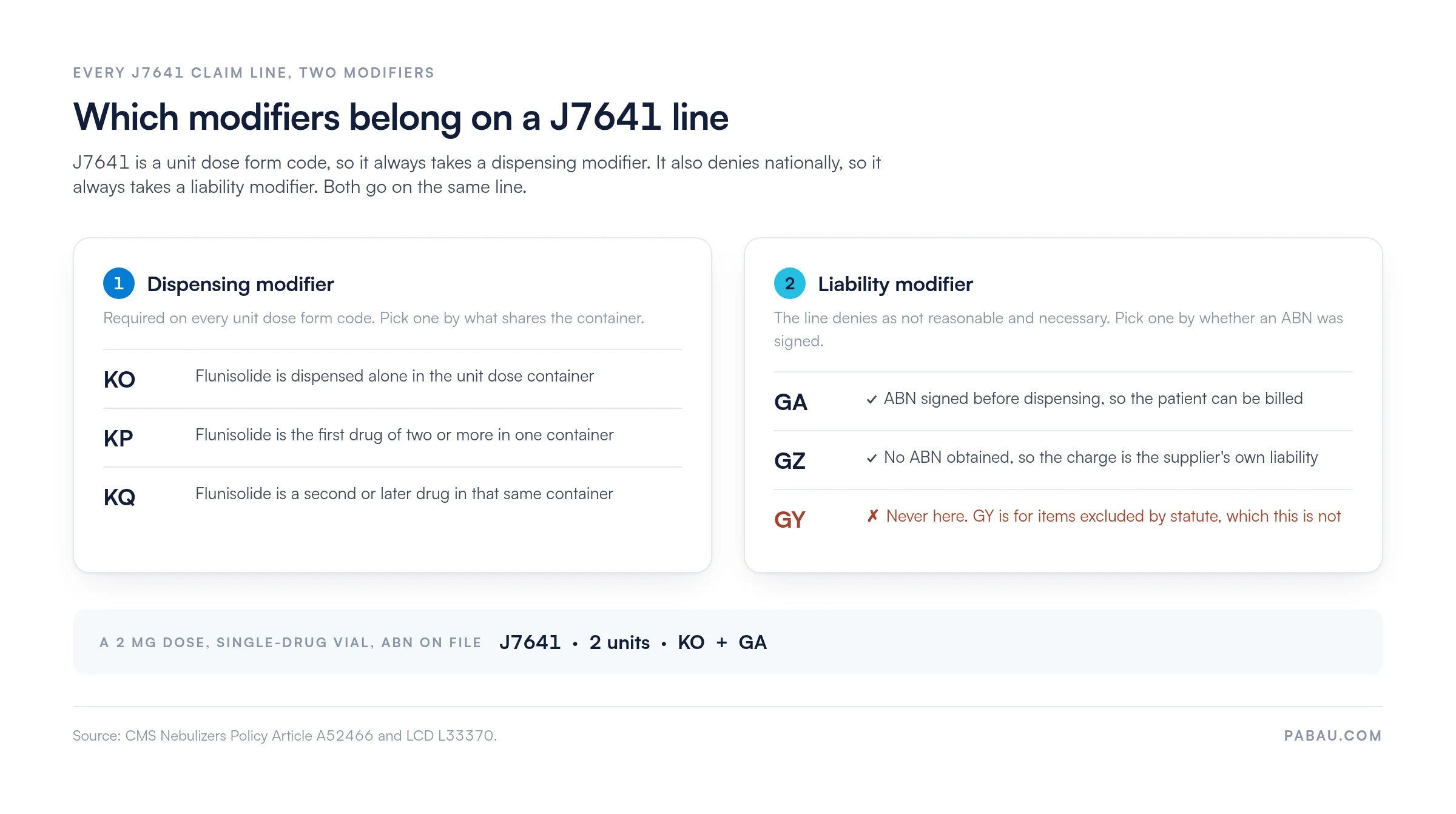
Every unit dose form code needs a KO, KP or KQ modifier, and J7641 is a unit dose code
Practice management software like Pabau submits J7641 claims electronically and tracks each one to its remittance from a single dashboard
HCPCS Code J7641 describes flunisolide, inhalation solution, compounded product, administered through DME, unit dose form, per milligram. It sits in the J-code section of HCPCS Level II. The Centers for Medicare and Medicaid Services (CMS) maintains that code set for drugs, biologics, and supplies that CPT codes do not describe.
The short descriptor that appears on claims is “Flunisolide comp unit.” That final word is the giveaway. It stands for unit dose. The drug reaches the patient in a sealed single-dose container, not as a concentrate the patient dilutes before nebulizing.
Charge masters often list J7641 with a “concentrated form, 0.1 mg” descriptor. That descriptor does not exist. The concentrated form wording belongs to J7642, the glycopyrrolate code sitting directly beside it. No code in the J76xx inhalation family carries a 0.1 mg strength at all. If a charge master or an internal cheat sheet shows 0.1 mg against J7641, the entry is wrong. Every unit count built from it is then wrong by a factor of ten.
Flunisolide is an inhaled corticosteroid used to manage inflammatory airway disease. When no commercially available nebulizer formulation suits the patient, a compounding pharmacy prepares the solution. J7641 is the code that captures that dispensing on the claim.
The billing unit for J7641 is one milligram. One unit on the claim equals 1 mg of flunisolide dispensed to the patient. You bill a 1 mg dose as 1 unit and a 2 mg dose as 2 units.
The arithmetic is simple, which is what makes the 0.1 mg myth so expensive. A supplier working from that basis bills 10 units for a 1 mg dose. Every line then overstates the quantity tenfold, and a reviewer reads the pattern as a repeated unit-count error.
Unit miscounting is one of the most common audit triggers for compounded inhalation drug codes. Verify the dispensed quantity against the physician order before you submit. A written record of the dose dispensed, tied to the compounding pharmacy batch documentation, gives a reviewer the traceability they need.
Rounding units to a convenient number rather than the exact dispensed dose is a billing error. Payers cross-check dispensed quantity against pharmacy records during post-payment review. Reconcile the milligrams on the dispensing note against the units on the claim before you submit. Correcting the count afterward means reopening a claim the payer has already processed.
Medicare does not pay for J7641. The Nebulizers Local Coverage Determination, LCD L33370, names J7641 in its list of compounded inhalation solutions that Medicare denies as not reasonable and necessary. All four DME MAC jurisdictions apply the same joint LCD, so the answer does not change with the patient’s state.
This is a medical necessity denial, not a statutory exclusion. That distinction decides which liability modifier belongs on the line:
Suppliers still submit these claims for a practical reason. The Medicare denial is often the document a supplemental plan, a Medicaid program, or a commercial payer needs before it considers the charge.
Related equipment follows the drug. If Medicare covers no drug used with the nebulizer, it denies the compressor and the nebulizer too. The related accessories and supplies go the same way.
Because the code denies, no Medicare allowable applies in practice. It is still worth knowing which file would govern payment. The DMEPOS fee schedule, not the Physician Fee Schedule, prices nebulizer drugs a DME supplier dispenses. The Physician Fee Schedule look-up tool excludes DMEPOS items altogether, so a search there returns no rate for this J-code.
Non-Medicare payers set their own rules. Some commercial plans and Medicaid programs do pay for compounded inhalation solutions under separate fee schedules or negotiated rates, priced per milligram. Verify coverage and the per-milligram rate with each payer before dispensing. Get the quoted per-milligram rate in writing before the first dispense.
Check the patient’s secondary coverage before you dispense, not after the Medicare denial lands. Compounded inhalation solutions deny nationally under LCD L33370, so the realistic payment sources are a supplemental plan, a Medicaid program, or the patient. An ABN signed before dispensing is what preserves your ability to bill the patient at all.
The Nebulizers Policy Article, A52466, states that a unit dose form code must carry a KO, KP or KQ modifier whenever you bill it. J7641 is a unit dose form code, so one of the three belongs on every line you file.
That requirement is also a useful sanity check on the descriptor. A concentrated form code would not take these modifiers at all. If your system is applying KO to J7641, the unit dose reading is the correct one.
A single-drug compounded flunisolide vial takes KO. If a pharmacy compounds flunisolide with a bronchodilator such as ipratropium in one container, one line carries KP and the other carries KQ. Omitting the modifier produces a coding denial stacked on top of the coverage denial, which makes the remittance harder for anyone to read later.
The dispensing modifier and the liability modifier both belong on the line. A typical J7641 claim therefore carries KO and GA together. Verify the current requirements against your MAC billing article, since MACs review them annually.
Billing J7641 correctly means getting several claim fields right at once. DME suppliers file on the CMS-1500 claim form or its 837P electronic equivalent. The key fields and requirements:
One piece of legacy paperwork no longer applies. CMS ended certificates of medical necessity and DME information forms for dates of service on or after January 1, 2023.
Several errors complicate J7641 claims. The frequent ones are unit counts built on the wrong descriptor and a missing dispensing modifier. Two more are no ABN before dispensing and diagnosis codes that do not match the record.
Submitting a clean claim the first time still matters here. When the denial itself is the document a secondary payer needs, a clean remittance is what moves the balance along.
Compounded drug claims draw close attention on review, and a denied line does not remove the record-keeping obligation. Keep three categories of records on file and readily retrievable for any J7641 claim.
The order must name flunisolide by name, state the dose in milligrams, and specify the nebulizer as the route. It should include a refill schedule where one applies. A generic “inhaled corticosteroid” order is not enough. The order date must precede the dispense date shown on the claim.
A statement of medical necessity should explain why the patient requires the compounded form rather than a commercially available inhaled corticosteroid. The prescribing physician normally records this in the clinical notes. Acceptable reasons include an allergy to an excipient in the commercial product, a dose no commercial product provides, or a patient-specific titration protocol. That statement will not change the Medicare outcome, but it is what a secondary payer reads. Capturing the statement in a structured form field, rather than free text, reduces the risk of leaving it incomplete.

Pharmacy batch records, lot numbers, beyond-use dates, and the pharmacy registration status should all be on file. Documentation differs for a 503A patient-specific compound and a 503B outsourcing facility product. Knowing which one you dispensed matters to state regulators and to secondary payers. Your compliance program should include a periodic check that those credentials are still current.
A J7641 claim still needs at least one ICD-10-CM diagnosis code, even though Medicare will deny the line. The diagnosis explains the clinical picture to whoever reviews the remittance next, and it has to match the documentation in the patient record. No diagnosis makes J7641 payable under Part B, so treat the choice as a documentation question rather than a coverage lever.
Do not shop for a diagnosis code that looks likely to unlock payment. Under LCD L33370 no such code exists for a compounded inhalation solution. A diagnosis chosen to fit a policy rather than the patient is a compliance problem.
J7641 requires delivery through a DME-supplied nebulizer. The route is not optional, because the code descriptor specifies it. A practice that administers flunisolide by metered-dose inhaler or dry-powder inhaler cannot use this code. J7641 is specific to the nebulized DME pathway.
Bill the nebulizer itself separately under the appropriate E-code, typically E0570 for a small volume nebulizer. Both the drug code and the equipment code appear on the claim when the DME supplier provides both. Remember that the equipment denies alongside the drug when the supplier dispenses no covered nebulizer drug. Running insurance eligibility verification before dispensing tells you what the patient’s other coverage will do with that outcome.
Audit your charge master for J7641 before the next dispense. If the stored descriptor reads concentrated form or shows 0.1 mg, the entry is wrong. Every historical claim built from it carries a unit count ten times the dose given. Correct the master entry first, then review the claims that came out of it.
Billers working with compounded inhalation solutions meet the same handful of adjacent J-codes again and again. Picking the wrong one is easy when a pharmacy dispenses several drugs together. The table below sets J7641 against the codes nearest to it in the HCPCS Level II code set.
When a patient receives flunisolide and albuterol on the same date, bill each drug on its own line under its own J-code. Merging two drugs into a single unit count under one code is a billing error. If the two share a unit dose container, the KP and KQ modifiers tell the payer the pharmacy dispensed them together. A charge sheet that pre-populates one J-code per dispensed drug reduces code confusion in multi-drug nebulizer regimens.
Compounded inhalation drug billing is messy to run. A single claim depends on records from three sources: the prescribing physician, the compounding pharmacy, and the DME supplier. When each one sits in a different system, the claim goes out before anyone has compared them.
Pabau keeps the clinical record and the billing side in one place. Its medical claims management tools submit claims electronically through Claim.MD in the US, then track each one from a single dashboard. Pabau records payments against the claim as they arrive, so you can see which J7641 lines have an answer and which are still open.
Background validation checks run before submission and flag missing details such as membership numbers and authorization codes. That will not overturn an LCD L33370 denial. It does stop a coding rejection landing on top of the coverage denial. A remittance carrying both is harder for a secondary payer to read.

Pabau submits your claims electronically and tracks every one from a single dashboard. Validation checks flag missing membership numbers and authorization codes before a claim goes out.

Accurate J7641 billing comes down to three things: the per-milligram unit, the two modifiers, and a realistic expectation of the Medicare outcome. One milligram is one unit, and the widely repeated 0.1 mg figure belongs to no code in this family. Every unit dose line needs KO, KP or KQ, and every line needs GA or GZ behind it.
Under LCD L33370 the claim will deny, so the ABN you collect before dispensing is what decides whether anyone else pays. Getting the unit count and both modifiers right keeps the remittance clean enough for a secondary payer to act on. Book a demo to see how Pabau submits and tracks HCPCS claims from one dashboard.

Need a structured framework for managing claim denials? Denial codes in medical billing breaks down the most common reason codes and how to respond to each one.
Want to understand how clearinghouses process HCPCS claims? Medical claims clearinghouse guide explains how 837P transactions move from biller to payer and where J-code claims get flagged.
Need to read a payer’s decision on a drug claim? Electronic remittance advice (ERA) covers how to read 835 remittance files to understand payer decisions on drug claims.
HCPCS Code J7641 is the billing code for flunisolide inhalation solution, compounded product, administered through DME in unit dose form. Billers report it per milligram. Medical billers and DME suppliers use it when filing claims for compounded flunisolide dispensed to patients with respiratory conditions such as asthma or COPD.
The billing unit is 1 mg. Each unit on the claim represents 1 mg of flunisolide dispensed. A 1 mg dose is 1 unit, and a 2 mg dose is 2 units. J7641 has no 0.1 mg descriptor, and any unit count built on a 0.1 mg basis overstates the quantity tenfold.
Commonly paired diagnoses include J45.40 for moderate persistent asthma, J44.1 for COPD with acute exacerbation, and J44.0 for COPD with acute lower respiratory infection. No diagnosis makes the code payable under Medicare Part B. The code documents the clinical picture for the record and for any secondary payer.
The pharmacy must hold a compounding license and keep batch records, lot numbers, and beyond-use dates that support the milligrams dispensed. Because Medicare denies the code no matter the source, those credentials matter most to state regulators, to secondary payers, and to your own liability record.