HCPCS Code V5255: Digital monaural ITC hearing aid billing guide
HCPCS Code V5255: Official descriptor and code definition HCPCS Code V5255 is a ...

Last Updated: Nov 19, 2026
J3230 is the HCPCS Level II code for injection, chlorpromazine hcl, up to 50 mg. It reports the drug supplied for an intramuscular or intravenous chlorpromazine dose given by a qualified provider.
One unit covers each 50 mg or part of it, so a 75 mg dose bills as two units. The injection itself is billed separately, and lines from a single-dose container carry the JZ modifier.
Let Pabau's smart automation suggest the right codes, reduce claim denials, and keep your practice compliant—effortlessly.
Automate repetitive tasks and focus on what matters most—your patients.
Reduce coding errors and ensure compliance with the latest regulations.
Clean claims, fewer denials, and faster reimbursements.
Powerful insights and reporting to help your practice thrive.
HIPAA compliant SOC 2 certified GDPR-compliant Trusted by 4,000+ clinics worldwide

HCPCS Code J3230 covers chlorpromazine HCl injection, billed in units of up to 50 mg. Oral and suppository forms fall outside the code.
Bill one unit for every 50 mg or part of it. A 25 mg dose is 1 unit, and a 75 mg dose is 2 units.
Chlorpromazine comes only in 1 mL and 2 mL single-dose containers, so the leftover drug never reaches a full unit. J3230 lines take the JZ modifier, not JW.
Medicare’s payment limit for J3230 is $16.802 per unit for October to December 2026, and CMS updates it every quarter.
Pabau’s claims management software keeps the injection note and the claim in one system, so units and NDCs come from the documented dose.
HCPCS Code J3230 is the Level II code for chlorpromazine hydrochloride injection, billed in units of up to 50 mg. CMS lists it in its October 2026 payment limit file as “Chlorpromazine hcl injection,” with a 50 mg billing unit and a $16.802 limit.
Verify the current descriptor against the CMS HCPCS Level II annual release before billing, as CMS updates descriptors each calendar year.
J3230 covers the drug cost of an injectable, FDA-approved chlorpromazine hydrochloride product administered by a qualified provider in a physician office or outpatient setting. Common reasons for the injection include acute psychosis and agitation, severe nausea and vomiting, and intractable hiccups.
The following drug forms and preparations are explicitly outside J3230’s scope:
Billing J3230 for an oral or suppository form invites a denial. The documentation must state the route of administration as IM or IV.
The descriptor “up to 50 mg” means one unit equals 50 mg administered. Bill the number of units that reflects the total dose given, rounding up for partial doses per standard CMS J-code unit billing guidance. Document the exact dose in milligrams in the medical record, because the unit count has to reconcile with that figure.
Each line drawn from a single-dose container also carries a modifier. The section on JZ and JW below explains why J3230 lines almost never need JW.
J3230 bills the drug only. CPT 96372 (therapeutic, prophylactic, or diagnostic injection, subcutaneous or intramuscular) bills the act of administration. Both codes are reported together when chlorpromazine is injected in an office setting.
Place of service determines whether 96372 is separately payable:
A common denial comes from billing 96372 on a facility claim (POS 22). The administration service is included in the facility’s APC payment, so a separate line returns CO-97 (payment included in the allowance for another service).
Medicaid programs require the 11-digit National Drug Code (NDC) on physician-administered drug lines, and many commercial payers ask for it too. It goes on the line with the N4 qualifier, the NDC quantity and the unit of measure. The NDC must match the product given, not a placeholder.
CMS’s October 2026 NDC-HCPCS crosswalk maps ten chlorpromazine NDCs from six labelers to J3230. Every one is 25 mg/mL, in a 1 mL or 2 mL container. The rows below come from that file, and the CMS Part B drug pricing file publishes a new crosswalk each quarter.
On an 837P claim, the N4 qualifier and the 11-digit NDC go in loop 2410, in the LIN segment. Learn more about clean claim submission to reduce NDC-related rejections.
Since July 1, 2023, Medicare has required a modifier on every separately payable Part B drug line from a single-dose container. JW reports an amount that was discarded, and JZ attests that none was. The CMS JW and JZ modifier FAQs also say JW is not used when the dose given is less than the billing unit.
For J3230, that makes JZ the modifier on almost every line. CMS pays no fractional units, so a partial dose is billed as a full 50 mg unit. Since no chlorpromazine container holds more than 50 mg, the leftover drug never adds up to a unit JW could report. The chart below runs through the common doses.
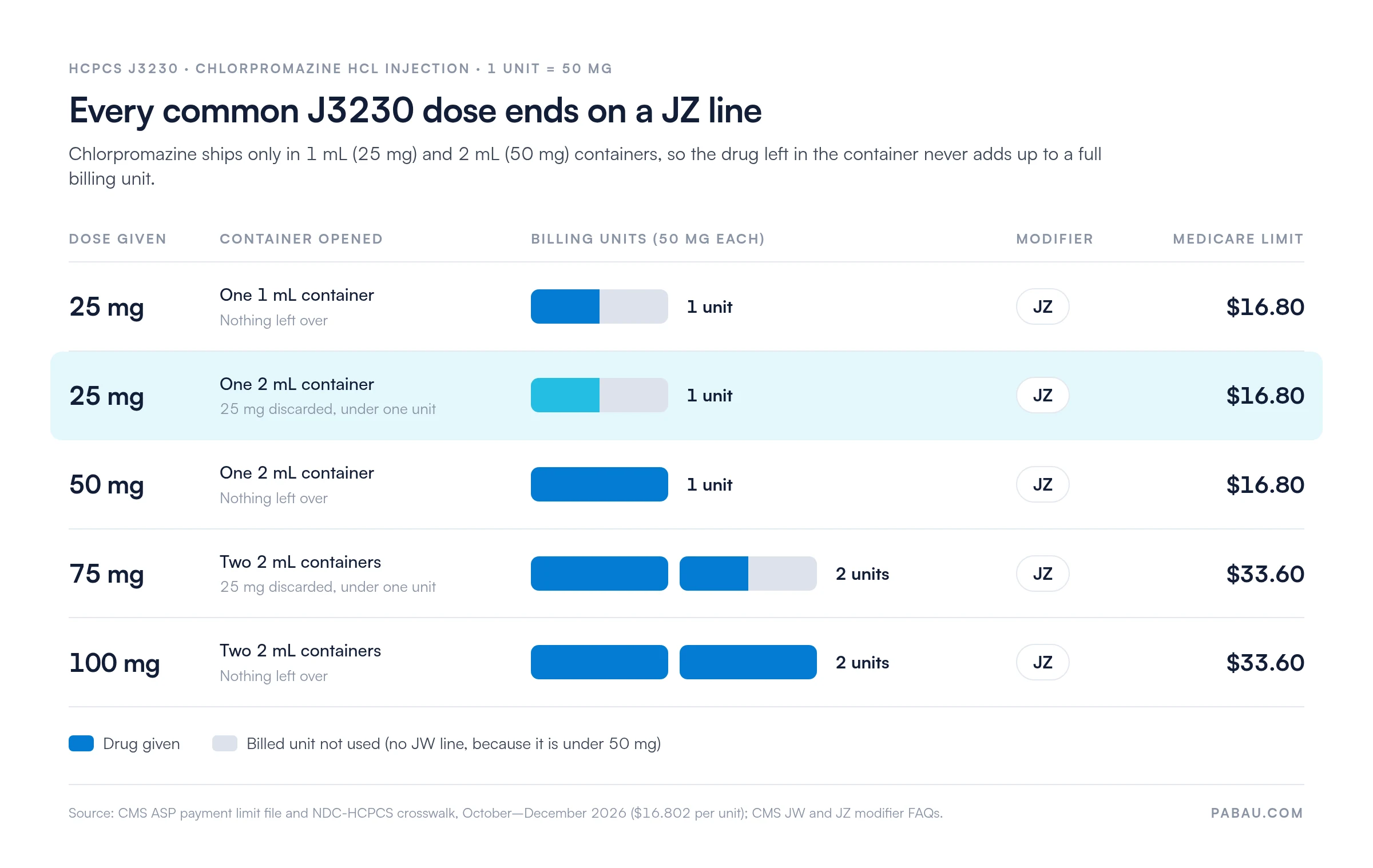
The chart still records the whole event. Note the NDC, the container size, the dose given and the amount discarded. Check the crosswalk if a larger single-dose container ever appears for J3230. Drug drawn from a multiple-dose container takes neither modifier.
Medicare Part B pays physician-administered drugs at the average sales price plus 6% (ASP+6%) per billing unit. CMS updates that limit every quarter in the CMS Part B drug pricing file. From October 1 to December 31, 2026, the J3230 limit is $16.802 per 50 mg unit.
Key reimbursement facts for J3230:
Understanding medical billing fundamentals for Part B drugs helps practices anticipate reimbursement correctly and reconcile explanations of benefits against expected ASP payment amounts.
Under traditional Medicare Part B fee-for-service, chlorpromazine injection is not on a prior authorization list. J3230 therefore needs no pre-authorization for most Medicare FFS claims. That said, verify with your Medicare Administrative Contractor, as local coverage determinations (LCDs) can impose additional documentation or coverage conditions that vary by MAC jurisdiction.
Commercial and Medicaid managed care plans are another matter. Prior authorization requirements vary by payer, plan, and clinical indication:
The safest workflow is to verify benefit coverage and PA status with each payer at scheduling, not at billing.
Most J3230 denials fall into six categories. The table maps each denial reason to its reason and remark codes and the corrective action. Denial management workflows that track J-code rejections by reason code shorten resubmission time.
Our reference to medical billing denial codes lists the full set of CARC and RARC codes that apply to drug claims.
Chlorpromazine belongs to a larger family of injectable antipsychotic and antiemetic phenothiazines, several of which have their own HCPCS J-codes. Selecting the wrong code is a common upcoding or downcoding error because the drug names look similar on the order. Intramuscular ziprasidone is not a phenothiazine, but it treats the same acute agitation in schizophrenia and bills under J3486 per 10 mg.
The riskiest mix-up is with promethazine, billed as J2550. Both drugs are phenothiazines with the same 50 mg billing unit, so confirm the drug name on the order before assigning the code.
Payers conducting post-payment audits pull the medical record and verify that every element of the claim is supported. Missing even one of the following items can flip a paid claim into a demand for repayment. Maintaining consistent medical billing compliance practices in drug administration documentation reduces that risk.
Practices using electronic health records should build a drug administration flowsheet that captures all of these fields at the point of care. Retrofitting documentation after the fact is both inefficient and a red flag for auditors.
The superbill that travels from the administration note to the claim should carry the dose in mg. The billing team can then calculate units without calling the clinical staff.
Audit your J3230 claims every quarter. Pull the last 90 days and reconcile units billed against the dose in each chart. Flag any line missing JZ, and any NDC that differs from the one recorded at administration.
Medicaid coverage for HCPCS Code J3230 is state-variable. Most Medicaid fee-for-service programs cover physician-administered injectables on the state’s formulary, but the billing pathway, prior authorization thresholds, and reimbursement methodology differ between states.
Coders should check their state Medicaid agency’s fee schedule and drug formulary before assuming coverage mirrors Medicare Part B.
For commercial payers, three factors drive coverage decisions:
Psychiatric practices billing J3230 for managed care patients should get each payer’s injectable drug policy in writing. Ask for it at contract negotiation, not after the first denial.
Many J3230 errors start with a retyped field. Someone reads the dose off a nursing note, works out the units, and keys the NDC into a separate billing screen.
Pabau, a practice management platform with built-in insurance billing, keeps the injection record and the claim in the same system. The billing team works from the administration note itself. Submission, eligibility checks, claim status and remittance posting all happen in that same place.
US claims go out through the Claim.MD clearinghouse, and electronic remittances post back against the patient record. A rejected J3230 line shows up the day it comes back, while the chart is still fresh.

Pabau keeps the injection note, the NDC and the claim in one system. Claims go out through the Claim.MD clearinghouse, and remittances post back against the patient record.

Two facts decide a J3230 claim, the milligrams given and the size of the container they came from. Bill one unit for every 50 mg or part of it, and add JZ to the line. A JW line on this code is almost always an error worth catching before submission.
The cheapest fix sits upstream of billing. When the nurse records the dose in milligrams and the NDC at the point of care, the claim line comes straight from the note. Book a demo to see how Pabau carries an injection record through to a clean J3230 claim.

Need a foundation in drug claim submission? Medical billing fundamentals covers the end-to-end process from order to payment posting for physician-administered services.
Want to understand the 837P claim structure? Clean claim submission walks through every required field on a professional drug claim, including NDC loop requirements.
Billing haloperidol alongside chlorpromazine? HCPCS code J1630 covers the 5 mg billing unit for short-acting haloperidol injection.
Switching a patient to a depot phenothiazine? HCPCS code J2680 explains billing for fluphenazine decanoate in 25 mg units.
HCPCS Code J3230 covers the drug cost of chlorpromazine hydrochloride injection, up to 50 mg per unit, given intramuscularly or intravenously by a qualified provider. It does not cover oral forms, suppositories, or the administration service itself.
Bill one unit per 50 mg administered, rounding up for partial doses. A 25 mg dose is 1 unit, a 75 mg dose is 2 units, and a 100 mg dose is 2 units. The dose in milligrams must be documented in the medical record to support the unit count.
In most cases you report no wastage line at all. Chlorpromazine comes in 1 mL and 2 mL single-dose containers, so the discarded amount never reaches the 50 mg billing unit. Bill the rounded-up units with the JZ modifier, and record the dose given and the amount discarded in the chart.
CPT 96372 (subcutaneous or intramuscular injection of therapeutic/prophylactic substance) is billed alongside J3230 in office settings (POS 11). In facility outpatient settings (POS 22), 96372 is bundled into the facility fee and cannot be billed separately on the professional claim.
Traditional Medicare Part B fee-for-service does not currently require prior authorization for J3230, but verify with your MAC and check for applicable LCDs. Medicare Advantage plans, Medicaid managed care, and commercial plans set their own PA requirements, which vary by indication and plan.
The most frequent cause is a missing or invalid 11-digit NDC, returned as CO-16 with remark M119. A unit count that doesn’t match the documented dose comes back as CO-16 with M53. A missing JZ modifier and CPT 96372 billed in a facility setting (CO-97) complete the list. Confirm the NDC, recalculate units from the chart dose, and check the place of service before resubmission.