CCSD code H4430: Examination of rectum under anaesthetic
CCSD code H4430 pays for the examination alone CCSD code H4430 is the UK private...

Last Updated: Oct 20, 2026
J2680 is the HCPCS Level II code for injection, fluphenazine decanoate, up to 25 mg.
Let Pabau's smart automation suggest the right codes, reduce claim denials, and keep your practice compliant—effortlessly.
Automate repetitive tasks and focus on what matters most—your patients.
Reduce coding errors and ensure compliance with the latest regulations.
Clean claims, fewer denials, and faster reimbursements.
Powerful insights and reporting to help your practice thrive.
HIPAA compliant SOC 2 certified GDPR-compliant Trusted by 4,000+ clinics worldwide

HCPCS Code J2680 covers injection, fluphenazine decanoate, up to 25 mg. It is a long-acting antipsychotic used for schizophrenia and related psychotic disorders.
Medicare pays J2680 at ASP plus 6% in the physician office. Check the current amount in the CMS Medicare Part B drug ASP pricing files, which are updated quarterly.
An NDC must be reported alongside J2680 on every Medicare and Medicaid claim, and CPT 96372 bills separately for the administration.
Pabau’s claims management tools submit and track J2680 claims, and flag common claim errors before they reach the payer.
HCPCS Code J2680 is a Level II HCPCS code maintained by the Centers for Medicare and Medicaid Services (CMS). It describes the injection of fluphenazine decanoate, up to 25 mg, given by a clinician in an office or outpatient setting. The code sits in the category “Drugs Administered Other than Oral Method”. That is the standard classification for physician-administered injectable medications billed to Medicare Part B and Medicaid.
Unlike a CPT procedure code, HCPCS Code J2680 represents only the drug component of the service. The administration itself requires a separate CPT billing line. Payers use J-codes to calculate drug reimbursement independently from the injection procedure fee. Both codes must appear on the same claim for payment to process correctly.
Prolixin Decanoate is the brand name for fluphenazine decanoate, a first-generation antipsychotic in the phenothiazine class. Clinicians prescribe it for schizophrenia and other chronic psychotic disorders where medication adherence is a clinical concern. As a long-acting injectable, the depot formulation releases medication over two to four weeks. That removes the daily oral dose from the treatment plan, which matters most in high-relapse populations.
The HCPCS descriptor covers dosages “up to 25 mg” per injection event. Clinicians may give doses below 25 mg based on patient response and prescribing guidelines. J2680 covers the billing unit regardless of the exact dose, as long as it does not exceed 25 mg. Do not read clinical dosing guidance out of a HCPCS descriptor. The FDA prescribing information is the source for dosing protocols.
Medicare Part B pays J2680 under the Average Sales Price methodology, at ASP plus 6% in physician office settings. CMS calculates ASP from manufacturer-reported sales data and updates it quarterly. No dollar figure printed in an article stays current for long. Check the active amount in the CMS Medicare Part B drug ASP pricing files before you bill.
Payment also varies by Medicare Administrative Contractor (MAC) jurisdiction. Facility rates for hospital outpatient and non-facility rates for the physician office differ, and office-based psychiatry practices bill the non-facility rate. Confirm your practice’s MAC jurisdiction before you set internal fee schedules, because the same J2680 line can pay differently by location.
CMS requires providers to report National Drug Codes (NDCs) on all Medicare Part B claims for physician-administered drugs billed with HCPCS J-codes. J2680 maps to several NDCs, depending on the manufacturer, labeler, and package size of the product actually given. An outdated or mismatched NDC is one of the most common rejection triggers on this code.
NDC codes follow an 11-digit format (5-4-2) and belong in box 24 of the CMS-1500, with the N4 qualifier on electronic claims. Verify current NDCs through the NLM HCPCS code search tool or FDA’s DailyMed. Manufacturers reformulate products and discontinue package sizes, which makes previously valid NDCs inactive. A static NDC list published in any article, this one included, may not match your shelf. Use your pharmacy supplier’s current product documentation as the primary source.
Report NDC codes in the 11-digit 5-4-2 format with the N4 qualifier on electronic claims. If a fluphenazine decanoate product is reformulated or discontinued, its NDC becomes invalid for new claims immediately. That holds even where existing stock was purchased before the change. Verify the NDC at the point of dispensing, not at the point of order.
J2680 follows the buy-and-bill model. The practice purchases fluphenazine decanoate, gives it in the office, and bills both the drug and the administration to the payer. The two codes travel on one claim, but they reimburse through separate payment mechanisms.
Both lines leave the practice on one claim, and each is paid on its own basis. The diagram below shows what each line carries, and the three requirements that sink both lines when they are missing.
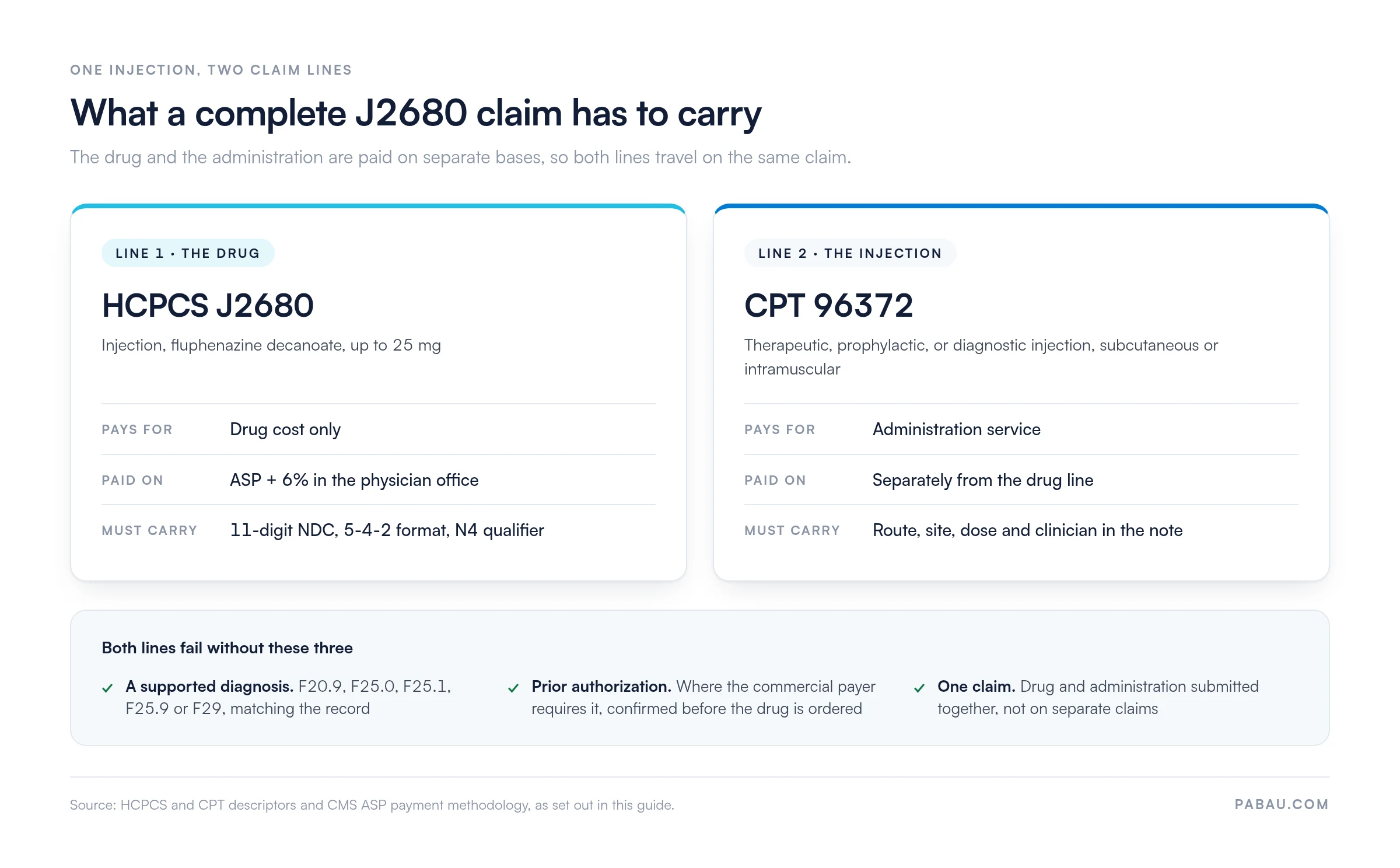
HCPCS Code J2680 covers the drug cost only. The act of injecting fluphenazine decanoate bills separately, on the same claim. CPT 96372 covers a therapeutic, prophylactic, or diagnostic injection given subcutaneously or intramuscularly, and it is the standard pairing for J2680. The full administration rules, including how the code applies to other injection routes, sit on the page for CPT 96372.
One billing distinction decides most 96372 edits. The code is not separately billable when a visit bundles the injection into a service with no distinct, separately identifiable E/M component. Documenting and billing that service with modifier 25 lets both lines stand. When the patient presents solely for the injection, 96372 is billable on its own. Record which of those happened, so the claim survives the edit.
Every J2680 claim must link to a diagnosis code that establishes medical necessity. Fluphenazine decanoate is indicated for schizophrenia and related psychotic disorders, so the codes below are the most commonly paired diagnoses. They belong in the diagnosis fields of the CMS-1500 and must match the clinical documentation. Reporting a diagnosis the record does not support is a compliance risk, even where the drug itself is clinically appropriate.
These pairings reflect commonly billed associations for fluphenazine decanoate, not coverage guarantees. Medical necessity comes from the clinical documentation, not from the diagnosis code by itself. Check for an applicable Local Coverage Determination (LCD) from your MAC contractor, and confirm payer-specific crosswalks at the plan level.
Medicare generally does not require prior authorization for J2680 in physician office settings. Commercial payers frequently do require it for long-acting antipsychotic injectables, fluphenazine decanoate included. Whether PA applies at all, and which clinical criteria attach to it, varies by payer and plan year.
Build the PA check into the pre-visit workflow as its own step. Practices that fold PA status into the eligibility check tend to confirm the first and assume the second. Confirming authorization before staff order the drug is what keeps the acquisition cost off the practice’s books.
Modifiers on J2680 tell the payer about the route of administration or the clinical circumstances of the injection. The wrong modifier, or a missing required one, is a fast path to a claim edit. The table below covers the modifiers most often raised on fluphenazine decanoate claims.
For standard office-based IM administration, most J2680 claims need no route-of-administration modifier beyond what CPT 96372 already specifies. Confirm modifier requirements with your MAC contractor or the commercial payer’s billing guidelines before submitting, particularly where plan-specific policies apply.
Medicare covers J2680 under Part B when a physician administers the drug in an eligible setting and documents medical necessity. Applicable Local Coverage Determinations and National Coverage Determinations govern coverage, and neither guarantees payment without supporting documentation. Medicaid coverage varies by state and may involve preferred drug lists, step therapy, or quantity limits.
Commercial criteria typically require a qualifying diagnosis, failure of or contraindication to oral antipsychotics, and psychiatric provider attestation of medical necessity. Maintain a clinical record that supports the LAI selection, because it is the first document an auditor asks for.
J2680 generates a predictable set of claim errors. Most denials on fluphenazine decanoate claims fall into six categories, and each one is preventable with the right pre-submission check. Reading the medical billing denial codes your payers actually return is the fastest way to see which of the six is costing you.
Tracking these denial patterns in your practice management system turns each rejection into a process fix rather than a one-off correction. Use the AAPC HCPCS code lookup to cross-reference J2680 billing rules and modifier requirements when a new payer returns an unfamiliar edit.
Build a pre-submission J2680 checklist. Confirm the NDC against the current product label, add CPT 96372 to the claim, and check that an ICD-10 diagnosis is present and documented. Attach the PA authorization number where one is required, and match the modifier to the administration route. Running this five-point check before every fluphenazine decanoate claim clears the most common denial categories in one step.
Psychiatry and behavioral health practices running long-acting injectables carry a steady schedule of repeat appointments. Each visit produces a two-line claim, an NDC to record, and a PA status to confirm. Handling that work by hand puts it on the same person every week.
Practice management software like Pabau keeps the billing record next to the appointment and the clinical note. Claims management software submits the claim and tracks it through to payment. Your team can see where a J2680 line sits without logging into a payer portal.
Claim scrubbing flags common errors before submission, while the claim is still editable. Pabau records denial reasons against the claim, giving the practice a pattern to work from instead of a stack of separate rejections.

Pabau’s claims management tools help behavioral health and psychiatry practices submit J2680 claims, track them through to payment, and flag common errors before submission. Your billing team spends less time reworking rejections.

J2680 rewards process over memory. The descriptor rarely changes, but the NDC on the vial, the payer’s PA rules, and the quarterly ASP amount all move independently of it. A claim built from what the biller remembers will eventually be built from something that has since changed.
So put the checks in the appointment rather than the appeal. Confirm coverage before you order the drug, read the NDC off the label at administration, and keep both claim lines together. A practice that does this consistently spends its billing time on new claims rather than old ones.
Book a demo to see how Pabau handles J2680 claim submission, tracking, and denial follow-up for behavioral health practices.

Need the administration code that pairs with J2680? CPT code 96372 sets out how the injection service is reported alongside the drug line.
Looking to reduce denied claims across your behavioral health practice? Denial management in healthcare explains how to track root causes and build systematic fixes for recurring payer rejections.
Want to verify insurance coverage before every injection appointment? Insurance eligibility verification outlines the pre-visit workflow for confirming coverage, PA status, and plan-specific requirements.
Want fewer J-code claims coming back? Clean claim submission covers the checks that get a claim paid the first time it reaches the payer.
HCPCS Code J2680 is a Level II billing code for fluphenazine decanoate injection, up to 25 mg. It applies when a clinician purchases and administers the drug in an office or outpatient setting. It covers the drug cost only and must be paired with a CPT administration code on the same claim.
Yes. Medicare Part B covers HCPCS Code J2680 when fluphenazine decanoate is physician-administered in an eligible setting and medical necessity is documented. Reimbursement is calculated at ASP plus 6% for non-facility (physician office) settings. Prior authorization is generally not required by Medicare but verify with your MAC contractor.
CPT 96372 (therapeutic, prophylactic, or diagnostic injection; subcutaneous or intramuscular) is the standard administration code paired with J2680 for intramuscular fluphenazine decanoate injections. It must be billed on the same claim as J2680 to capture both the drug and administration reimbursement.
J2680 maps to multiple NDC codes depending on the manufacturer and package size of the fluphenazine decanoate product administered. NDC codes must be reported in 11-digit 5-4-2 format with the N4 qualifier on Medicare claims. Verify current NDCs via FDA’s DailyMed or your pharmacy supplier’s current product documentation, as NDCs change when products are reformulated or discontinued.