CPT code 34812: Open femoral artery exposure for endovascular repair
CPT code 34812: Official descriptor and procedure overview CPT code 34812 is off...

Last Updated: Nov 19, 2026
J3486 is the HCPCS Level II code for injection, ziprasidone mesylate, 10 mg. It reports intramuscular ziprasidone, sold as Geodon for injection, given for acute agitation in patients with schizophrenia.
One unit equals 10 mg, so a 20 mg dose is 2 units. The drug comes in a 20 mg single-dose vial. A 10 mg dose therefore leaves 10 mg to report as waste with modifier JW, while a full 20 mg dose takes JZ.
Let Pabau's smart automation suggest the right codes, reduce claim denials, and keep your practice compliant—effortlessly.
Automate repetitive tasks and focus on what matters most—your patients.
Reduce coding errors and ensure compliance with the latest regulations.
Clean claims, fewer denials, and faster reimbursements.
Powerful insights and reporting to help your practice thrive.
HIPAA compliant SOC 2 certified GDPR-compliant Trusted by 4,000+ clinics worldwide

J3486 bills injection, ziprasidone mesylate (Geodon IM) at 10 mg per unit, so a 20 mg dose is 2 units.
Each vial holds 20 mg and is single-dose. A 10 mg dose bills 1 unit plus 1 unit of waste with JW, and a full vial takes JZ.
The JZ modifier has been required on Medicare Part B claims since July 1, 2023, under MLN Matters MM13056.
The FDA label covers IM ziprasidone for acute agitation in schizophrenia only, at up to 40 mg a day, by intramuscular injection.
J3486 is not ketorolac. Ketorolac tromethamine, per 15 mg, is billed with J1885.
HCPCS Code J3486 is the Level II code for “injection, ziprasidone mesylate, 10 mg.” It reports the intramuscular form of ziprasidone, an atypical antipsychotic sold as Geodon for injection and as generics. CMS added the code on January 1, 2004, and it is still active in the CMS HCPCS quarterly update file.
The code bills the drug only. The injection itself goes on a separate administration line, and the dose sets the unit count. Here are the reference facts a coder needs before the first claim:
One mix-up is worth flagging before you go further. Some coding references and charge masters list J3486 against ketorolac, the injectable NSAID sold as Toradol. That is wrong. Ketorolac tromethamine, per 15 mg, has its own code, HCPCS J1885. If your fee schedule maps ketorolac to J3486, every ketorolac claim goes out as an antipsychotic.
Ziprasidone mesylate for injection is a lyophilized powder in a single-dose vial. Reconstituted with 1.2 mL of sterile water, it gives 20 mg of ziprasidone per mL. The Geodon prescribing information on DailyMed sets out who gets it and how much.
The label carries a boxed warning on increased mortality in elderly patients with dementia-related psychosis, and the drug is not approved for them. It is also contraindicated with a history of QT prolongation, a recent heart attack, or uncompensated heart failure. The same goes for use with other drugs that prolong the QT interval.
These label limits matter for billing as much as for safety. Payers check J3486 claims against the label: the diagnosis, the route, and the daily dose. A claim that falls outside any of the three is the one most likely to be reviewed.
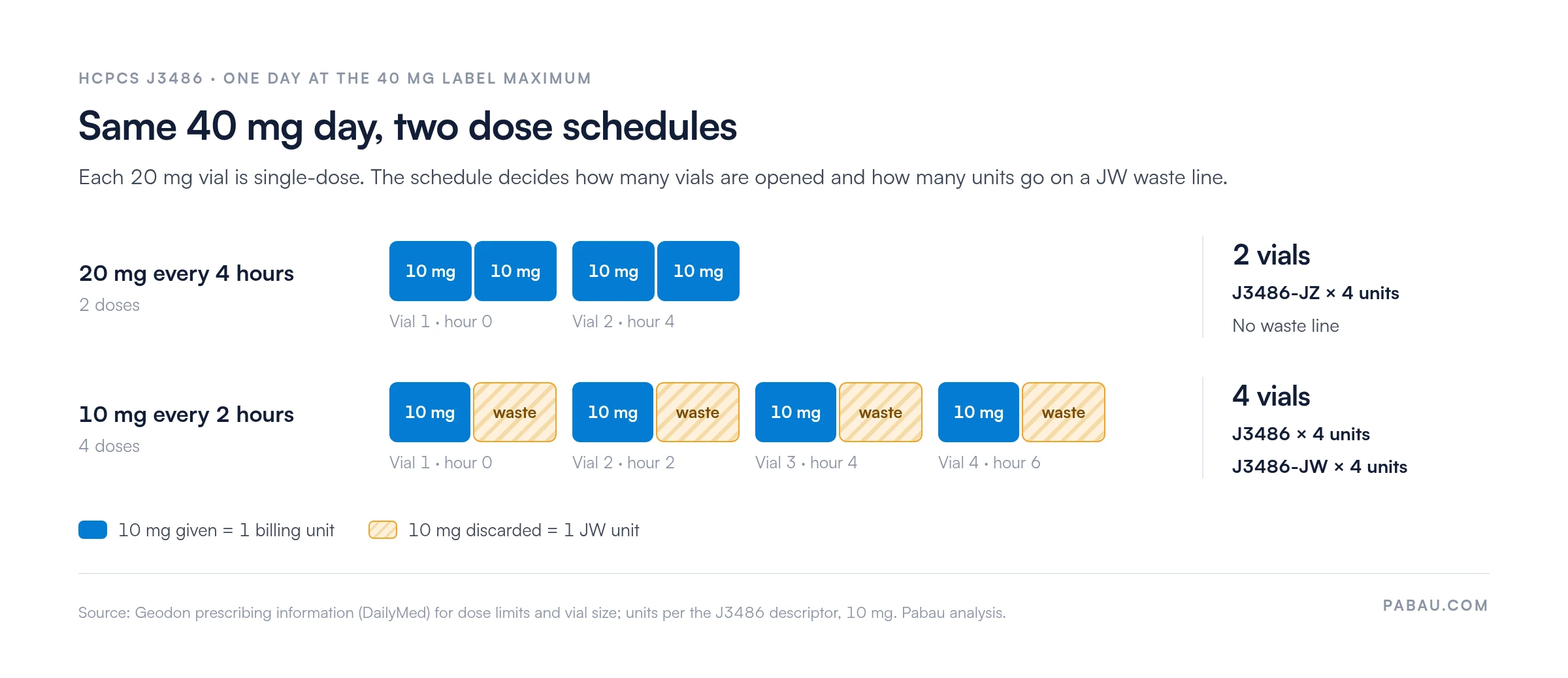
Divide the dose given in milligrams by 10. That is the unit count for the administered line. Because each vial holds 20 mg and is single-dose, a 10 mg dose leaves 10 mg that must be discarded. On a Medicare claim, that discarded amount goes on a second J3486 line with modifier JW.
Two details trip billers here. First, the vial is single-dose, so the 10 mg left in it cannot be saved for a second injection two hours later. Each dose opens a new vial and creates its own waste. Second, 40 mg a day is 4 units. A day billed above 4 units sits outside the label maximum, and the payer will ask why.
Run the 40 mg daily maximum both ways and the schedule changes the claim. Four 10 mg doses open four vials and add 4 units of waste, while two 20 mg doses add none.
J3486 covers the drug. The injection is a separate service, reported with CPT 96372 for a therapeutic intramuscular injection. Because ziprasidone is IM only, IV push codes such as 96374 never belong on the same claim. An IV administration code next to J3486 contradicts the label and invites a records request.
When a significant, separately identifiable evaluation happens at the same visit, the E/M code takes modifier 25. In a hospital outpatient department or emergency department, the facility reports the drug and the injection on the UB-04. The physician bills the professional E/M service separately on the CMS-1500.
Medicaid programs require the National Drug Code on physician-administered drug claims, and many commercial payers do too. Report it in the 11-digit 5-4-2 format with the N4 qualifier, followed by the unit of measure and the quantity. A powder vial is usually reported in units (UN). Check the payer’s billing manual for its preferred convention.
The CMS NDC-HCPCS crosswalk for October 2026 maps several products to J3486, each counted as 2 billing units per vial. Examples include:
Bill the NDC from the vial you used, not the one in the charge master. Practices often switch between Geodon and a generic when supply changes. A claim that carries the old product’s NDC no longer matches the drug in the patient record.
J3486 is a single-dose vial drug, so the JW and JZ modifiers apply to almost every separately payable Medicare claim for it. CMS made JZ reporting mandatory from July 1, 2023, under MLN Matters MM13056.
Before that date, JZ was available for voluntary use from January 1, 2023. Claims without the right modifier may be returned from October 1, 2023.
The JW and JZ policy does not apply to drugs that are not separately payable. Per the CMS JW and JZ modifier FAQ, that includes drugs with OPPS status indicator N, which are packaged into the visit. Check the J3486 status indicator in the current OPPS Addendum B before adding either modifier on a facility claim.
The FDA indication is agitation in schizophrenia, so the primary diagnosis should come from category F20. Code the type of schizophrenia the clinician documented, and add the agitation code when the record supports it.
Agitation in other conditions, such as bipolar mania or delirium, is off-label for IM ziprasidone. Check your MAC’s coverage articles and the payer’s drug policy before billing J3486 with a diagnosis outside F20. A dementia diagnosis on the same claim deserves extra care, because the label carries a boxed warning for that group.
Medicare Part B pays for J3486 in the physician office at the ASP-based payment limit. CMS publishes it quarterly in its ASP pricing files.
For October 1 to December 31, 2026, the limit is $5.940 per 10 mg unit. A full 20 mg vial therefore pays about $11.88 before the administration code.
The CMS HCPCS file gives J3486 coverage code C, which leaves coverage to the judgment of the local Medicare contractor. So the MAC’s policies decide what documentation it expects. Other settings work differently:
The dollar amount on a J3486 line is small. The administration code and the E/M service carry most of the visit’s value. That is why a denial on the drug line still costs time. The rework is the same whatever the line is worth.
Traditional Medicare does not require prior authorization for J3486. IM ziprasidone is given for acute agitation, so there is rarely time to request one before the injection. That shifts the work to the payers that do review it.
Check the patient’s plan at registration, not after the injection. Where the plan allows retroactive authorization, the record needs to show the urgency in the clinician’s own words.
Several injectable drugs are used for acute agitation, and each has its own code and unit size. Picking the right one depends on the drug in the syringe, not on the reason it was given.
When a patient gets ziprasidone and lorazepam at the same visit, each drug goes on its own line with its own units and NDC. Each injection also takes its own administration code, with the units the payer requires.
Most J3486 denials come from the unit count, the waste line, or a diagnosis that does not match the label. Each one can be fixed before the claim goes out. If one slips through, the denial codes billers see on the remittance name the cause.
An auditor reviewing a J3486 claim reads the medication record against the claim line by line. The record should hold each of these items:
The waste entry is the one most often left out. Without it, a JW line has nothing to support it, and a JZ line has nothing to prove the vial was emptied.
Most J3486 errors start at the point of care. The nurse records the dose in one place, the waste goes on a paper log, and the biller rebuilds the claim days later. By then the vial is gone, and so is the NDC.
Pabau, a practice management and billing platform, keeps the dose and the claim on the same patient record. Stock carries a batch number and expiry date, and the lot is recorded against the patient and the appointment. When the claim is built, the drug, the dose and the vial details are already in the record.
Pabau’s claims software for billers sends CMS-1500 claims to US payers through the Claim.MD clearinghouse. It also runs eligibility checks and posts electronic remittances back to the patient record. For plans that review antipsychotics, the authorization code, dates and sessions are tracked on the case. Pabau warns when one is missing.

Pabau records the vial lot and expiry against the appointment, then sends the claim through the Claim.MD clearinghouse. Eligibility checks and remittances come back to the same patient record.

J3486 is a small line on the claim, but it fails in predictable ways. The vial holds 20 mg, the unit is 10 mg, and the label stops at 40 mg a day. Get those three numbers into the medication record at the bedside, and the units, the waste line and the modifier follow.
Start with the charge master. If ketorolac is mapped to J3486 anywhere in your system, fix it today, because every claim built from it is wrong. Book a demo to see how Pabau keeps the dose, the vial details and the claim on one patient record.

Need a broader overview of drug claim submission? Medical billing fundamentals covers the end-to-end claims lifecycle from superbill to remittance.
Seeing recurring denials across multiple J-codes? Denial management in healthcare outlines a structured workflow for categorizing and resolving claim denials systematically.
Want to understand how drug claims fit the wider revenue picture? Revenue cycle management explained connects individual claim decisions to practice-wide financial performance.
HCPCS Code J3486 represents injection, ziprasidone mesylate, 10 mg. Ziprasidone is an atypical antipsychotic sold as Geodon for injection. The IM form is approved for acute agitation in patients with schizophrenia.
No. Ketorolac tromethamine, per 15 mg, is billed with J1885. J3486 is ziprasidone mesylate, 10 mg. If a charge master maps ketorolac to J3486, correct it before more claims go out.
Bill one unit for every 10 mg given. A 10 mg dose is 1 unit, and a 20 mg dose is 2 units. The label maximum of 40 mg a day equals 4 units.
Yes, on separately payable Medicare Part B claims. Each 20 mg vial is single-dose, so a 10 mg dose needs a second line for the discarded 10 mg with JW. A full vial takes JZ, which has been mandatory since July 1, 2023, under MLN Matters MM13056.
Report CPT 96372 for the intramuscular injection. Ziprasidone mesylate for injection is IM only, so IV push codes such as 96374 should not appear with J3486.
The FDA indication is agitation in schizophrenia, so the primary diagnosis comes from category F20, such as F20.0 or F20.9. R45.1, restlessness and agitation, can be added as a secondary code. Other diagnoses are off-label and depend on payer policy.
Traditional Medicare does not require it. Medicare Advantage, Medicaid managed care and commercial plans may review it, often after the fact, because the drug is given for acute agitation. Check the plan’s rules at registration.