HCPCS code J2690: Procainamide units and billing guide
What HCPCS code J2690 covers, and what it does not HCPCS code J2690 reports R...

Last Updated: Oct 30, 2026
HCPCS code J2786 is the Level II code for injection, reslizumab, 1 mg. It covers Cinqair, the IV biologic given to adults with severe eosinophilic asthma. Each billing unit equals one milligram, so a 70 kg patient dosed at 3 mg/kg is billed 210 units.
That single conversion drives most of the claim. Units set the payment, show whether drug was discarded, and decide between the JW and JZ modifiers. Get it wrong, and the claim comes back. The sections that follow trace a J2786 claim from dose to remittance, including CPT pairing, diagnosis codes, prior authorization and NDC fields.
Let Pabau's smart automation suggest the right codes, reduce claim denials, and keep your practice compliant—effortlessly.
Automate repetitive tasks and focus on what matters most—your patients.
Reduce coding errors and ensure compliance with the latest regulations.
Clean claims, fewer denials, and faster reimbursements.
Powerful insights and reporting to help your practice thrive.
HIPAA compliant SOC 2 certified GDPR-compliant Trusted by 4,000+ clinics worldwide

HCPCS code J2786 bills reslizumab (Cinqair) at 1 mg per unit, so a 210 mg dose is reported as 210 units.
On Medicare claims for single-dose vials, discarded drug goes on a JW line and a no-waste dose takes JZ.
The infusion pairs with CPT 96365 or 96413 depending on payer policy, and an add-on hour applies only past 90 minutes.
Report the J45.5x severity code with J82.83 for eosinophilic asthma, and keep the eosinophil count on file for authorization.
Pabau, practice software with built-in claims management, submits J2786 claims and tracks each one until it is paid or denied.
HCPCS code J2786 is the HCPCS Level II code for “Injection, reslizumab, 1 mg.” It covers Cinqair, Teva’s IV anti-IL-5 biologic for adults with severe eosinophilic asthma. One billing unit equals one milligram, so the unit count always matches the dose given.
Medicare covers the drug under Part B because a clinician gives every dose in an office or outpatient setting. Keep these reference facts close when you build the claim.
Start with the dose, then convert it. The labeled dose is 3 mg/kg every four weeks, and each milligram is one unit. The math takes four steps.
The weight on the claim must match the infusion note and the pharmacy preparation record. If the three disagree, an auditor can question the whole dose.
Reslizumab is an IV infusion, so every J2786 line needs a CPT drug administration code beside it. The drug and its administration are separate line items, and each is paid on its own.
The right initial code depends on CPT rules and payer policy. Many payers want 96365 for a non-cancer biologic like reslizumab. CPT also lets 96413 cover some monoclonal antibodies, so read the plan’s policy first.
Timing rarely causes trouble here. Reslizumab runs 20 to 50 minutes, so most visits bill one initial code and nothing more. Under CPT time rules, an add-on hour such as 96415 counts only from 91 minutes, which is 31 minutes past the first hour. Record start and stop times on every visit anyway.
Every J2786 claim needs an ICD-10-CM code that supports medical necessity. Payers look for severe asthma and an eosinophilic phenotype, and those facts live in two different codes.
The J45.5x codes describe severity, and they say nothing about the eosinophilic phenotype. J82.83 carries the phenotype, and its tabular note tells you to code the J45 severity code first. Report both, and keep the eosinophil count on file to back them up.
Most commercial plans and many Medicare Advantage plans require prior authorization for J2786. Original Medicare does not, though its contractors still review medical necessity. Billing a plan that requires approval without a number is a fast route to a CO-197 denial.
Criteria vary by plan, but most requests ask for the same five items:
Medicaid requires an NDC on physician-administered drug claims, and many commercial plans do too. Use the 11-digit NDC in 5-4-2 format, matched to the vial you opened.
Cinqair packaging can change, so confirm current NDCs in the AAPC Codify HCPCS lookup or the CMS NDC-HCPCS crosswalk. Each Medicaid claim needs three NDC fields:
A frequent slip is entering 210 as the NDC quantity. The HCPCS line counts milligrams, while the NDC line counts milliliters.
On Medicare claims, J2786 from a single-dose vial needs JW or JZ. JW reports discarded drug, and JZ confirms none was discarded. CMS has enforced the JZ requirement since July 1, 2023.
The discarded amount goes on its own claim line. For example, a 210 mg dose drawn from three vials leaves 90 mg, billed as 90 units of J2786-JW.
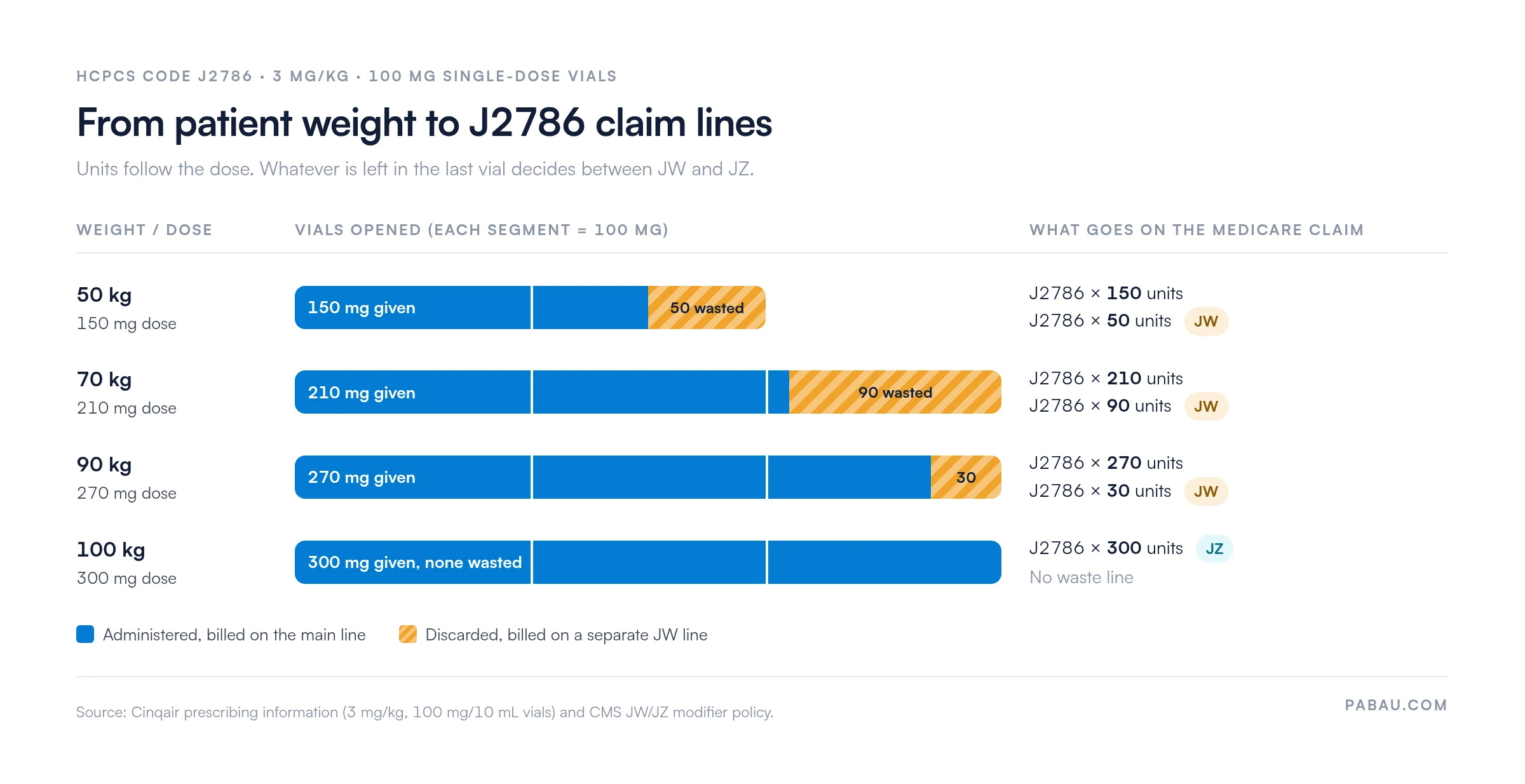
The most common modifier error is leaving both off. Medicare contractors can return or deny those lines. Medicaid and commercial plans set their own rules, so check them before adding JW or JZ.
Medicare pays J2786 under Part B at the average sales price plus 6%, under Section 1847A of the Social Security Act. CMS updates the rate each quarter, so check the CMS ASP pricing files before quoting an expected payment.
Place of service changes the payment system and the claim form. It does not, by itself, lower the drug rate. Hospital outpatient departments bill under OPPS, which generally pays separately payable drugs at ASP plus 6% too.
Check the CMS ASP pricing files every quarter before setting an expected allowable for J2786. A stale rate throws off payment posting and the coinsurance estimate you give the patient.
Physician-administered drugs fall under Part B, not Part D. Reslizumab qualifies because a clinician gives it in a covered setting. Part D covers self-administered drugs from a pharmacy, so it does not pay for a reslizumab infusion.
Each J2786 claim follows the same path through your revenue cycle management process. Most denials start at one of these five steps.
Auditors reviewing a J2786 claim look for six items in the record. If one is missing, they can flag the claim as unsupported.
A clean claim for J2786 carries all six before it leaves the practice. Building them into the infusion note template means staff capture them during the visit, while the details are fresh.
J2786 denials cluster around four failure points. They are missing modifiers, missing authorization, unsupported diagnoses and NDC errors. Tracking which one hits most often sharpens your denial management work.
For every CARC and RARC you may see on an 835 remittance, keep the medical billing denial codes reference handy.
Two minutes here can save a resubmission later. Check each item against the infusion record:
Several asthma biologics have their own codes. Billing the wrong one misstates the drug given, which turns a simple denial into a compliance problem.
J2786 is the only IV infusion in this group, while J0517 and J2182 are subcutaneous injections. Dupilumab has no dedicated J-code, so payers that cover it in the office ask for J3590 with the drug name and NDC. If a J2786 claim comes from a setting with no IV capability, the code is likely wrong.
Add one more pre-submission check to your J2786 workflow: confirm the infusion note records IV administration. A subcutaneous note on a J2786 claim is an audit flag and may mean the wrong code was chosen.
Most J2786 errors happen when details are retyped between the infusion note and the claim. Weight, units and NDC pass through several hands before submission.
Pabau’s claims software for practices fills the CMS-1500 from the patient record. The J2786 code attached to the service lands on the charge line, and recorded diagnoses seed the ICD-10 fields. The claim cannot be sent until its required fields are complete.
In the US, claims go out through Claim.MD with real-time eligibility checks. Pabau then tracks each claim’s status and posts the remittance when payment or a denial comes back.

Pabau’s claims management fills claims from the patient record, checks required fields before sending, and tracks every reslizumab claim from submission to payment.

Reslizumab billing is a math problem before it is a coding problem. Get the weight, dose and vial count right in the infusion note, and the units, JW line and NDC quantity follow.
The weak points sit outside the drug code itself. Authorization numbers go missing, J82.83 gets left off, and the NDC quantity lands in milligrams. Build those three checks into your routine, and most J2786 denials stop before submission.
Software helps once the numbers are right. Pabau, the practice management platform we build, fills the claim from the record and tracks it to payment. Book a demo to see how it handles your infusion billing.

Need a full overview of how medical billing works? Medical billing compliance covers the regulatory framework and documentation standards that apply to physician-administered drug claims.
Want to understand 837P claim structure for J-code submissions? Superbill guide explains how the superbill maps to the 837P and CMS-1500 fields billers populate for drug codes.
Looking for best-practice claims submission workflows? Best medical billing software for US practices reviews platforms that support J-code, modifier, and NDC field requirements.
The J-code for Cinqair is J2786, injection, reslizumab, 1 mg. There is no separate brand-name code, so every reslizumab claim uses J2786 with units equal to the milligrams given.
No. Cinqair carries a boxed warning for anaphylaxis, so a healthcare professional gives it in a setting prepared to manage that reaction. Patients are observed after the infusion. That is why J2786 claims come from offices, clinics and hospital outpatient departments.
Cinqair is approved only for adults 18 and older. A claim for a younger patient is off-label, so most payers deny it unless they approve an exception first. Check the plan’s policy before scheduling.
The labeled schedule is one dose every four weeks. Many payers apply frequency edits, so an infusion billed early may deny. If a dose has to move, document the reason in the record.
Usually, yes. Many plans approve reslizumab for six or twelve months at a time. Renewal requests typically need proof of response, such as fewer exacerbations or less oral steroid use.