

HCPCS code E0198: Water pressure pad billing guide
HCPCS code E0198 is a water pad for a standard mattress HCPCS code E0198 is the ...

Last Updated: Oct 13, 2026
J2180 is the HCPCS Level II code for injection, meperidine and promethazine HCl, up to 50 mg.
It covers the premixed combination of meperidine, a Schedule II opioid analgesic, and promethazine, an antihistamine, once sold as Mepergan. One billing unit equals up to 50 mg. The combined product has been discontinued, and Medicare allows zero units of J2180. When the two drugs come from separate vials, report J2175 for meperidine and J2550 for promethazine instead.
Let Pabau's smart automation suggest the right codes, reduce claim denials, and keep your practice compliant—effortlessly.
Automate repetitive tasks and focus on what matters most—your patients.
Reduce coding errors and ensure compliance with the latest regulations.
Clean claims, fewer denials, and faster reimbursements.
Powerful insights and reporting to help your practice thrive.
HIPAA compliant SOC 2 certified GDPR-compliant Trusted by 4,000+ clinics worldwide

J2180 reports the premixed meperidine and promethazine HCl injection once sold as Mepergan, at one unit per 50 mg or less.
Medicare’s medically unlikely edit for J2180 is zero units in practitioner and outpatient hospital settings, because CMS lists the drug as discontinued.
When meperidine and promethazine come from separate vials, bill J2175 for meperidine and J2550 for promethazine, each with its own units and NDC.
Meperidine is a Schedule II opioid, so every dose needs a controlled-substance log entry alongside the administration record.
Claims software such as Pabau keeps the drug code, units and NDC tied to the treatment note before the claim goes out.
HCPCS code J2180 is the Level II code for Injection, meperidine and promethazine HCl, up to 50 mg. It describes a premixed injection that combines meperidine, a Schedule II opioid analgesic, with promethazine, a phenothiazine antihistamine.
The combination was marketed as Mepergan and given by intramuscular injection. One billing unit covers up to 50 mg. The product is no longer manufactured, and Medicare now allows zero units of J2180 per day.
The J-series is maintained by the Centers for Medicare and Medicaid Services (CMS) HCPCS program. J2180 shares the J2000 range with J2175 for meperidine alone and J2550 for promethazine alone. That makes a code mix-up easy during claim entry.
J2180 is still a valid HCPCS code, but Medicare has no payable units for it. CMS sets its medically unlikely edit (MUE) at zero units per day.
The Medicare NCCI MUE tables effective October 1, 2026 list that zero in both the practitioner and the outpatient hospital files. The rationale recorded in both is “Drug discontinued.”
For comparison, the same October 2026 payment limit file sets J2175 at $9.652 per 100 mg and J2550 at $3.241 per 50 mg. Those rates change every quarter, so check the current CMS ASP pricing files before quoting them.
In practice, a J2180 line on a Medicare claim today usually signals a coding error. Either an old charge master entry still maps to it, or two separate drugs were keyed as the old combination.
When a patient receives meperidine and promethazine at the same visit, report each drug under its own code. Use J2175 for meperidine and J2550 for promethazine, then add the administration code.
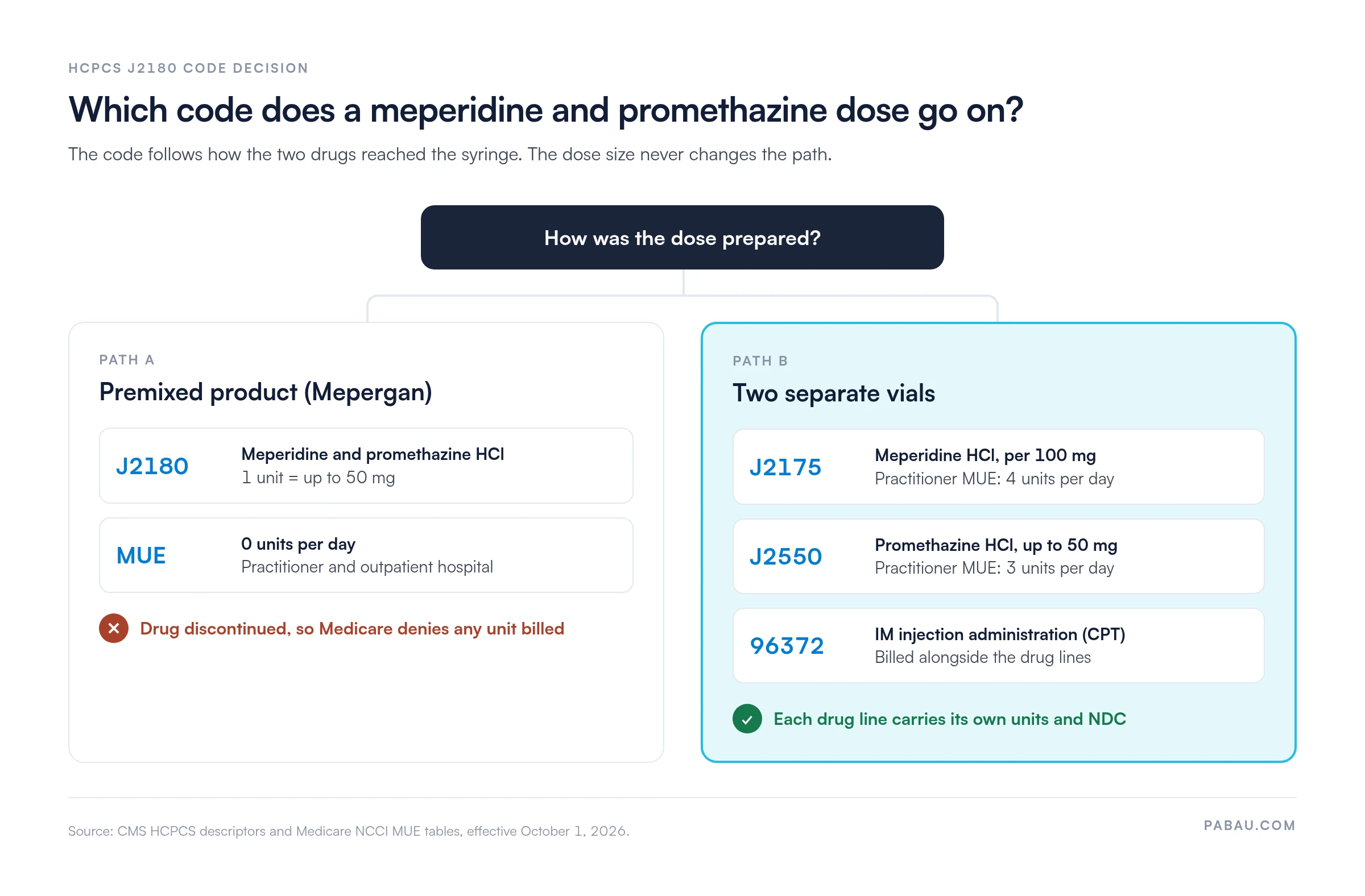
HCPCS code J2175 is reported per 100 mg of meperidine. HCPCS code J2550 is reported per 50 mg or less of promethazine. Each line carries its own units and its own NDC. The diagram below maps both preparations to the lines they put on the claim.
Drug units are whole numbers on the claim. When a dose falls between two units, round up to the next whole unit and record the exact milligrams in the chart.
Medicare caps practitioner claims at 4 units per day for J2175 and 3 units for J2550. A dose above either edit needs documented medical necessity before the claim goes out.
A complete claim for these drugs carries six elements on the CMS-1500 or its electronic 837P equivalent:
Using claims management software that ties NDC data to the dose record catches a wrong drug code before submission.
Check the vial label before you key J2180. Premixed Mepergan is no longer made, so a combined dose almost always came from two vials. That claim belongs on J2175 and J2550.
Meperidine is a DEA Schedule II controlled substance. The chart has to satisfy the billing record and the controlled-substance log at the same time.
Promethazine is not a controlled substance. Its injection carries an FDA boxed warning for severe tissue injury, so the route and injection site need recording too.
Prior authorization (PA) rules for these drugs vary by payer and setting. Medicare Advantage plans, Medicaid programs and commercial payers can each set their own rules.
The code choice for this combination depends on how the drugs reached the syringe. A premixed product goes to J2180, and separate vials go to J2175 and J2550.
HCPCS code J3490 is a not otherwise classified (NOC) code for drugs without a specific HCPCS code. Meperidine and promethazine each have one, so billing either under J3490 invites a payer edit or a denial.
Most J2180 denials trace back to code selection rather than documentation. The denial management fix is to catch the code before submission instead of appealing afterward.
CMS gives J2180 MUE adjudication indicator 3, so a denial for exceeding the edit can be appealed. The claim adjustment reason code on the remittance names the edit that fired. Check it against these denial codes before you choose a route.
For a discontinued drug, the appeal rarely succeeds. When the wrong code caused the denial, ask your MAC whether a reopening or a corrected claim fits instead.
Where an appeal is justified, the Medicare process runs through these levels:
Review medical billing compliance requirements for your practice type when the same denial repeats across claims. A repeating pattern usually points to a charge master or workflow problem.
A Schedule II opioid on a claim draws closer scrutiny than most drug codes. A discontinued code on the same line adds a second reason for review.
Most J2180 errors start at the charge master, where an old mapping sends a two-vial dose to a retired combination code. The mistake only surfaces weeks later as a denial.
In Pabau, the practice management platform we build, the drug, dose and NDC are recorded in the treatment note. The claim is built from that same record, so the code and units match what the clinician gave.
Billing staff can review drug lines before submission and track denials by reason code. Once the mapping is fixed, the same J2180 rejection stops coming back every month.

Pabau links each drug’s dose, NDC and billing units to the treatment record. Your team submits J-code claims that match what the clinician gave.

Treat J2180 as a code you should rarely need. With the premixed product discontinued and a Medicare MUE of zero, almost every combined dose belongs on J2175 and J2550.
The work that prevents these denials happens before the claim. Remap the charge master, record each vial’s NDC, and keep the controlled-substance log in step with the chart. Book a demo to see how Pabau ties drug codes, units and NDCs to the treatment record.

Need to understand how denials get resolved at scale? Denial management in healthcare covers the end-to-end workflow for tracking, categorizing, and appealing claim denials across your practice.
Want a compliance framework for your billing team? Medical billing compliance requirements outlines the audit controls and documentation standards practices need to stay clean during payer reviews.
Looking for a plain-language overview of how medical billing works? What is medical billing explains the full revenue cycle from charge capture through remittance posting.
J2180 covers an injection of premixed meperidine and promethazine HCl, up to 50 mg per unit. The combination was sold as Mepergan and is now discontinued, so Medicare allows zero units of J2180.
One unit of J2180 equals up to 50 mg. A premixed dose above 50 mg and up to 100 mg reports as 2 units. Medicare’s MUE for J2180 is still zero units per day.
Medicare pays no units for J2180. CMS sets its medically unlikely edit at zero units in practitioner and outpatient hospital settings, citing the drug as discontinued. The October 2026 ASP file lists no payment limit for it.
Bill J2175 for meperidine, per 100 mg, and J2550 for promethazine, up to 50 mg. Report each line with its own units and NDC, plus an administration code such as CPT 96372.
You need a signed order naming both drugs, an administration record with milligrams, route and site, and a supporting diagnosis. Add each vial’s NDC and lot number and a Schedule II log entry for the meperidine.
J2180 is the specific code for the premixed meperidine and promethazine injection. J3490 covers unclassified drugs that have no specific code. Both components have specific codes, so J3490 does not apply.
Prior authorization rules vary by payer. Medicare Advantage plans, Medicaid programs and commercial insurers may require it for opioid injections given outside an emergency. Verify with each payer before non-emergency administration.
The most likely reason at Medicare is the zero-unit MUE for a discontinued drug. Other causes include a missing NDC, wrong units, no prior authorization, an unsupported diagnosis and the wrong place-of-service code.



