HCPCS Code Q4185: Cellesta flowable amnion billing guide
HCPCS Code Q4185: definition and official descriptor HCPCS Code Q4185 is the Lev...

Last Updated: Nov 20, 2026
J2410 is the HCPCS Level II code for injection, oxymorphone HCl, up to 1 mg. Each unit covers up to 1 mg, so a 0.5 mg IV dose is 1 unit and 1.5 mg IM is 2 units.
Oxymorphone is a DEA Schedule II opioid, and the code is often confused with J2270, which is morphine sulfate per 10 mg. Drugs@FDA lists Opana injection, the only FDA-approved oxymorphone injection, as discontinued. Confirm the drug given before you bill J2410.
Let Pabau's smart automation suggest the right codes, reduce claim denials, and keep your practice compliant—effortlessly.
Automate repetitive tasks and focus on what matters most—your patients.
Reduce coding errors and ensure compliance with the latest regulations.
Clean claims, fewer denials, and faster reimbursements.
Powerful insights and reporting to help your practice thrive.
HIPAA compliant SOC 2 certified GDPR-compliant Trusted by 4,000+ clinics worldwide

HCPCS Code J2410 reports injection, oxymorphone HCl, up to 1 mg. Each billing unit covers up to 1 mg, so round any partial milligram up.
J2410 is not a morphine code. Morphine sulfate injection is J2270, billed per 10 mg, and it is still active with its own Medicare payment limit.
Drugs@FDA lists Opana injection, the only FDA-approved oxymorphone injection, as discontinued. CMS’s October 2026 files give J2410 no payment limit and no NDC.
A partial dose from a 1 mg ampule bills as one full unit with the JZ modifier, because CMS does not use fractional billing units.
Pabau, the practice management platform we build, keeps the drug, dose, NDC and modifier with the patient record. Each J2410 line is checked before it leaves.
HCPCS Code J2410 is the Level II code for injection, oxymorphone HCl, up to 1 mg. The Centers for Medicare & Medicaid Services (CMS) maintains it in the J-code range, the section for drugs administered other than by mouth. The January 2027 CMS HCPCS file and AAPC Codify both list that descriptor.
Oxymorphone is a Schedule II opioid. The last FDA label for Opana injection lists four uses for the injectable form:
The same label contraindicates the injection in moderate or severe hepatic impairment. It also warns of life-threatening respiratory depression, with the closest monitoring in the first 24 to 72 hours. Both points belong in the chart, so a reviewer can see the dose suited the patient.
Oxymorphone and morphine differ by three letters, so the two codes are easy to swap. The units differ too: a 10 mg morphine dose billed under J2410 becomes 10 units of a different drug.
Neither code replaced the other, and J2270 has not been deleted. Our J2270 guide covers morphine injection billing in full.
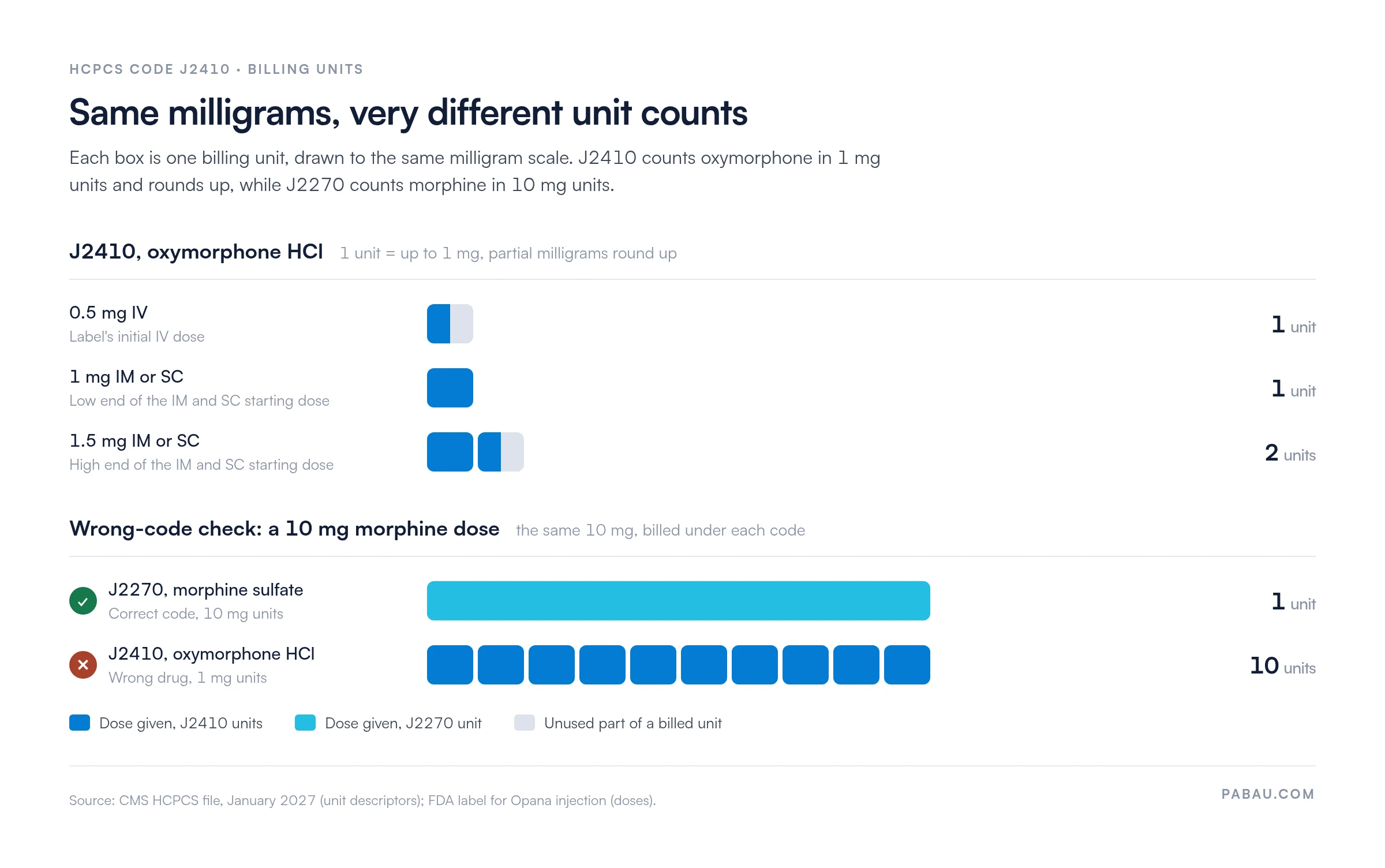
One unit of HCPCS Code J2410 covers up to 1 mg of oxymorphone HCl. Divide the dose by 1 mg and round any remainder up to the next whole unit. The doses below come from the FDA label’s starting doses.
Check every J2410 line against the medication administration record (MAR) before submission. A J2410 line with 10 units is the classic sign of a 10 mg morphine dose coded as oxymorphone.
So is a J2410 line with 1 unit against a note that records 10 mg. The chart below draws both codes to the same milligram scale, so the mismatch is easy to see.
Medicare Part B pays most separately payable drugs at 106% of the average sales price (ASP), using the quarterly CMS ASP pricing files. J2410 has no row in the October 2026 payment limit file, and the matching NDC-HCPCS crosswalk lists no NDC for it.
CMS notes in that file that a missing code does not settle whether Medicare covers a drug. The local Medicare Administrative Contractor (MAC) makes that call when it processes the claim. Ask your MAC what pricing documentation it needs, such as the purchase invoice, before you submit.
For comparison, J2270 carries a payment limit of $7.259 per 10 mg unit for the same quarter. Never estimate a J2410 rate from another opioid’s limit, because the drugs and units differ.
Most payers want the 11-digit National Drug Code (NDC) on each drug line. The NDC lets the payer match the exact product you used to the code you billed.
CMS requires the JW or JZ modifier on separately payable Part B drugs from single-dose containers. JW reports a discarded amount that is eligible for payment. JZ attests that no such amount was discarded, and it has been required since July 1, 2023.
Opana injection came in 1 mg/mL, 1 mL ampules, so one ampule matched one billing unit. The CMS JW and JZ modifier FAQs say CMS does not use fractional billing units. When the dose is less than the billing unit, you bill the full unit with JZ and skip the JW line.
Because the ampule and the billing unit are both 1 mg, a J2410 line with JW is rare. If one appears, check whether the units were miscounted or whether a different drug was given. Then confirm your MAC’s wastage documentation rules before you resubmit.
J2410 pays for the drug only. Report the administration with its own CPT code on the same claim, chosen by route.
National Correct Coding Initiative (NCCI) edits decide whether the administration code is separately billable in a given setting. Some pairs need modifier 59 or an X-modifier (XE, XS, XP, XU).
Use one only when the record shows a separate encounter, site, practitioner or service. Edit pairs change quarterly, so confirm them through the AAPC Codify HCPCS lookup or the CMS website.
Diagnosis codes that support medical necessity: link J2410 to an ICD-10-CM code that matches the documented indication. Common pairings include:
The diagnosis has to appear in the clinical record and be supported by it, not simply listed on the claim.
J2410 denials follow predictable patterns, and most trace back to the drug or the unit count. Using structured denial management workflows that track these reasons by code cuts rework time.
See the full CARC and RARC denial code reference for what each adjustment reason means. Commercial insurers and Medicaid managed care plans often require prior authorization for opioid injections. Verify the plan’s rules before the dose is given, because many plans will not authorize after the fact.
Because oxymorphone is a Schedule II controlled substance, J2410 carries a heavier documentation load than most injectable drugs. Medical billing compliance for Schedule II drugs overlaps with federal DEA rules and state controlled substance reporting. Auditors look for each item below.
The PGM Billing HCPCS lookup tool can help you confirm the current J2410 descriptor and related codes during documentation review.
J2410 is one of several opioid injection codes, and each has its own drug and unit. Picking the wrong one is a common source of unit errors and medical necessity mismatches.
Use the official CMS HCPCS files as your primary source for descriptors and status. The Medicare Informatics HCPCS tables work as a quick secondary lookup, but reconcile anything you find against the current CMS file.
A J2410 claim depends on details that start at the bedside: which opioid was drawn, how much, from which package. When those details are re-keyed from a paper MAR, a morphine dose can easily leave the practice coded as oxymorphone.
Pabau records the drug, dose, NDC and wastage in the patient record at the point of care. Its software for cleaner claims then builds each claim from that record. Your coder checks units and modifiers against what was charted, so the claim matches the chart.
Claims go out electronically, and eligibility responses, claim status and remittances come back against the same patient. A denial on a controlled-substance drug line shows up the day it arrives, not at month-end reconciliation.

Pabau’s claims management software keeps drug administration, NDC numbers and billing units with the patient record, so your J2410 claims match what was charted.

J2410 is an active code for a drug whose only FDA-approved injection is listed as discontinued. That makes every J2410 line worth a second look before it leaves the practice. Confirm the record names oxymorphone, not morphine or hydromorphone.
Once the drug is right, the rest is simple arithmetic: 1 mg per unit, rounded up, with JZ when a partial ampule is discarded. If the chart says morphine, the code is J2270. Book a demo to see how Pabau keeps the charted drug and the billed code in step.

Need to understand how drug claims clear the payer? Medical claims clearinghouse guide explains how electronic claims are validated before they reach the payer.
Seeing recurring CO-97 denials on drug codes? What makes a clean claim walks through the fields payers check on every drug claim line.
J2410 represents injection, oxymorphone HCl, up to 1 mg. Oxymorphone is a Schedule II opioid agonist. The FDA label for Opana injection lists intravenous, intramuscular and subcutaneous use.
Bill one unit per 1 mg, rounding any partial milligram up. A 0.5 mg IV dose is 1 unit, a 1 mg dose is 1 unit, and a 1.5 mg dose is 2 units.
No. Morphine sulfate injection is J2270, billed per 10 mg. J2270 is still active, and its Medicare payment limit for October to December 2026 is $7.259 per unit.
CMS lists no payment limit for J2410 in its October 2026 Medicare Part B payment limit file. Your MAC decides coverage and payment, so ask what pricing documentation it needs before you submit.
Medicare requires JW or JZ on separately payable drugs from single-dose containers. CMS does not use fractional billing units, so a partial dose from a 1 mg ampule bills as one full unit with JZ.
The administration code depends on the route. Use CPT 96372 for IM or SC injection, 96374 for an initial IV push, and 96375 for an additional sequential IV push. Confirm current NCCI edits first, because they change quarterly.
Drugs@FDA lists both strengths of Opana injection, NDA 011707, as discontinued, and DailyMed carries no current oxymorphone injection label. Confirm the product given before you bill J2410.