CCSD Code H0480: Abdominal revision of restorative proctocolectomy
What is CCSD Code H0480? CCSD Code H0480 is the procedure code for abdominal rev...

Last Updated: Oct 15, 2026
CPT code 96367 is the add-on code for an additional sequential intravenous infusion of a new drug or substance, up to one hour. It reports one unit per additional drug and never stands alone on a claim. Its parent is a primary infusion code such as 96365, 96409, or 96413.
Where a second drug runs at the same time as the first rather than after it, 96368 applies instead. This reference covers the official descriptor, the primary code pairings, and the documentation requirements. It also sets out 2026 Medicare rates and the errors that most often send a 96367 line back unpaid.

CPT code 96367 is an add-on code and cannot be billed without a parent primary infusion code such as 96365, 96409, or 96413.
96367 applies only to sequential infusion of a new drug or substance. Use 96368 when a second drug runs at the same time, and 96366 for each extra hour of the same infusion.
Each additional sequential infusion of a distinct drug reports one unit of 96367, up to 1 hour per unit.
Medicare pays 96367 at the same national amount in the office and in a facility, because the code carries no separate facility value.
Pabau’s claims management software checks that the fields an insurer requires are present before a claim can be sent.
The American Medical Association (AMA) defines CPT code 96367 as follows. “Intravenous infusion, for therapy, prophylaxis, or diagnosis; additional sequential infusion of a new drug or substance, up to 1 hour.” The code sits in the Hydration, Therapeutic, Prophylactic, Diagnostic Injections and Infusions section of the CPT code set.
Three words in that descriptor carry specific billing weight: “Additional,” “sequential,” and “new drug or substance.” All three must be met for 96367 to apply.
CPT code 96367 cannot be reported alone. The CMS National Correct Coding Initiative (NCCI) requires it to be appended to a valid primary infusion code on the same claim. Submitting 96367 without a parent code is the single most common denial reason for this code family.
The primary codes that can anchor 96367 include:
An add-on code cannot anchor another add-on code. One 96367 line never serves as the parent for a second 96367 line, so both units hang off the same primary code.
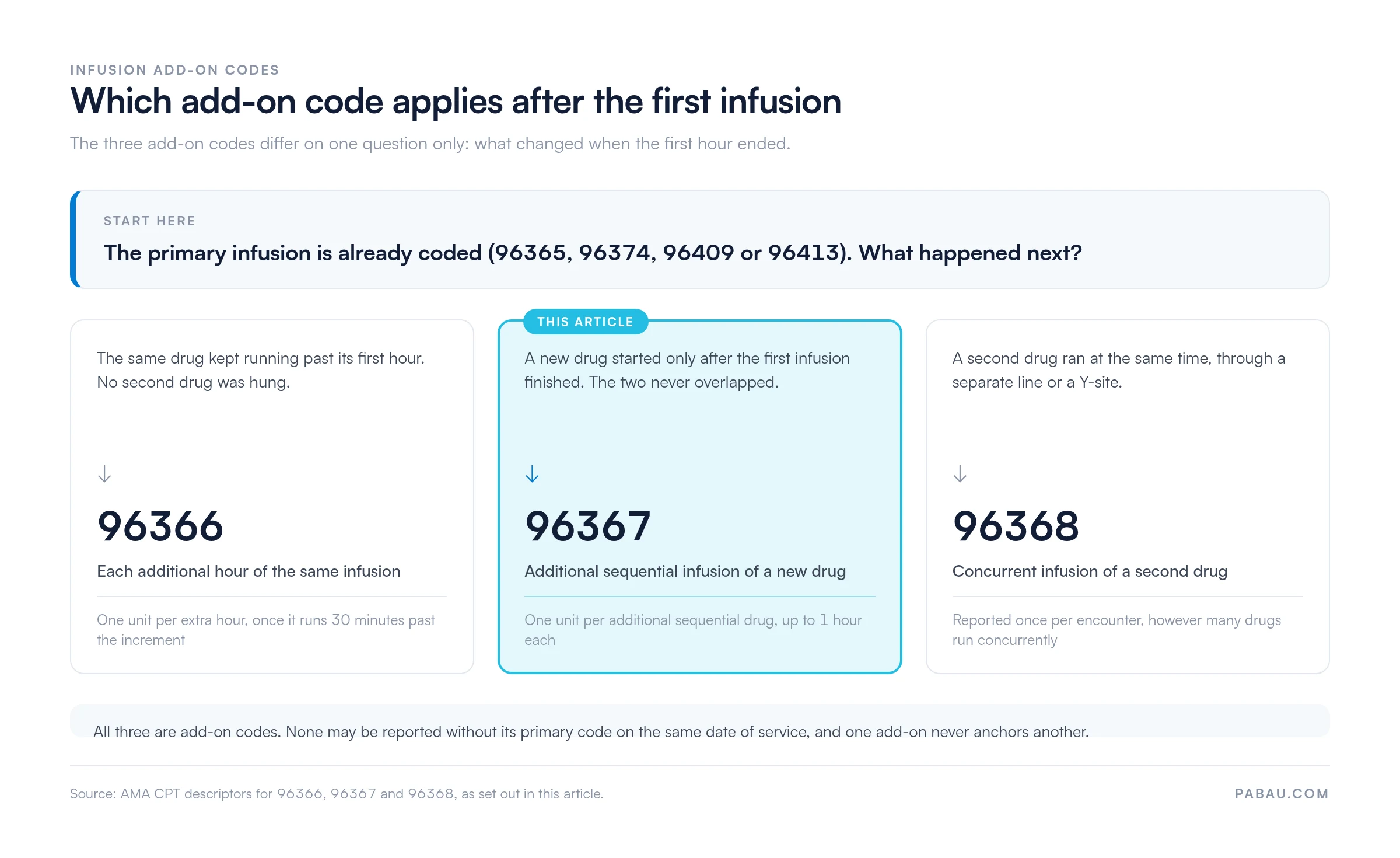
“Sequential” means one infusion ends before the next begins. The patient receives Drug A, that infusion completes, then Drug B starts. That is 96367 territory. If Drug A and Drug B run simultaneously through separate lines or Y-sites, that is concurrent infusion, and 96368 applies instead.
The choice between 96367 and 96368 comes down to whether the two drugs overlap on the clock. Sequential administration reports 96367, and simultaneous administration reports 96368. Payer auditors flag this mix-up among the most frequent denial reasons on infusion claims.
When documentation is ambiguous about whether infusions overlapped, payers default to denying the add-on or requesting medical records. Clear nursing notes with start and stop times for each drug resolve most of these disputes at the first review stage.
96366 is often dragged into the sequential-versus-concurrent argument, and it does not belong there. Its descriptor reads “each additional hour,” so it extends the time of an infusion already reported under 96365. The drug does not change, and no second line is started.
Report 96366 for each additional hour beyond the first, once the infusion runs more than 30 minutes past that increment. A saline infusion running two hours reports 96365 plus one unit of 96366. Neither 96367 nor 96368 covers that scenario, because no new drug was hung and nothing ran in parallel.
Across all three add-on codes, the question that decides the answer is a single one. What changed when the first hour ended?
The same distinction carries over to IV pushes. A new substance pushed sequentially reports as 96375. A repeat push of the same drug more than 30 minutes later, in a facility, reports as 96376.
Every element below must appear in the medical record before a 96367 claim is submitted. These are the items a payer asks for first when an infusion claim goes to medical review.
Payer-specific documentation requirements vary. Some commercial insurers require prior authorization for repeated sequential infusion sessions. Verify coverage policies before the encounter rather than after claim denial.
CPT code 96367 follows unit-based reporting. Each additional sequential infusion of a new drug or substance reports one unit, up to 1 hour. A second distinct drug infused sequentially after the first add-on generates a second unit of 96367 on the same claim.
The most common pairing puts 96365 on the first line and 96367 on the second. A patient receiving normal saline first, then magnesium sulfate after the saline completes, would generate this line-item set:
For chemotherapy sessions where 96413 is the primary code, a non-chemotherapy drug given sequentially afterward reports as 96367. When the chemotherapy infusion itself runs past its first hour, the extra time reports under 96415, not 96367. Some payers apply additional edits when 96413 and 96367 appear together without a corresponding drug (J-code) line.
Key billing rules to confirm before submitting:
Medicare pays roughly $29.73 per unit of CPT code 96367 in 2026, and the amount is the same in the office and in a facility. CMS’s 2026 relative value file lists the code at a total of 0.89 RVUs in both settings, with no separate facility value. At the 2026 conversion factor of $33.4009, that works out to the figure above before any locality adjustment.
The CMS Physician Fee Schedule lookup tool remains the authoritative source for the rate in your own locality. Check there before using any national figure in a financial projection.
Medicaid reimbursement for 96367 varies by state. Some states reimburse at a percentage of Medicare; others apply their own fee schedules. Always confirm state-specific rates through the relevant Medicaid managed care organization before assuming Medicare parity.
Before using the national figure in budget projections, apply the Geographic Practice Cost Index (GPCI) for your locality. The national average understates rates in high-cost urban markets and overstates them in rural areas. Run your ZIP code through the CMS PFS lookup to get the locality-adjusted number.
Most 96367 denials trace back to a handful of preventable errors. Each one comes back with a specific rejection reason, and the denial codes on the remittance tell you which error the payer found. Catching them at claim scrubbing keeps the line from reaching the payer at all.
CPT code 96367 sits within a closely related group of infusion and injection administration codes. Understanding where each one fits prevents miscoding across the session. The AAPC Codify CPT lookup provides full descriptors for each code alongside crosswalk data.
Infusion visits carry more add-on code complexity than almost any other service category. Each drug administered needs its own documented start and stop time, a confirmed clinical indication, and the correct parent-child relationship on the claim. A missing membership number or authorization code then holds up a claim that was coded correctly.
Pabau builds software for billing teams that checks those insurer-required fields before anything is sent. The Send button stays locked until the membership number, the authorization code, and the rest of the payer’s required fields are filled in. Completed claims then go out through Claim.MD or straight to Medicare.
The check happens while the biller still has the chart open, rather than three weeks later in a rejection report. Your team spends its time on the coding decisions this article covers, instead of on resubmitting claims that were missing a field.
Run a quarterly audit of your 96367 claims. Pull every claim that includes 96367 and check the parent code column. Any 96367 line without 96365, 96374, 96409, or 96413 on the same date of service is a compliance risk. Correct it before a payer finds it.

Pabau’s claims management software checks that membership numbers and authorization codes are present before a claim can be sent. Completed claims submit through Claim.MD or direct to Medicare.

CPT code 96367 is straightforward once its three core requirements are clear. It is an add-on, it applies only to sequential infusion of a new drug, and it cannot stand alone on a claim. The expensive mistakes are reporting a concurrent infusion as sequential, and submitting 96367 with no primary parent code.
Both mistakes are settled by the nursing record rather than by the coder. Where start and stop times for each drug are written down as they happen, the choice between 96366, 96367, and 96368 makes itself. Where they are not, the coder is guessing, and a payer audit will eventually say so.
Get the charting right and the coding follows. Book a demo to see how Pabau checks an infusion claim for missing insurer fields before your team sends it.

Need the parent code for a 96367 line? CPT code 96365 covers the initial IV infusion that anchors most sequential add-on claims.
Billing an oncology infusion session? CPT code 96413 is the chemotherapy primary code that 96367 hangs off when a non-chemo drug follows.
Was the second substance a push rather than a drip? CPT code 96375 is the sequential IV push add-on, and the direct counterpart to 96367.
Want fewer infusion claims coming back? Clean claim submission sets out what has to be right on the first pass, from eligibility through to code pairing.
Building an internal audit routine? Medical billing compliance outlines the OIG risk areas that apply to time-based infusion coding.
CPT code 96367 is the add-on code for an additional sequential IV infusion of a new drug or substance, up to one hour. It is reported after an initial infusion already coded under a primary code such as 96365 or 96413.
No. CPT 96367 is a designated add-on (+) code. It must always be reported alongside a valid primary infusion code such as 96365, 96374, 96409, or 96413 on the same claim date. A claim with 96367 and no parent code will be denied by Medicare and most commercial payers.
96367 covers a new drug infused sequentially, after the previous infusion has ended. 96368 covers a second drug infused at the same time as another infusion, and it is reported only once per encounter. 96366 sits on a separate axis again, reporting each additional hour of the same infusion.
One unit of 96367 per additional sequential drug infused, up to one hour per unit. If three distinct drugs are administered sequentially, the claim would include one primary code and two units of 96367. Always verify with the individual payer whether additional unit rules apply.
Required documentation includes start and stop times for each drug, plus the drug name and dose. The record must confirm the drug is distinct from the substance billed under the primary code. It also needs a medical necessity statement tied to a diagnosis and an ordering provider signature. Missing start/stop times is the leading cause of post-payment audits on infusion claims.
Medicare pays approximately $29.73 per unit of CPT 96367 in 2026, and the rate is the same in an office and in a facility. CMS lists the code at a total of 0.89 RVUs in both settings, applied to the 2026 conversion factor of $33.4009. Verify your locality-adjusted rate using the CMS Physician Fee Schedule lookup tool at cms.gov.