

CCSD code G5100: Bypass of duodenum billing guide
CCSD code G5100 bills a bypass that leaves the duodenum in place CCSD code G5100...

Last Updated: Oct 16, 2026
J1645 is the HCPCS Level II code for injection, dalteparin sodium, per 2500 iu.
Let Pabau's smart automation suggest the right codes, reduce claim denials, and keep your practice compliant—effortlessly.
Automate repetitive tasks and focus on what matters most—your patients.
Reduce coding errors and ensure compliance with the latest regulations.
Clean claims, fewer denials, and faster reimbursements.
Powerful insights and reporting to help your practice thrive.
HIPAA compliant SOC 2 certified GDPR-compliant Trusted by 4,000+ clinics worldwide

HCPCS Code J1645 describes an injection of dalteparin sodium (Fragmin), billed per 2500 IU of the drug administered.
Bill one unit of J1645 per 2500 IU ordered, so a 5000 IU dose is 2 units and 10,000 IU is 4 units.
Medicare Part B reimburses J1645 at ASP+6%, and the NDC on the claim carries the F2 unit of measure qualifier.
Fragmin is approved for thrombosis prophylaxis and extended treatment, not for the acute treatment of VTE.
A single-dose container needs modifier JZ when no drug is discarded, or JW to report the discarded amount.
Dalteparin sodium is sold under the brand name Fragmin and belongs to the low molecular weight heparin (LMWH) anticoagulant class. In turn, J1645 sits in the J-code series, which CMS maintains for drugs and biologicals given by injection. In contrast, oral drug products are reported under a different code family.
Specifically, the table below summarizes the core attributes of HCPCS Code J1645 as maintained by CMS.
Dalteparin sodium is a low molecular weight heparin derived from porcine intestinal mucosa. It works by inhibiting Factor Xa and, to a lesser extent, thrombin, preventing the clot formation that causes deep vein thrombosis and pulmonary embolism. In practice, Fragmin (the brand name manufactured by Pfizer) is available in single-dose prefilled syringes and multi-dose vials, which affects NDC reporting requirements on claims.
Importantly, the FDA has approved dalteparin for the indications below, and the label draws a firm line between prophylaxis and treatment.
Fragmin’s label states plainly that it is not indicated for the acute treatment of VTE. Therefore, that wording decides how a J1645 claim has to read. A line built around an acute DVT or PE treatment narrative does not match an approved use, however well the dose is documented.
Notably, off-label use of dalteparin does not generate a covered claim on its own. Instead, the ICD-10 code on the claim must correspond to an FDA-approved or payer-recognized indication. Cancer-associated thrombosis needs careful pairing, because the malignancy code and the thrombosis code both have to appear.
Each unit of HCPCS Code J1645 represents 2500 IU of dalteparin sodium. Accordingly, the units billed must match the dose ordered and administered, not the amount held in the vial. Round to the nearest whole unit, since CMS does not permit partial units on a J1645 line.
The table below shows the unit calculation for the most common dalteparin doses.
Wastage rule: when a single-dose container holds more drug than the dose ordered, Medicare pays for the discarded portion if it cannot be salvaged. In that case, report the administered amount on one line and the discarded amount on a second line with modifier JW.
When a single-dose container yields no waste, append modifier JZ instead to attest to that. CMS required JZ reporting from July 1, 2023, and began rejecting claims without JW or JZ as unprocessable on October 1, 2023. As a result, a missing modifier is enough on its own to stop the line. So, document the dose ordered, the dose given, and any discarded amount in the patient record.
Confirm your Medicare Administrative Contractor’s wastage policy before you rely on it, since the rules vary by setting and container type.
Every J1645 claim requires a supporting ICD-10-CM diagnosis code that establishes medical necessity. Specifically, the diagnosis must reflect the clinical indication documented in the patient record. Accordingly, the table below lists the primary ICD-10 codes paired with HCPCS Code J1645 claims across DVT, pulmonary embolism, and cancer-associated thrombosis indications.
Specifically, every entry in the clinical context column assumes prophylaxis or extended therapy. The label rules out acute VTE treatment, so a diagnosis code cannot make an acute treatment claim payable on its own.
For cancer-associated thrombosis claims, add the patient’s specific malignancy code to the DVT or VTE code. For example, this includes C18.9 for colon cancer and C50.911 for breast cancer. Likewise, a bare Z85 personal history code will not support medical necessity by itself. Finally, confirm code validity against the CDC/NCHS ICD-10-CM tool for the applicable fiscal year.
Before submitting any J1645 claim, verify that the ICD-10 code reflects the documentation in the patient’s chart for that date of service. A prophylaxis dose billed with a DVT diagnosis code is a medical necessity mismatch. If the notes carry no new DVT diagnosis for that date, expect the line to be reviewed.
Medicare Part B reimburses HCPCS Code J1645 under the buy-and-bill model at the average sales price (ASP) plus 6 percent. In turn, CMS recalculates ASP every quarter from the net selling prices manufacturers report. As a result, the 6 percent add-on offsets the cost of buying, storing, and administering the drug.
Because ASP is refreshed quarterly, the per-unit payment for J1645 changes four times a year. Check the current figure in the CMS ASP drug pricing files before projecting revenue, since the Physician Fee Schedule lookup does not carry drug rates. Specifically, three billing requirements apply to every Part B J1645 claim.
Build the check into the document the biller works from. Specifically, the charge record for a J1645 dose should carry the code, the units, the NDC, the dose given, the route, and the diagnosis. That way, reconciling that record against the remittance advice by denial reason code shows which field the payer keeps rejecting.
The place of service (POS) code on a J1645 claim decides which payment system applies. Physician-administered claims use the CMS-1500 form with a POS code. In contrast, institutional outpatient claims use UB-04 with a revenue code. Specifically, the table below summarizes the relevant settings for dalteparin administration.
Home health agencies have no place of service code of their own, so no row above covers them. Instead, they submit institutional claims on a UB-04, and drugs other than covered osteoporosis injections sit outside home health consolidated billing. Check the patient’s episode status before you bill J1645 under a home health plan of care.
Coverage narrows sharply once the patient injects Fragmin at home. Part B then turns on whether the dose qualifies for an exception to the self-administered drug exclusion.
Notably, dalteparin is generally not covered as a self-administered drug for home use under Part B. Instead, an exception needs a qualifying condition that prevents self-injection. Verify your Medicare Administrative Contractor’s Local Coverage Determination before you bill J1645 in a home setting.
Notably, J1645 and J1650 are the two most frequently confused low molecular weight heparin codes. Both describe injectable anticoagulants in the same drug class, but they cover different drugs and use different per-unit structures. As a result, submitting J1650 when the patient received dalteparin (or vice versa) generates an automatic payer rejection. Use this comparison table to distinguish the two codes before submitting.
The unit measurement is the most common source of error when switching between J1645 and J1650. Dalteparin is measured in IU. In contrast, enoxaparin is measured in mg. Mixing up the denominator makes the unit count wrong even when the coder picks the right drug. Verify the drug name on the administration record first, then confirm the descriptor in the AAPC HCPCS code lookup.
Notably, the Office of Inspector General treats drug injection billing as a high-risk area for improper payments. Most J1645 errors are procedural rather than deliberate, but a repeated pattern draws a payer audit. Each one shows up in a single claim line, so it helps to see what a compliant line carries.
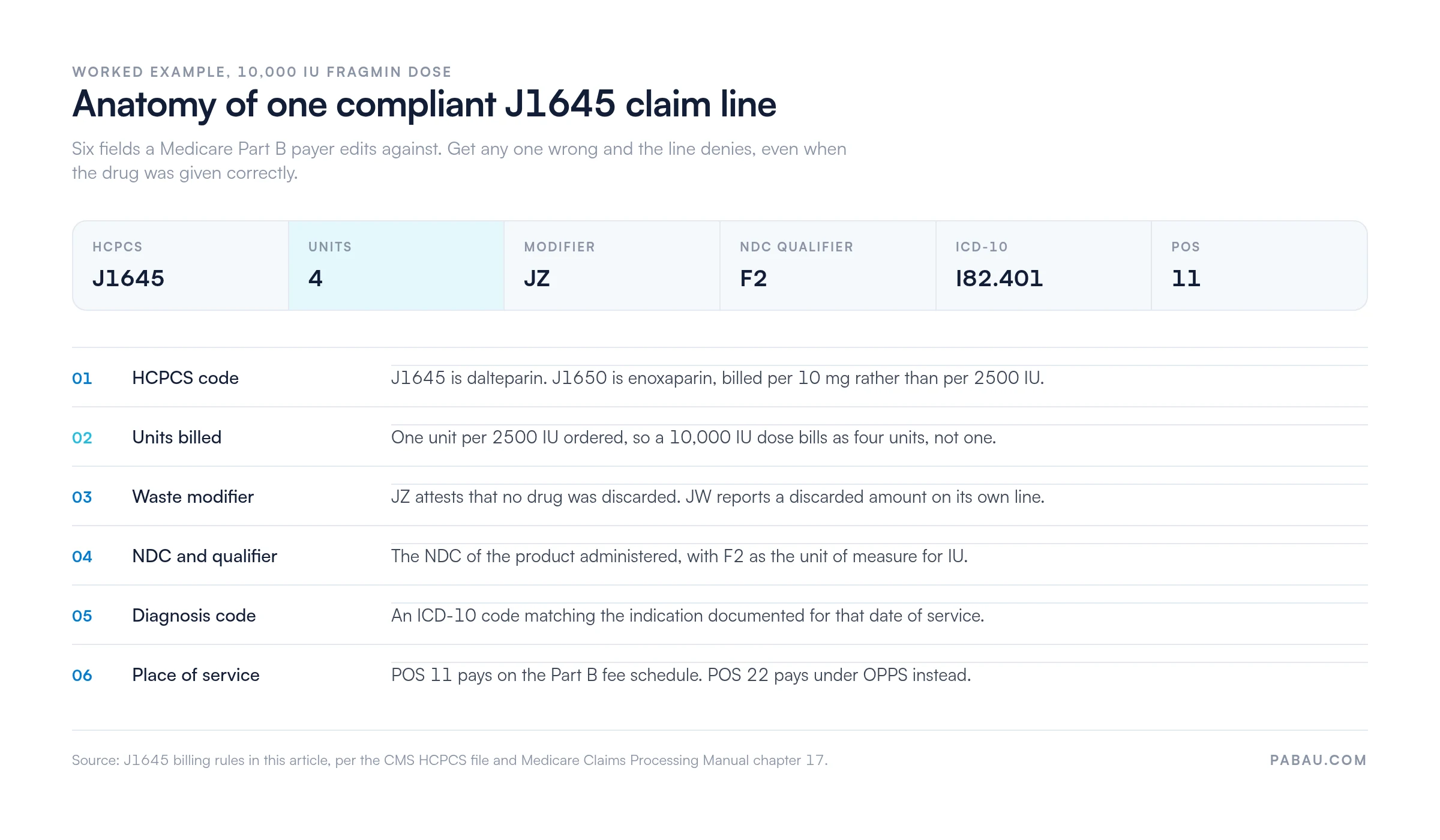
Specifically, the errors below account for most J1645 denials and recoupments.
In practice, pre-submission auditing is what keeps these off the remittance. Review the dose ordered in the chart, calculate the units, and confirm the NDC. Then match the diagnosis to the documented indication and check the modifier and the place of service.
It is worth learning which denial codes your payers return most often on drug lines, since each one points at a specific field. As a result, a clean claim on the first pass avoids the rework cycle that delays payment on a drug the practice has already bought.
Run a monthly audit of all J1645 claims submitted in the prior period. Then, pull the administered dose from the clinical record and cross-check the units billed. Any discrepancy between dose and units is a refund liability, whether the error was over-billing or under-billing. Catching these internally is far less costly than a payer recoupment or OIG audit.
In practice, a Fragmin dose is usually recorded in one system and billed from another. The dose ordered sits in the clinical note, the NDC and lot number sit on the medication record, and the biller retypes both. As a result, every retype is a chance to bill one unit instead of four.
In practice, Pabau, practice management software for medical and aesthetic practices, holds the drug, the dose, the diagnosis, and the treatment note on one patient record. Its claims management software pulls that stored data into a pre-filled claim, then submits and tracks it. Pabau does not pick the code or the diagnosis for you, so a coder still owns the J1645 line.
The outcome is a shorter path between what the nurse recorded and what the payer receives. As a result, fewer hand-copied fields mean fewer of the transcription errors that put a J1645 line on the denial report.

Pabau keeps the dose, the units, and the diagnosis on one patient record. It pulls that stored data into a pre-filled claim you can submit and track.

A J1645 line pays when it agrees with the chart on four points. Specifically, those are the units, the NDC and its F2 qualifier, the waste modifier, and a diagnosis that matches an approved use.
That last point is where this code parts company with the rest of the LMWH family. Fragmin’s label rules out acute VTE treatment, so no amount of documentation makes an acute treatment claim payable. Write the order and the note around prophylaxis or extended treatment, and let the diagnosis follow.
If your team bills J-codes regularly, the cheapest fix is catching these fields before the claim leaves. Book a demo to see how Pabau keeps drug doses, diagnoses, and claim data on one record.

Need a deeper guide to medical claims submission? Medical billing workflows explained walks through the full claims lifecycle from charge capture to remittance.
Struggling with denied claims on drug injections? Denial management in healthcare covers root cause analysis and appeal strategies for common denial patterns.
Want to understand how electronic claims are filed? 837 electronic claim file explains the EDI format used for Part B drug claims, including J-code submissions.
HCPCS Code J1645 bills the administration of dalteparin sodium (Fragmin), a low molecular weight heparin anticoagulant. It is reported per 2500 IU administered. In turn, the approved uses are DVT prophylaxis and extended treatment of symptomatic VTE in cancer or pediatric patients. However, Fragmin is not indicated for the acute treatment of VTE.
Bill 2 units of J1645 for a 5000 IU dose. Each unit represents 2500 IU, so divide the total dose by 2500 to get the unit count. For example, a 10,000 IU dose bills as 4 units. Likewise, a 7500 IU dose bills as 3 units.
Common pairings include I82.401 and I82.402 for acute DVT of the lower extremity. In addition, I26.09 covers pulmonary embolism with acute cor pulmonale, and Z79.01 records long-term anticoagulant use as a secondary code. For cancer-associated thrombosis, add the patient’s specific malignancy code, such as C18.9 for colon cancer.
Specifically, revenue code 0636 (drugs requiring specific identification) is used for J1645 on UB-04 institutional claims in the outpatient hospital setting (POS 22). In that setting, payment follows the Outpatient Prospective Payment System rather than the Part B fee schedule. Notably, the OPPS rate is typically lower than the office rate under POS 11.



