HCPCS Code J1455: Foscarnet sodium injection billing guide
What is HCPCS Code J1455? Definition and code descriptor HCPCS Code J1455 is the...

Last Updated: Nov 11, 2026
J1560 is the HCPCS Level II code for injection, gamma globulin, intramuscular, over 10 cc. It covers intramuscular immune globulin given for passive immunization, most often GamaSTAN S/D after hepatitis A or measles exposure.
The administered volume decides the code. A dose of 10 cc or less is billed under J1460. The note must record the exact volume before the claim is coded.
Let Pabau's smart automation suggest the right codes, reduce claim denials, and keep your practice compliant—effortlessly.
Automate repetitive tasks and focus on what matters most—your patients.
Reduce coding errors and ensure compliance with the latest regulations.
Clean claims, fewer denials, and faster reimbursements.
Powerful insights and reporting to help your practice thrive.
HIPAA compliant SOC 2 certified GDPR-compliant Trusted by 4,000+ clinics worldwide

J1560 covers gamma globulin given by intramuscular injection in a dose over 10 cc. A dose of 10 cc or less is billed under J1460.
The administered volume recorded in the clinical note decides the code, so chart it exactly as measured.
CPT 96372 goes on the same claim as J1560 to report the intramuscular injection itself.
IV and subcutaneous immune globulin products have their own HCPCS codes and are never billed under J1560.
Pabau’s claims management software sends US claims through the Claim.MD clearinghouse from the record that holds the injection note.
HCPCS Code J1560 carries the official CMS descriptor: Injection, gamma globulin, intramuscular, over 10 cc. Every word in that descriptor sets a billing condition that must be met before the code is valid.
J1560 sits in the J-code section of HCPCS Level II, which covers drugs given other than by mouth, according to the CMS HCPCS overview. Its descriptor names no brand.
In practice, GamaSTAN S/D generates J1560 claims, because it is the only intramuscular immune globulin (IGIM) product with FDA approval in the US. The codes for other immune globulin products sit in our HCPCS codes library.
J1560 is administered for passive immunization, where the patient receives ready-made antibodies instead of building an immune response. The clinical scenarios behind a J1560 claim fall into three groups.
The injection is usually given in a physician office or a hospital outpatient department, and Medicare Part B requires physician supervision. The clinical note must record both the intramuscular route and the volume given.
One billing unit under J1560 equals 10 cc of administered gamma globulin, per the CMS ASP drug pricing file. CMS bills a dose that falls between increments up to the next whole unit, so 12 cc and 15 cc each bill as 2 units. J1460 counts in 1 cc units instead. Confirm the rounding rule with your MAC or payer before the claim goes out.
The most common unit mistake is rounding a volume like 10.5 cc down to 10 cc to simplify the claim. That rounding switches the code from J1560 to J1460. If the note says 10.5 cc was given, the claim and the chart now contradict each other. Document and bill the volume exactly as measured.
J1460 and J1560 cover the same drug by the same route, and volume is the only difference. J1460 applies to intramuscular gamma globulin doses of 10 cc or less, while J1560 applies to doses over 10 cc.
The fix for J1460 and J1560 mix-ups is structural. Build the 10 cc threshold into the coding workflow, so the documented volume picks the code rather than the coder’s memory. The chart below sets out the two checks in order, route first and then volume.
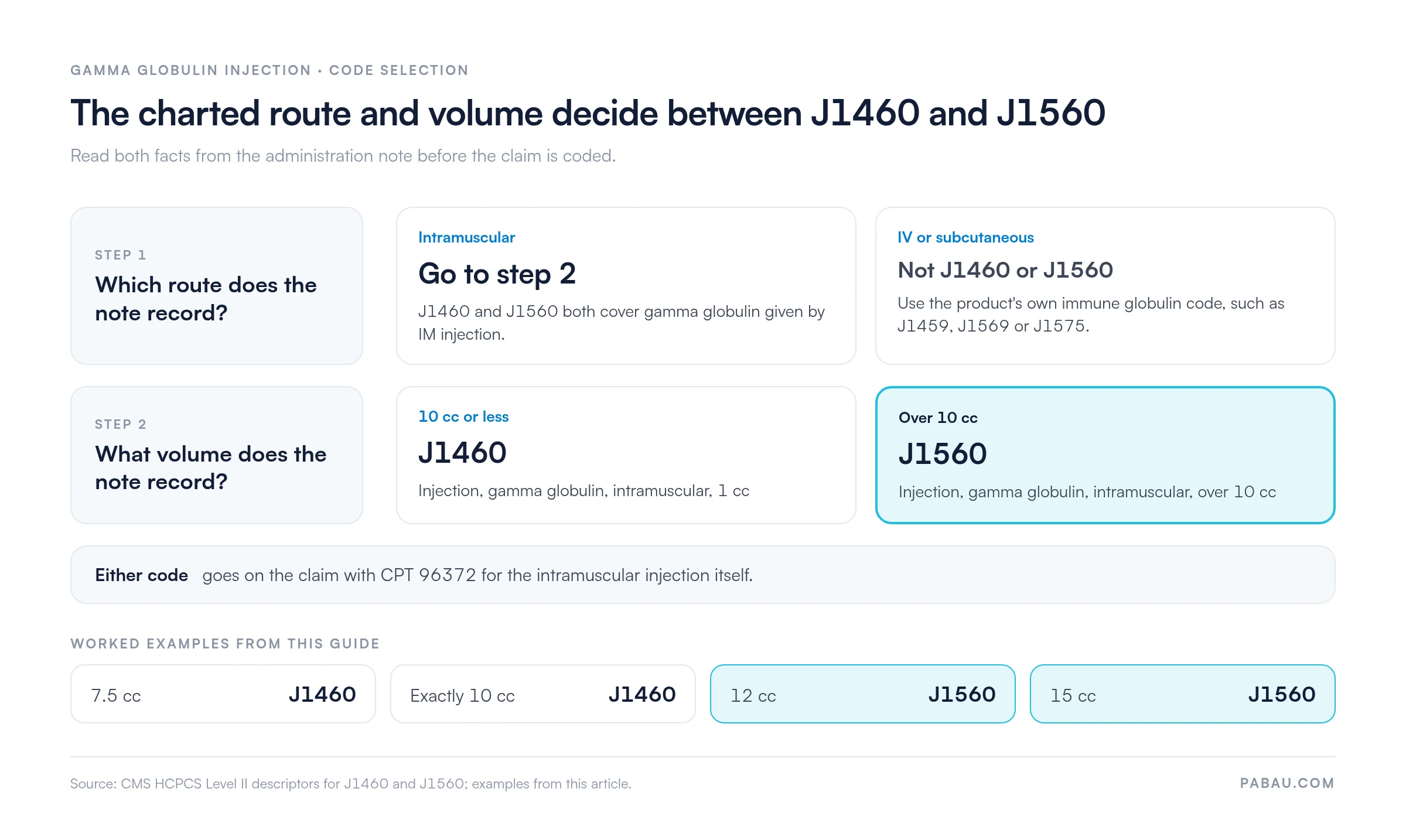
J1560 never stands alone on a compliant claim. At minimum, CPT 96372 must accompany it on the same date of service.
The crosswalk warning matters most for IV and subcutaneous immune globulin products. Each has its own HCPCS code, because its formulation, route and payment method differ from IGIM. Billing one of them under J1560 is a miscoding error, whatever the intent.
HCPCS modifiers on a J-code report the route of administration or set apart services billed on the same date. Few apply to J1560, because its descriptor already fixes the route.
Most J1560 claims go out without a modifier. Add modifier 59 only when a payer edit requires it to prevent bundling, and only when the note supports a distinct service.
Before adding a modifier to a J1560 claim, check the payer’s edit policy for CPT 96372 and J1560 on the same date. Some commercial payers pay both without a modifier, and others require 59 on the administration code. A modifier the payer doesn’t require raises an audit flag and fixes no denial.
Medicare Part B covers J1560 when the injection is medically necessary, the note supports the indication, and a physician supervises it. In the physician office setting, CMS pays the drug at ASP (average sales price) plus 6%. Rates change every quarter, so check the current payment limit in the CMS ASP pricing files before quoting a figure.
Coverage criteria vary by indication. Hepatitis A post-exposure prophylaxis usually meets medical necessity when the note records the exposure and the unvaccinated status. Off-label uses carry coverage risk without a Local or National Coverage Determination (LCD or NCD). Our guide to medical billing fundamentals shows where these coverage checks fit in the claim cycle.
Commercial payers and state Medicaid programs set their own coverage criteria and fee schedules. Many reimburse at AWP (average wholesale price) minus a percentage, while others follow ASP methodology. Neither rate is predictable without checking the specific payer contract.
Traditional Medicare generally does not require prior authorization (PA) for J1560 given for standard indications such as hepatitis A post-exposure prophylaxis. Medicare Advantage plans and commercial insurers often do. Many require PA for immune globulin products whatever the route, and the rule may depend on the indication.
When a plan requires PA, the request usually carries these documents:
Most commercial plans decide standard prophylaxis requests within 24 to 72 hours, and urgent routes exist for time-sensitive exposures. Under most billing compliance requirements, PA status is confirmed before the drug is given.
A J1560 claim cannot be submitted compliantly without each of the following elements in the clinical record. Missing even one is enough for a denial or a post-payment recovery.
A J1560 checklist built into the clinical workflow saves coders from chasing records after the fact. It is also how you get to a clean claim, with every field the payer checks filled from the note.
J1560 denials follow predictable patterns. Each one below has a documented root cause and a corrective action that can be built into the pre-submission workflow.
Systematic denial management workflows shorten the time between a J1560 denial and a corrected resubmission. Track denial reasons by code, and you can see whether J1560 denials cluster around NDC issues, unit errors or missing PAs. Then fix that cause once instead of reworking each claim.
CMS publishes the Medicare payment limit for J1560 each quarter in the ASP drug pricing file. The limit reflects ASP plus 6% for physician office administration, the non-facility setting. Hospital outpatient rates differ and follow the Outpatient Prospective Payment System (OPPS).
Because ASP rates change each quarter, a dollar figure in a coding reference can be out of date within weeks. A rate hardcoded into the billing system leads to underpayments and reconciliation errors. Confirm the current limit through the AAPC Codify HCPCS lookup or the PGM Billing HCPCS lookup tool.
Commercial payer rates for J1560 are negotiated separately and vary by contract. Many payers pay AWP minus a percentage, or a fixed contract rate that differs from Medicare’s ASP method. Check the contracted rate against the payer fee schedule before you stock GamaSTAN in volume.
Set a quarterly reminder to pull the latest CMS ASP drug pricing file each January, April, July and October. J1560 payment changes with every update. Billing at a stale rate either leaves money on the table or creates an overpayment to repay. The CMS file is free to download.
When the chart and the claim live in separate systems, the coder re-keys the volume from the note. A 10.5 cc dose becomes 10 cc on the form, and the code slips from J1560 to J1460.
Pabau’s claims management software builds the claim from the patient record that holds the injection note. Stock carries a batch number and expiry date, and the lot is recorded against the patient and the appointment.
US claims go out through the Claim.MD clearinghouse, and eligibility checks and remittances come back to the same record.
Prior authorization is tracked there too. The auth code, dates and sessions sit on the patient’s case, and Pabau warns the team when a code is missing. Your billers see a missing PA before the claim goes out, not when the denial comes back.

Pabau builds US claims from the patient record that holds the injection note and sends them through Claim.MD. Lot numbers and prior authorizations are tracked alongside, so the claim matches the chart.

J1560 turns on one fact a coder can’t infer, the volume the nurse drew up and gave. If the note says 12 cc, the claim says J1560. If it says 10 cc, J1460 is the code, however close the dose came to the line.
So chart the measured volume, the route, the NDC and the lot at the time of the injection. Pair the drug line with CPT 96372, and take the payment limit from this quarter’s ASP file rather than last year’s rate.
Book a demo to see how Pabau carries the injection note straight into a J1560 claim your payer can match to the chart.

Need a broader grounding in J-code billing mechanics? Medical billing fundamentals explains how HCPCS Level II codes fit into the broader claim lifecycle from charge capture to payment posting.
Want to understand what makes a drug claim pass a clearinghouse edit? Submitting a clean claim walks through every field-level requirement that affects whether a J1560 claim clears or kicks back before it reaches the payer.
HCPCS Code J1560 covers an intramuscular injection of gamma globulin (immune globulin) in a dose over 10 cc. It applies mainly to GamaSTAN S/D, the only FDA-approved intramuscular immune globulin product in the US. It is used for passive immunization, most often after hepatitis A or measles exposure.
J1460 and J1560 cover the same drug by the same route, and administered volume is the only difference. J1460 applies to doses of 10 cc or less, while J1560 applies to doses over 10 cc. Select the code from the volume in the clinical note, and never round down a volume above the threshold.
One J1560 billing unit equals 10 cc of administered gamma globulin. A dose between increments bills up to the next whole unit, so a 15 cc dose bills as 2 units of J1560. Base the count on the volume charted in the note, and confirm the rounding rule with your MAC or payer.
CPT 96372 reports a therapeutic, prophylactic or diagnostic subcutaneous or intramuscular injection. It must appear alongside J1560 on the same claim, billed once per injection. Submitting J1560 without 96372 is one of the most common reasons for a denial in this category.
Yes, Medicare Part B covers J1560 for medically necessary passive immunization given under physician supervision. CMS pays the drug at ASP plus 6% in the physician office setting, with rates updated quarterly. Medicare Advantage plans may add prior authorization or coverage criteria that traditional Medicare does not apply.
The most common reason is a volume of 10 cc or less, which belongs under J1460. Other causes are units that don’t match the documented volume, a missing or wrong NDC, and no CPT 96372 on the claim. An unsupported ICD-10 code or a missing prior authorization also triggers denials.